Living
Which is the easier all-around choice?
The Beagle, for most households -- better with other pets, better for beginners, and just as low-maintenance on grooming as the Jack Russell.

Quick answer
Which is the easier all-around choice?
The Beagle, for most households -- better with other pets, better for beginners, and just as low-maintenance on grooming as the Jack Russell.
Beagle or Jack Russell Terrier? On paper they differ most on good with other dogs, and on the scales Beagle is the heavier at 20–30 lbs. Here is how the two compare on everything that shapes an ordinary week.
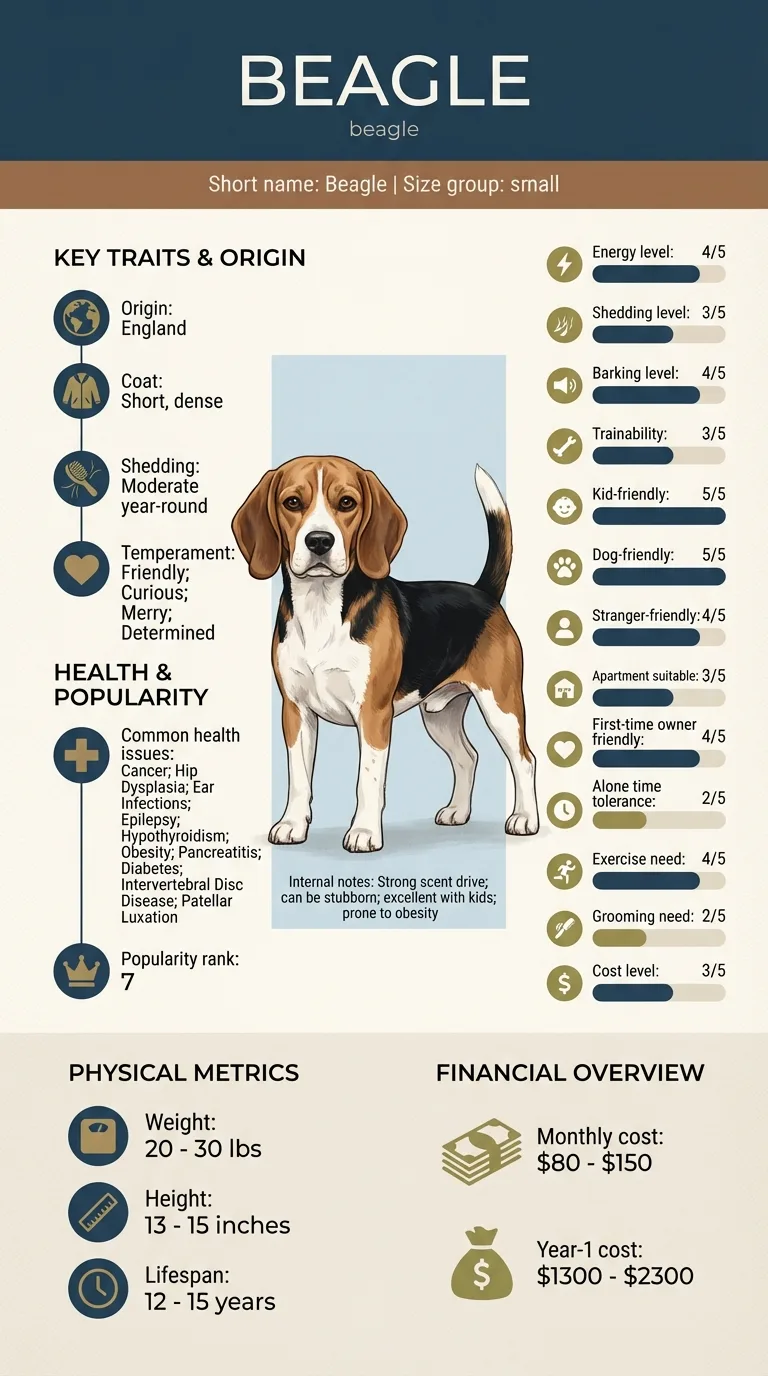
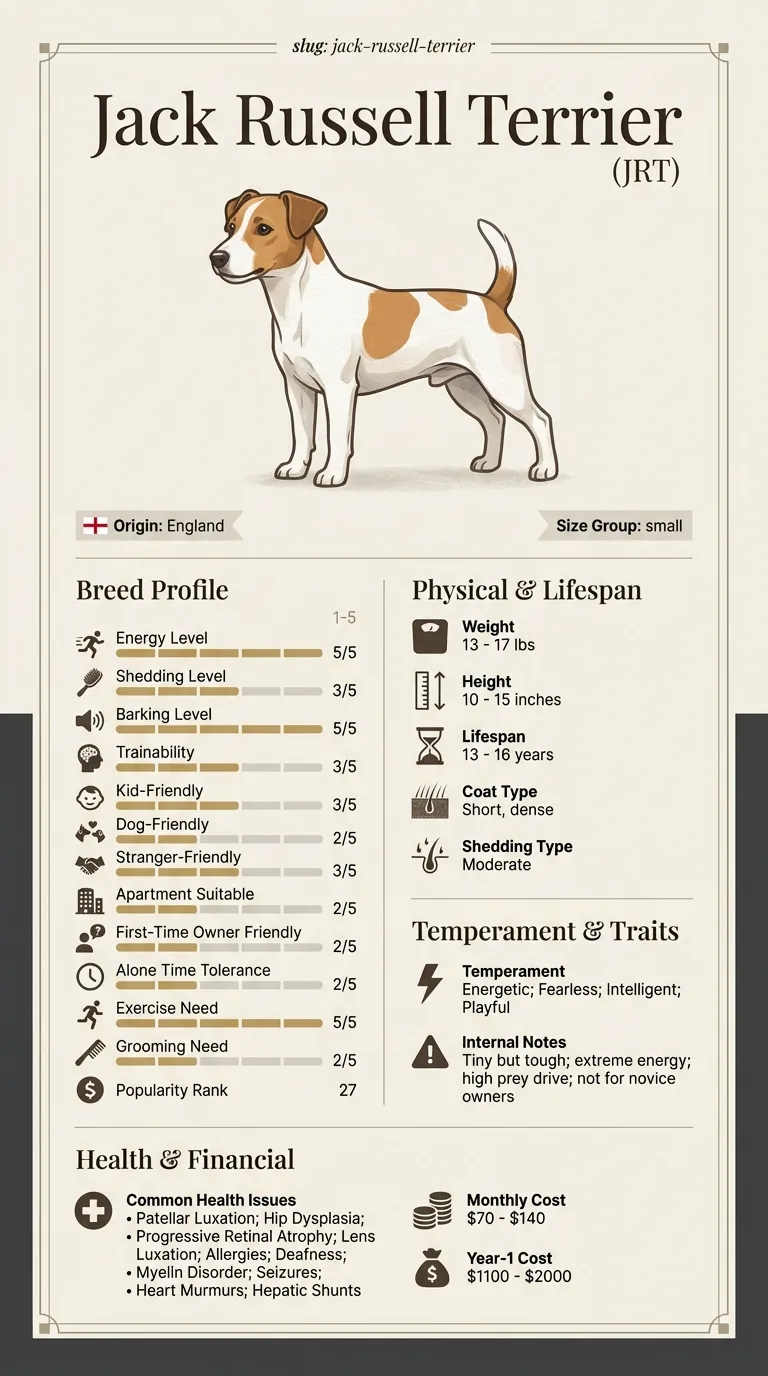
This is for someone already down to Beagle and Jack Russell Terrier and deciding between them. For this pair the decision usually turns on good with other dogs and good for first-time owners, so those are covered first and in most detail. Anyone choosing from a flat has a clear answer here: Beagle rates 3/5 against 2/5. There is no origin story here — only what changes about your week.
Between Beagle and Jack Russell Terrier, good with other dogs is what separates them, and Beagle is the lower-effort dog of the two to keep.
Choose Beagle if you are in a flat or a smaller home, this is your first dog and your walking routine is modest.
Choose Jack Russell Terrier if a smaller dog suits your car, your home or your back, you want a dog that can keep up with an active routine and you want a dog that is more watchful with visitors.
| Feature | beagle | jack russell terrier | Winner |
|---|---|---|---|
| Size class | small | small | Equal |
| Weight | 20–30 lbs | 13–17 lbs | Equal |
| Height | 13–15 in | 10–15 in | Equal |
| Lifespan | 12–15 years | 13–16 years | jack russell terrier |
| Exercise need | High (4/5) | Very high (5/5) | beagle |
| Grooming need | Low (2/5) | Low (2/5) | Equal |
| Shedding | Moderate (3/5) | Moderate (3/5) | Equal |
| Energy level | High (4/5) | Very high (5/5) | Equal |
| Barking | High (4/5) | Very high (5/5) | beagle |
| Apartment suitability | Moderate (3/5) | Low (2/5) | beagle |
| Good for first-time owners | High (4/5) | Low (2/5) | beagle |
| Tolerates being alone | Low (2/5) | Low (2/5) | Equal |
| Trainability | Moderate (3/5) | Moderate (3/5) | Equal |
| Good with kids | Very high (5/5) | Moderate (3/5) | beagle |
| Good with other dogs | Very high (5/5) | Low (2/5) | beagle |
| Friendly to strangers | High (4/5) | Moderate (3/5) | beagle |
| Cost level | Moderate (3/5) | Low (2/5) | jack russell terrier |
| Coat | Short, dense | Short, dense | Equal |
| Origin | England | England | Equal |
| Typical monthly cost | $80–$150 | $70–$140 | Equal |
| Typical first-year cost | $1,300–$2,300 | $1,100–$2,000 | Equal |
Close in category, not identical in numbers. The Beagle runs 20 to 30 pounds and 13 to 15 inches; the Jack Russell Terrier is lighter and lower, 13 to 17 pounds and 10 to 15 inches -- up to 17 pounds lighter at the top end. Both are compact, sturdy dogs built for work rather than show, but the Beagle carries noticeably more mass on a similar-height frame, which shows up in how much space each needs to turn around indoors.
Neither breed is a good match for a sedentary household. The Jack Russell Terrier tops the chart at very high (5/5) exercise need, one notch above the Beagle's already-high 4 out of 5. Both were bred for pursuit work -- the Beagle after scent, the Jack Russell after vermin -- and both will find their own entertainment if you don't provide enough of it, usually in the form of digging, escaping, or general chaos.
A wash here: both breeds tie at low (2/5) for grooming need and moderate (3/5) for shedding. Short, dense coats on both dogs mean a weekly brush and regular vacuuming covers it. Neither will cost you real grooming money or time, which is unusual for this kind of side-by-side comparison -- most pairings split on at least one of these two.
The Beagle has the edge for small spaces: moderate (3/5) apartment suitability against the Jack Russell's low (2/5). Barking runs very high for the Jack Russell (5/5) and high for the Beagle (4/5) -- both are vocal breeds, but neither is a quiet-apartment candidate. Alone tolerance ties at low (2/5) for both, so long unsupervised stretches are a problem regardless of which one you choose.
Trainability ties at moderate (3/5) for both -- neither is a naturally obedient breed, and both need consistent, engaging training to avoid boredom-driven mischief. The bigger split is first-time-owner suitability: the Beagle rates high (4/5), the Jack Russell Terrier rates low (2/5). The JRT's intensity, prey drive, and stubborn streak are a lot to manage without prior dog experience -- this is not usually recommended as anyone's first dog.
This is the widest gap in the whole comparison. The Beagle rates very high (5/5) with kids and with other dogs; the Jack Russell rates moderate (3/5) with kids and just low (2/5) with other dogs -- its terrier instincts can trigger real conflict with other pets, especially smaller animals. Strangers follow the same pattern: high (4/5) for the Beagle, moderate (3/5) for the Jack Russell. A multi-dog household should weigh this heavily.
The Jack Russell Terrier edges out the Beagle on lifespan, 13 to 16 years against 12 to 15. Both breeds share risk of hip dysplasia and patellar luxation. Past that, the Beagle's list runs toward cancer, epilepsy, and pancreatitis, while the Jack Russell's runs toward eye conditions like progressive retinal atrophy and lens luxation, along with seizures and hepatic shunts. Ask about eye screening specifically if you're considering a Jack Russell.
The Jack Russell Terrier is the cheaper dog to keep on paper: $70 to $140 a month against the Beagle's $80 to $150, and $1,100 to $2,000 in year one against $1,300 to $2,300. Neither is an expensive breed relative to the field, but if budget is the deciding factor between two otherwise similar small dogs, the Jack Russell comes out slightly ahead.
Beagle weighs 20–30 lbs and lives 12–15 years; Jack Russell Terrier weighs 13–17 lbs and lives 13–16 years. The two diverge most on good with other dogs, good for first-time owners and good with kids. They are level on tolerates being alone, grooming need and shedding, so those cannot decide it. Where the table declares a winner it means less work for the owner, nothing more; descriptive rows are left as ties on purpose. The value here is in the differences between the two columns; treat any single score as approximate.

Not hugely -- the Beagle runs 20 to 30 pounds and 13 to 15 inches, the Jack Russell Terrier 13 to 17 pounds and 10 to 15 inches. The Beagle is the heavier, taller dog of the two, but both are compact by any standard.
Neither -- shedding ties at moderate (3/5) for both, and grooming need ties at low (2/5) too. This is one of the few categories where the two breeds are functionally identical.
The data says no, or at least 'not ideal' -- it rates low (2/5) for first-time owners against the Beagle's high (4/5). High prey drive, high energy, and a stubborn streak make it a demanding first dog.
The Beagle does better -- moderate (3/5) apartment suitability against the Jack Russell's low (2/5). Both bark a lot (high to very high), so neither is a natural fit for thin-walled buildings.
Small but real: $80-$150 for the Beagle versus $70-$140 for the Jack Russell Terrier. Both are inexpensive to keep relative to larger or more grooming-intensive breeds.
Yes -- hip dysplasia and patellar luxation appear on both lists. The Jack Russell carries additional eye-related risk (progressive retinal atrophy, lens luxation) that the Beagle's list doesn't include.
The Beagle, by a wide margin -- very high (5/5) versus the Jack Russell's low (2/5). Jack Russells were bred to work independently against vermin, and that instinct can translate into friction with other household pets.
The Beagle, for most households -- better with other pets, better for beginners, and just as low-maintenance on grooming as the Jack Russell.
Beagle: $80-$150. Jack Russell Terrier: $70-$140 -- a modest edge for the JRT.
The Jack Russell Terrier, rated Very high (5/5), just above the Beagle's High (4/5). Both need serious daily activity.
The Jack Russell Terrier, 13-16 years, versus the Beagle's 12-15.
Secure checkout on Stripe. We never see your card.
7-day money-back guarantee. Instant access.

Health information here is general and is not veterinary advice. If your dog shows pain, sudden behaviour change, or worsening symptoms, consult a licensed veterinarian.
Some links on this site are affiliate links. We may earn a commission at no extra cost to you, and we only suggest products we believe are helpful for dog owners.
We research and check what we publish, but we do not warrant that any figure, date, price, or statement is accurate, complete, or current, and we accept no liability for any loss, cost, injury, or other harm arising from the use of this site. Use it as one reference among several. You remain responsible for your own decisions and for your dog's care - confirm anything that matters with a licensed veterinarian or another qualified professional before you act on it. Full disclaimer.
Match your lifestyle to the right dog.
Take quizNot sure which breed is right for you? Take our 2-minute quiz to find out.
Take the quiz