Beagle vs English Cocker Spaniel: Which Suits Your Home?
Quick answer
Beagle or English Cocker Spaniel — which wins out?
Take the English Cocker if you want faster training progress and a quieter apartment dog and don't mind extra grooming. Take the Beagle if you'd rather skip the grooming time and save $20-50 a month.
Beagle or English Cocker Spaniel? On paper they differ most on grooming need, and on the scales English Cocker Spaniel is the heavier at 26–34 lbs. Here is how the two compare on everything that shapes an ordinary week.
This is for someone already down to Beagle and English Cocker Spaniel and deciding between them. For this pair the decision usually turns on grooming need, so those are covered first and in most detail. Anyone choosing from a flat has a clear answer here: English Cocker Spaniel rates 4/5 against 3/5. It is written for the decision rather than the breed history.
Quick verdict
Between Beagle and English Cocker Spaniel, grooming need is what separates them, and Beagle is the lower-effort dog of the two to keep.
Choose beagle if...
Choose Beagle if you do not want a standing grooming appointment, you already have another dog and a smaller dog suits your car, your home or your back.
Choose english cocker spaniel if...
Choose English Cocker Spaniel if you are in a flat or a smaller home and you want a dog that picks up training quickly.
Head-to-head comparison
Feature
beagle
english cocker spaniel
Winner
Size class
small
medium
Equal
Weight
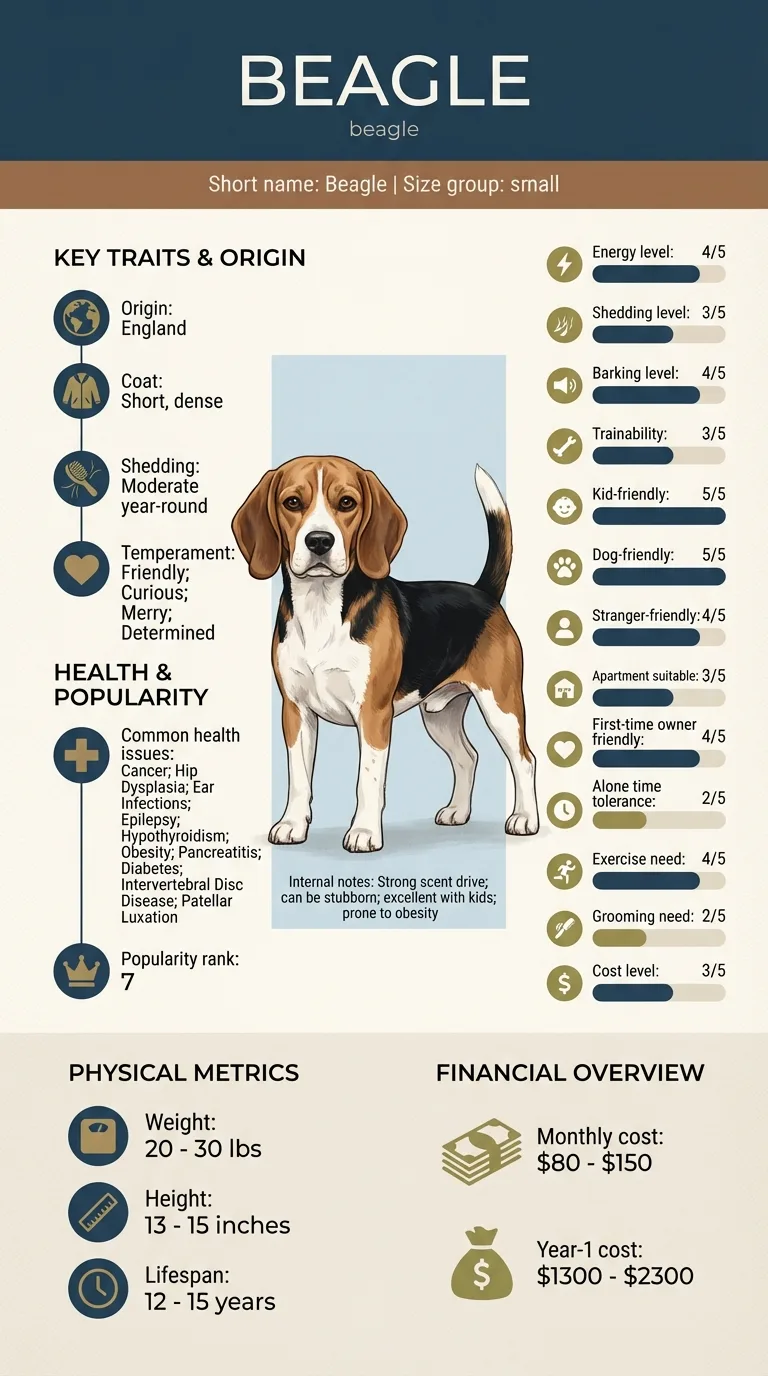
20–30 lbs
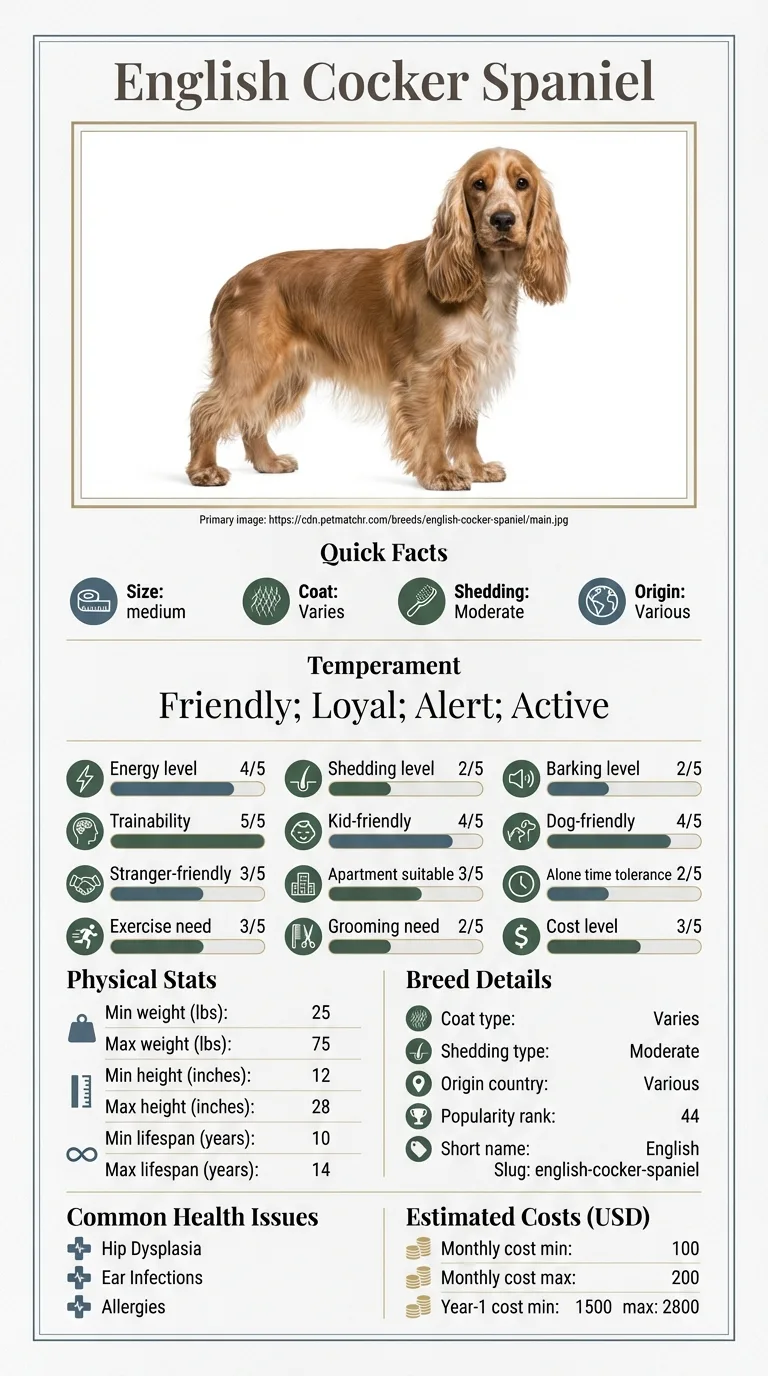
26–34 lbs
Equal
Height
13–15 in
15–17 in
Equal
Lifespan
12–15 years
12–14 years
beagle
Exercise need
High (4/5)
High (4/5)
Equal
Grooming need
Low (2/5)
High (4/5)
beagle
Shedding
Moderate (3/5)
Moderate (3/5)
Equal
Energy level
High (4/5)
High (4/5)
Equal
Barking
High (4/5)
Moderate (3/5)
english cocker spaniel
Apartment suitability
Moderate (3/5)
High (4/5)
english cocker spaniel
Good for first-time owners
High (4/5)
High (4/5)
Equal
Tolerates being alone
Low (2/5)
Low (2/5)
Equal
Trainability
Moderate (3/5)
High (4/5)
english cocker spaniel
Good with kids
Very high (5/5)
Very high (5/5)
Equal
Good with other dogs
Very high (5/5)
High (4/5)
beagle
Friendly to strangers
High (4/5)
High (4/5)
Equal
Cost level
Moderate (3/5)
Moderate (3/5)
Equal
Coat
Short, dense
Medium, silky and feathered
Equal
Origin
England
Various
Equal
Typical monthly cost
$80–$150
$100–$200
Equal
Typical first-year cost
$1,300–$2,300
$1,400–$2,900
Equal
Deep dive
Size and build
The English Cocker Spaniel runs a little larger than the Beagle across the board — 26-34 lbs versus 20-30, and 15-17 inches versus 13-15. It's not a dramatic gap, more a size class shift within the same general range. Anyone comparing this pair on frame alone will find the difference noticeable but not decisive.
Energy and exercise
Both breeds tie at a high 4/5 for exercise need and energy level — this is not a matchup where one dog is obviously lower-maintenance than the other on activity. Both were bred for fieldwork (scent tracking for the Beagle, flushing game for the Cocker), and both carry that work ethic into daily life. Budget real exercise time for either dog, not a token walk.
Grooming and shedding
The English Cocker Spaniel needs meaningfully more grooming — a high 4/5 versus the Beagle's low 2/5 — thanks to its medium, silky, feathered coat. Shedding itself ties at a moderate 3/5 for both, so the extra work with the Cocker is about brushing and coat care, not a heavier volume of loose hair around the house.
Apartment living, noise and time alone
The English Cocker rates better for apartment life, 4/5 versus the Beagle's 3/5, and it barks less too — 3/5 against the Beagle's 4/5. Both tolerate alone time equally poorly, at a low 2/5, so this pair's apartment gap is really about noise and general adaptability, not independence. Neither breed should be your pick if daily solo hours are unavoidable.
Training and owner experience
Both are rated 4/5 for first-time owners, so either is a reasonable starter breed. The English Cocker pulls ahead on trainability, 4/5 versus the Beagle's 3/5 — a gundog bred to work in close partnership with a handler tends to pick up commands faster than a scent hound bred to work independently. That difference will show up most in early obedience training.
Kids, other dogs and visitors
Both score 5/5 with kids and 4/5 with strangers, so neither has an edge there. The Beagle rates slightly better with other dogs, 5/5 versus the English Cocker's 4/5, though both numbers are strong enough that either dog should integrate well into a household with an existing pet. This is one of the few categories where the two breeds are effectively interchangeable.
Health and lifespan
The Beagle has a longer expected lifespan — 12-15 years versus the English Cocker's 12-14, a narrower gap than in some other comparisons. Health overlap includes ear infections and hip dysplasia. The English Cocker's remaining risks — progressive retinal atrophy, familial nephropathy, and adult-onset neuropathy — skew toward eye and neurological conditions not present in the Beagle's list.
Cost to keep
The English Cocker runs a bit pricier: $100-200 monthly versus the Beagle's $80-150, and a first-year range of $1,400-2,900 versus $1,300-2,300. Both are rated a moderate 3/5 on overall cost level, so the dollar gap is real but not dramatic — plan for maybe an extra $20-50 a month with the English Cocker.
Beagle vs English Cocker Spaniel at a glance
Beagle weighs 20–30 lbs and lives 12–15 years; English Cocker Spaniel weighs 26–34 lbs and lives 12–14 years. The two diverge most on grooming need. They are level on tolerates being alone, cost level and energy level, so those cannot decide it. In the table, a "winner" means easier for an ordinary household — not better. Size, coat and origin are recorded without a verdict. Because both breeds are scored the same way, the gaps are reliable even where the absolute numbers are rough.
Beagle vs English Cocker Spaniel: Which Suits Your Home? - Beagle vs English Cocker Spaniel at a glance
Frequently asked questions
How different in size are these two breeds?
Moderately — the English Cocker weighs 26-34 lbs and stands 15-17 inches, versus the Beagle's 20-30 lbs and 13-15 inches. It's a noticeable but not huge size step up.
Which needs more grooming?
The English Cocker Spaniel, at a high 4/5 versus the Beagle's low 2/5, due to its silky, feathered coat. Shedding levels are the same for both (3/5).
Is the English Cocker a good first dog?
Yes — it rates 4/5 for first-time owners, matching the Beagle, and actually trains a bit faster (4/5 trainability versus the Beagle's 3/5).
Which is better in an apartment?
The English Cocker Spaniel — 4/5 apartment suitability and a quieter 3/5 bark rating, against the Beagle's 3/5 and 4/5. Neither handles being left alone well, though.
How much more does the English Cocker cost?
Roughly $20-50 more a month ($100-200 versus $80-150) and up to $600 more in the first year. Both are still rated a moderate 3/5 on overall cost.
What health risks do they share?
Ear infections and hip dysplasia appear on both. The English Cocker's other risks lean toward eye and neurological issues — progressive retinal atrophy, familial nephropathy, adult-onset neuropathy — that don't show up on the Beagle's list.
How much exercise does each need?
The same amount — both rate a high 4/5. This is one of the few pairs in this dataset where exercise need doesn't separate the two breeds at all.
Beagle or English Cocker Spaniel — which wins out?
Take the English Cocker if you want faster training progress and a quieter apartment dog and don't mind extra grooming. Take the Beagle if you'd rather skip the grooming time and save $20-50 a month.
Costs
Which is cheaper monthly?
The Beagle, at $80-150 versus the English Cocker's $100-200. Both are rated a moderate 3/5 on overall cost, but the dollar figures favor the Beagle.
Living
Which needs more exercise?
Neither — both tie at a high 4/5 for exercise need. This is a genuine dead heat on activity level.
Health
How long does each live?
The Beagle averages 12-15 years, the English Cocker 12-14 — a narrow one-year gap at most.
Related DogBreedCompass guides
Beagle breed guide – Readers comparing the two usually want the full profile of Beagle before deciding.
Health information here is general and is not veterinary advice. If your dog shows pain, sudden behaviour change, or worsening symptoms, consult a licensed veterinarian.
Some links on this site are affiliate links. We may earn a commission at no extra cost to you, and we only suggest products we believe are helpful for dog owners.
We research and check what we publish, but we do not warrant that any figure, date, price, or statement is accurate, complete, or current, and we accept no liability for any loss, cost, injury, or other harm arising from the use of this site. Use it as one reference among several. You remain responsible for your own decisions and for your dog's care - confirm anything that matters with a licensed veterinarian or another qualified professional before you act on it. Full disclaimer.