DogBreedCompass

Malamute or Amstaff: Sixteen Years of Terrier or a Sled Dog

The American Staffordshire Terrier can live sixteen years — the longest figure of any medium-to-large breed on this site — grooms at 1/5 and costs $100 to $200 a month. The Malamute lives 10 to 14, grooms at 4/5 and costs $150 to $300. On upkeep and longevity this is not a close comparison.

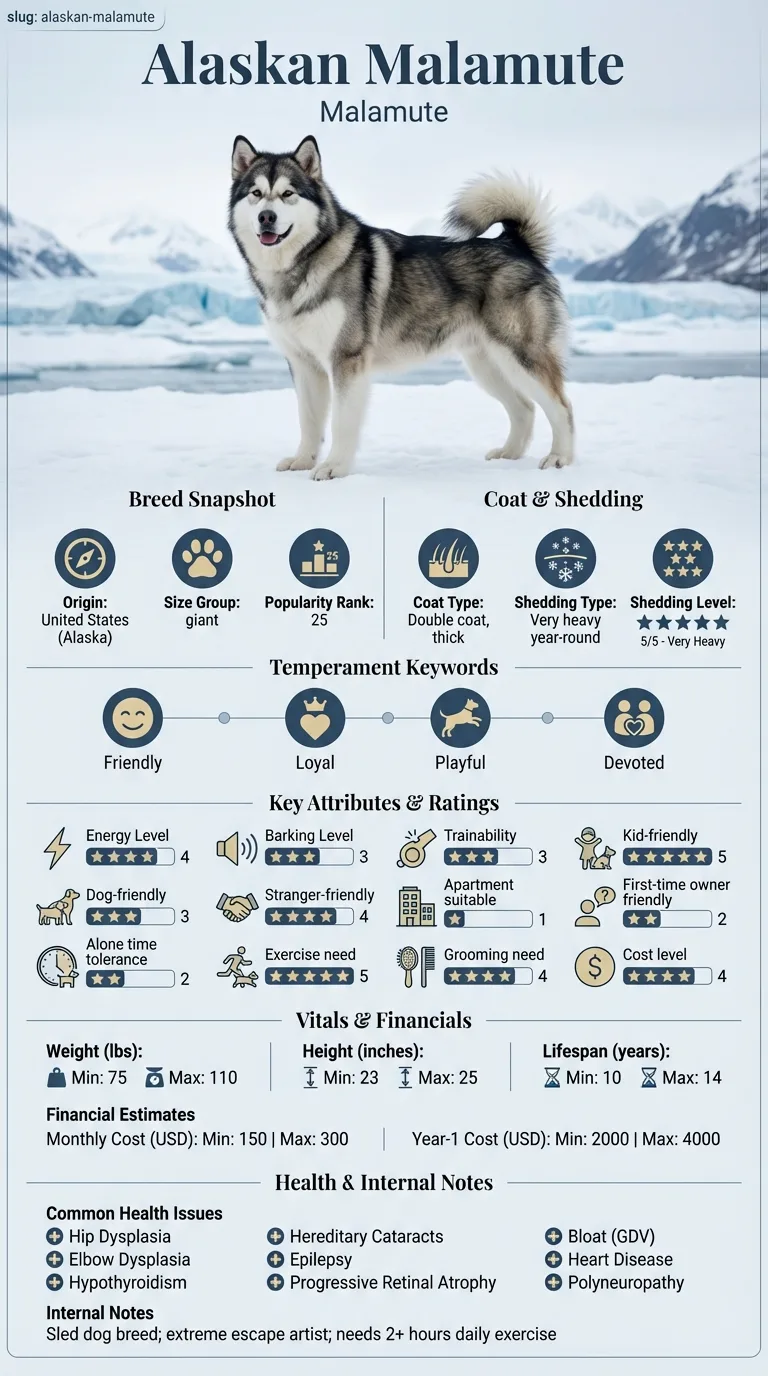
alaskan malamute infographic
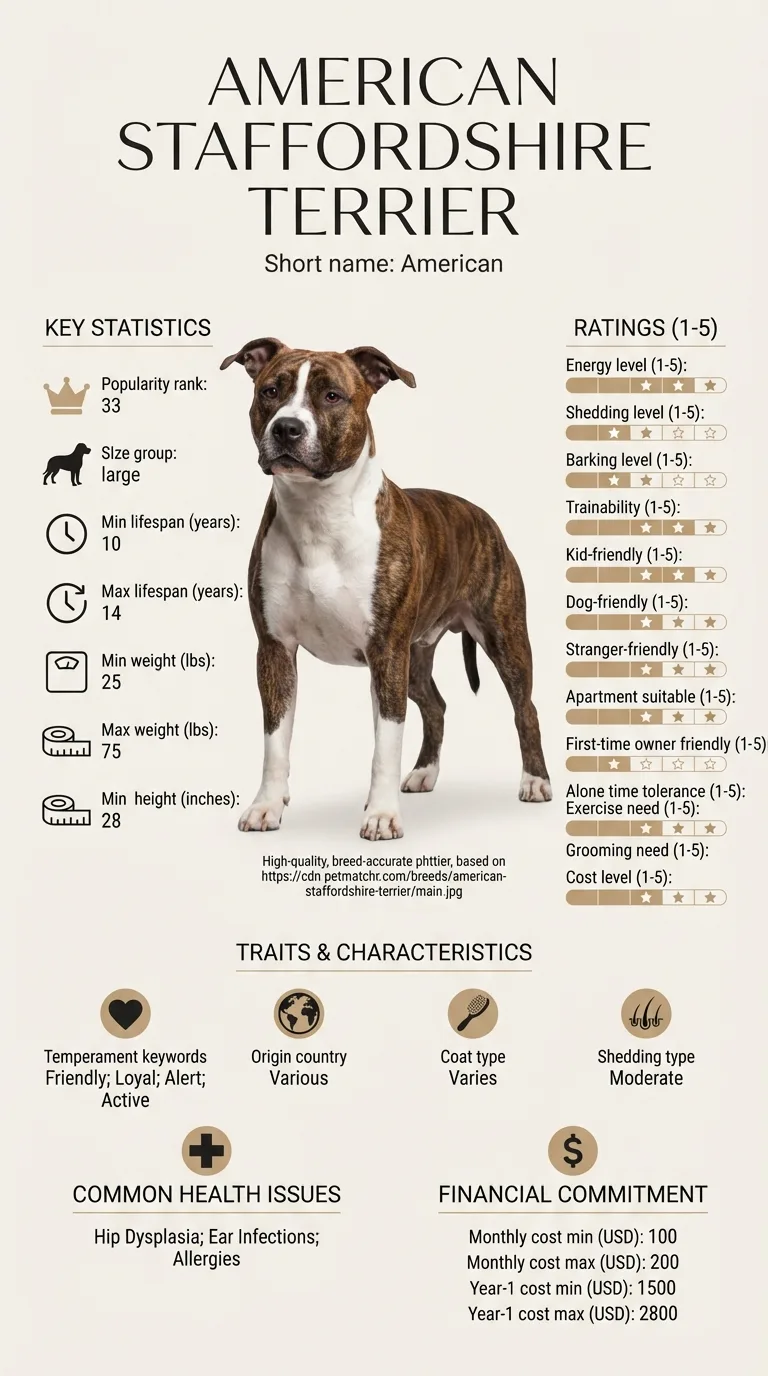
american staffordshire terrier infographic

This page is for someone weighing two strong, people-oriented breeds with very different maintenance. It covers longevity and cost, how the Amstaff differs from a pit bull type dog, dog tolerance, an inherited neurological disease with a DNA test, and containment.

Quick verdict

The Amstaff is cheaper, longer-lived, easier to groom and easier to house; the Malamute is the more demanding dog in every practical respect and the more sociable one with other dogs.

Choose alaskan malamute if...

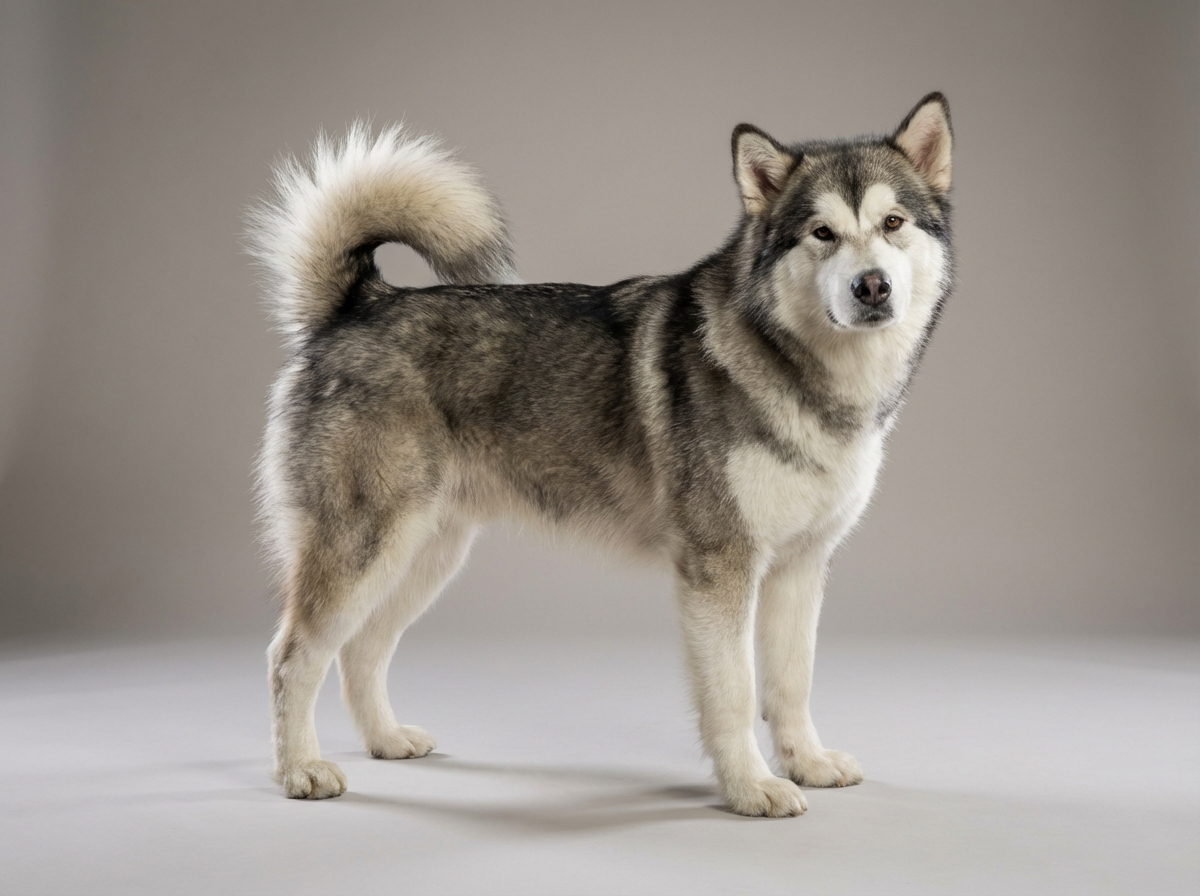
Choose the Alaskan Malamute if you are athletic, live somewhere cold and want a northern breed. It rates 5/5 with children and 3/5 with other dogs against the Amstaff's 2/5. You are accepting $150–$300 a month, 5/5 shedding, 4/5 grooming, 5/5 exercise, a 1/5 apartment rating and a determined escape artist.

Choose american staffordshire terrier if...

Choose the American Staffordshire Terrier if upkeep and longevity matter. It lives 12 to 16 years, grooms at 1/5, costs $100–$200 a month, rates 4/5 with strangers and 3/5 for apartments, and tolerates being alone at 3/5. You are accepting 2/5 with other dogs and possible housing or insurance restrictions.

Head-to-head comparison

Featurealaskan malamuteamerican staffordshire terrierWinner
Weight75–110 lbs40–70 lbsEqual
Height23–25 in17–19 inEqual
Lifespan10–14 years12–16 yearsamerican staffordshire terrier
CoatThick double coatShort, stiff and glossyEqual
Grooming needHigh (4/5)Very low (1/5)american staffordshire terrier
SheddingVery high (5/5)Moderate (3/5)american staffordshire terrier
Energy levelHigh (4/5)High (4/5)Equal
Exercise needVery high (5/5)High (4/5)american staffordshire terrier
TrainabilityModerate (3/5)High (4/5)american staffordshire terrier
BarkingModerate (3/5)Low (2/5)american staffordshire terrier
Good with kidsVery high (5/5)High (4/5)alaskan malamute
Good with other dogsModerate (3/5)Low (2/5)alaskan malamute
Friendly to strangersHigh (4/5)High (4/5)Equal
Apartment suitabilityVery low (1/5)Moderate (3/5)american staffordshire terrier
Good for first-time ownersLow (2/5)Moderate (3/5)american staffordshire terrier
Tolerates being aloneLow (2/5)Moderate (3/5)american staffordshire terrier
Typical monthly cost$150–$300$100–$200american staffordshire terrier
Typical first-year cost$2,000–$4,000$1,400–$2,900american staffordshire terrier

Deep dive

How an Amstaff differs from a pit bull type dog

The Amstaff and the American Pit Bull Terrier share ancestry and are frequently confused, but they have been bred apart for the better part of a century and the ratings show it.

The Amstaff is the standardised show breed: heavier and more compact at 40 to 70 pounds, and selected for a stable, confident, unbothered temperament. It rates 4/5 with strangers against the Pit Bull Terrier's 3/5, 3/5 for apartments against 2/5, 3/5 for first-time owners against 2/5, and lives 12 to 16 years against 12 to 14.

Where they match is dog tolerance, both at 2/5, and that is the honest headline risk for either.

One practical point does not distinguish them at all. Breed-specific restrictions in insurance policies, tenancy agreements and some jurisdictions are frequently written by appearance rather than by pedigree, so an Amstaff is commonly caught by rules aimed at pit bull type dogs. Check the actual policy wording before you commit.

Against the Malamute, both terriers are cheaper, easier and longer-lived.

A 2/5 that has to be managed rather than fixed

The Amstaff's 2/5 with other dogs deserves a straight explanation, because it is the row that shapes daily life.

Dog-directed reactivity in bull-and-terrier types is a real and heritable tendency, not a symptom of poor upbringing. Good socialisation from eight weeks makes an enormous difference to how manageable it is, and it does not make it disappear. Many Amstaffs are perfectly civil on a lead and unsuitable for a dog park; some live happily with an opposite-sex housemate and cannot tolerate a same-sex one.

What that means practically: no dog parks, no flexi leads, a good muzzle taught early as a neutral thing long before it is needed, and an owner who crosses the road early.

The Malamute's 3/5 is milder but the same shape — same-sex intolerance is common and usually surfaces at social maturity around two years old.

Both breeds are notably good with people and both carry real prey drive toward cats and small animals, which is a separate question from dog tolerance and needs managing separately.

Cerebellar ataxia and the test for it

Cerebellar ataxia is the item on the Amstaff's condition list most worth knowing about, and it is unusual in appearing in adulthood rather than puppyhood.

It is an inherited neurodegenerative disease that typically begins between three and five years old in a dog that has been entirely normal. The first signs are subtle coordination problems — a slight wobble, clumsiness on stairs, difficulty judging a jump — and it progresses over months to years into a serious loss of balance and coordination. There is no cure.

The reason to know about it before buying is that there is a DNA test, and a responsible breeder will have used it so that two carriers are never mated together. Ask for both parents' results by name rather than accepting a general assurance that the dogs are healthy — carriers are healthy, which is exactly the problem.

Skin allergies, hip dysplasia, heart disease and cruciate ligament tears complete the list, and skin is the everyday one.

The Malamute's burden is hip and elbow dysplasia, hypothyroidism, hereditary cataracts, progressive retinal atrophy, epilepsy, heart disease, bloat, polyneuropathy and zinc-responsive skin disease.

Coat, containment and running costs

The Amstaff's coat is the least demanding in this batch: 1/5 grooming, a rubber curry once a week, and 3/5 shedding in short stiff hairs that weave into upholstery but need no equipment to manage.

The Malamute's 4/5 grooming and 5/5 shedding are a different order of commitment. It sheds heavily all year and blows its undercoat in sheets twice a year, and an undercoat rake plus several sessions is the minimum during those weeks. The coat should never be clipped — it insulates against heat as well as cold — and summer exercise moves to the cool ends of the day.

On containment the Malamute is the harder problem. Its own breed notes call it an extreme escape artist: it digs, climbs, works at latches and travels once loose. A fence dug in at the base and secured gates are the baseline.

On money the Amstaff runs $100–$200 a month against $150–$300, and $1,400–$2,900 against $2,000–$4,000 in the first year.

And it lives longer — 12 to 16 years against 10 to 14.

Alaskan Malamute vs American Staffordshire Terrier: upkeep decides it

Strangers ties at 4/5 and energy ties at 4/5. Both are people-oriented, demonstrative dogs that are poor choices for anyone wanting a guard.

Everything else favours the Amstaff on practicality. It lives two to four years longer, grooms at 1/5 against 4/5, sheds at 3/5 against 5/5, costs a third less, rates 3/5 for apartments against 1/5, and manages a working day at 3/5 against 2/5.

The Malamute's two clear advantages are social. 5/5 with children against 4/5, and 3/5 with other dogs against 2/5 — that second row is the one most likely to shape your walks.

And the Malamute is the more physically demanding animal: 5/5 exercise against 4/5, in a breed built to pull rather than sprint.

If you want a large powerful dog and your constraints are money, time and floor space, this comparison points one way fairly clearly.

Frequently asked questions

How is an Amstaff different from an American Pit Bull Terrier?

They share ancestry but have been bred apart for decades. The Amstaff is the standardised show breed — heavier, more compact, and selected for a stable temperament. It rates 4/5 with strangers against 3/5, 3/5 for apartments against 2/5, and lives 12 to 16 years against 12 to 14. Dog tolerance matches at 2/5.

Which lives longer?

The American Staffordshire Terrier, at 12 to 16 years against the Malamute's 10 to 14 — the longest figure of any medium-to-large breed on this site. Size explains much of it, and the Amstaff's health list is shorter and less systemic than the Malamute's.

Which is cheaper to keep?

The Amstaff, at $100–$200 a month against the Malamute's $150–$300, and $1,400–$2,900 against $2,000–$4,000 in the first year. Grooming widens the gap further: 1/5 against 4/5, meaning a rubber curry once a week rather than an undercoat rake and seasonal sessions.

What is cerebellar ataxia in Amstaffs?

An inherited neurodegenerative disease that usually begins between three and five years old in a previously normal dog, starting with subtle coordination problems and progressing to serious loss of balance. There is no cure and there is a DNA test — ask for both parents' results by name before buying.

Can an Amstaff live with another dog?

Sometimes, carefully. It rates 2/5, and dog-directed reactivity in bull-and-terrier types is heritable rather than a training failure. Many live happily with an opposite-sex housemate and cannot tolerate a same-sex one. Socialisation makes it manageable, not absent — and a dog park is never the place to test it.

Which needs more exercise?

The Malamute at 5/5 against the Amstaff's 4/5, and the kind differs. The Malamute wants to pull and cover ground — two hours a day of carting, hiking or scootering. The Amstaff wants shorter intense bursts, around ninety minutes, and takes readily to structured training at 4/5 trainability.

Do breed restrictions apply to an Amstaff?

Often, yes. Restrictions in insurance policies, tenancy agreements and some jurisdictions are frequently written by appearance rather than pedigree, so an Amstaff is commonly caught by rules aimed at pit bull type dogs. Read the actual policy wording before committing rather than relying on the breed name.

Quick answers

View more answers
Living

Malamute vs American Staffordshire Terrier: which should I choose?

The Amstaff if cost, upkeep, longevity or floor space matter — it wins every practical row. The Malamute if you are athletic, live somewhere cold, and want a dog that is better with other dogs and children.

Costs

How much does each cost per month?

The Malamute runs $150–$300 a month and the Amstaff $100–$200, with first-year totals of $2,000–$4,000 and $1,400–$2,900. Check insurance and tenancy wording for an Amstaff before committing.

Behavior

Are either of these guard dogs?

No — both rate 4/5 with strangers and are demonstrative, people-oriented breeds. The Malamute in particular will greet an intruder happily. Neither should be chosen for deterrence.

Living

Which is easier to groom?

The Amstaff at 1/5 against the Malamute's 4/5 — a rubber curry once a week against an undercoat rake and several sessions during two heavy shedding periods a year.

Related DogBreedCompass guides

  • Alaskan Malamute breed guideThe Malamute profile covers exercise, containment and the breed's coat.
  • American Staffordshire Terrier guideThe Amstaff profile covers temperament, dog tolerance and health testing.
  • Malamute vs American Pit Bull TerrierThe Pit Bull Terrier is the closely related breed most often confused with the Amstaff.
  • Akita vs Alaskan MalamuteThe Akita comparison sets out how the Malamute differs from a Japanese guardian breed.
  • Amstaff skin allergiesSkin allergies are the everyday health complaint in bull-and-terrier types.
  • Malamute bloat and GDVBloat is a genuine emergency in the Malamute and every owner should know the signs.

Related guides

Important reminder

Health information here is general and is not veterinary advice. If your dog shows pain, sudden behaviour change, or worsening symptoms, consult a licensed veterinarian.

Some links on this site are affiliate links. We may earn a commission at no extra cost to you, and we only suggest products we believe are helpful for dog owners.

Find Your Perfect Breed

Match your lifestyle to the right dog.

Take quiz

Find your match

Not sure which breed is right for you? Take our 2-minute quiz to find out.

Take the quiz