Akita or Brussels Griffon: Guardian or Lap Comedian?
Quick answer
Akita vs Brussels Griffon: which should I choose?
The Brussels Griffon if you live in a flat and want a small, funny, attached companion. The Akita if you have space, a fenced garden and experience with a powerful guardian breed rated 1/5 for first-time owners.
An Akita at the top of its range weighs more than ten Brussels Griffons. This is the widest weight gap in any comparison on this site, and almost nothing about living with one prepares you for living with the other.
This page is for someone whose shortlist has drifted a long way in both directions and who needs to see the practical consequences laid out. It covers apartment fit, the Griffon's breathing and spinal risks, the Akita's socialisation problem, shedding, sensitivity to household mood, and cost.
Quick verdict
The Brussels Griffon is a flat dog with a delicate build and a short face; the Akita is a house-and-garden dog with a guarding brain, and the only sensible way to choose is by deciding what your home is.
Choose akita if...
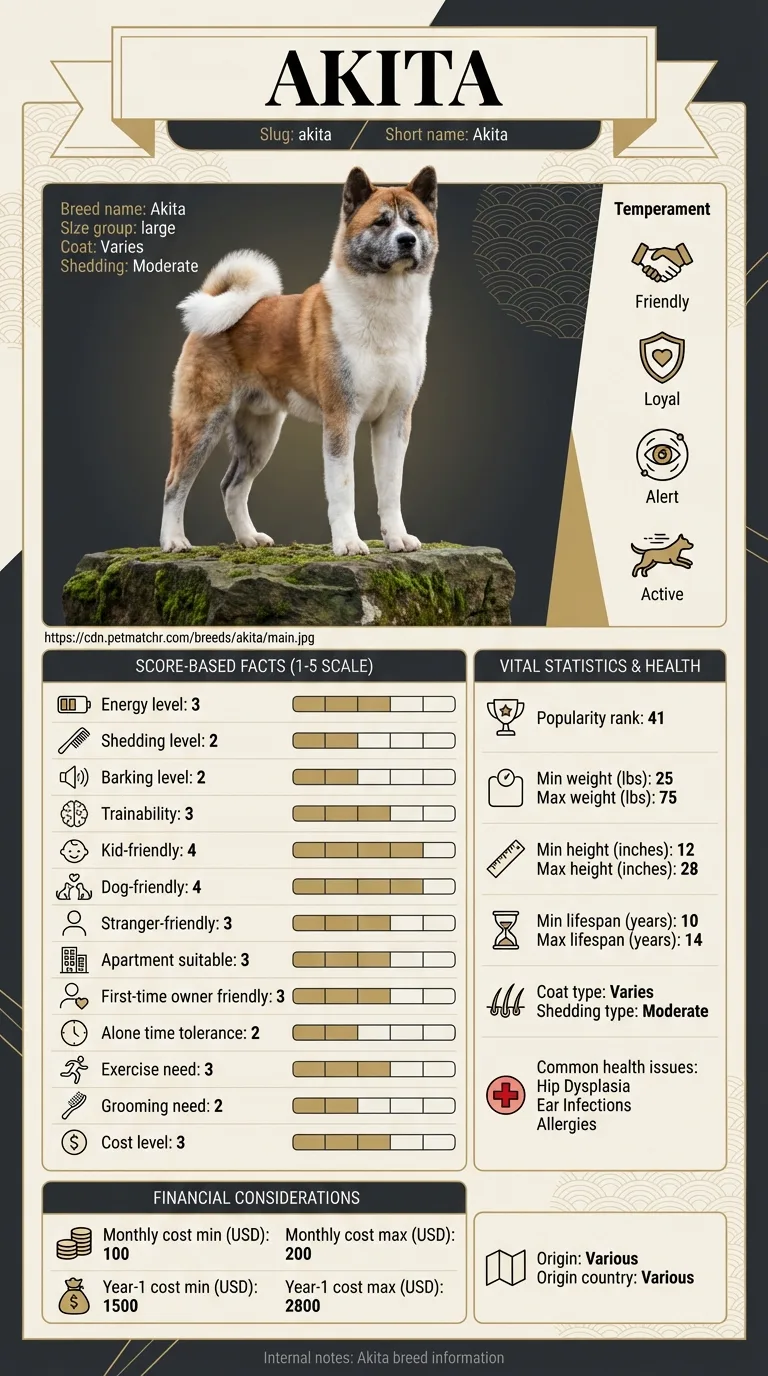
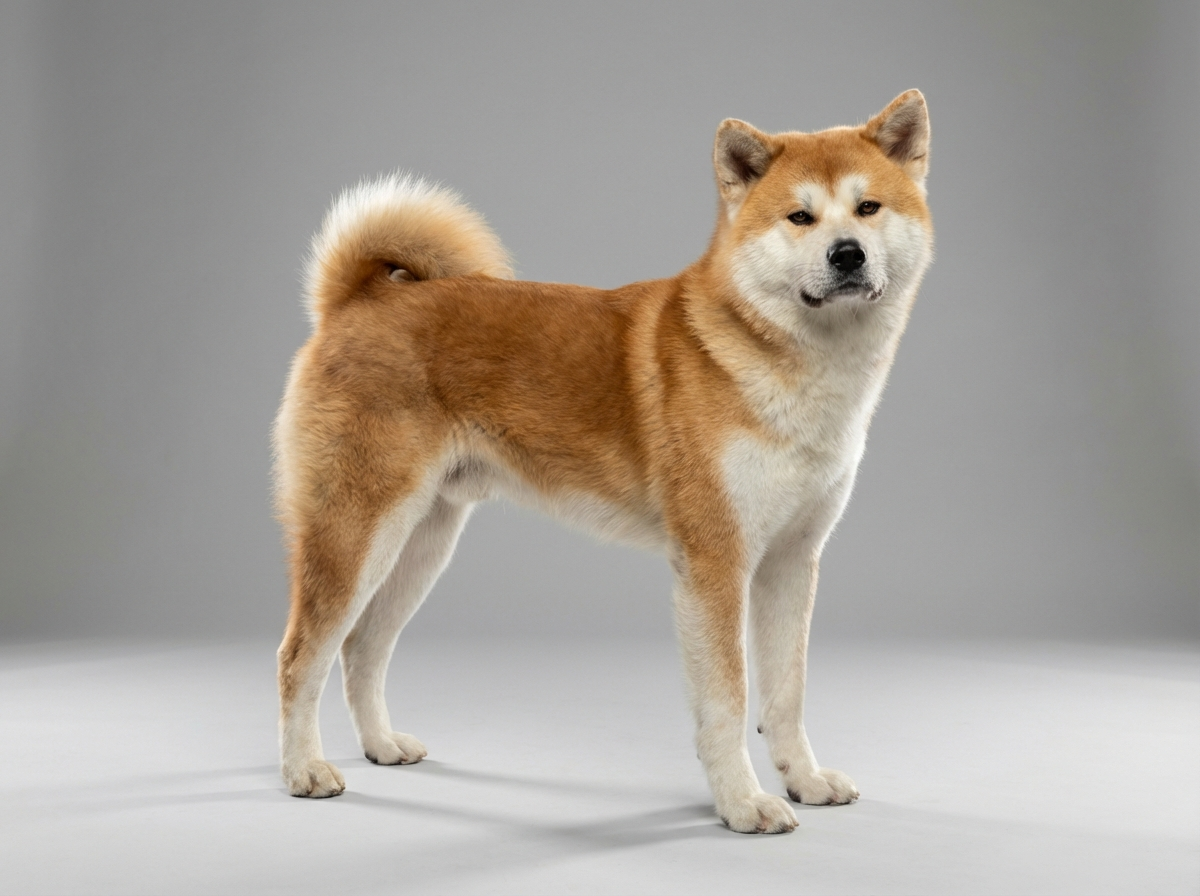
Choose the Akita if you have space, a fenced garden and experience with a powerful breed. It rates 3/5 for tolerating time alone against the Griffon's 2/5, barks at 2/5 against 3/5, and lives 10 to 13 years. You are accepting 1/5 for first-time owners, 2/5 with other dogs, 5/5 shedding and up to 130 pounds.
Choose brussels griffon if...
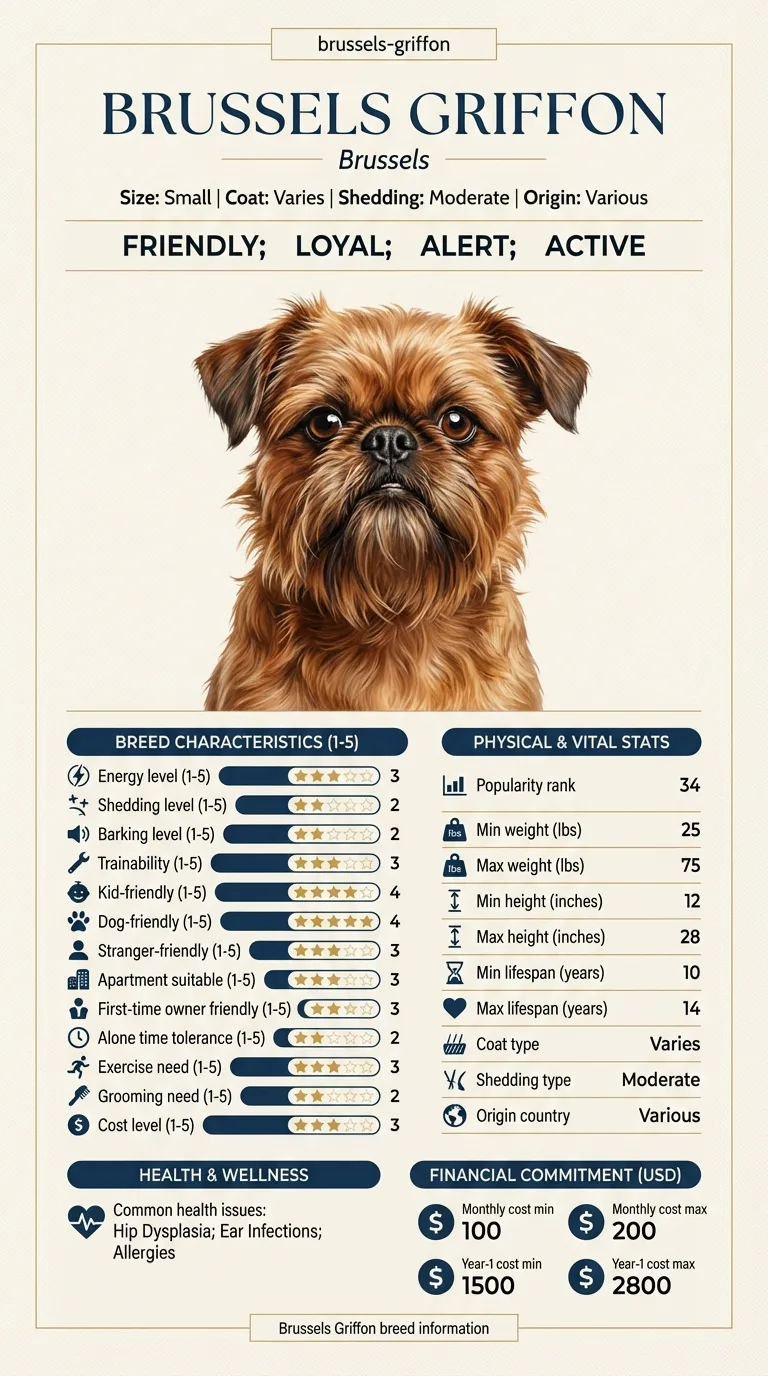
Choose the Brussels Griffon if you live in a flat and want a small, funny, intensely attached companion. It rates 5/5 for apartments against 2/5, needs only 2/5 exercise, sheds at 2/5, and costs $80–$150 a month. You are accepting a brachycephalic airway, prominent eyes that injure easily, and a dog that does not cope well alone.
Head-to-head comparison
Feature
akita
brussels griffon
Winner
Weight
70–130 lbs
8–12 lbs
Equal
Height
24–28 in
7–10 in
Equal
Lifespan
10–13 years
12–15 years
brussels griffon
Coat
Dense double coat
Rough or smooth
Equal
Grooming need
Moderate (3/5)
Moderate (3/5)
Equal
Shedding
Very high (5/5)
Low (2/5)
brussels griffon
Energy level
Moderate (3/5)
Moderate (3/5)
Equal
Exercise need
Moderate (3/5)
Low (2/5)
brussels griffon
Trainability
Moderate (3/5)
Moderate (3/5)
Equal
Barking
Low (2/5)
Moderate (3/5)
akita
Good with kids
Moderate (3/5)
Moderate (3/5)
Equal
Good with other dogs
Low (2/5)
Moderate (3/5)
brussels griffon
Friendly to strangers
Low (2/5)
Moderate (3/5)
brussels griffon
Apartment suitability
Low (2/5)
Very high (5/5)
brussels griffon
Good for first-time owners
Very low (1/5)
Moderate (3/5)
brussels griffon
Tolerates being alone
Moderate (3/5)
Low (2/5)
akita
Typical monthly cost
$110–$240
$80–$150
brussels griffon
Typical first-year cost
$1,700–$3,200
$1,100–$2,300
brussels griffon
Deep dive
The apartment case, and its limits
The Griffon's 5/5 apartment rating is real: 8 to 12 pounds, 2/5 exercise, and no requirement for a garden. Two short walks and some indoor play covers the day.
The caveats are noise and solitude. Barking is 3/5 against the Akita's 2/5 — the Griffon is alert and opinionated, and it announces the lift, the post, and the neighbour's television. In a building with thin walls that matters.
Alone-tolerance is 2/5, and this is the harder constraint. Griffons attach intensely to one or two people and are poor at being left, which combines badly with flat living because there is nowhere for a distressed small dog to go and nothing for it to do.
The Akita at 2/5 for apartments is not about noise — it barks less — but about size in shared corridors, 5/5 shedding in a small space, and a guarding instinct that finds communal entrances ambiguous.
A short face, a domed skull and a fragile frame
Three items on the Brussels Griffon's health list deserve real attention before you commit.
Brachycephalic airway syndrome comes first. The Griffon's shortened muzzle means narrowed nostrils and often an elongated soft palate. In practice: no exercise in the heat of the day in summer, a harness rather than a collar, strict weight control, and a conversation with any airline before travel.
Syringomyelia is the second, and it is the one most owners have not heard of. It is a condition in which fluid-filled cavities form in the spinal cord, usually because the skull is too small for the brain behind it. Signs include scratching at the neck and shoulder without contact, yelping when picked up, and sensitivity around the head. It is diagnosed by MRI and can be managed but not cured.
The third is the eyes. Griffon eyes are large and prominent and corneal injuries are common — a scratched eye is a same-day veterinary problem, not a wait-and-see one. Patellar luxation and hip dysplasia round out the list.
Sensitivity against self-possession
The Brussels Griffon is often described as the most human-like of the toy breeds, and what people usually mean is that it reads mood. Griffons are sensitive to household tension, sulk visibly, and respond badly to sharp voices — training a Griffon with any harshness stalls it completely.
That sensitivity is why the 3/5 trainability rating is misleading. A Griffon can learn a great deal, but only in short cheerful sessions from someone it trusts. House-training in particular is slow, and small-breed bladder size plus a reluctance to go out in rain is a common combination.
The Akita is not sensitive in that way at all. It is self-possessed. It does not read the room and it does not care very much what mood you are in. What it does do is form judgements about strangers and other dogs, at 2/5 and 2/5, and those judgements typically firm up at social maturity around two years old rather than in puppyhood.
Both need socialisation. Only one of them will be hurt by getting it wrong loudly.
Coat work and running costs
Both rate 3/5 for grooming and the work could not be less alike. The rough-coated Griffon needs hand-stripping or regular clipping and a tidy of the beard and facial furnishings, which for most owners means a groomer every couple of months. The smooth-coated variety needs almost nothing. Shedding is 2/5 either way.
The Akita sheds at 5/5, blowing a dense double coat in clumps twice a year, and needs an undercoat rake and a bin bag through those weeks. Between blows it is undemanding. The coat should never be clipped, since it insulates against heat as well as cold.
On money the Griffon is cheaper to run at $80–$150 a month against $110–$240, and $1,100–$2,300 against $1,700–$3,200 in the first year. Weight explains most of that.
The number to be careful with is veterinary. Airway surgery, an MRI for suspected syringomyelia, and repeated corneal treatment are all realistic in a Griffon's life, and any one of them will erase several years of the difference in food.
Akita vs Brussels Griffon: where the ratings agree
What is strange about this pairing is how many rows tie. Grooming is 3/5 for both. Energy is 3/5 for both. Trainability is 3/5 for both. Children are 3/5 for both.
Those ties describe completely different situations. The Griffon's 3/5 with children is about fragility — a 10-pound dog with fine bones and prominent eyes is genuinely at risk from a clumsy toddler. The Akita's 3/5 is the reverse concern. Both are 3/5 and neither number means the same thing.
The same goes for trainability. The Griffon is bright but stubborn and famously sensitive to tone; the Akita is bright but independent and simply forms its own view.
The rows that do separate them are the ones that decide it: apartments at 5/5 against 2/5, shedding at 2/5 against 5/5, and a weight range that differs by an order of magnitude.
Akita or Brussels Griffon: Guardian or Lap Comedian? - Akita vs Brussels Griffon: where the ratings agree
Frequently asked questions
Which is better for an apartment, an Akita or a Brussels Griffon?
The Brussels Griffon at 5/5 against the Akita's 2/5. It weighs 8 to 12 pounds and needs only 2/5 exercise, so two short walks cover the day. The two caveats are noise — it barks at 3/5 and announces everything — and a 2/5 tolerance for being left alone, which is harder to manage in a flat than in a house.
What is syringomyelia and should it worry me?
It is a condition in which fluid-filled cavities form in the spinal cord, usually because the skull is too small for the brain behind it, and it appears on the Brussels Griffon's condition list. Signs include scratching at the neck without making contact, yelping when lifted, and sensitivity around the head. It is diagnosed by MRI and can be managed but not cured.
Which sheds more?
The Akita at 5/5 against the Griffon's 2/5. The Akita blows a dense double coat in clumps twice a year and needs an undercoat rake through those weeks. Both breeds rate 3/5 for grooming, but the Griffon's work is a rough coat that needs stripping or clipping and a beard that needs tidying, usually at a groomer.
Is the Brussels Griffon good with children?
Moderately, at 3/5 — the same rating as the Akita, for the opposite reason. The Griffon is small-boned with prominent eyes and is genuinely at risk of injury from a clumsy toddler. It suits older, calmer children. The Akita's 3/5 reflects its size and guardian temperament rather than any fragility.
Which is easier to train?
Neither, and both rate 3/5. The Griffon is bright but stubborn and extremely sensitive to tone — harsh correction stops progress completely, and house-training is slow. The Akita is independent rather than sensitive: it understands the request, considers it, and forms a view. Short, cheerful, consistent sessions work for both.
How much does each cost to keep?
The Griffon runs $80–$150 a month and the Akita $110–$240, with first-year totals of $1,100–$2,300 and $1,700–$3,200. Weight explains most of the gap. The Griffon's risk is a single large bill — airway surgery, an MRI, or corneal treatment — rather than the running cost.
Which copes better with being left alone?
The Akita at 3/5 against the Griffon's 2/5. Griffons attach intensely to one or two people and are poor at being left. The Akita is self-contained and will sleep. Neither should be left for a full working day without a break, but the Akita gets closer to managing it.
The Brussels Griffon if you live in a flat and want a small, funny, attached companion. The Akita if you have space, a fenced garden and experience with a powerful guardian breed rated 1/5 for first-time owners.
Costs
How much does each cost per month?
The Akita runs $110–$240 a month and the Brussels Griffon $80–$150, with first-year totals of $1,700–$3,200 and $1,100–$2,300.
Behavior
Which barks more?
The Brussels Griffon at 3/5 against the Akita's 2/5. It is alert and opinionated and will announce the lift, the post and the neighbours — worth weighing in a building with thin walls.
Health
What are the main health tests for a Brussels Griffon?
Ask about breathing under exertion in the parents rather than at rest, patella scores, hip scores, and whether syringomyelia has appeared in the line. Eye health matters too — prominent eyes injure easily.
Related DogBreedCompass guides
Akita breed guide – The Akita profile covers guardian temperament and the long socialisation window the breed needs.
Brussels Griffon breed guide – The Brussels Griffon profile covers flat living, coat types and the breed's sensitivity.
Akita vs Pug – The Pug shares the Griffon's short face and is the most common alternative to it.
Akita vs Boston Terrier – The Boston Terrier is the other small short-faced breed worth weighing against the Griffon.
Brussels Griffon eye problems – Prominent eyes make corneal injury a recurring risk in this breed.
Akita autoimmune diseases – Autoimmune disease is the Akita's most distinctive burden and the first question for a breeder.
Health information here is general and is not veterinary advice. If your dog shows pain, sudden behaviour change, or worsening symptoms, consult a licensed veterinarian.
Some links on this site are affiliate links. We may earn a commission at no extra cost to you, and we only suggest products we believe are helpful for dog owners.
We research and check what we publish, but we do not warrant that any figure, date, price, or statement is accurate, complete, or current, and we accept no liability for any loss, cost, injury, or other harm arising from the use of this site. Use it as one reference among several. You remain responsible for your own decisions and for your dog's care - confirm anything that matters with a licensed veterinarian or another qualified professional before you act on it. Full disclaimer.