Behavior
Which breed is the better overall choice?
The Griffon for apartments, tight budgets and first-time owners. The Great Dane only for owners with space, a bigger budget, and readiness for a shorter lifespan with serious health risks.

Quick answer
Which breed is the better overall choice?
The Griffon for apartments, tight budgets and first-time owners. The Great Dane only for owners with space, a bigger budget, and readiness for a shorter lifespan with serious health risks.
Brussels Griffon or Great Dane? On paper they differ most on apartment suitability, and on the scales Great Dane is the heavier at 110–175 lbs. Here is how the two compare on everything that shapes an ordinary week.
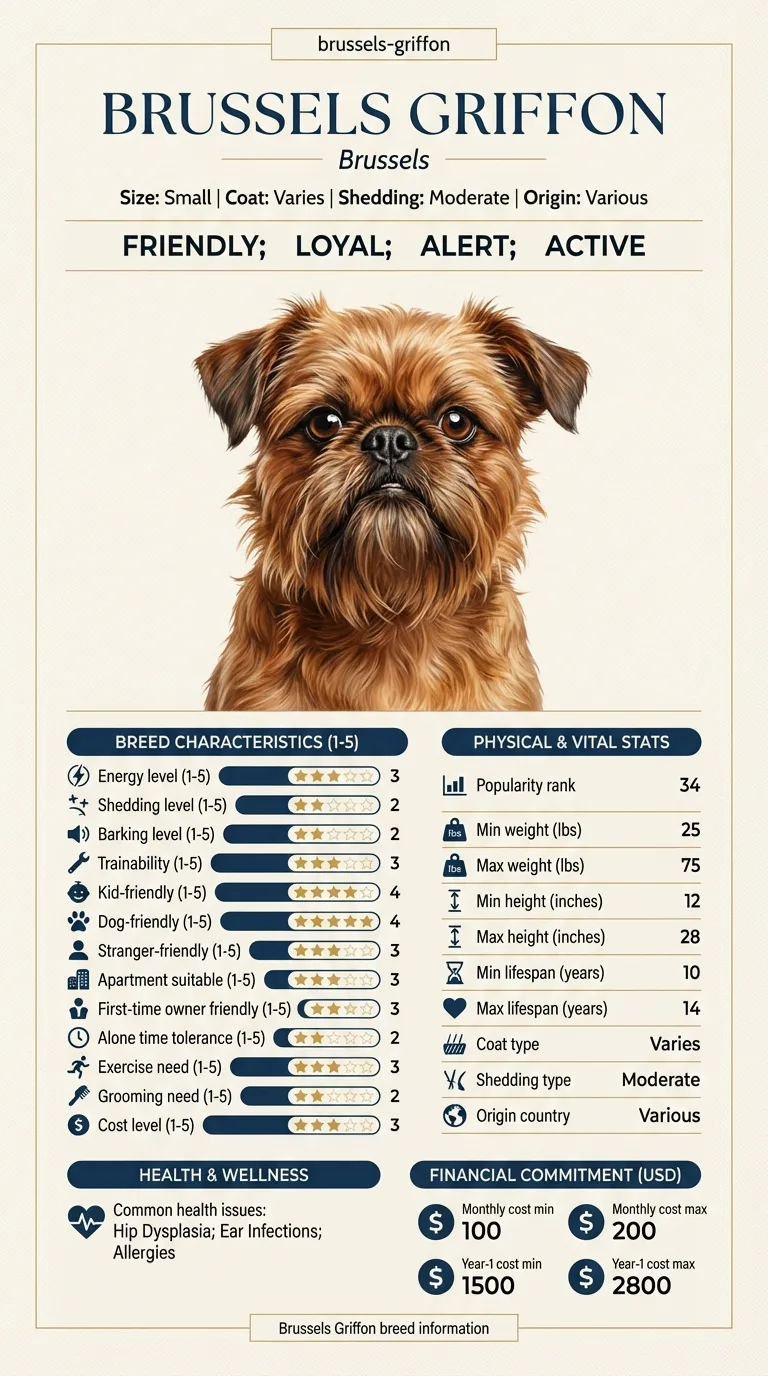
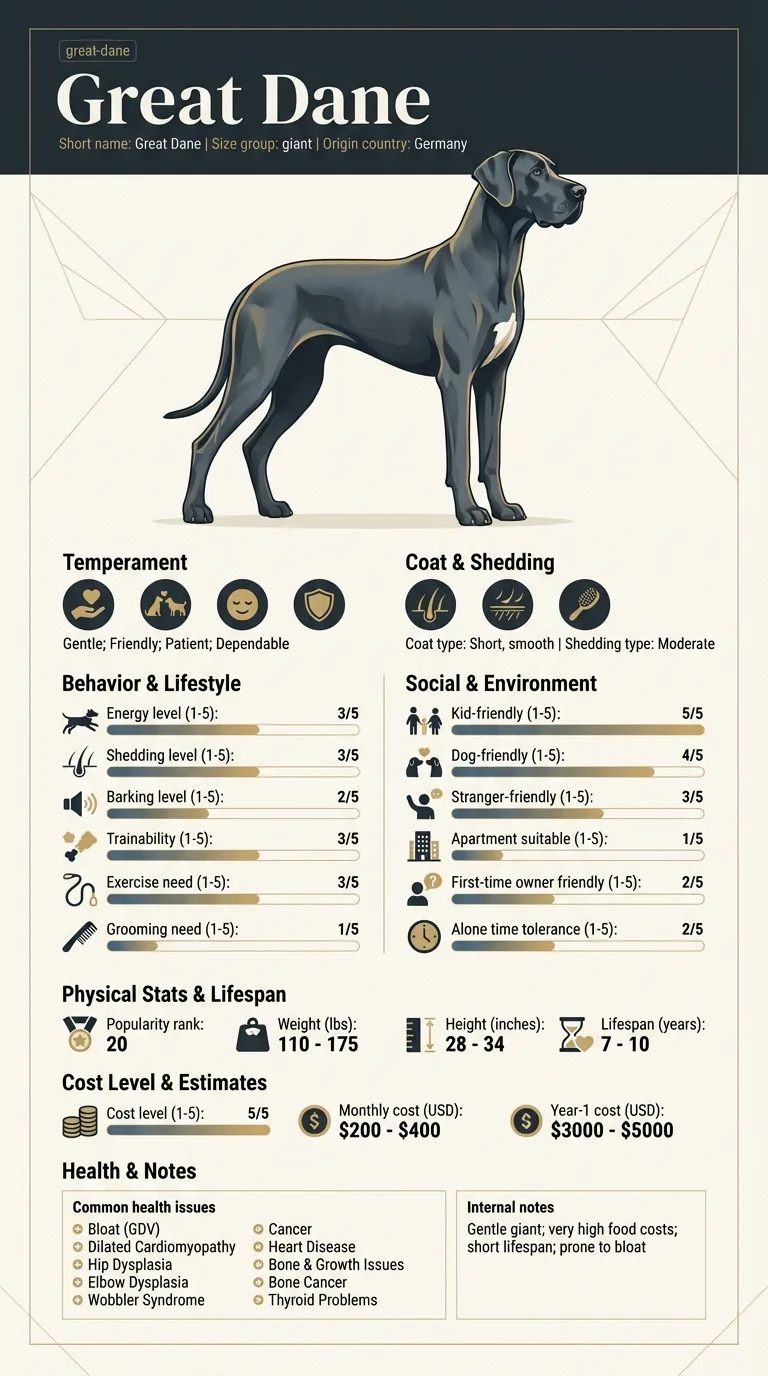
This is for someone already down to Brussels Griffon and Great Dane and deciding between them. For this pair the decision usually turns on apartment suitability and grooming need, so those are covered first and in most detail. Anyone choosing from a flat has a clear answer here: Brussels Griffon rates 5/5 against 1/5. Breed history is left out; what follows is what you will actually live with.
Between Brussels Griffon and Great Dane, apartment suitability is what separates them, and Brussels Griffon is the lower-effort dog of the two to keep.
Choose Brussels Griffon if you are in a flat or a smaller home, this is your first dog and shedding is a problem in your house.
Choose Great Dane if you do not want a standing grooming appointment, there are young children at home and you already have another dog.
| Feature | brussels griffon | great dane | Winner |
|---|---|---|---|
| Size class | small | giant | Equal |
| Weight | 8–12 lbs | 110–175 lbs | Equal |
| Height | 7–10 in | 28–34 in | Equal |
| Lifespan | 12–15 years | 7–10 years | brussels griffon |
| Exercise need | Low (2/5) | Moderate (3/5) | brussels griffon |
| Grooming need | Moderate (3/5) | Very low (1/5) | great dane |
| Shedding | Low (2/5) | Moderate (3/5) | brussels griffon |
| Energy level | Moderate (3/5) | Moderate (3/5) | Equal |
| Barking | Moderate (3/5) | Low (2/5) | great dane |
| Apartment suitability | Very high (5/5) | Very low (1/5) | brussels griffon |
| Good for first-time owners | Moderate (3/5) | Low (2/5) | brussels griffon |
| Tolerates being alone | Low (2/5) | Low (2/5) | Equal |
| Trainability | Moderate (3/5) | Moderate (3/5) | Equal |
| Good with kids | Moderate (3/5) | Very high (5/5) | great dane |
| Good with other dogs | Moderate (3/5) | High (4/5) | great dane |
| Friendly to strangers | Moderate (3/5) | Moderate (3/5) | Equal |
| Cost level | Moderate (3/5) | Very high (5/5) | brussels griffon |
| Coat | Rough or smooth | Short, smooth | Equal |
| Origin | Various | Germany | Equal |
| Typical monthly cost | $80–$150 | $200–$400 | Equal |
| Typical first-year cost | $1,100–$2,300 | $3,000–$5,000 | Equal |
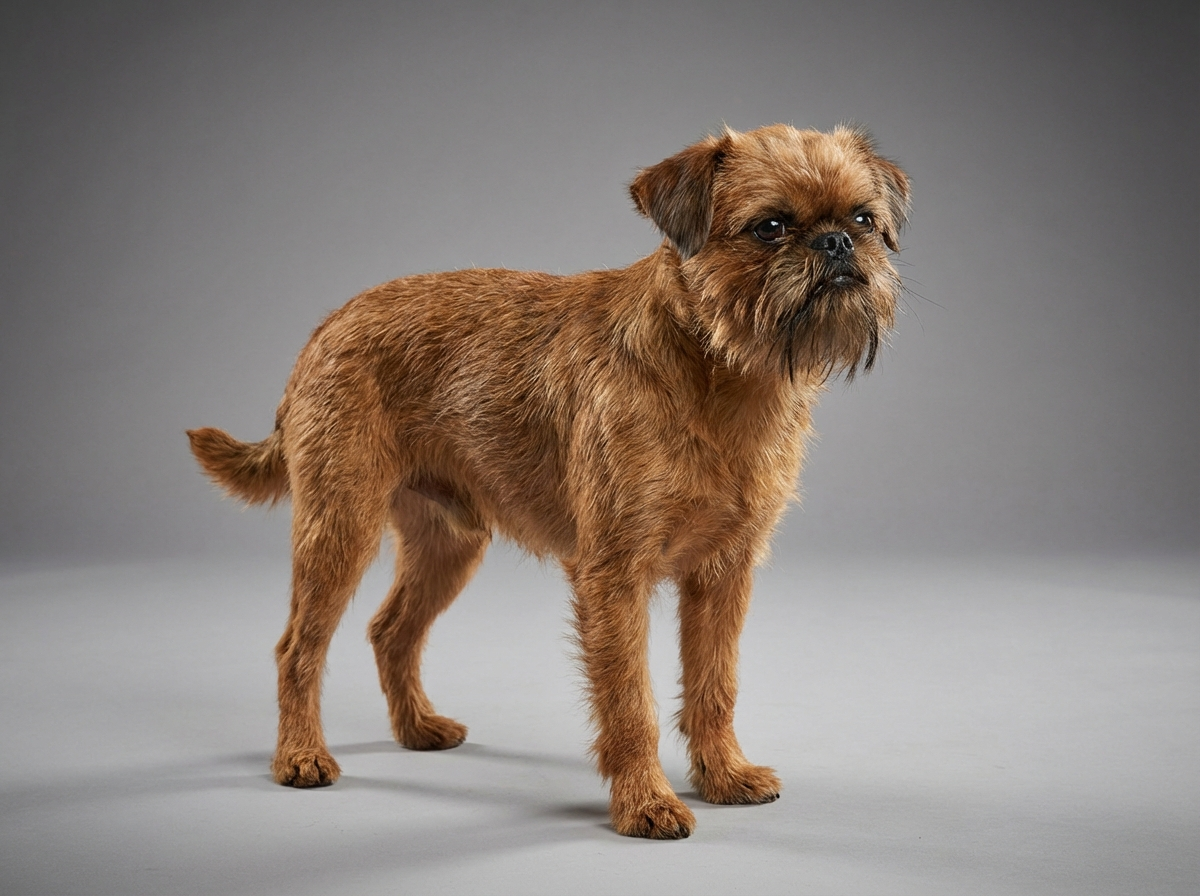
This is the most extreme size gap in any Griffon comparison on this site. A Great Dane weighs 110-175 lbs and stands 28-34 inches; a Brussels Griffon weighs 8-12 lbs and stands 7-10 inches. The Dane can outweigh the Griffon by more than fourteen times and stand nearly three times as tall. These aren't really two sizes of the same kind of pet - they're at opposite ends of what "dog" can mean.
Despite the size gap, exercise needs are closer than you'd expect: the Dane rates a moderate 3/5, the Griffon a low 2/5, and energy level ties at moderate (3/5) for both. Great Danes are famously low-key indoors for their size - big, but not hyperactive. Don't mistake the Dane's bulk for a demand for constant activity; it just needs consistent moderate exercise, not marathon sessions.
The Dane is the easier coat to manage, rated very low (1/5) grooming against the Griffon's moderate (3/5) - its short, smooth coat needs minimal upkeep despite the animal's sheer size. Shedding flips the other way, low (2/5) for the Griffon versus moderate (3/5) for the Dane - more surface area means more hair even on a short coat, but neither breed sheds heavily.
The Griffon rates 5/5 for apartment suitability; the Dane rates just 1/5, very low - size alone makes small-unit living impractical regardless of the breed's genuinely calm temperament. Interestingly the Dane barks less (low 2/5 versus the Griffon's moderate 3/5). Both breeds tolerate being alone poorly, tied at low (2/5), so neither is right for long stretches without company.
Trainability ties at moderate (3/5) for both breeds. First-time-owner suitability favors the Griffon slightly - moderate (3/5) versus the Dane's low (2/5) - a gap that has less to do with temperament, described as gentle, friendly and patient, and more to do with the practical challenge of managing a 150-lb dog's size, strength and space needs as a novice owner.
The Great Dane is the famous "gentle giant" for good reason: very high with kids (5/5) and high with other dogs (4/5), against the Griffon's moderate 3/5 in both categories. Friendliness to strangers ties at moderate (3/5). The Dane's patient, dependable temperament makes it a genuinely good family dog despite its intimidating size - just one that needs careful supervision with small kids simply due to its bulk.
The lifespan gap here is stark: 12-15 years for the Griffon against just 7-10 for the Great Dane, a near-doubling reflecting the shortened lifespans common to giant breeds. The Dane's ten-condition health list includes serious risks like bloat (GDV), dilated cardiomyopathy, Wobbler Syndrome and bone cancer. The Griffon's five conditions center on its brachycephalic build. Both share hip dysplasia and elbow dysplasia risk.
The Great Dane is the most expensive dog to keep in this entire comparison set: very high cost tier at $200-400 monthly and $3,000-5,000 first year, roughly double to triple the Griffon's moderate $80-150 monthly and $1,100-2,300 first year. Feeding a 150-lb dog alone runs up the grocery bill fast, before factoring in size-scaled medication doses and larger everything - crates, beds, collars.
Brussels Griffon weighs 8–12 lbs and lives 12–15 years; Great Dane weighs 110–175 lbs and lives 7–10 years. The two diverge most on apartment suitability, grooming need and good with kids and 1 other rated axes. They are level on tolerates being alone, energy level and friendly to strangers, so those cannot decide it. The comparison marks an easier option only where one exists. Facts like weight and country of origin are not scored. Both dogs are rated from the same dataset, which is what makes the numbers comparable with each other even though any individual dog sits somewhere inside its breed's range.

Enormously - a Dane can weigh 110-175 lbs against the Griffon's 8-12 lbs, more than fourteen times heavier, and stands nearly three times as tall. This is the largest size gap in any Griffon comparison.
Less than you'd guess for their size - a moderate 3/5, not far above the Griffon's low 2/5. Danes are known for being fairly low-key indoors despite their bulk.
The Great Dane, rated very low (1/5) versus the Griffon's moderate (3/5) - its short, smooth coat needs minimal upkeep.
Yes, very high (5/5), earning its reputation as a gentle giant - though its sheer size still calls for supervision around small children.
A lot more - $200-400 a month versus the Griffon's $80-150, landing the Dane in the very high cost tier against the Griffon's moderate tier. Food alone accounts for a large part of that gap.
Giant breeds generally live shorter lives, and the data reflects that here - 7-10 years for the Dane against 12-15 for the Griffon, alongside serious size-linked risks like bloat, dilated cardiomyopathy and bone cancer.
The Griffon, at 5/5 apartment suitability. The Dane rates just 1/5 - its size alone makes small-unit living impractical no matter how calm its temperament is.
The Griffon for apartments, tight budgets and first-time owners. The Great Dane only for owners with space, a bigger budget, and readiness for a shorter lifespan with serious health risks.
Griffon: $80-150. Great Dane: $200-400 - the widest cost gap of any breed compared against the Griffon on this site.
Moderate, rated 3/5 - not as much as their size suggests, and only slightly above the Griffon's 2/5.
The Griffon by a wide margin - 12-15 years versus the Great Dane's 7-10 years, reflecting the shorter lifespans typical of giant breeds.
Secure checkout on Stripe. We never see your card.
7-day money-back guarantee. Instant access.
Health information here is general and is not veterinary advice. If your dog shows pain, sudden behaviour change, or worsening symptoms, consult a licensed veterinarian.
Some links on this site are affiliate links. We may earn a commission at no extra cost to you, and we only suggest products we believe are helpful for dog owners.
We research and check what we publish, but we do not warrant that any figure, date, price, or statement is accurate, complete, or current, and we accept no liability for any loss, cost, injury, or other harm arising from the use of this site. Use it as one reference among several. You remain responsible for your own decisions and for your dog's care - confirm anything that matters with a licensed veterinarian or another qualified professional before you act on it. Full disclaimer.
Match your lifestyle to the right dog.
Take quizNot sure which breed is right for you? Take our 2-minute quiz to find out.
Take the quiz