Behavior
Griffon or Cocker Spaniel, which is the better family dog?
The Cocker, by most household measures, kids, other dogs, and strangers all score higher for it. The Griffon still wins on lower grooming demands and slightly less exercise.

Quick answer
Griffon or Cocker Spaniel, which is the better family dog?
The Cocker, by most household measures, kids, other dogs, and strangers all score higher for it. The Griffon still wins on lower grooming demands and slightly less exercise.
Brussels Griffon or Cocker Spaniel? On paper they differ most on grooming need, and on the scales Cocker Spaniel is the heavier at 20–30 lbs. Here is how the two compare on everything that shapes an ordinary week.
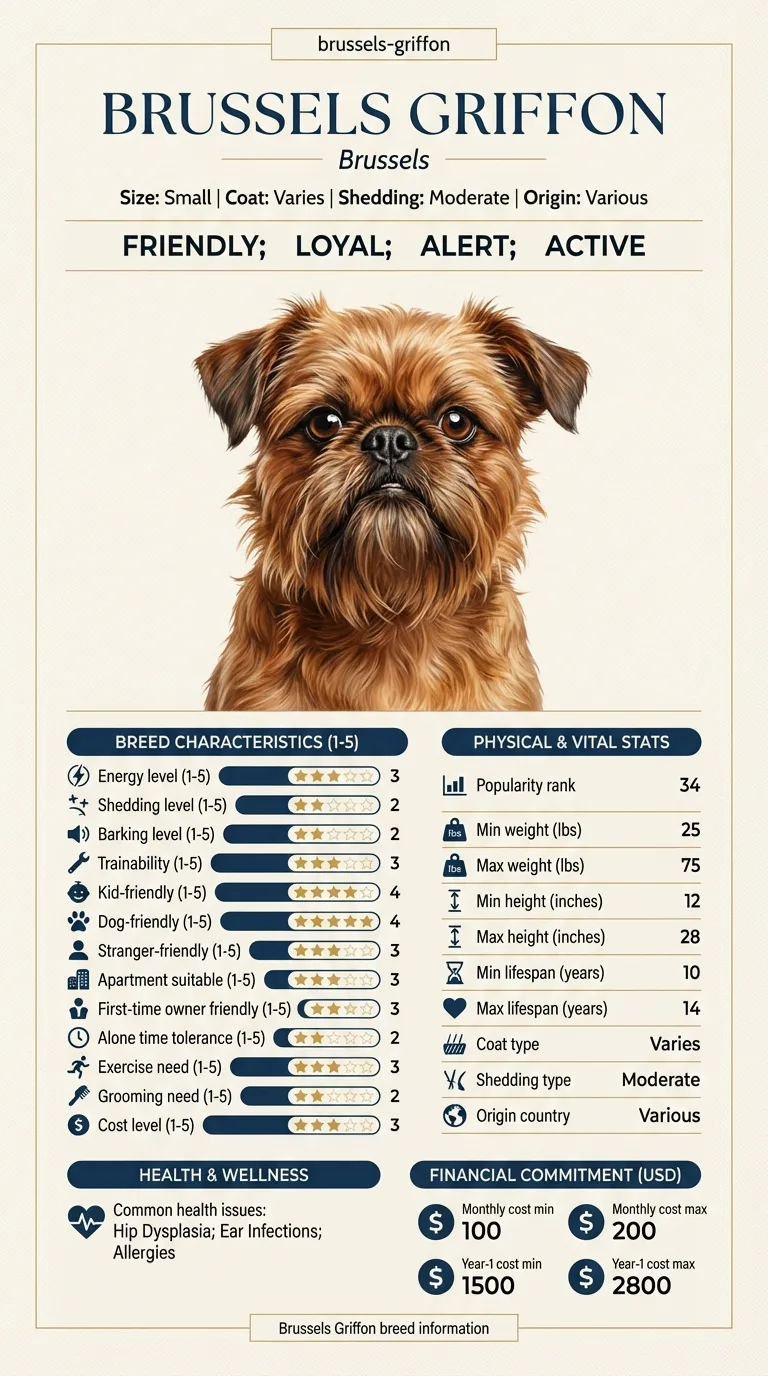
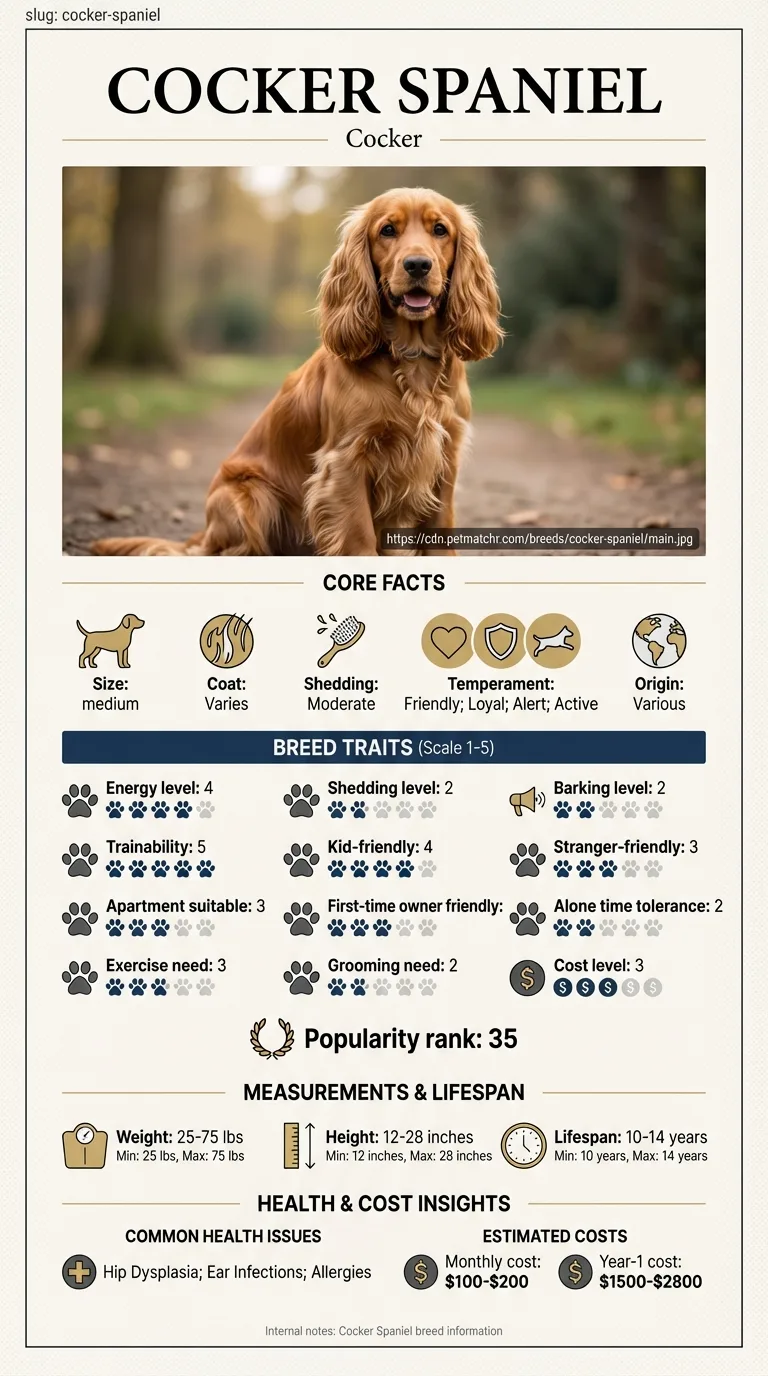
This is for someone already down to Brussels Griffon and Cocker Spaniel and deciding between them. For this pair the decision usually turns on grooming need and good with kids, so those are covered first and in most detail. Anyone choosing from a flat has a clear answer here: Brussels Griffon rates 5/5 against 4/5. It is written for the decision rather than the breed history.
Between Brussels Griffon and Cocker Spaniel, grooming need is what separates them, and Brussels Griffon is the lower-effort dog of the two to keep.
Choose Brussels Griffon if you are in a flat or a smaller home, you do not want a standing grooming appointment and shedding is a problem in your house.
Choose Cocker Spaniel if this is your first dog, there are young children at home and you already have another dog.
| Feature | brussels griffon | cocker spaniel | Winner |
|---|---|---|---|
| Size class | small | small | Equal |
| Weight | 8–12 lbs | 20–30 lbs | Equal |
| Height | 7–10 in | 13–16 in | Equal |
| Lifespan | 12–15 years | 10–14 years | brussels griffon |
| Exercise need | Low (2/5) | Moderate (3/5) | brussels griffon |
| Grooming need | Moderate (3/5) | Very high (5/5) | brussels griffon |
| Shedding | Low (2/5) | Moderate (3/5) | brussels griffon |
| Energy level | Moderate (3/5) | Moderate (3/5) | Equal |
| Barking | Moderate (3/5) | Moderate (3/5) | Equal |
| Apartment suitability | Very high (5/5) | High (4/5) | brussels griffon |
| Good for first-time owners | Moderate (3/5) | High (4/5) | cocker spaniel |
| Tolerates being alone | Low (2/5) | Low (2/5) | Equal |
| Trainability | Moderate (3/5) | High (4/5) | cocker spaniel |
| Good with kids | Moderate (3/5) | Very high (5/5) | cocker spaniel |
| Good with other dogs | Moderate (3/5) | High (4/5) | cocker spaniel |
| Friendly to strangers | Moderate (3/5) | High (4/5) | cocker spaniel |
| Cost level | Moderate (3/5) | Moderate (3/5) | Equal |
| Coat | Rough or smooth | Silky and feathered | Equal |
| Origin | Various | Various | Equal |
| Typical monthly cost | $80–$150 | $80–$150 | Equal |
| Typical first-year cost | $1,100–$2,300 | $1,100–$2,300 | Equal |
The Cocker Spaniel is the bigger dog here, 20 to 30 pounds and 13 to 16 inches against the Griffon's 8 to 12 pounds and 7 to 10 inches, roughly two to three times the weight. Both stay in the small-breed bracket officially, but you'll feel the difference the moment you pick either one up off the floor. It's a gap you notice on the leash more than on the label.
The Cocker needs a bit more daily activity, rating moderate (3/5) for exercise against the Griffon's low (2/5), though their overall energy level ties at moderate for both breeds. A longer walk or a game of fetch in the yard covers the Cocker's extra requirement without much extra effort on your part, and neither dog demands a serious training regimen to stay content.
Coat care is a clear win for the Griffon here: grooming rates moderate (3/5) against the Cocker's very high (5/5), and shedding follows, low (2/5) versus moderate (3/5). The Cocker's silky, feathered coat mats easily and needs frequent brushing plus regular trims from a groomer to stay manageable long term, a real recurring cost most new owners underestimate.
Both breeds work well in apartments, the Griffon rates 5 out of 5, the Cocker a still-solid 4, and barking ties at moderate for each. Neither tolerates being left alone for long stretches, tying at a low 2 out of 5, so this isn't the pairing for an empty-house-all-day work schedule regardless of which one you pick.
The Cocker Spaniel is the more beginner-friendly dog: high (4/5) for first-time owners against the Griffon's moderate (3/5), and it trains more readily too, 4 versus 3. Its eager-to-please temperament, right there in its own descriptor list, backs up the numbers, Cockers are bred to work closely with people and generally respond well to consistent, reward-based training.
The Cocker pulls ahead across every household measure: very high with kids (5 vs 3), high with other dogs (4 vs 3), and high with strangers (4 vs 3). If you're weighing this pairing for a family home with kids, visiting friends, or another dog already in the house, the Cocker's numbers make the case for themselves fairly clearly across the board.
The Griffon lives a bit longer on average, 12 to 15 years against the Cocker's 10 to 14. Hip dysplasia is their one shared risk. Beyond that, the Cocker's concerns center on its eyes and ears, cataracts, progressive retinal atrophy, and chronic ear infections tied to those long, floppy ears, while the Griffon's trace to its flat face and spine.
Cost is a rare tie in this comparison: both breeds run $80 to $150 a month and $1,100 to $2,300 in the first year. The Cocker's higher grooming needs likely offset the Griffon's other cost advantages, landing them in the same budget bracket despite the size difference between them and the very different coats they carry.
Brussels Griffon weighs 8–12 lbs and lives 12–15 years; Cocker Spaniel weighs 20–30 lbs and lives 10–14 years. The two diverge most on grooming need and good with kids. They are level on tolerates being alone, barking and cost level, so those cannot decide it. In the table, a "winner" means easier for an ordinary household — not better. Size, coat and origin are recorded without a verdict. Because both breeds are scored the same way, the gaps are reliable even where the absolute numbers are rough.

About two to three times the weight, 20 to 30 pounds against the Griffon's 8 to 12, and a few inches taller, 13 to 16 inches versus 7 to 10. Both are still classed as small breeds.
The Cocker, rating moderate (3/5) against the Griffon's low (2/5). It also needs far more grooming overall, a very high 5 out of 5 versus the Griffon's moderate 3, thanks to its silky, feathered coat.
Yes, it rates high, 4 out of 5, against the Griffon's moderate 3. Its eager-to-please, affectionate temperament makes it one of the easier breeds for someone training their first dog.
Both do, the Griffon at 5 out of 5, the Cocker at 4 out of 5. Neither handles being alone well, though, tying at a low 2 out of 5, so plan for company during the day.
Neither, really, they tie at $80 to $150 a month and $1,100 to $2,300 in the first year. It's one of the closer cost matchups on this site.
Hip dysplasia appears on both lists. Otherwise they diverge, the Cocker is more prone to ear infections and eye conditions like cataracts and progressive retinal atrophy, while the Griffon's risks trace to its flat face and spine.
The Cocker Spaniel, rated very high (5/5) against the Griffon's moderate (3/5). If you have young children at home, the Cocker's family-oriented temperament shows up clearly in the numbers.
The Cocker, by most household measures, kids, other dogs, and strangers all score higher for it. The Griffon still wins on lower grooming demands and slightly less exercise.
They tie at $80 to $150 a month, one of the few pairings on this site where cost isn't a differentiator.
The Cocker needs a bit more, rating moderate (3/5) against the Griffon's low (2/5).
The Brussels Griffon, 12 to 15 years against the Cocker Spaniel's 10 to 14.
Secure checkout on Stripe. We never see your card.
7-day money-back guarantee. Instant access.

Health information here is general and is not veterinary advice. If your dog shows pain, sudden behaviour change, or worsening symptoms, consult a licensed veterinarian.
Some links on this site are affiliate links. We may earn a commission at no extra cost to you, and we only suggest products we believe are helpful for dog owners.
We research and check what we publish, but we do not warrant that any figure, date, price, or statement is accurate, complete, or current, and we accept no liability for any loss, cost, injury, or other harm arising from the use of this site. Use it as one reference among several. You remain responsible for your own decisions and for your dog's care - confirm anything that matters with a licensed veterinarian or another qualified professional before you act on it. Full disclaimer.
Match your lifestyle to the right dog.
Take quizNot sure which breed is right for you? Take our 2-minute quiz to find out.
Take the quiz