Akita or Bernedoodle: Purebred Guardian or Doodle Cross?
Quick answer
Akita vs Bernedoodle: which should I choose?
The Bernedoodle for a family dog — 5/5 with children and other dogs, 5/5 trainability, 4/5 for first-time owners, and very little shedding. Choose the Akita if you want predictable size and temperament plus guardian instinct, and prefer a coat you rake rather than one you pay to clip.
This is a comparison between a breed and a cross, and that difference matters more than any single rating. An Akita is highly predictable — you know roughly what you are getting. A Bernedoodle is a Bernese Mountain Dog crossed with a Poodle, and depending on the generation it can weigh 20 pounds or 90, and shed almost nothing or a fair amount.
This is for someone weighing a traditional guardian breed against a modern designer cross, usually because shedding is the deciding factor. It covers what the low-shedding coat actually costs in grooming, how predictable each dog is, the temperament and exercise differences, and the health questions that matter for a cross specifically.
Quick verdict
The Bernedoodle is the family dog and the near-shed-free one; the Akita is the predictable one, and the Bernedoodle's low shedding is paid for in grooming bills rather than saved.
Choose akita if...
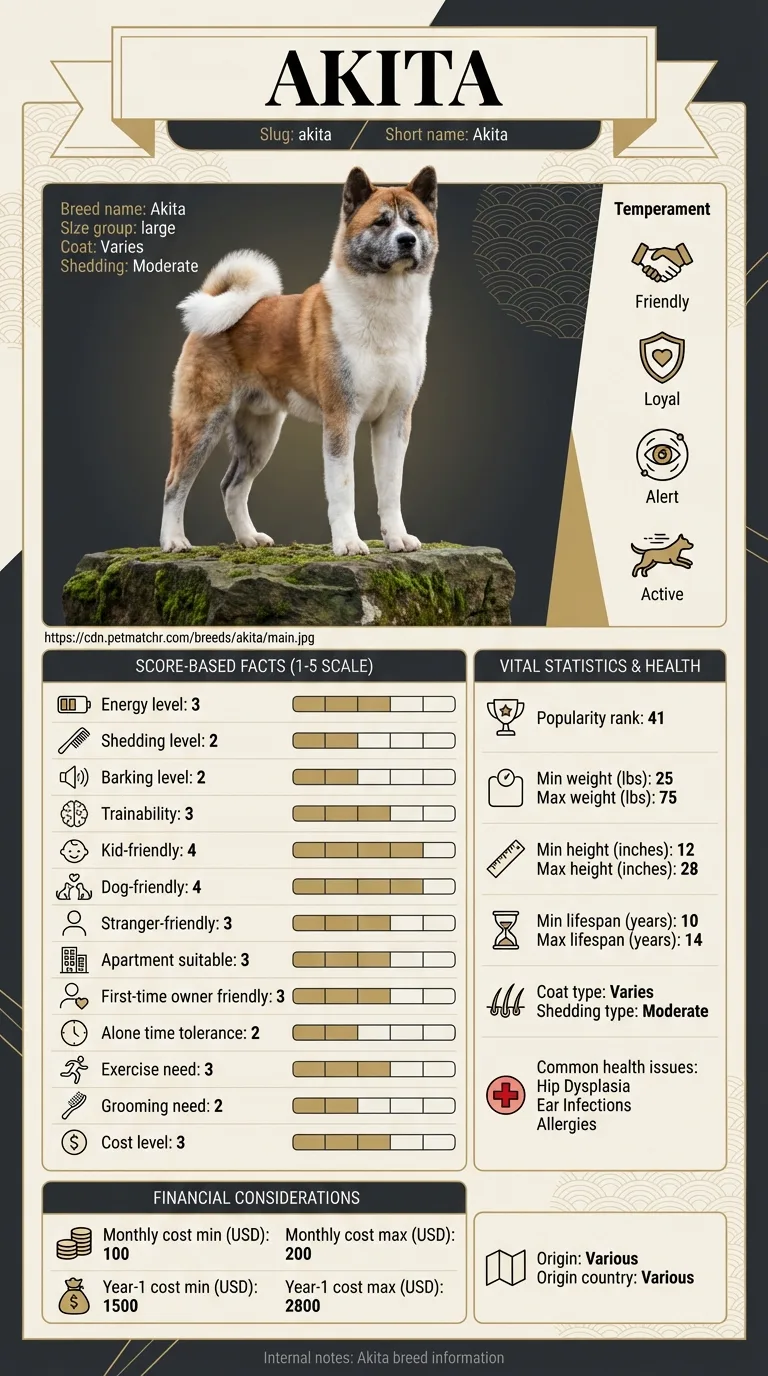
Choose the Akita if predictability matters to you — size, temperament and coat are all knowable in advance — and you specifically want guardian instinct in a quiet house dog at 2/5 barking and 3/5 exercise. Accept 1/5 first-time suitability, 2/5 with strangers and other dogs, and a coat that sheds at 5/5.
Choose bernedoodle if...
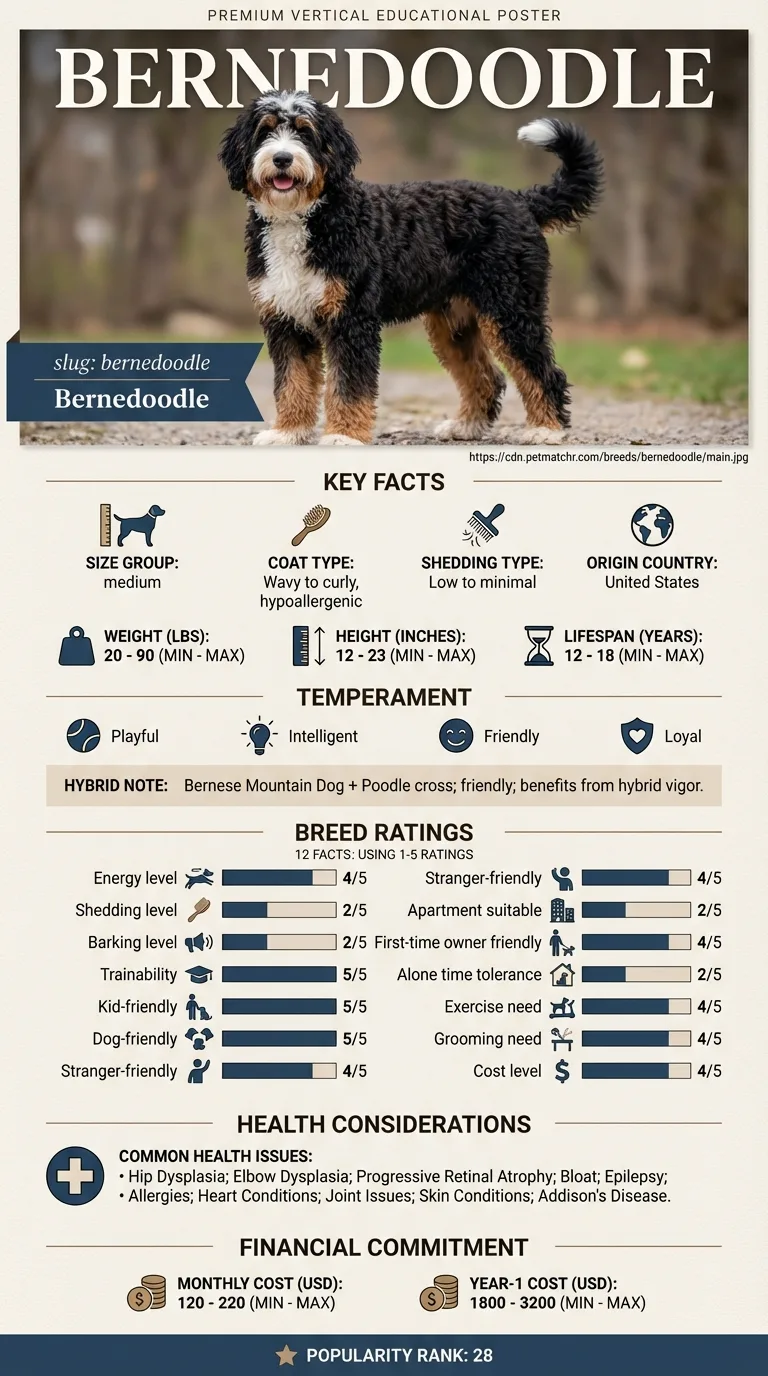
Choose the Bernedoodle if you want a family dog: 5/5 with children, 5/5 with other dogs, 5/5 trainability, 4/5 for first-time owners, and shedding at 1 to 2 out of 5. It typically lives 12 to 18 years, far longer than either parent breed. Budget for grooming at 4/5 — a clipped coat needs professional attention every six to eight weeks, permanently.
Head-to-head comparison
Feature
akita
bernedoodle
Winner
Weight
70–130 lbs
20–90 lbs (varies by generation)
Equal
Height
24–28 in
12–23 in
Equal
Lifespan
10–13 years
12–18 years
bernedoodle
Coat
Dense double coat
Wavy to curly, low-shedding
Equal
Grooming need
Moderate (3/5)
High (4/5)
akita
Shedding
Very high (5/5)
Low (2/5)
bernedoodle
Energy level
Moderate (3/5)
High (4/5)
Equal
Exercise need
Moderate (3/5)
High (4/5)
akita
Trainability
Moderate (3/5)
Very high (5/5)
bernedoodle
Barking
Low (2/5)
Low (2/5)
Equal
Good with kids
Moderate (3/5)
Very high (5/5)
bernedoodle
Good with other dogs
Low (2/5)
Very high (5/5)
bernedoodle
Friendly to strangers
Low (2/5)
High (4/5)
bernedoodle
Apartment suitability
Low (2/5)
Low (2/5)
Equal
Good for first-time owners
Very low (1/5)
High (4/5)
bernedoodle
Tolerates being alone
Moderate (3/5)
Low (2/5)
akita
Typical monthly cost
$110–$240
$120–$220
Equal
Typical first-year cost
$1,700–$3,200
$1,800–$3,200
Equal
Deep dive
Low shedding is not low maintenance
This is the trade most Bernedoodle buyers do not price correctly.
The Bernedoodle sheds at 2/5 and often lower — the whole point of the cross. But a coat that does not shed does not stop growing, and hair that would have fallen out instead stays in the coat and mats. Grooming rates 4/5 for that reason: line-brushing several times a week at home, and a professional groom every six to eight weeks for the dog's entire life.
That is a permanent recurring bill. Over twelve to eighteen years it is one of the larger costs of owning the dog, and it is why the Bernedoodle's monthly figure of $120–$220 is not lower than the Akita's despite often being a smaller animal.
The Akita is the opposite trade. Shedding is 5/5 and spectacular twice a year, but grooming is 3/5 and the work is an undercoat rake and a bin bag rather than an appointment. Nobody clips an Akita — the double coat insulates against heat as well as cold and must never be shaved.
If what you actually want is a low-effort coat rather than a low-hair house, the Akita is closer to that than the Bernedoodle is.
How much you can know in advance
With an Akita puppy from a decent breeder you can predict adult size within a fairly narrow band, coat type exactly, and temperament in broad strokes — including the guardian instinct that will sharpen at maturity.
With a Bernedoodle you cannot. A first-generation cross varies enormously; later generations bred back to Poodle are more consistent in coat but still variable in size. Two puppies in one litter can grow up different in both. Anyone selling a Bernedoodle puppy with a confident adult weight and a guarantee of no shedding is overstating what the genetics allow.
The practical questions to ask a Bernedoodle breeder are which generation the litter is, what size of Poodle was used, and what the coats of previous litters from the same pairing turned out like. A breeder who can answer all three is worth listening to.
None of this makes the cross a bad dog. It makes it a less predictable one, which matters if you are choosing on a specific requirement like coat or size.
Family dog against guardian
The Bernedoodle takes the sociability rows comfortably: 5/5 with children, 5/5 with other dogs, 4/5 with strangers. Both parent breeds are friendly — the Bernese is famously gentle and the Poodle is sociable and clever — and the cross inherits that reliably.
It also takes trainability at 5/5, largely from the Poodle side, which is one of the most trainable breeds there is. Bernedoodles tend to be easy to teach and eager to work with you.
The Akita rates 3/5 with children, 2/5 with other dogs and 2/5 with strangers. Its dog intolerance is a genuine breed trait, often same-sex, and it typically appears at around two years old rather than in puppyhood. Its guardian instinct is the reason many owners choose it and the reason it rates 1/5 for first-time owners.
Both are quiet at 2/5 barking, which is unusual for a pair with so little else in common.
Hybrid vigour is real but oversold
The Bernedoodle's 12 to 18 year range is genuinely striking, especially set against the Bernese Mountain Dog's 7 to 10. Crossing widens the gene pool and the Poodle contributes considerably more longevity than the Bernese does, so the cross does typically outlive the Bernese parent by years.
But hybrid vigour does not cancel inherited disease. Both parent breeds carry hip and elbow dysplasia, both carry progressive retinal atrophy, and both carry bloat risk, so the cross carries all of them too. A responsible Bernedoodle breeder health-tests both parents exactly as a purebred breeder would, and the absence of a breed club overseeing it makes asking for the paperwork more important, not less.
The Akita's burden is autoimmune and endocrine — immune-mediated disease, hypothyroidism, progressive retinal atrophy — plus bloat and a known anaesthesia sensitivity worth flagging to any unfamiliar vet.
Both are deep-chested. Learn the signs of gastric dilatation-volvulus for either: unproductive retching, a tight swollen abdomen, distress, and go immediately.
Exercise, time alone and housing
The Bernedoodle rates 4/5 for exercise against the Akita's 3/5, and its 4/5 energy indoors reflects the Poodle in it — this is a busier dog around the house than the Akita, which lies down and stays there.
On time alone the Akita takes it at 3/5 against 2/5. Bernedoodles are companion-bred on both sides and tend to want company; a Bernedoodle alone all day is a candidate for separation problems.
Both rate 2/5 for apartments, though for opposite reasons — the Akita because of sheer size, the Bernedoodle because of energy and the grooming space a big curly coat needs.
Costs are close on paper: $110–$240 a month against $120–$220. The composition differs, though. Most of the Akita's is food for a large dog; a large share of the Bernedoodle's is the groomer, and that bill does not go away.
Akita vs Bernedoodle: a breed against a cross
Most comparisons here are between two breeds with settled standards. This one is not, and that is the first thing to understand.
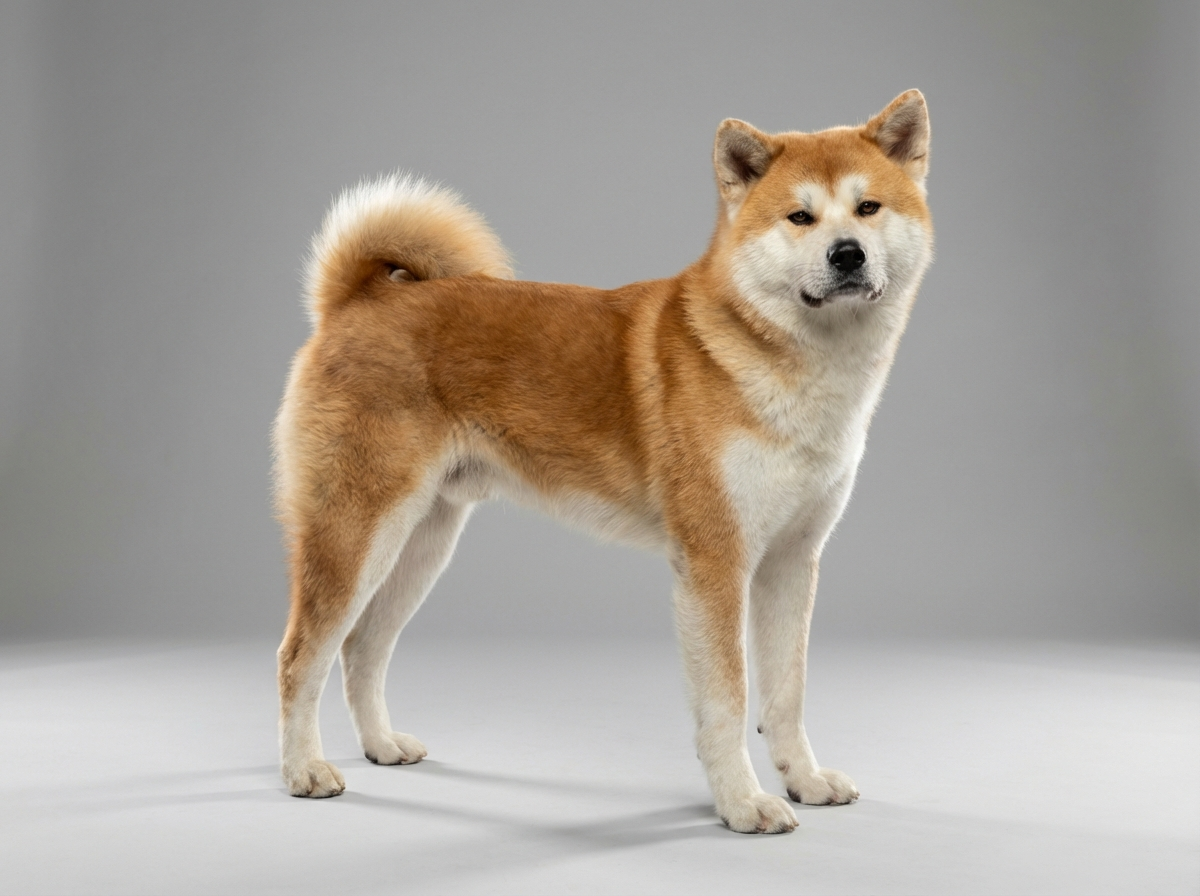
An Akita is 70 to 130 pounds, dense double coat, guardian temperament. Those things are reliable because the breed has been selected toward them for a very long time.
A Bernedoodle is a Bernese Mountain Dog crossed with a Poodle. Depending on which size of Poodle was used and which generation the puppy is, adult weight can land anywhere from 20 to 90 pounds and the coat can range from genuinely non-shedding to noticeably shedding. The ratings on this page are averages across a wide spread, and they are less predictive than the Akita's.
Where the Bernedoodle does win consistently is temperament: 5/5 with children, 5/5 with other dogs, 5/5 trainability, 4/5 for first-time owners.
Akita or Bernedoodle: Purebred Guardian or Doodle Cross? - Akita vs Bernedoodle: a breed against a cross
Frequently asked questions
Do Bernedoodles really not shed?
They shed very little — 2/5 or lower — but that is not the same as low maintenance. A non-shedding coat keeps growing and the hair that would have fallen out mats instead, so grooming rates 4/5: line-brushing several times a week plus a professional groom every six to eight weeks for the dog's life. Shedding varies by generation, and no breeder can guarantee a non-shedding puppy.
How big does a Bernedoodle get?
Anywhere from about 20 to 90 pounds, depending on which size of Poodle was used and which generation the litter is. That is the main practical drawback of a cross with no breed standard. Ask the breeder which generation the puppies are, what size of Poodle was in the pairing, and how previous litters from the same parents turned out.
Which is better with children and other dogs?
The Bernedoodle, at 5/5 on both against the Akita's 3/5 and 2/5. Both parent breeds are sociable and the cross inherits that reliably. Akita dog intolerance is a breed trait, frequently same-sex, that typically appears at social maturity around two years old rather than in puppyhood.
Which lives longer?
The Bernedoodle, typically 12 to 18 years against the Akita's 10 to 13. The range is genuinely wide because size varies so much, but the cross reliably outlives its Bernese parent, which manages only 7 to 10 years. Widening the gene pool helps; it does not eliminate inherited disease.
Which is easier to train?
The Bernedoodle at 5/5 against the Akita's 3/5, largely thanks to the Poodle side. The Akita is independent rather than slow — it understands and then decides — and it needs early positive training plus years of deliberate socialisation rather than obedience drilling.
Which costs more to keep?
They are close: $110–$240 a month for the Akita against $120–$220 for the Bernedoodle. The composition differs, though. Most of the Akita's cost is food for a large dog, while a substantial and permanent share of the Bernedoodle's is professional grooming every six to eight weeks.
What health tests should a Bernedoodle breeder have done?
The same ones a purebred breeder would: hip and elbow scores and eye certificates on both parents, since both Bernese and Poodle carry dysplasia and progressive retinal atrophy. Because no breed club oversees the cross, asking to see the paperwork matters more rather than less. Both parent breeds also carry bloat risk.
The Bernedoodle for a family dog — 5/5 with children and other dogs, 5/5 trainability, 4/5 for first-time owners, and very little shedding. Choose the Akita if you want predictable size and temperament plus guardian instinct, and prefer a coat you rake rather than one you pay to clip.
Living
Which sheds less?
The Bernedoodle by a wide margin, 2/5 against the Akita's 5/5. But grooming runs the other way, 4/5 against 3/5, because a non-shedding coat mats and needs clipping every six to eight weeks.
Costs
How much does each cost per month?
The Akita runs $110–$240 a month and the Bernedoodle $120–$220, with first-year totals of $1,700–$3,200 and $1,800–$3,200. A large share of the Bernedoodle's is the groomer.
Behavior
Which is more predictable?
The Akita, clearly. A cross with no breed standard varies widely in adult size and coat, sometimes within a single litter, so a Bernedoodle puppy is a less certain proposition than a purebred one.
Related DogBreedCompass guides
Akita breed guide – The Akita profile covers guardian temperament, coat care and the socialisation window.
Bernedoodle breed guide – The Bernedoodle profile covers generations, coat variation and grooming in more detail.
Bernedoodle vs Bernese Mountain Dog – The Bernese parent explains where the Bernedoodle's temperament and its shorter-lived side come from.
Bernedoodle vs Poodle – The Poodle is the other parent and the source of the coat and the trainability.
Bernedoodle hip dysplasia – Hip dysplasia is carried by both parent breeds and is the first paperwork to ask for.
Akita autoimmune diseases – Autoimmune disease is the Akita's most distinctive burden and the first question for a breeder.
Health information here is general and is not veterinary advice. If your dog shows pain, sudden behaviour change, or worsening symptoms, consult a licensed veterinarian.
Some links on this site are affiliate links. We may earn a commission at no extra cost to you, and we only suggest products we believe are helpful for dog owners.
We research and check what we publish, but we do not warrant that any figure, date, price, or statement is accurate, complete, or current, and we accept no liability for any loss, cost, injury, or other harm arising from the use of this site. Use it as one reference among several. You remain responsible for your own decisions and for your dog's care - confirm anything that matters with a licensed veterinarian or another qualified professional before you act on it. Full disclaimer.