Akita or American Staffordshire Terrier: The Real Differences
Quick answer
Akita vs American Staffordshire Terrier: which should I choose?
The AmStaff wins on most practical measures: three to four more years of life, far less grooming, lower cost, better with strangers and children, and workable in a flat. Choose the Akita only if you specifically want a guardian temperament and a very quiet house dog.
The AmStaff outlives the Akita by an average of three to four years, sheds at 3/5 against 5/5, costs less to keep, and rates 4/5 with strangers where the Akita rates 2/5. The Akita's case rests on being the quieter dog with the guardian temperament some owners specifically want.
This is for someone comparing two strong, capable breeds and wanting to know which is the more practical animal to live with. It covers the weight and coat gap, the substantial lifespan difference, how each behaves with visitors and other dogs, the housing question, and the specific health risks a breeder should be able to discuss.
Quick verdict
On almost every practical measure — lifespan, cost, grooming, sociability, apartment tolerance — the AmStaff wins; the Akita's argument is the guardian temperament and a quieter house.
Choose akita if...
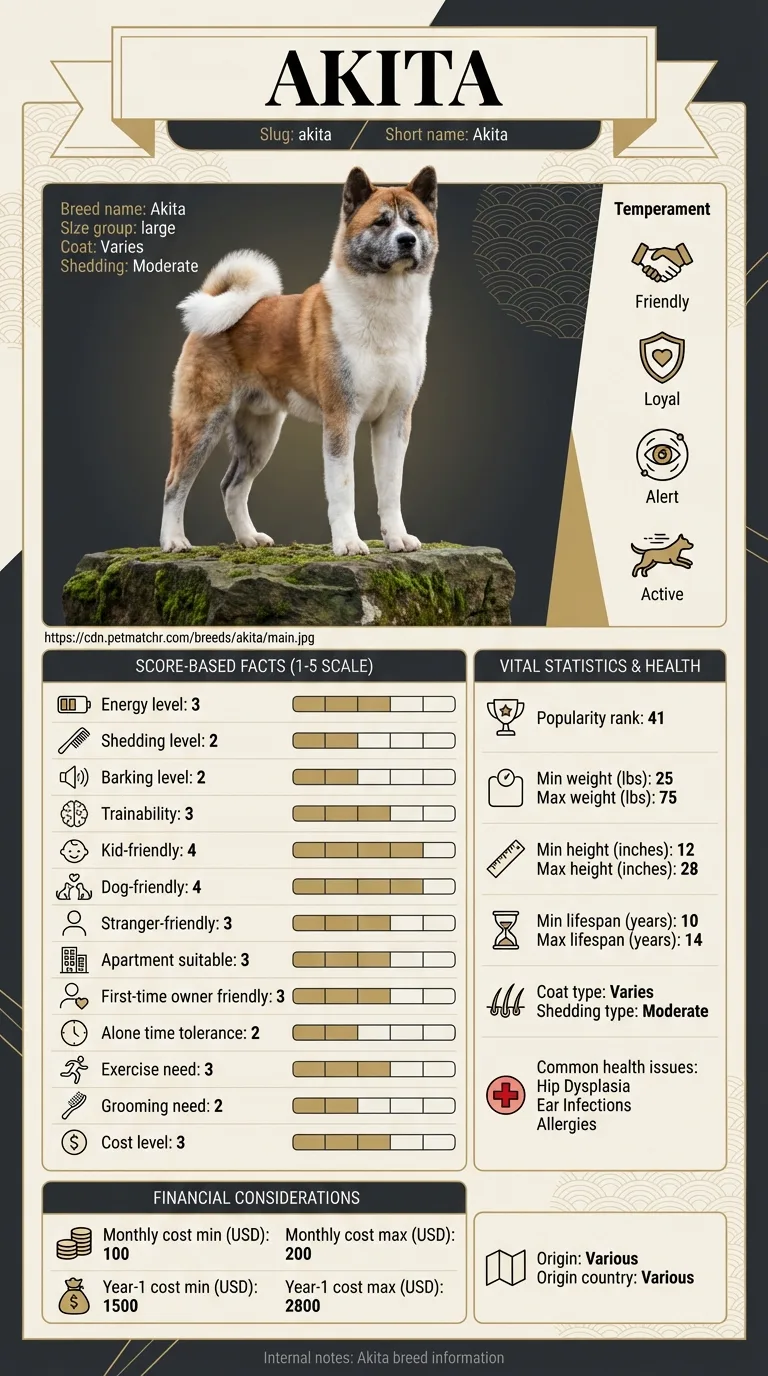
Choose the Akita if you want a guardian breed and a genuinely calm household dog: 2/5 barking, 3/5 exercise, and a dog that lies down for long stretches. You are accepting 1/5 first-time suitability, 2/5 with strangers, 2/5 with other dogs, a shorter life at 10–13 years, and a double coat that sheds at 5/5.
Choose american staffordshire terrier if...
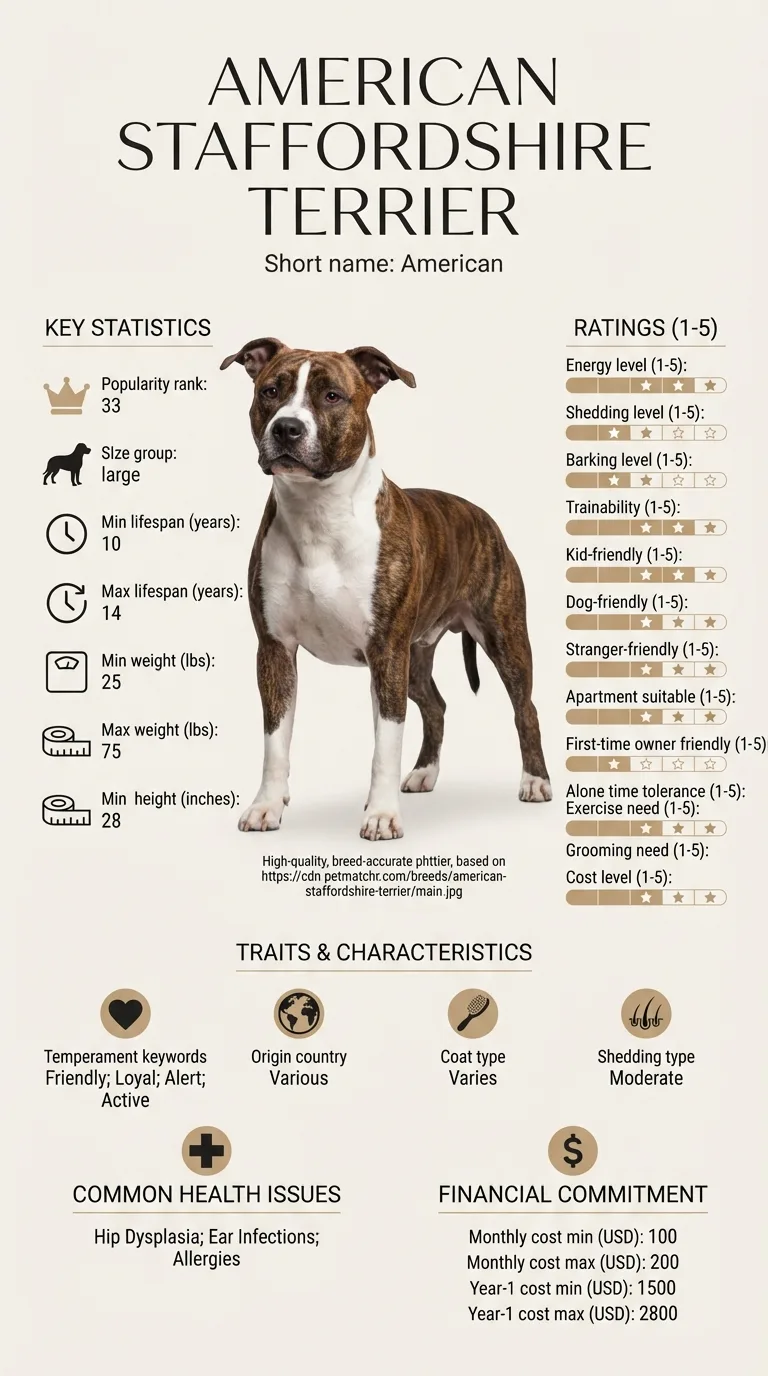
Choose the American Staffordshire Terrier for the more practical dog by a wide margin: 12–16 years of life, grooming at 1/5, $100–$200 a month, 4/5 with strangers, 4/5 with children, and 3/5 for apartments — the only one of the pair that is plausible in a smaller home. Expect an athletic dog wanting 4/5 exercise, and check your insurer, because AmStaffs appear on restricted lists.
Head-to-head comparison
Feature
akita
american staffordshire terrier
Winner
Weight
70–130 lbs
40–70 lbs
Equal
Height
24–28 in
17–19 in
Equal
Lifespan
10–13 years
12–16 years
american staffordshire terrier
Coat
Dense double coat
Short, stiff and glossy
Equal
Grooming need
Moderate (3/5)
Very low (1/5)
american staffordshire terrier
Shedding
Very high (5/5)
Moderate (3/5)
american staffordshire terrier
Energy level
Moderate (3/5)
High (4/5)
Equal
Exercise need
Moderate (3/5)
High (4/5)
akita
Trainability
Moderate (3/5)
High (4/5)
american staffordshire terrier
Barking
Low (2/5)
Low (2/5)
Equal
Good with kids
Moderate (3/5)
High (4/5)
american staffordshire terrier
Good with other dogs
Low (2/5)
Low (2/5)
Equal
Friendly to strangers
Low (2/5)
High (4/5)
american staffordshire terrier
Apartment suitability
Low (2/5)
Moderate (3/5)
american staffordshire terrier
Good for first-time owners
Very low (1/5)
Moderate (3/5)
american staffordshire terrier
Tolerates being alone
Moderate (3/5)
Moderate (3/5)
Equal
Typical monthly cost
$110–$240
$100–$200
american staffordshire terrier
Typical first-year cost
$1,700–$3,200
$1,400–$2,900
american staffordshire terrier
Deep dive
Three to four years is a large difference
The AmStaff typically lives 12 to 16 years. The Akita lives 10 to 13. At the extremes that is a six-year gap, and even at the midpoints it is three to four.
Some of it is simply size — a 40 to 70 pound dog ages more slowly than one that can reach 130 — and some of it is disease burden. The Akita carries a heavy load of autoimmune conditions and thyroid disease alongside the joint problems both breeds share.
It is worth thinking about what that means concretely rather than as a statistic. A dog acquired when a child is six is a dog that either sees them to sixteen or to twenty-two. For a lot of households that is the row that matters most, and it is the one people skip because it feels morbid at the point of buying a puppy.
Visitors: 4/5 against 2/5
The AmStaff rates 4/5 with strangers and 4/5 with children. Generations of selection for a dog that could be handled safely by anyone produced an animal that is, in most lines, indiscriminately pleased to see people. Its enthusiasm is usually the management problem rather than its reserve.
The Akita rates 2/5 with strangers and 3/5 with children. It is aloof rather than hostile: it assesses a visitor, decides, and settles. This is the guardian temperament doing exactly what it was bred to do, and for some owners it is the whole point of the breed. It also means the socialisation burden is much heavier, because guardian instinct sharpens at social maturity rather than fading, and an under-socialised Akita becomes a serious problem at eighteen months.
Both rate 2/5 for barking, so neither is noisy about any of it.
The row where they are equal, and it is the hard one
Both rate 2/5 with other dogs, and for both it is a breed trait rather than a training failure.
The AmStaff descends from stock bred for gameness, and while human-directed aggression was selected against hard, dog-directed reserve was not. It often shows as a dog that is fine with its own household companions and unreliable with unfamiliar dogs, particularly same-sex.
The Akita's version is territorial and also frequently same-sex, and it arrives late. A great many Akita owners describe a dog that was fine with everything until it was about two.
For either, the working assumptions are the same: no dog parks, careful managed introductions, and never leaving unfamiliar dogs together unsupervised. If you already own a dog of the same sex, this row should carry real weight for both breeds.
The coat and the hundred-pound question
The AmStaff's short, stiff, glossy coat rates 1/5 for grooming — the lowest on the scale — and 3/5 for shedding. Hair happens, but no brushing routine is required and the dog dries in minutes.
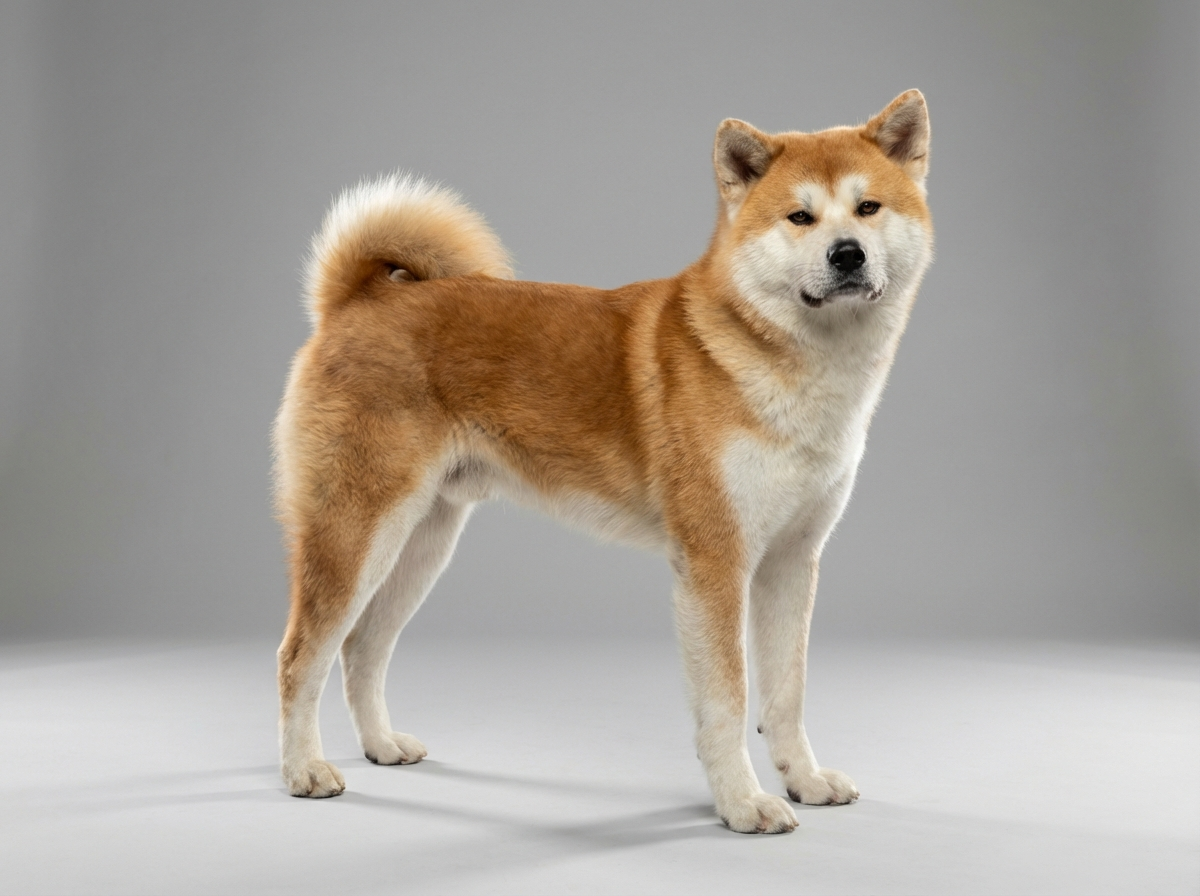
The Akita's dense double coat rates 5/5 for shedding, blows out twice a year in clumps, and needs an undercoat rake through the moult. Grooming rates 3/5, which is fair rather than generous. It must never be shaved: the coat insulates against heat as well as cold.
Size compounds it. The Akita runs to 130 pounds against the AmStaff's 70. Everything priced or measured by dog — boarding, medication, crates, car space, and whether one person can hold the lead — scales accordingly. The AmStaff's 3/5 apartment rating against the Akita's 2/5 follows directly from that.
Both may raise questions with an insurer; one raises more
American Staffordshire Terriers are frequently grouped with pit-bull-type dogs under breed-specific legislation and on insurance and rental restricted lists. Akitas also appear on some insurer lists, though less consistently.
The position varies enormously by jurisdiction and by company, so this is a phone call rather than an assumption. If you rent, get the landlord's position in writing before committing. It is a small piece of admin that occasionally turns out to be the entire decision.
Joints in common, very different systemic risks
Both carry hip dysplasia and both should come from hip-scored parents.
The AmStaff's distinctive risks are cerebellar ataxia — a late-onset inherited neurological condition for which a DNA test exists and which any responsible breeder will have used — plus skin allergies, heart disease and cruciate ligament tears in an athletic, muscular dog. Ask for the ataxia test result specifically; it is the single most useful question you can put to an AmStaff breeder.
The Akita's burden is autoimmune and endocrine: immune-mediated conditions affecting skin, eyes and blood, hypothyroidism, progressive retinal atrophy, and bloat. The breed is also known for anaesthesia sensitivity, which is worth mentioning to any vet unfamiliar with it before a procedure.
Bloat applies to the Akita in particular as a deep-chested breed. Unproductive retching with a tight, swollen abdomen is an emergency measured in hours.
Akita vs American Staffordshire Terrier: a one-sided table
Most comparisons on this site come down to trade-offs. This one mostly does not. The AmStaff takes lifespan by three to four years, grooming by two points, shedding by two, trainability by one, strangers by two, first-time suitability by two, apartments by one, and cost on both measures.
The Akita takes exercise — 3/5 against 4/5, meaning it asks less of your week — and it is the quieter, more self-contained animal in the house.
That is the real decision. If you want a guardian dog and a calm home and you can handle the coat and the socialisation work, the Akita has a genuine case. If you are choosing on practicality, the table is not close.
Akita or American Staffordshire Terrier: The Real Differences - Akita vs American Staffordshire Terrier: a one-sided table
Frequently asked questions
Which lives longer, an Akita or an American Staffordshire Terrier?
The AmStaff, and by a wide margin — 12 to 16 years against the Akita's 10 to 13. At the extremes that is a six-year difference. Size explains part of it, and the Akita's heavier burden of autoimmune and thyroid disease explains the rest.
Which is friendlier with visitors?
The AmStaff, at 4/5 against the Akita's 2/5. Generations of selection for a dog that could be safely handled by anyone produced a breed that is typically delighted to meet people. The Akita is a guardian breed and assesses visitors rather than greeting them, which is deliberate and is what some owners specifically want.
Are both breeds difficult with other dogs?
Yes, both rate 2/5. The AmStaff's dog-directed reserve is a legacy of its history and often shows as reliability at home and unreliability with strange dogs. The Akita's is territorial, frequently same-sex, and typically appears at social maturity around two years old. Neither is a dog-park breed.
Which needs less grooming?
The AmStaff, decisively — 1/5 against the Akita's 3/5, with shedding at 3/5 against 5/5. The AmStaff's short coat needs essentially no routine. The Akita's double coat blows out twice a year, needs an undercoat rake, and should never be shaved because it insulates against heat as well as cold.
Can either live in an apartment?
The AmStaff is the more plausible at 3/5 against the Akita's 2/5, helped by its smaller size and short coat. Both rate 2/5 for barking, so noise is not the obstacle for either. The AmStaff's higher exercise requirement of 4/5 means a flat works only if the daily walking actually happens.
Which is better for a first-time owner?
The AmStaff at 3/5 against the Akita's 1/5. The Akita is a guardian breed whose protectiveness sharpens with maturity and which requires years of deliberate socialisation, and it is one of the least beginner-suited breeds on this site. The AmStaff is more trainable at 4/5 and more forgiving, though the legal and insurance position needs checking.
What should I ask a breeder about health?
For the AmStaff, ask for the cerebellar ataxia DNA test result — it is the single most useful question for the breed — plus hip scores and any cardiac screening. For the Akita, ask about autoimmune disease history in the line, thyroid testing, eye certificates and hip scores, and tell your vet about the breed's anaesthesia sensitivity before any procedure.
Akita vs American Staffordshire Terrier: which should I choose?
The AmStaff wins on most practical measures: three to four more years of life, far less grooming, lower cost, better with strangers and children, and workable in a flat. Choose the Akita only if you specifically want a guardian temperament and a very quiet house dog.
Costs
How much does each cost per month?
The Akita runs $110–$240 a month and the American Staffordshire Terrier $100–$200, with first-year totals of $1,700–$3,200 and $1,400–$2,900.
Living
Which needs more exercise?
The AmStaff at 4/5 against the Akita's 3/5. The Akita is the more sedentary of the two indoors and is content with a decent daily walk.
Training
Which is easier to train?
The AmStaff at 4/5 against the Akita's 3/5. The Akita is strong-willed and independent and weighs whether it agrees with you; the AmStaff is more biddable and more food-motivated.
Related DogBreedCompass guides
Akita breed guide – The Akita profile covers the guardian temperament and the sustained socialisation the breed needs.
Akita vs Alaskan Malamute – The Malamute is the other large northern dog people compare the Akita against, and it is far more sociable.
Akita autoimmune diseases – Autoimmune disease is the Akita's most distinctive health burden and the first thing to raise with a breeder.
American Staffordshire Terrier skin allergies – Skin allergies are the most common ongoing complaint in the AmStaff and the usual reason for repeat visits.
Health information here is general and is not veterinary advice. If your dog shows pain, sudden behaviour change, or worsening symptoms, consult a licensed veterinarian.
Some links on this site are affiliate links. We may earn a commission at no extra cost to you, and we only suggest products we believe are helpful for dog owners.
We research and check what we publish, but we do not warrant that any figure, date, price, or statement is accurate, complete, or current, and we accept no liability for any loss, cost, injury, or other harm arising from the use of this site. Use it as one reference among several. You remain responsible for your own decisions and for your dog's care - confirm anything that matters with a licensed veterinarian or another qualified professional before you act on it. Full disclaimer.