Living
Which fits an apartment lifestyle better?
The Dachshund wins on space at 5 out of 5, but its 1-out-of-5 alone-tolerance score means the two numbers should be read together.

Quick answer
Which fits an apartment lifestyle better?
The Dachshund wins on space at 5 out of 5, but its 1-out-of-5 alone-tolerance score means the two numbers should be read together.
American Staffordshire Terrier or Dachshund? On paper they differ most on apartment suitability, and on the scales American Staffordshire Terrier is the heavier at 40–70 lbs. Here is how the two compare on everything that shapes an ordinary week.
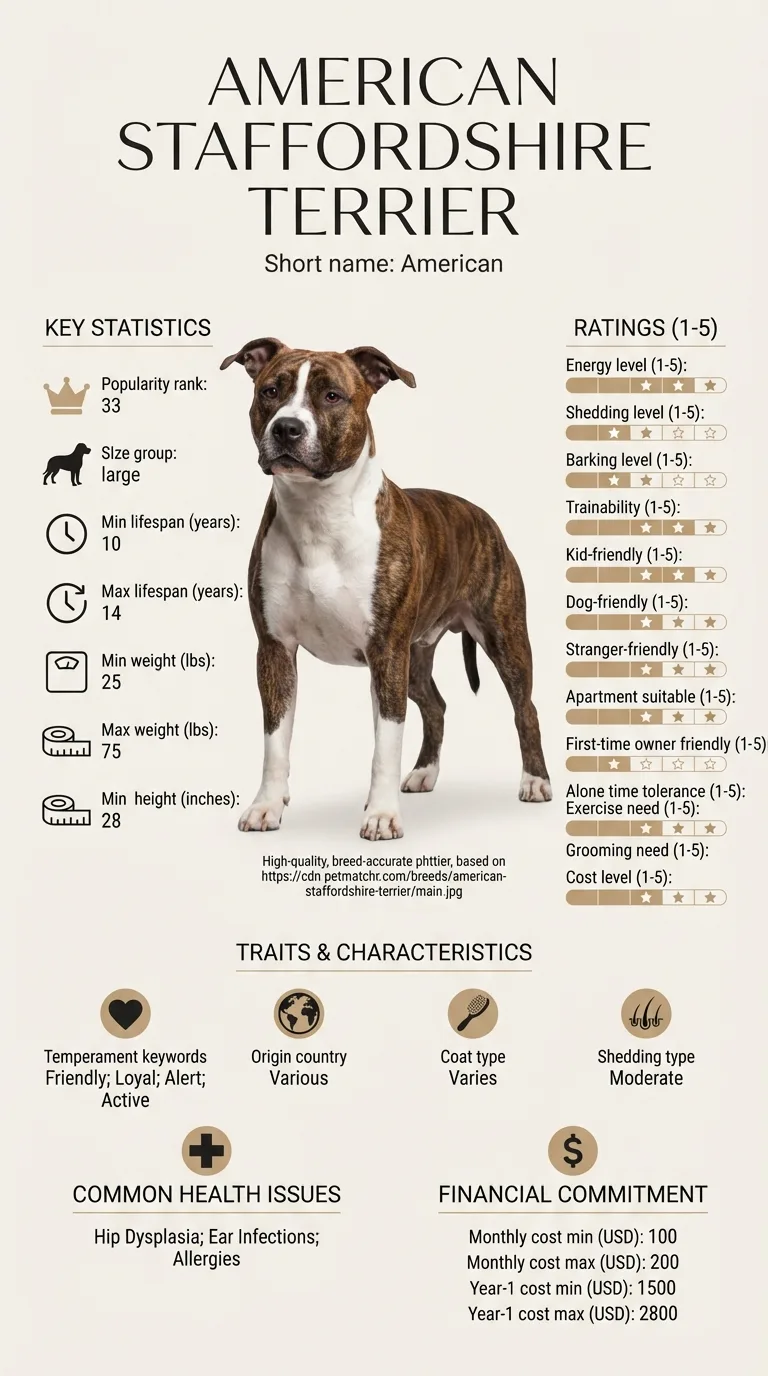
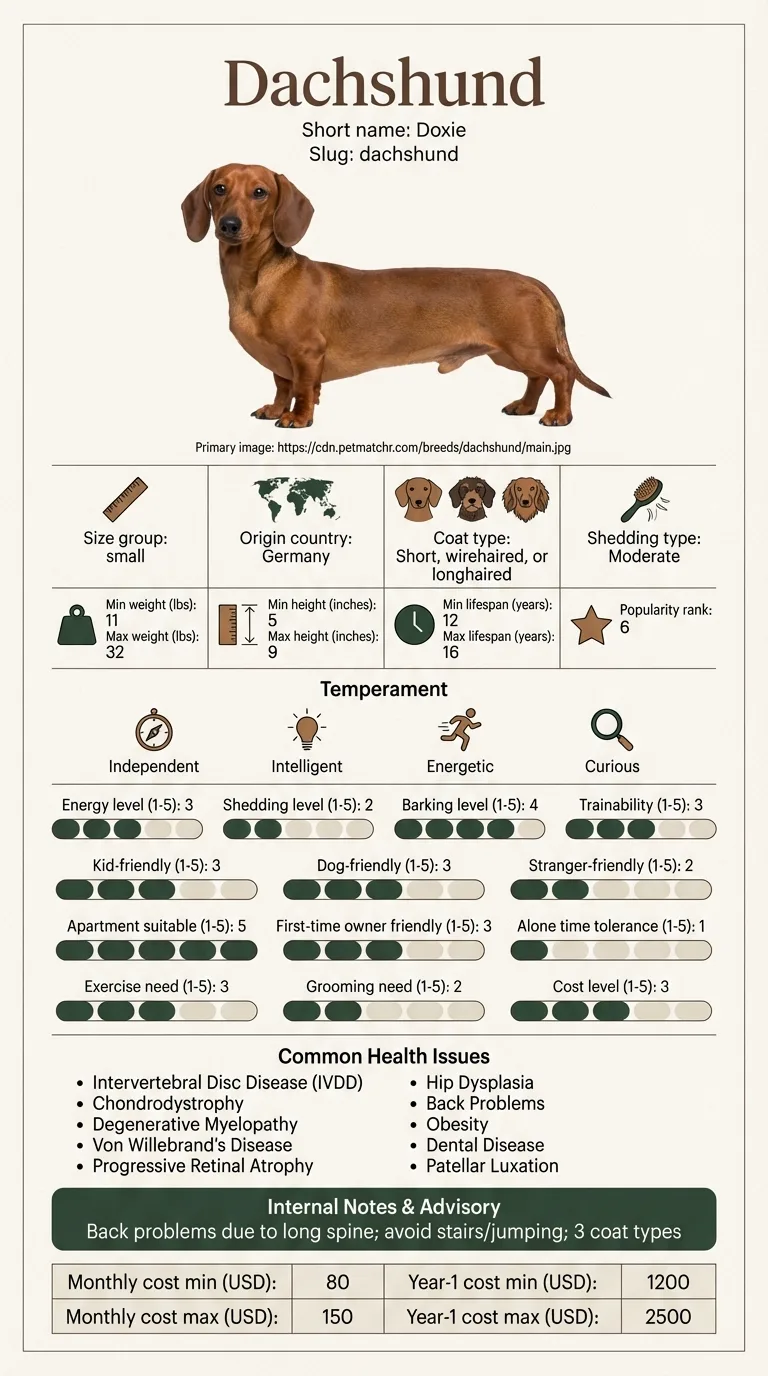
This is for someone already down to American Staffordshire Terrier and Dachshund and deciding between them. For this pair the decision usually turns on apartment suitability and tolerates being alone, so those are covered first and in most detail. Anyone choosing from a flat has a clear answer here: Dachshund rates 5/5 against 3/5. It is written for the decision rather than the breed history.
Between American Staffordshire Terrier and Dachshund, apartment suitability is what separates them; neither is the lower-effort dog overall.
Choose American Staffordshire Terrier if you do not want a standing grooming appointment, the dog will be alone during the working day and there are young children at home.
Choose Dachshund if you are in a flat or a smaller home, shedding is a problem in your house and your walking routine is modest.
| Feature | american staffordshire terrier | dachshund | Winner |
|---|---|---|---|
| Size class | medium | small | Equal |
| Weight | 40–70 lbs | 11–32 lbs | Equal |
| Height | 17–19 in | 5–9 in | Equal |
| Lifespan | 12–16 years | 12–16 years | Equal |
| Exercise need | High (4/5) | Moderate (3/5) | dachshund |
| Grooming need | Very low (1/5) | Low (2/5) | american staffordshire terrier |
| Shedding | Moderate (3/5) | Low (2/5) | dachshund |
| Energy level | High (4/5) | Moderate (3/5) | Equal |
| Barking | Low (2/5) | High (4/5) | american staffordshire terrier |
| Apartment suitability | Moderate (3/5) | Very high (5/5) | dachshund |
| Good for first-time owners | Moderate (3/5) | Moderate (3/5) | Equal |
| Tolerates being alone | Moderate (3/5) | Very low (1/5) | american staffordshire terrier |
| Trainability | High (4/5) | Moderate (3/5) | american staffordshire terrier |
| Good with kids | High (4/5) | Moderate (3/5) | american staffordshire terrier |
| Good with other dogs | Low (2/5) | Moderate (3/5) | dachshund |
| Friendly to strangers | High (4/5) | Low (2/5) | american staffordshire terrier |
| Cost level | Moderate (3/5) | Moderate (3/5) | Equal |
| Coat | Short, stiff and glossy | Short, wirehaired, or longhaired | Equal |
| Origin | Various | Germany | Equal |
| Typical monthly cost | $100–$200 | $80–$150 | Equal |
| Typical first-year cost | $1,400–$2,900 | $1,200–$2,500 | Equal |
Put these two side by side and the size gap borders on absurd: an American Staffordshire Terrier can weigh six times what a Dachshund does, 40 to 70 pounds against 11 to 32, and stands 17 to 19 inches tall to the Dachshund's 5 to 9. Lifespan is the one place they match exactly, both rated 12 to 16 years, a long-lived small dog next to a long-lived medium one.
Exercise need favors more activity from the AmStaff, a 4 out of 5 against the Dachshund's 3, and energy level follows the same split. Don't mistake the Dachshund's lower number for laziness, though, these are dogs bred to dig and chase, just in shorter bursts than the AmStaff's sustained drive. A short walk plus some sniffing time in the yard tends to satisfy a Dachshund; the AmStaff wants a longer outing or real off-leash running to burn down that extra energy.
Grooming stays low-effort for both: a 1 out of 5 for the AmStaff, a 2 for the Dachshund, whose coat can be short, wirehaired, or longhaired depending on the individual dog. Shedding is a shade lower for the Dachshund too, 2 versus the AmStaff's 3, neither breed will bury your floors in fur. Whichever Dachshund coat type you land on, an occasional brush and nail trim covers most of the routine, well short of anything resembling a grooming schedule.
The Dachshund posts the best apartment-suitability score of the two, a 5 out of 5 against the AmStaff's 3, and small size backs that up. But look at the alone-tolerance numbers before committing to a Dachshund for a full-time-work household: it rates a 1, the lowest score on this page, against a moderate 3 for the AmStaff. Barking runs the other way too, high for the Dachshund at 4, low for the AmStaff at 2.
Trainability favors the AmStaff, 4 out of 5 against the Dachshund's 3, Dachshunds are smart but famously independent-minded, which shows up as stubbornness during basic obedience work. Both land at a 3 for first-time-owner suitability, so neither is the easiest option on the site, just difficult in different ways: strength management for one, willfulness for the other. A firm, consistent hand helps with either breed, though the Dachshund's stubborn streak tends to show up earlier in a training session than the AmStaff's does.
The AmStaff comes out ahead with kids, 4 versus 3, and with strangers by a wider margin, 4 versus a low 2 for the Dachshund, which tends toward wariness of unfamiliar people. Other dogs is the one category where the Dachshund noses ahead, 3 to 2, though neither breed scores especially high there. Early, deliberate socialization matters for both dogs given those numbers, particularly around new people for the Dachshund and other dogs for the AmStaff.
Both breeds are rated for 12 to 16 years, and hip dysplasia shows up on both health lists. Past that, the Dachshund's long back and short legs bring a distinct set of risks, intervertebral disc disease, chondrodystrophy, and general back problems chief among them, that the AmStaff simply doesn't share. The AmStaff's list runs shorter and leans toward skin allergies, heart disease and cruciate ligament tears instead.
Cost level rates moderate for both, but the Dachshund runs cheaper in the actual dollar ranges, $80 to $150 a month against $100 to $200, and $1,200 to $2,500 in year one versus $1,400 to $2,900. Smaller dogs generally cost less to feed and medicate, and that shows up here. Neither range accounts for a back-related vet bill, though, and the Dachshund's spinal risk means that's a cost worth budgeting for even if it never materializes.
American Staffordshire Terrier weighs 40–70 lbs and lives 12–16 years; Dachshund weighs 11–32 lbs and lives 12–16 years. The two diverge most on apartment suitability, tolerates being alone and barking and 1 other rated axes. They are level on cost level and good for first-time owners, so those cannot decide it. In the table, a "winner" means easier for an ordinary household — not better. Size, coat and origin are recorded without a verdict. Because both breeds are scored the same way, the gaps are reliable even where the absolute numbers are rough.

Considerably, up to six times the weight at the top of each range, 70 pounds versus 32, and more than double the height.
No, shedding is low for the Dachshund at 2 out of 5 and moderate for the AmStaff at 3, easier categories for both than grooming-heavy breeds.
Not really by these numbers, it rates a 1 out of 5 for tolerating time alone, the lowest score in this comparison. The AmStaff's moderate 3 handles solo time better.
The Dachshund, 5 out of 5 versus 3, mostly on size alone. Its barking score of 4 out of 5 is something to weigh against noise-sensitive neighbors, though.
The Dachshund runs cheaper, $80 to $150 a month and $1,200 to $2,500 in year one, against $100 to $200 and $1,400 to $2,900 for the AmStaff.
Hip dysplasia is shared. The Dachshund's back-related risks, including IVDD, are unique to its build and not on the AmStaff's list.
The AmStaff, 4 out of 5 against the Dachshund's 2, a notably wary breed with unfamiliar people.
The Dachshund wins on space at 5 out of 5, but its 1-out-of-5 alone-tolerance score means the two numbers should be read together.
The Dachshund, $80 to $150 versus $100 to $200 for the AmStaff.
The AmStaff, 4 out of 5 against the Dachshund's 3.
They tie, both rated 12 to 16 years, though the Dachshund carries added back-related health risk.
Secure checkout on Stripe. We never see your card.
7-day money-back guarantee. Instant access.
Health information here is general and is not veterinary advice. If your dog shows pain, sudden behaviour change, or worsening symptoms, consult a licensed veterinarian.
Some links on this site are affiliate links. We may earn a commission at no extra cost to you, and we only suggest products we believe are helpful for dog owners.
We research and check what we publish, but we do not warrant that any figure, date, price, or statement is accurate, complete, or current, and we accept no liability for any loss, cost, injury, or other harm arising from the use of this site. Use it as one reference among several. You remain responsible for your own decisions and for your dog's care - confirm anything that matters with a licensed veterinarian or another qualified professional before you act on it. Full disclaimer.
Match your lifestyle to the right dog.
Take quizNot sure which breed is right for you? Take our 2-minute quiz to find out.
Take the quiz