Living
Which is the better overall pick?
The Cocker fits small spaces and multi-dog homes better; the AmStaff handles solo time slightly better, match the choice to which gap matters more to you.

Quick answer
Which is the better overall pick?
The Cocker fits small spaces and multi-dog homes better; the AmStaff handles solo time slightly better, match the choice to which gap matters more to you.
American Staffordshire Terrier or English Cocker Spaniel? On paper they differ most on grooming need, and on the scales American Staffordshire Terrier is the heavier at 40–70 lbs. Here is how the two compare on everything that shapes an ordinary week.
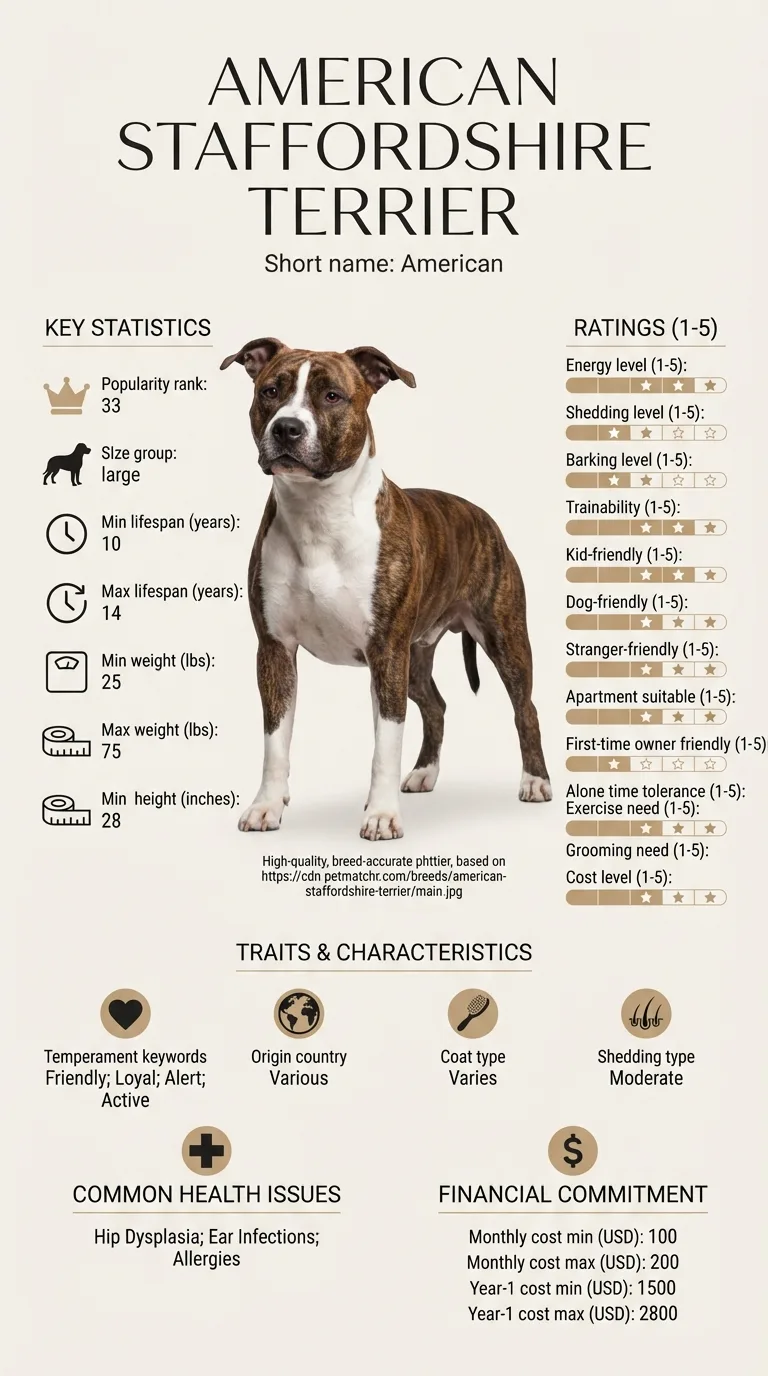
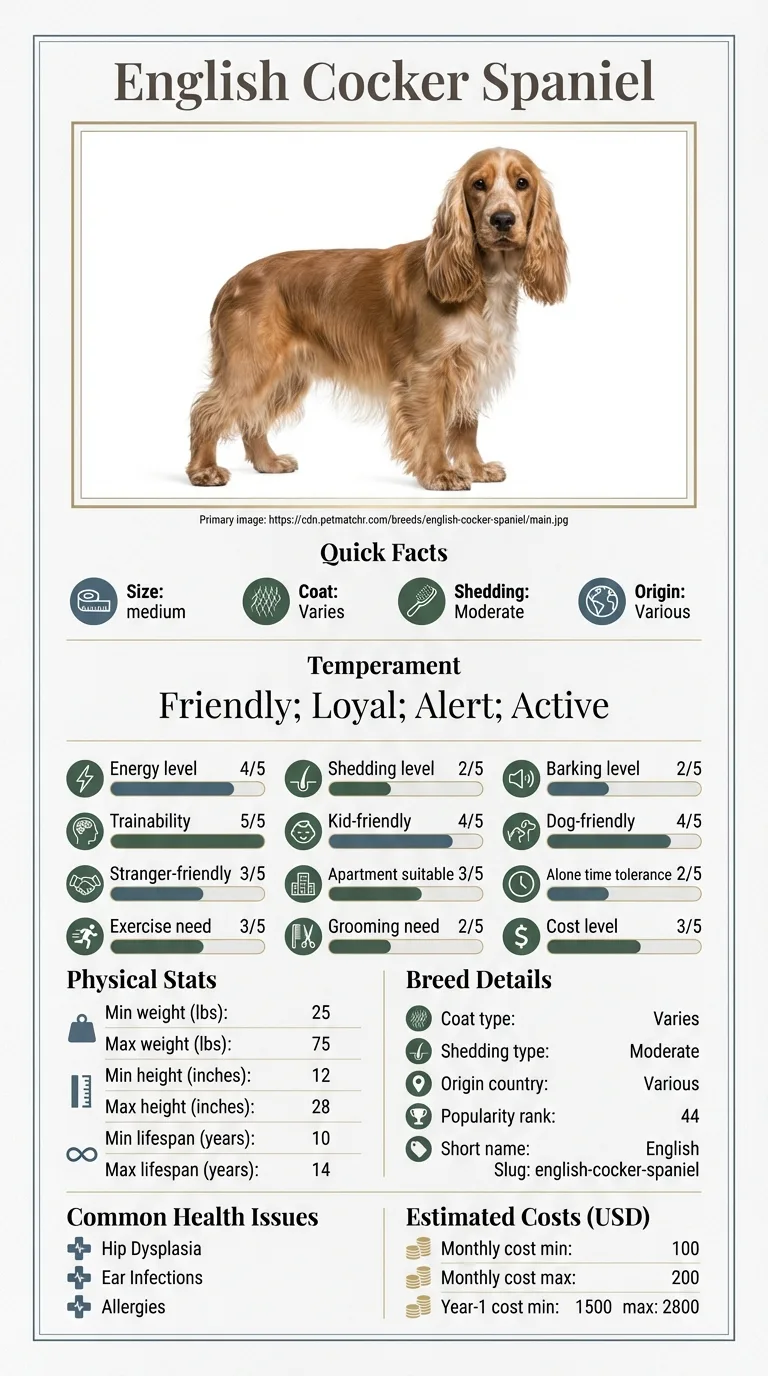
This is for someone already down to American Staffordshire Terrier and English Cocker Spaniel and deciding between them. For this pair the decision usually turns on grooming need and good with other dogs, so those are covered first and in most detail. Anyone choosing from a flat has a clear answer here: English Cocker Spaniel rates 4/5 against 3/5. The focus throughout is on daily consequences rather than breed background.
Between American Staffordshire Terrier and English Cocker Spaniel, grooming need is what separates them, and American Staffordshire Terrier is the lower-effort dog of the two to keep.
Choose American Staffordshire Terrier if you do not want a standing grooming appointment and the dog will be alone during the working day.
Choose English Cocker Spaniel if you are in a flat or a smaller home, this is your first dog and there are young children at home.
| Feature | american staffordshire terrier | english cocker spaniel | Winner |
|---|---|---|---|
| Size class | medium | medium | Equal |
| Weight | 40–70 lbs | 26–34 lbs | Equal |
| Height | 17–19 in | 15–17 in | Equal |
| Lifespan | 12–16 years | 12–14 years | american staffordshire terrier |
| Exercise need | High (4/5) | High (4/5) | Equal |
| Grooming need | Very low (1/5) | High (4/5) | american staffordshire terrier |
| Shedding | Moderate (3/5) | Moderate (3/5) | Equal |
| Energy level | High (4/5) | High (4/5) | Equal |
| Barking | Low (2/5) | Moderate (3/5) | american staffordshire terrier |
| Apartment suitability | Moderate (3/5) | High (4/5) | english cocker spaniel |
| Good for first-time owners | Moderate (3/5) | High (4/5) | english cocker spaniel |
| Tolerates being alone | Moderate (3/5) | Low (2/5) | american staffordshire terrier |
| Trainability | High (4/5) | High (4/5) | Equal |
| Good with kids | High (4/5) | Very high (5/5) | english cocker spaniel |
| Good with other dogs | Low (2/5) | High (4/5) | english cocker spaniel |
| Friendly to strangers | High (4/5) | High (4/5) | Equal |
| Cost level | Moderate (3/5) | Moderate (3/5) | Equal |
| Coat | Short, stiff and glossy | Medium, silky and feathered | Equal |
| Origin | Various | Various | Equal |
| Typical monthly cost | $100–$200 | $100–$200 | Equal |
| Typical first-year cost | $1,400–$2,900 | $1,400–$2,900 | Equal |
Unlike some of the size mismatches you'll find elsewhere on this site, the American Staffordshire Terrier and English Cocker Spaniel aren't wildly apart, 40 to 70 pounds and 17 to 19 inches for the AmStaff against 26 to 34 pounds and 15 to 17 inches for the Cocker. Call it medium versus medium-small rather than a genuine size mismatch. Either dog fits comfortably in a standard crate or the back seat of most cars without the space planning a larger breed would require.
Exercise need matches exactly here, a 4 out of 5 for both breeds, and energy level does too. That's unusual for this site, most AmStaff comparisons show a gap. If activity level was going to be your deciding factor, you'll need to look elsewhere in the numbers. Both dogs do best with a real daily walk plus some structured play, not just a few minutes in the backyard.
Grooming is where these two actually separate. The AmStaff's short coat rates a 1 out of 5; the English Cocker's medium, silky, feathered coat rates a 4, calling for regular brushing to prevent mats around the ears and legs. Shedding itself ties at moderate for both, so the difference is entirely about upkeep, not hair volume. Plan on brushing an English Cocker two or three times a week at minimum to keep that feathering from matting around the ears and legs.
The Cocker scores better for apartment living, 4 against the AmStaff's 3, but tolerates being alone worse, a 2 versus a 3. Barking runs slightly higher for the Cocker too, moderate at 3 against the AmStaff's low 2. Read those three numbers together rather than any one alone if you're weighing a small space with long work hours. Neither dog's bark score is high enough to worry a typical landlord, but the Cocker's lower alone-tolerance is the number that matters most for an empty-apartment schedule.
Trainability ties at 4 out of 5 for both breeds. The first-time-owner score is where the Cocker pulls ahead, 4 versus 3, likely reflecting its more forgiving, biddable temperament compared to the strength and drive an AmStaff brings to the table. Both breeds respond well to positive-reinforcement methods, food-motivated training in particular tends to work fast with either dog once you find the right routine.
The Cocker rates higher with kids, 5 versus 4, and considerably higher with other dogs, 4 versus a low 2 for the AmStaff. Both breeds are equally friendly with strangers at 4 out of 5, so that category won't help you decide. If you're choosing based on a busy household with kids running in and out and other pets underfoot, the Cocker's numbers make that scenario noticeably easier.
Lifespan ranges overlap almost entirely, 12 to 16 years for the AmStaff against 12 to 14 for the Cocker. Hip dysplasia appears on both health lists. Past that they diverge: the Cocker's remaining risks lean toward ears and eyes, ear infections and progressive retinal atrophy, plus two more specific conditions, familial nephropathy and adult-onset neuropathy, while the AmStaff's list covers skin, heart and joint issues instead.
Cost is essentially identical on paper, the same $100 to $200 monthly range, the same $1,400 to $2,900 first year, the same moderate cost rating. The Cocker's grooming needs are the one place actual spend could tilt higher if you're paying a groomer rather than doing it yourself. Budget an extra $30 to $60 a month for professional grooming if you'd rather not handle the Cocker's coat maintenance on your own.
American Staffordshire Terrier weighs 40–70 lbs and lives 12–16 years; English Cocker Spaniel weighs 26–34 lbs and lives 12–14 years. The two diverge most on grooming need and good with other dogs. They are level on cost level, energy level and exercise need, so those cannot decide it. The table below marks a winner only where one breed is genuinely easier for a typical owner; size and origin are facts rather than merits and stay level. Ratings come from one source applied to both breeds, so they are meaningful against each other rather than as absolute scores.

Fairly close, 40 to 70 pounds and 17 to 19 inches for the AmStaff versus 26 to 34 pounds and 15 to 17 inches for the Cocker, not the dramatic gap you see in some comparisons.
The English Cocker Spaniel by a wide margin, 4 out of 5 versus the AmStaff's 1, due to its silky feathered coat.
The Cocker scores higher, 4 out of 5 versus the AmStaff's 3.
The Cocker, 4 out of 5 versus 3, though it tolerates being alone less well, 2 versus 3.
No, identical ranges, $100 to $200 a month and $1,400 to $2,900 in the first year for both.
Both risk hip dysplasia; otherwise their lists don't overlap.
The Cocker, clearly, 4 out of 5 versus 2 for the AmStaff.
The Cocker fits small spaces and multi-dog homes better; the AmStaff handles solo time slightly better, match the choice to which gap matters more to you.
None, identical on paper, $100 to $200 a month and $1,400 to $2,900 in year one for either breed.
Neither, exercise need ties at 4 out of 5 for both, an unusually even match on this site.
Lifespans overlap closely, 12 to 16 years for the AmStaff and 12 to 14 for the Cocker.
Secure checkout on Stripe. We never see your card.
7-day money-back guarantee. Instant access.
Health information here is general and is not veterinary advice. If your dog shows pain, sudden behaviour change, or worsening symptoms, consult a licensed veterinarian.
Some links on this site are affiliate links. We may earn a commission at no extra cost to you, and we only suggest products we believe are helpful for dog owners.
We research and check what we publish, but we do not warrant that any figure, date, price, or statement is accurate, complete, or current, and we accept no liability for any loss, cost, injury, or other harm arising from the use of this site. Use it as one reference among several. You remain responsible for your own decisions and for your dog's care - confirm anything that matters with a licensed veterinarian or another qualified professional before you act on it. Full disclaimer.
Match your lifestyle to the right dog.
Take quizNot sure which breed is right for you? Take our 2-minute quiz to find out.
Take the quiz