Living
More reserved with strangers?
The Welsh Springer Spaniel, rated Moderate (3/5) versus the Pug's Very high (5/5).

Quick answer
More reserved with strangers?
The Welsh Springer Spaniel, rated Moderate (3/5) versus the Pug's Very high (5/5).
Pug or Welsh Springer Spaniel? On paper they differ most on apartment suitability, and on the scales Welsh Springer Spaniel is the heavier at 35–55 lbs. Here is how the two compare on everything that shapes an ordinary week.
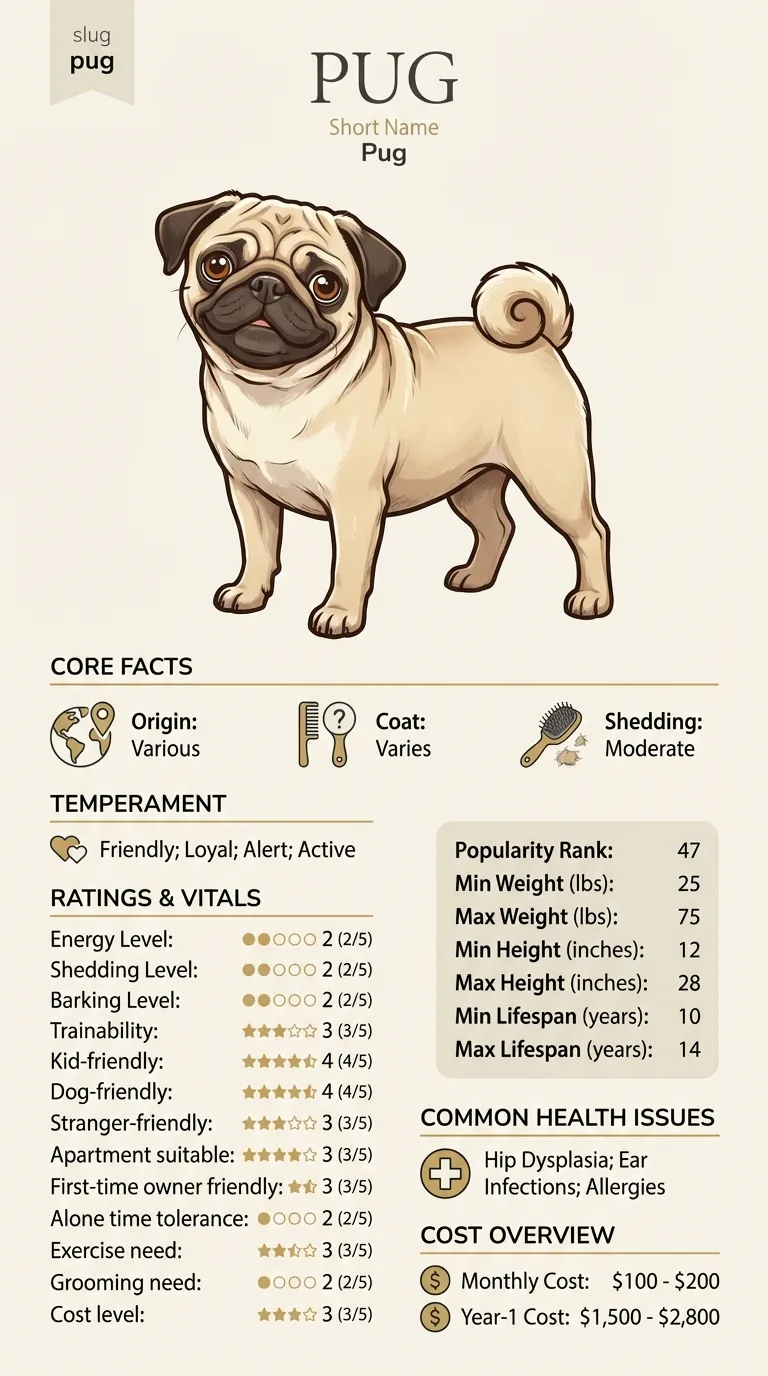
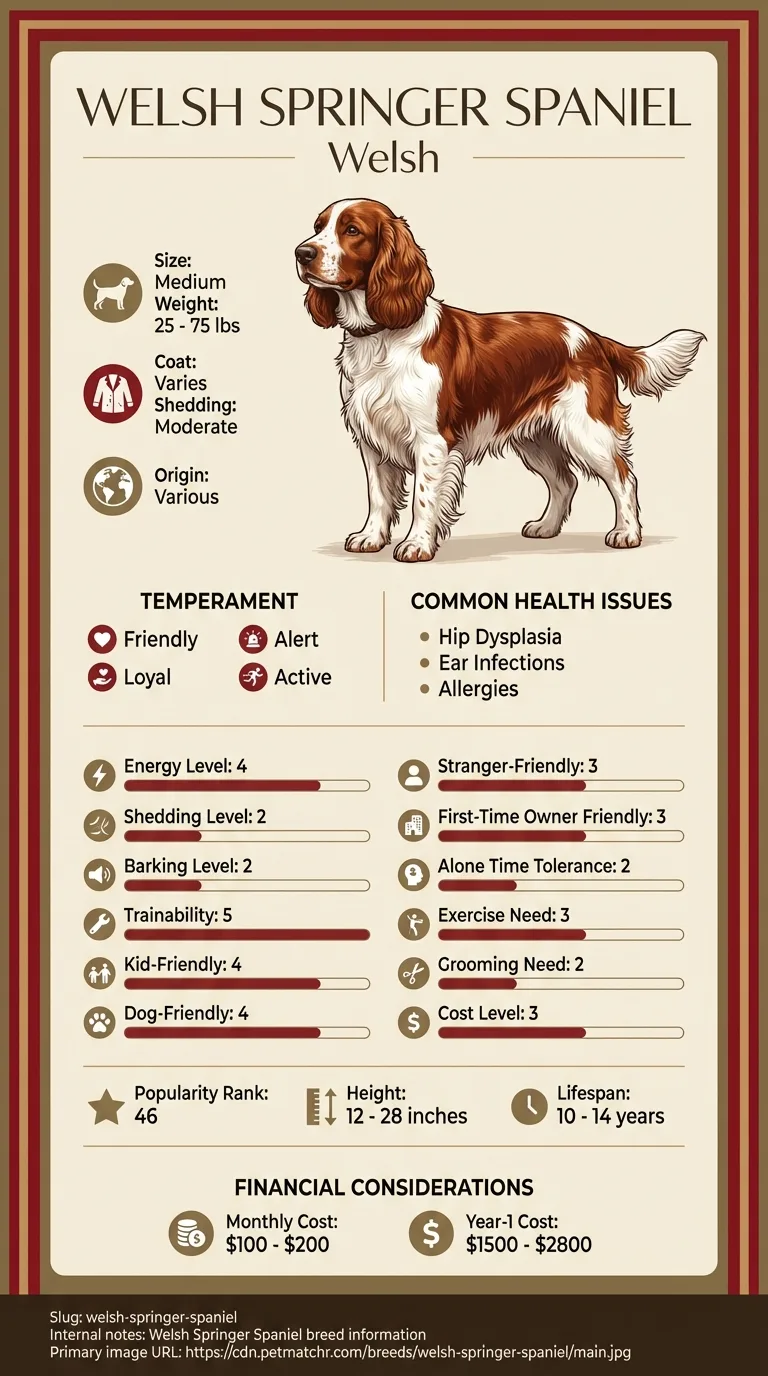
This is for someone already down to Pug and Welsh Springer Spaniel and deciding between them. For this pair the decision usually turns on apartment suitability and exercise need, so those are covered first and in most detail. Anyone choosing from a flat has a clear answer here: Pug rates 5/5 against 2/5. It is written for the decision rather than the breed history.
Between Pug and Welsh Springer Spaniel, apartment suitability is what separates them, and Pug is the lower-effort dog of the two to keep.
Choose Pug if you are in a flat or a smaller home, this is your first dog and you do not want a standing grooming appointment.
Choose Welsh Springer Spaniel if shedding is a problem in your house, you want a dog that picks up training quickly and you want a dog that can keep up with an active routine.
| Feature | pug | welsh springer spaniel | Winner |
|---|---|---|---|
| Size class | small | medium | Equal |
| Weight | 14–18 lbs | 35–55 lbs | Equal |
| Height | 10–13 in | 17–19 in | Equal |
| Lifespan | 13–15 years | 12–15 years | pug |
| Exercise need | Low (2/5) | High (4/5) | pug |
| Grooming need | Low (2/5) | Moderate (3/5) | pug |
| Shedding | High (4/5) | Moderate (3/5) | welsh springer spaniel |
| Energy level | Low (2/5) | High (4/5) | Equal |
| Barking | Low (2/5) | Moderate (3/5) | pug |
| Apartment suitability | Very high (5/5) | Low (2/5) | pug |
| Good for first-time owners | Very high (5/5) | Moderate (3/5) | pug |
| Tolerates being alone | Low (2/5) | Low (2/5) | Equal |
| Trainability | Moderate (3/5) | High (4/5) | welsh springer spaniel |
| Good with kids | Very high (5/5) | High (4/5) | pug |
| Good with other dogs | High (4/5) | High (4/5) | Equal |
| Friendly to strangers | Very high (5/5) | Moderate (3/5) | pug |
| Cost level | Moderate (3/5) | Moderate (3/5) | Equal |
| Coat | Short, smooth double coat | Medium, straight and water-resistant | Equal |
| Origin | Various | Various | Equal |
| Typical monthly cost | $80–$150 | $100–$200 | Equal |
| Typical first-year cost | $1,100–$2,300 | $1,400–$2,900 | Equal |
The Welsh Springer Spaniel outweighs the Pug by roughly 20 to 40 pounds and stands several inches taller — 35–55 pounds and 17–19 inches against the Pug's 14–18 pounds and 10–13 inches. Built as a versatile flushing and retrieving gun dog, the Welsh Springer has a sturdy, athletic frame with a medium, water-resistant coat suited to working wet terrain, a clear contrast to the Pug's compact, flat-faced companion build. Its coat coloring — a distinctive rich red-and-white pattern — is another visible marker of its working spaniel heritage that has nothing in common with the Pug's short, smooth double coat.
Exercise need is rated Low (2/5) for the Pug against High (4/5) for the Welsh Springer Spaniel, a gun dog bred to work full days in the field flushing and retrieving game. Its temperament list describes it as Energetic and Even-tempered, a combination that means it needs a genuine daily outlet but channels that energy calmly once it gets one, rather than becoming frantic or destructive. The Pug's Low (2/5) exercise need sits at the opposite end, satisfied by short leisurely walks — a Welsh Springer given the same routine would likely become restless within days.
Grooming need is Low (2/5) for the Pug against Moderate (3/5) for the Welsh Springer Spaniel, whose medium, water-resistant coat needs regular brushing to prevent matting, particularly around the ears and feathering on the legs. Shedding tips slightly in the Welsh Springer's favor too — Moderate (3/5) versus the Pug's High (4/5) — a modest but real advantage for anyone sensitive to hair around the house. Because the coat is functional rather than decorative, upkeep is more about preventing tangles from fieldwork and outdoor play than achieving any particular look, unlike more ornamental long-coated breeds.
Apartment suitability favors the Pug clearly, Very high (5/5) against the Welsh Springer Spaniel's Low (2/5), and barking follows the same direction, Low (2/5) versus Moderate (3/5). The Welsh Springer's own temperament — described as 'Reserved with strangers' alongside Energetic — means it can be more alert and vocal around unfamiliar activity near a shared building than the instantly relaxed Pug. Combined with its High (4/5) exercise need, a Welsh Springer in a small apartment without daily field-style exercise is likely to become restless in ways that show up as noise and destructive behavior.
The Welsh Springer Spaniel rates higher for trainability, High (4/5) against the Pug's Moderate (3/5), a natural fit for a gun dog bred to work closely and responsively with a handler in the field. Yet first-time-owner suitability still favors the Pug, Very high (5/5) against the Welsh Springer's Moderate (3/5) — trainability alone doesn't guarantee ease of ownership when a breed also needs structured daily exercise and purposeful engagement to stay well-behaved. A novice owner willing to commit to regular training and activity can do very well with a Welsh Springer, but the Pug asks far less in return.
With other dogs, both breeds tie at High (4/5), and the Welsh Springer's gun-dog background makes it generally comfortable working and living alongside other dogs. The Pug edges ahead elsewhere: Very high (5/5) with kids against High (4/5), and Very high (5/5) with strangers against Moderate (3/5) — that last gap tracking directly with the Welsh Springer's own 'Reserved with strangers' temperament trait. Families that entertain frequently or want a dog to greet every visitor warmly may find the Pug's instant friendliness the better match, while the Welsh Springer tends to warm up more gradually.
Lifespan is close, 13–15 years for the Pug against 12–15 for the Welsh Springer Spaniel, with real overlap between the two ranges. Health profiles differ more than longevity does: the Welsh Springer's list includes Hip Dysplasia, Ear Infections, Epilepsy, Glaucoma, and Hypothyroidism — concerns tied to a working sporting breed with drop ears prone to moisture and infection — while the Pug's list of Brachycephalic Airway Syndrome, Pug Dog Encephalitis, Corneal Ulcers, Hemivertebrae, and Obesity reflects its flattened face and short spine instead. Routine ear cleaning matters more for the Welsh Springer specifically, given how often ear infections appear in spaniel breeds generally.
Cost level ties at Moderate (3/5), though the actual figures lean toward the Pug: $80–$150 monthly and $1,100–$2,300 in year one against the Welsh Springer's $100–$200 and $1,400–$2,900. Larger food portions for a 35–55 pound dog account for some of the difference, and the breed's High (4/5) exercise need can add costs too if an owner relies on daycare, a dog walker, or field-training classes to meet it. The Pug's low exercise and grooming needs keep its ongoing budget comparatively predictable and simple by contrast.
Pug weighs 14–18 lbs and lives 13–15 years; Welsh Springer Spaniel weighs 35–55 lbs and lives 12–15 years. The two diverge most on apartment suitability, exercise need and energy level and 2 other rated axes. They are level on tolerates being alone, cost level and good with other dogs, so those cannot decide it. In the table, a "winner" means easier for an ordinary household — not better. Size, coat and origin are recorded without a verdict. Because both breeds are scored the same way, the gaps are reliable even where the absolute numbers are rough.

Somewhat reserved — it rates Moderate (3/5) versus the Pug's Very high (5/5), and its own temperament profile specifically notes it's reserved with unfamiliar people.
A good amount — High (4/5), well above the Pug's Low (2/5); it was bred as a working gun dog and needs a real daily outlet.
The Welsh Springer Spaniel, rated High (4/5) versus the Pug's Moderate (3/5), reflecting its gun-dog heritage of close handler cooperation.
The Welsh Springer, rated Moderate (3/5) versus the Pug's High (4/5), though the gap is modest.
Yes, both tie at High (4/5), and the Welsh Springer's working background makes it generally comfortable around other dogs.
The Pug, rated Very high (5/5) versus the Welsh Springer's Moderate (3/5).
Ear infections are common in the breed given its drop ears, alongside Hip Dysplasia, Epilepsy, and Glaucoma on its documented health list.
The Welsh Springer Spaniel, rated Moderate (3/5) versus the Pug's Very high (5/5).
The Welsh Springer Spaniel, rated High (4/5) versus the Pug's Low (2/5).
The Welsh Springer Spaniel, rated High (4/5) versus the Pug's Moderate (3/5).
The Pug, rated Very high (5/5) versus the Welsh Springer's Low (2/5).
See every pug comparison.
Secure checkout on Stripe. We never see your card.
7-day money-back guarantee. Instant access.
Health information here is general and is not veterinary advice. If your dog shows pain, sudden behaviour change, or worsening symptoms, consult a licensed veterinarian.
Some links on this site are affiliate links. We may earn a commission at no extra cost to you, and we only suggest products we believe are helpful for dog owners.
We research and check what we publish, but we do not warrant that any figure, date, price, or statement is accurate, complete, or current, and we accept no liability for any loss, cost, injury, or other harm arising from the use of this site. Use it as one reference among several. You remain responsible for your own decisions and for your dog's care - confirm anything that matters with a licensed veterinarian or another qualified professional before you act on it. Full disclaimer.
Match your lifestyle to the right dog.
Take quizNot sure which breed is right for you? Take our 2-minute quiz to find out.
Take the quiz