Health
Are ear infections a documented issue in this breed?
Yes, chronic ear infections are one of the specific health issues formally documented for the Welsh Springer Spaniel.

Quick answer
Are ear infections a documented issue in this breed?
Yes, chronic ear infections are one of the specific health issues formally documented for the Welsh Springer Spaniel.
Between the pendant ear shape this breed shares with the wider spaniel family and a genuine love of water many of these dogs have, the ear canal often stays warmer and damper than it should for comfort.
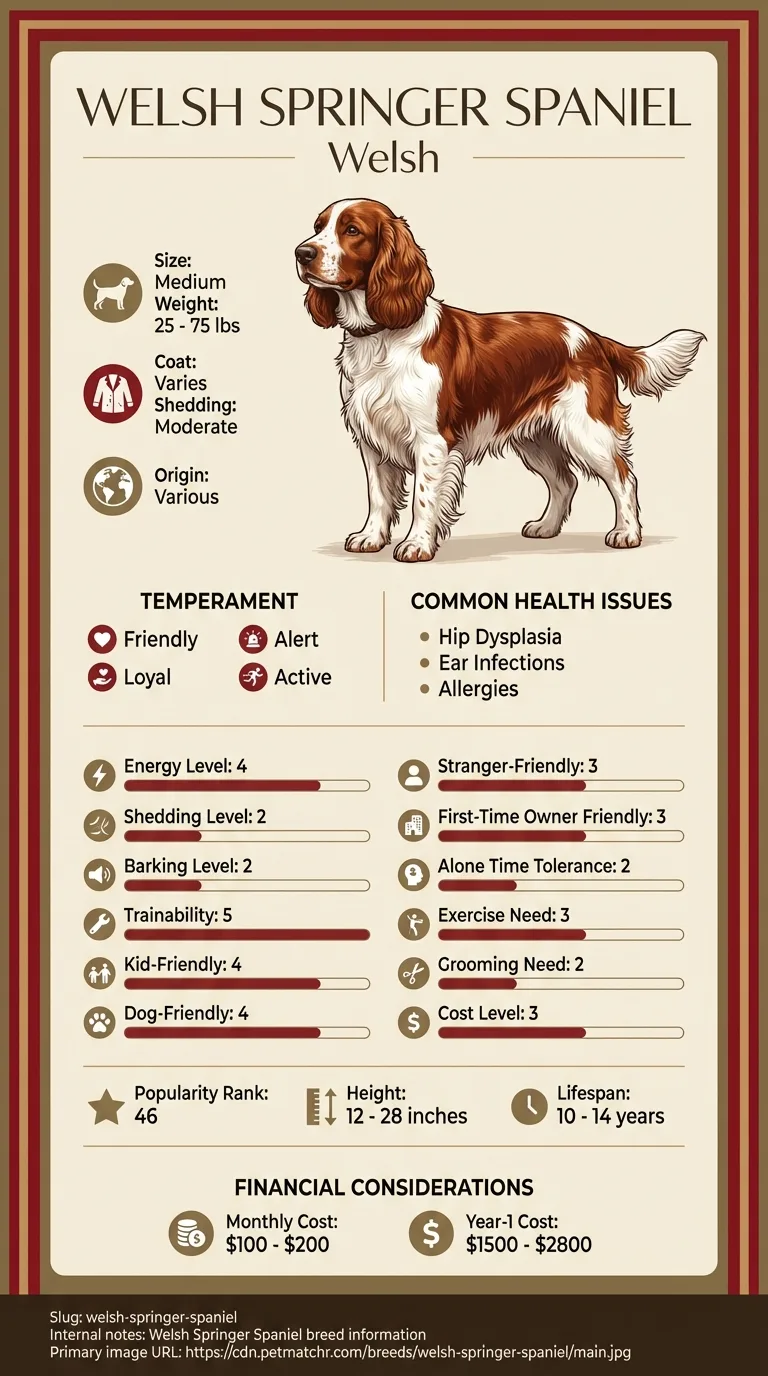
Owners whose dogs swim regularly, or who live somewhere humid, tend to fight this the hardest, since moisture is the single biggest factor turning a normal ear into an infected one.
This guide is not medical advice. If your dog shows pain, sudden behavior change, or worsening symptoms, consult a licensed veterinarian.
Some links may be affiliate links. We may earn a commission at no extra cost to you. We only suggest products we believe are helpful for dog owners.
We research and check what we publish, but we do not warrant that any figure, date, price, or statement is accurate, complete, or current, and we accept no liability for any loss, cost, injury, or other harm arising from the use of this site. Use it as one reference among several. You remain responsible for your own decisions and for your dog's care - confirm anything that matters with a licensed veterinarian or another qualified professional before you act on it. Full disclaimer.
Chronic ear infections are a documented health issue for the Welsh Springer Spaniel, driven by the combination of pendant ears that restrict airflow and an active, often water-loving lifestyle that regularly introduces moisture into the ear canal. Warm, damp, poorly ventilated ears provide ideal conditions for yeast and bacteria to multiply, leading to recurring inflammation and infection.
Ear infections are one of the five specific health issues formally documented for this breed, making them one of the more predictable, manageable concerns owners should plan for from the start rather than being caught off guard by later.
The breed's pendant ear shape is the core structural driver, limiting airflow into the canal in a way upright-eared breeds don't experience. This is compounded by the breed's documented high energy and exercise needs, which often express themselves through enthusiastic water activity.
Moisture is the dominant environmental trigger, whether from swimming, bathing, or humid weather. Underlying allergies compound the risk further, since allergic inflammation in the canal reduces its ability to self-regulate even when moisture exposure is otherwise well managed.
See your vet if you notice persistent head shaking, visible redness or swelling, discharge, or an odor that doesn't improve with a few days of at-home cleaning. Pain when the ear is touched or a sudden tilt of the head warrants prompt attention rather than waiting.
See all Welsh Springer Spaniel health problems, which breeds are prone to ear infections, or the full Welsh Springer Spaniel breed guide for temperament, exercise needs and ownership costs.
A straightforward infection typically clears within one to two weeks of appropriate treatment. For dogs with an underlying allergy, expect an ongoing management pattern with occasional flare-ups rather than a single permanent fix.
Success looks like fewer infections per year, faster resolution when they do occur, and ears that stay comfortable through regular swims and baths rather than becoming a source of dread for both dog and owner.
The Welsh Springer Spaniel's ears are long, pendant, and set to hang close against the head, a shape shared across the wider spaniel family and one that restricts airflow into the ear canal compared to an upright-eared breed. Less airflow means less natural drying, and less drying means any moisture, from a bath, a swim, or humid weather, lingers longer.
This breed's documented energy and exercise needs often translate into real enthusiasm for water, whether that's a pond during a walk or a deliberate swim, and every one of those sessions adds moisture to ears that already struggle to dry out fully on their own. Warm, dark, moist ear canals are close to ideal conditions for yeast and bacteria to multiply.
This combination, floppy ear shape plus a lifestyle that includes real water exposure, is why ear infections are formally documented for this breed rather than being an occasional individual issue. It's a mechanical and environmental problem as much as a medical one, and understanding that shapes how prevention actually works.
Because this is a documented, structural vulnerability rather than a one-off issue, prevention works best as an ongoing habit rather than a reaction to the first sign of trouble.

Huw's Welsh Springer Spaniel, Mabon, loved nothing more than diving into the pond on their regular countryside walks, but by the third ear infection in a single summer, Huw started wondering if he needed to keep Mabon out of the water entirely. His vet explained that the issue wasn't the swimming itself but the moisture left behind afterward, and suggested a simple routine: a vet-approved drying solution applied right after every swim, plus a weekly check even on dry weeks. Huw also started checking for early redness rather than waiting for the more obvious signs. Mabon still swims every chance he gets, but hasn't had a full infection since Huw started the post-swim drying routine, just the occasional mild redness caught and settled within a day or two.
Key takeaway: The fix wasn't keeping an eager swimmer out of the water, it was addressing the moisture left behind afterward, consistently, every single time.
The combination of pendant ears, which restrict airflow and trap moisture, and this breed's active, often water-loving lifestyle creates ideal conditions for yeast and bacteria to multiply in the ear canal, which is why it's a formally recognized health issue for the breed.
Head shaking, scratching at the ears, a visible red or swollen canal, and a yeasty or foul odor are the clearest signs. Discharge, whether dark and waxy or more liquid, is another common indicator.
A weekly check with drying or cleaning as needed is reasonable for most dogs, with more frequent attention right after swimming. Over-cleaning can irritate the canal, so this isn't a case where more is automatically better.
A standard vet visit for an ear infection, including exam and medication, commonly costs $100 to $300, with costs rising if the infection is severe, recurrent, or requires more advanced diagnostics.
Not always, but allergies are the most common underlying driver of repeat infections in this breed. If infections keep recurring despite good ear hygiene, it's worth discussing allergy testing with your vet.
Mild redness might respond to a gentle at-home cleaning routine, but a true infection typically needs a vet-diagnosed, targeted treatment, since using the wrong product on a ruptured eardrum or unusual infection type can make things worse.
Swimming itself isn't the problem, trapped moisture afterward is. Thorough drying after every swim session is the single most effective way to let your dog keep enjoying water without paying for it in ear infections.
Yes, chronic ear infections are one of the specific health issues formally documented for the Welsh Springer Spaniel.
Pendant ears that restrict airflow, combined with an active, water-loving lifestyle, together create ideal conditions for infection.
Every single time, thorough drying right after a swim is the single most effective prevention habit for this breed.
A typical vet visit with medication runs $100 to $300, more if the infection is severe or recurrent.
Recurring infections often point to an underlying allergy and are worth discussing with your vet rather than repeating the same treatment indefinitely.
A one-page prep sheet for this condition: the signs, the questions to ask, what to get priced. Unlocks here.
You get: Vet visit prep sheet
No spam. One-click unsubscribe. See our privacy policy.
See a sample page before you decide.
Early access list
The free prep sheet covers the same-day warning signs, a symptom log and the questions to ask. We are considering a fuller kit that adds a cost worksheet for the usual tests and treatments (US price ranges with their sources) and a plain-English guide to ways of covering the bill. It is not built yet; this list tells us whether it is worth building.
One email, no spam, unsubscribe anytime. Information only, not veterinary advice.