Health
Do Shelties have breathing problems?
Not the flat-faced kind. Their long muzzle protects them from that entirely. Their respiratory problems are throat irritation, nasal foreign bodies and infection.

Quick answer
Do Shelties have breathing problems?
Not the flat-faced kind. Their long muzzle protects them from that entirely. Their respiratory problems are throat irritation, nasal foreign bodies and infection.
A long nose brings its own problems, and two of them are shaped directly by how this breed lives: it barks constantly, and it puts its face into long grass.
Owners of a Sheltie with a persistent cough or noisy breathing who have found a great deal of information about bulldogs and pugs and none of it applies.
This guide is not medical advice. If your dog shows pain, sudden behavior change, or worsening symptoms, consult a licensed veterinarian.
Some links may be affiliate links. We may earn a commission at no extra cost to you. We only suggest products we believe are helpful for dog owners.
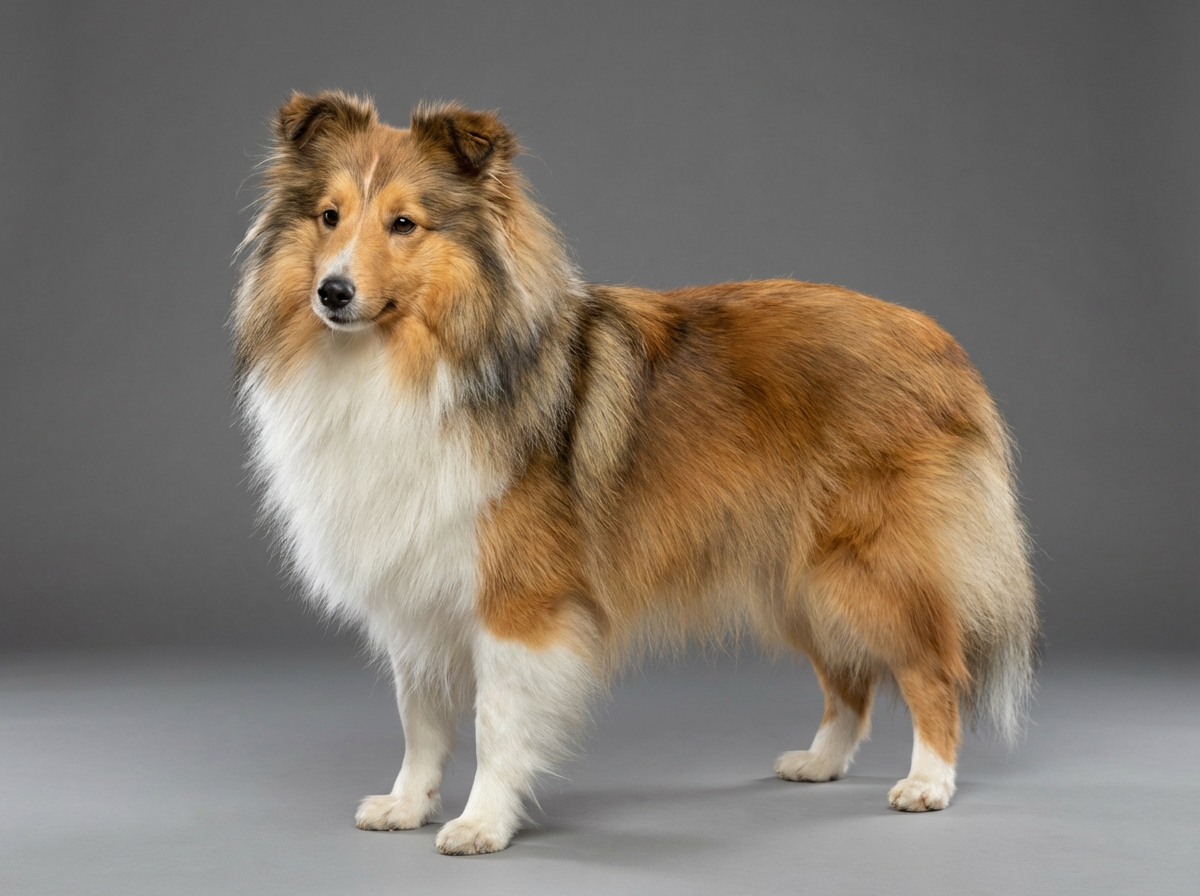
Respiratory problems in Shetland Sheepdogs have nothing to do with the flat-faced airway syndrome that dominates writing on the subject. This breed has a long muzzle and a full nasal chamber. Its actual issues are chronic upper airway irritation in a dog that barks constantly and pulls on a collar, inhaled grass seeds in a dog that hunts with its nose in long vegetation, and the ordinary infectious coughs any dog can catch.
Collar-related cough is very common in this breed and very commonly misattributed. Grass awns are a seasonal problem concentrated in summer and autumn. Serious nasal disease is uncommon but is over-represented in long-muzzled breeds, and any one-sided nasal sign should be taken seriously rather than treated empirically.
Two breed traits drive almost everything on this page and neither is anatomical in the way owners expect. The first is vocalisation: the Shetland Sheepdog is exceptionally barky, and a dog that barks hard while straining against a flat collar irritates its own upper airway repeatedly. The second is the long, narrow muzzle, which spares the breed the compressed-airway problems of flat-faced dogs but leaves a long nasal chamber open to inhaled plant material and to the fungal and neoplastic conditions that favour dolichocephalic breeds. MDR1 drug sensitivity is the third consideration, because retrieving a nasal foreign body means sedation.
Equipment and terrain do most of the work. A flat collar on a pulling, barking dog is the single most modifiable factor. Long grass and stubble fields in summer are where awns are inhaled, and a dog that works with its nose down is far more exposed than one that trots on a path. Communal environments such as training classes, shows and kennels are where infectious coughs are acquired, which matters for a breed whose owners tend to be active in dog sports.
Go immediately, as an emergency: breathing that is laboured at rest, gums that look blue or grey, a dog standing with elbows out and neck extended, choking or collapse, or a cough so severe the dog cannot rest. Same day: a sudden violent sneezing fit that started outdoors, blood or discharge from one nostril, a face the dog is pawing at, or noisy breathing that has come on abruptly. Within a week: a persistent cough that has not improved after switching to a harness, a wet cough in an older dog, exercise intolerance with increased respiratory effort, or discharge from both nostrils that has lasted more than a few days. Mention MDR1 whenever sedation is likely.
See all Shetland Sheepdog health problems, which breeds are prone to respiratory disease, or the full Shetland Sheepdog breed guide for temperament, exercise needs and ownership costs.
Collar-related cough usually improves noticeably within two to four weeks of switching to a harness, and often disappears entirely. Barking reduction is a project of months rather than weeks. Grass awns are resolved in a single procedure once located, though a migrated awn can take longer to find. Infectious coughs typically run one to three weeks. Serious nasal disease requires imaging and referral and follows its own course.
Success for most Sheltie owners is a dog that has stopped honking after the doorbell, walks on a harness without straining, and gets through summer without a seed head up its nose. It is not a silent dog, which this breed will never be. Where a cough has been investigated and cleared, success also includes knowing what it is not, which is worth the appointment on its own.
Shetland Sheepdogs are among the most vocal breeds alive. That is not a training failure; it is what the breed was developed to do, and it is written into its temperament as clearly as its coat is written into its appearance.
A dog that barks hard and often is working its larynx and upper airway constantly. Add a flat collar and a dog that pulls toward whatever it is barking at, and you have repeated compression of the trachea and larynx at exactly the moment those structures are already under load.
The result, over months and years, is a dog with a chronically irritated upper airway. It produces a dry, honking cough after excitement, after a doorbell, after a walk on which the dog pulled. Owners find it alarming, and it is regularly mistaken for a heart cough or for kennel cough.
The fix is straightforward and it is the highest-yield change in this section. Move the dog onto a well-fitted harness, which distributes pull across the chest rather than the throat, and work on the barking as a behaviour problem in its own right. Many Sheltie coughs simply resolve.
What this does not fix, and what should still be investigated, is a cough that continues on a harness, a cough that is wet rather than dry, or a cough that appears at night in an older dog with a known murmur.
Long-muzzled breeds are spared the flat-faced conditions and are more exposed to a different set.

Anwen's Sheltie, Bryn, developed a dry honking cough at four. It came after the postman, after visitors, and after every walk. She was convinced it was his heart, and two separate vets found nothing on auscultation. The third vet she saw asked what he walked on. Bryn wore a flat collar, and Anwen described him as pulling hard while barking at other dogs, which she had accepted as normal for the breed. She bought a Y-front harness that afternoon and started a barking programme with a local trainer the following week. The cough reduced within a fortnight and was gone within two months. Bryn still barks. He barks a great deal, because he is a Shetland Sheepdog. But he does it without his throat being compressed at the same time, and Anwen has not heard the honk in three years.
Key takeaway: In a breed that barks constantly and pulls toward what it barks at, a flat collar is a chronic airway insult. Try a harness for a month before assuming a cough is coming from the chest.
No, and it is the opposite. Shelties have a long, narrow, tapering muzzle. Brachycephalic airway syndrome, stenotic nares and elongated soft palate are conditions of flat-faced breeds and have nothing to do with this one. Information written for bulldogs and pugs does not apply here.
In a heavily barking dog on a flat collar, chronic upper airway irritation is the commonest reason. It is typically dry, comes after excitement, and improves markedly within weeks of switching to a harness. If it persists on a harness, it needs investigating rather than accepting.
A spasm in which the dog pulls air rapidly inward through the nose, making a dramatic snorting noise. It looks frightening and is usually harmless, ending within a minute. Gently stroking the throat or briefly covering the nostrils often stops it. Frequent or prolonged episodes are worth mentioning to your vet.
That is a grass awn until proven otherwise and it needs a same-day appointment. Seed heads migrate and do not come out on their own. Retrieval usually requires sedation, which in a Shetland Sheepdog means the MDR1 genotype should be on file before you go.
Count sleeping breaths. A dog whose resting breathing rate while asleep is normal and stable is very unlikely to be coughing from fluid on the lungs. A dry honking cough after excitement in a barky dog points to the airway; a soft wet cough at night in an older dog with a murmur points to the heart.
In a healthy adult it is usually self-limiting but unpleasant and highly contagious. It matters more in puppies, elderly dogs and any dog with underlying heart or airway disease. Vaccination is worth discussing if your dog attends classes, shows or boarding kennels.
The early signs are set out in the sections above, and they are the reason to book a veterinary appointment rather than wait. Respiratory Disease in Shetlands is diagnosed by a vet, not from a symptom list, and the sooner it is on record the more options remain open.
Not the flat-faced kind. Their long muzzle protects them from that entirely. Their respiratory problems are throat irritation, nasal foreign bodies and infection.
A harness for walking. In a breed that barks and pulls, a flat collar puts repeated pressure on the throat and is a common cause of chronic cough.
Yes. One-sided nasal discharge or bleeding warrants proper investigation rather than an antibiotic course, and needs a prompt appointment.
Sedation and retrieval typically runs a few hundred dollars, and considerably more if the awn has migrated and needs imaging to locate.
Substantially, though not eliminated, since this breed is bred to be vocal. A trainer can reduce frequency, which also helps the throat.
A one-page prep sheet for this condition: the signs, the questions to ask, what to get priced. Unlocks here.
You get: Vet visit prep sheet
No spam. One-click unsubscribe. See our privacy policy.
Preview page 1 before you decide.