Living
Boston Terrier or Shetland Sheepdog — which fits my life better?
Go Boston if you want low exercise needs and an easy first dog. Go Sheltie if you want a sharp, trainable herder and can handle the barking and brushing.

Quick answer
Boston Terrier or Shetland Sheepdog — which fits my life better?
Go Boston if you want low exercise needs and an easy first dog. Go Sheltie if you want a sharp, trainable herder and can handle the barking and brushing.
Boston Terrier or Shetland Sheepdog? On paper they differ most on grooming need, and on the scales Shetland Sheepdog is the heavier at 15–25 lbs. Here is how the two compare on everything that shapes an ordinary week.
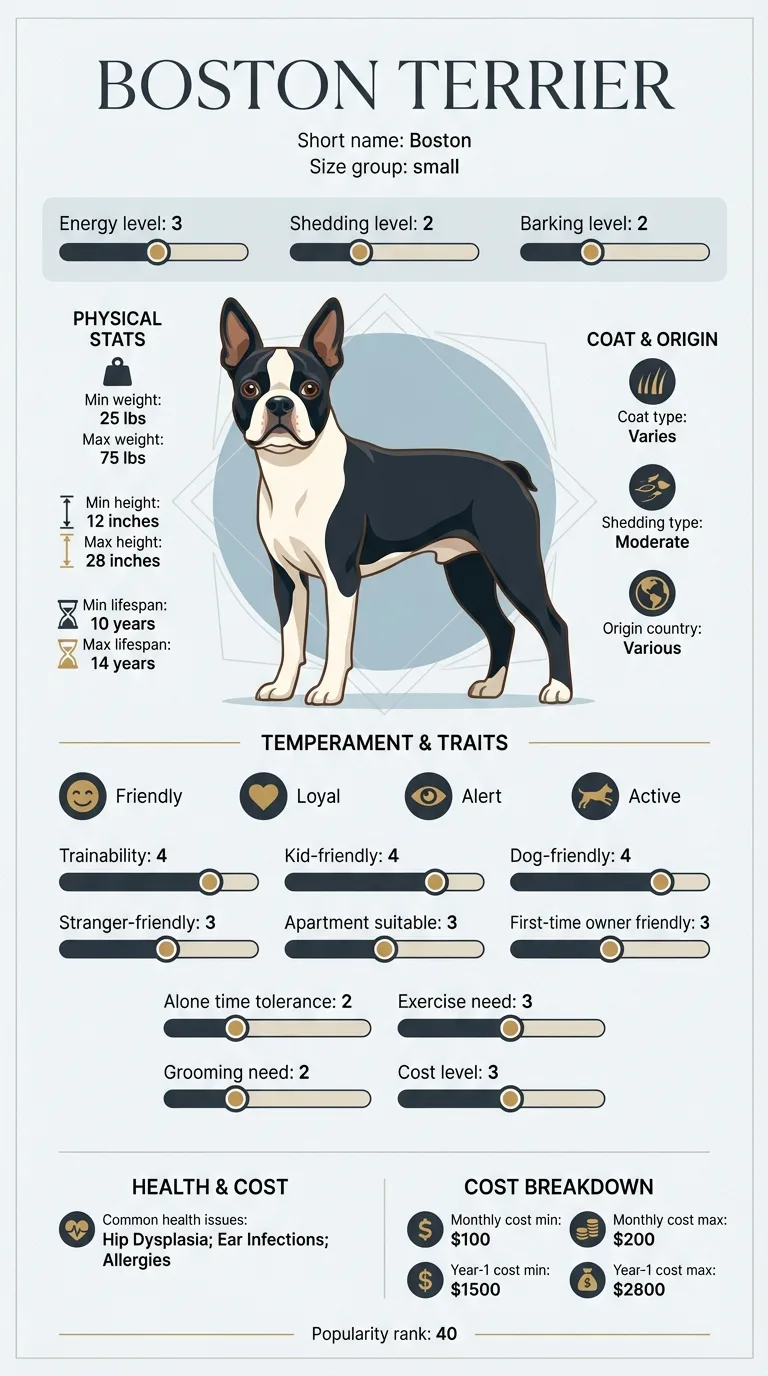
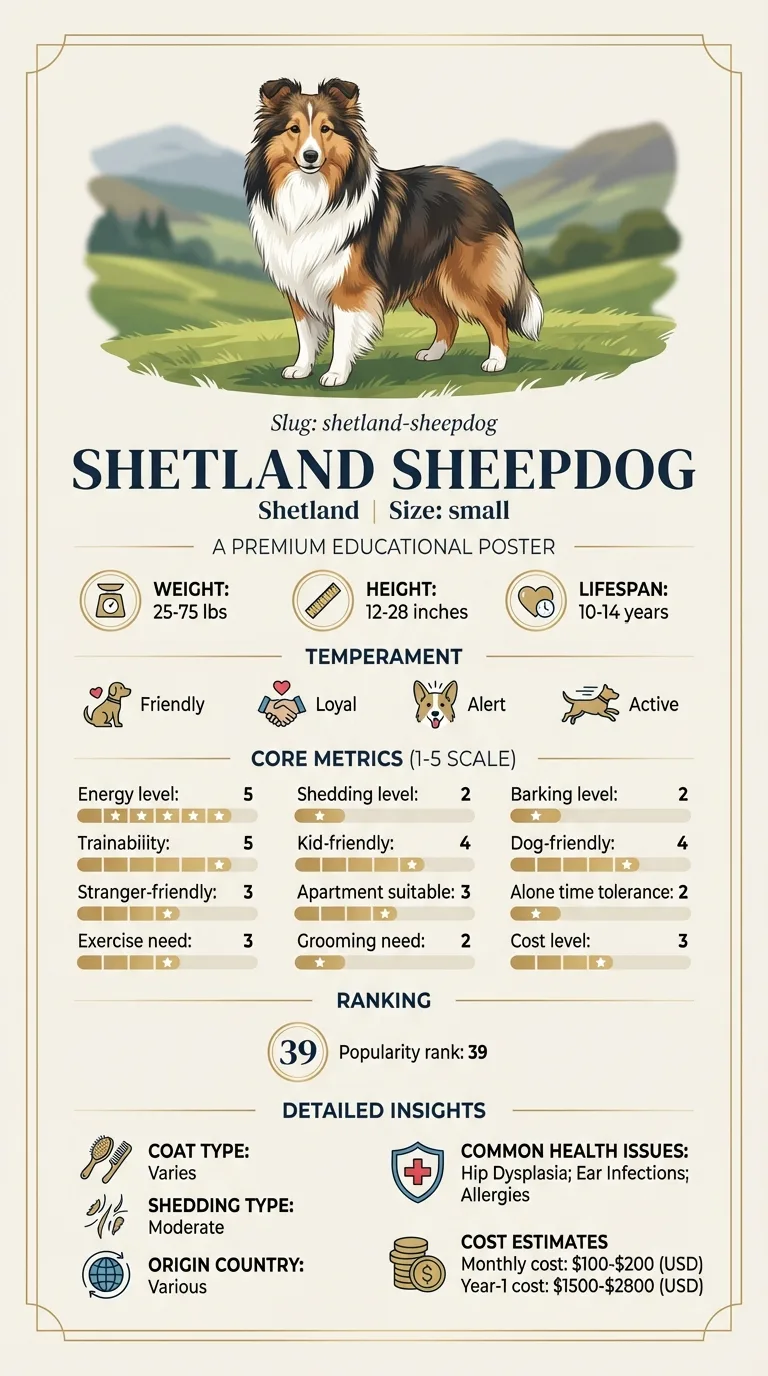
This is for someone already down to Boston Terrier and Shetland Sheepdog and deciding between them. For this pair the decision usually turns on grooming need and barking, so those are covered first and in most detail. Anyone choosing from a flat has a clear answer here: Boston Terrier rates 5/5 against 3/5. There is no origin story here — only what changes about your week.
Between Boston Terrier and Shetland Sheepdog, grooming need is what separates them, and Boston Terrier is the lower-effort dog of the two to keep.
Choose Boston Terrier if you are in a flat or a smaller home, this is your first dog and you do not want a standing grooming appointment.
Choose Shetland Sheepdog if you want a dog that picks up training quickly, you want a dog that can keep up with an active routine and you want a dog that is more watchful with visitors.
| Feature | boston terrier | shetland sheepdog | Winner |
|---|---|---|---|
| Size class | small | small | Equal |
| Weight | 12–25 lbs | 15–25 lbs | Equal |
| Height | 15–17 in | 13–16 in | Equal |
| Lifespan | 11–13 years | 12–14 years | shetland sheepdog |
| Exercise need | Low (2/5) | High (4/5) | boston terrier |
| Grooming need | Very low (1/5) | High (4/5) | boston terrier |
| Shedding | Low (2/5) | High (4/5) | boston terrier |
| Energy level | Moderate (3/5) | High (4/5) | Equal |
| Barking | Low (2/5) | Very high (5/5) | boston terrier |
| Apartment suitability | Very high (5/5) | Moderate (3/5) | boston terrier |
| Good for first-time owners | Very high (5/5) | High (4/5) | boston terrier |
| Tolerates being alone | Moderate (3/5) | Low (2/5) | boston terrier |
| Trainability | High (4/5) | Very high (5/5) | shetland sheepdog |
| Good with kids | Very high (5/5) | High (4/5) | boston terrier |
| Good with other dogs | High (4/5) | High (4/5) | Equal |
| Friendly to strangers | High (4/5) | Low (2/5) | boston terrier |
| Cost level | Moderate (3/5) | Moderate (3/5) | Equal |
| Coat | Short and smooth | Long, dense double coat | Equal |
| Origin | Various | Various | Equal |
| Typical monthly cost | $80–$150 | $80–$150 | Equal |
| Typical first-year cost | $1,100–$2,300 | $1,100–$2,300 | Equal |
Despite being classed in the same size bracket, a Shetland Sheepdog and Boston Terrier look built for different jobs. The Sheltie carries a fine-boned, elegant frame — 15 to 25 pounds under 13 to 16 inches of flowing double coat — meant for herding on the move. The Boston is stockier and more compact at 12 to 25 pounds, 15 to 17 inches, with a short coat and a boxier head. Weight ranges overlap almost completely; the silhouette does not.
Don't let the Sheltie's dainty look fool you — it rates a 4/5 for exercise need and high energy, built from generations of herding work that still shows up as a dog that wants a job. The Boston Terrier sits at the opposite end, a 2/5 that's satisfied with a couple of short walks. An under-exercised Sheltie tends to redirect that drive into herding your kids, your cat, or your ankles.
The Sheltie's coat is genuinely demanding: a long, dense double coat that rates 4/5 for both grooming need and shedding, meaning regular brushing and a seasonal blowout of loose fur. The Boston's short coat needs almost none of that — grooming at 1/5, shedding at just 2/5. If a vacuum cleaner is not already part of your weekly routine, factor that in before choosing the Sheltie.
This category favors the Boston clearly. It barks rarely (2/5), tolerates being alone at a moderate 3/5, and rates a full 5/5 for apartment living. The Sheltie is a notably vocal breed — barking rates a full 5/5 — pairs that with a low 2/5 tolerance for being alone, and a 3/5 apartment score. A Sheltie left alone in a small unit for long stretches is a recipe for complaints from next door.
Both breeds train well, but the Sheltie is rated the sharper student at 5/5 trainability, against the Boston's still-solid 4/5. Where the Boston pulls ahead is forgiveness for beginners — a 5/5 first-time-owner score versus the Sheltie's 4/5. Neither is a hard dog to teach; the difference is how much the Sheltie's intelligence needs channeling before it channels itself.
With kids the Boston edges it out, 5/5 to the Sheltie's 4/5, and it's friendlier to strangers too — 4/5 against a notably low 2/5 for the Sheltie, which tends toward reserved or wary with people it doesn't know. Both score equally well with other dogs at 4/5. If you host often or your kids bring friends home, the Boston's easier social nature is worth weighing.
The Sheltie's typical lifespan, 12 to 14 years, edges out the Boston's 11 to 13. Its documented health list runs to eye and drug-sensitivity issues specific to herding breeds — Collie Eye Anomaly and MDR1 drug sensitivity among them — while the Boston's centers on its flat face and eyes. Patellar luxation shows up in both breeds' data, so that's a shared thing to ask a breeder or vet about.
Cost lands almost identically on paper: both breeds carry a moderate 3/5 cost rating, $80–$150 a month, and $1,100–$2,300 in year one. The real difference won't show up in the sticker price — it's in grooming tools, brush time, and possibly professional grooming visits for the Sheltie's coat, none of which the low-maintenance Boston requires.
Boston Terrier weighs 12–25 lbs and lives 11–13 years; Shetland Sheepdog weighs 15–25 lbs and lives 12–14 years. The two diverge most on grooming need, barking and exercise need and 3 other rated axes. They are level on cost level and good with other dogs, so those cannot decide it. Where the table declares a winner it means less work for the owner, nothing more; descriptive rows are left as ties on purpose. The value here is in the differences between the two columns; treat any single score as approximate.

On paper, yes — both fall in the small size class with overlapping weight ranges (12-25 lbs for the Boston, 15-25 lbs for the Sheltie). In build they read differently: the Sheltie is leaner and coated for herding, the Boston is stockier and short-coated.
The Sheltie, by a clear margin — its shedding rates 4/5 against the Boston's 2/5, and its long double coat means noticeable seasonal blowouts on top of everyday shedding.
It can work, rating a moderate 3/5 for apartment suitability, but its 5/5 barking tendency and low tolerance for being alone (2/5) make it a harder sell in close quarters than the Boston, which scores 5/5 on apartment fit and barks rarely.
The Boston Terrier, rated 5/5 for first-timers against the Sheltie's 4/5. Both are trainable, but the Sheltie's herding instincts and higher exercise needs ask a little more of a new owner.
Both run about $80-150 a month and $1,100-2,300 in the first year — nearly identical on paper. The Sheltie's grooming needs are the wildcard that can push real spending higher.
Patellar luxation appears in both breeds' health data. Otherwise their risk profiles differ: the Sheltie's list includes Collie Eye Anomaly and MDR1 drug sensitivity, while the Boston's centers on airway and eye issues tied to its short muzzle.
The Boston, clearly — it rates 4/5 for friendliness to strangers against the Sheltie's low 2/5. Shelties tend to be reserved or wary around unfamiliar people, which suits watchdog instincts more than a house full of visitors.
Go Boston if you want low exercise needs and an easy first dog. Go Sheltie if you want a sharp, trainable herder and can handle the barking and brushing.
Barely any — both run about $80-150 a month, though the Sheltie's grooming can push real costs higher.
The Sheltie, rated 4/5 against the Boston's 2/5 — it's a working-breed energy level in a small body.
The Sheltie, typically 12-14 years versus 11-13 for the Boston.
Secure checkout on Stripe. We never see your card.
7-day money-back guarantee. Instant access.
Health information here is general and is not veterinary advice. If your dog shows pain, sudden behaviour change, or worsening symptoms, consult a licensed veterinarian.
Some links on this site are affiliate links. We may earn a commission at no extra cost to you, and we only suggest products we believe are helpful for dog owners.
We research and check what we publish, but we do not warrant that any figure, date, price, or statement is accurate, complete, or current, and we accept no liability for any loss, cost, injury, or other harm arising from the use of this site. Use it as one reference among several. You remain responsible for your own decisions and for your dog's care - confirm anything that matters with a licensed veterinarian or another qualified professional before you act on it. Full disclaimer.
Match your lifestyle to the right dog.
Take quizNot sure which breed is right for you? Take our 2-minute quiz to find out.
Take the quiz