Health
Are Saint Bernards prone to weight gain?
Yes, their low natural exercise drive makes it easy for excess weight to build up gradually.

Quick answer
Are Saint Bernards prone to weight gain?
Yes, their low natural exercise drive makes it easy for excess weight to build up gradually.
A few extra pounds on a smaller dog is a cosmetic concern; on a Saint Bernard already carrying joint, heart, and heat-tolerance risk, those same extra pounds meaningfully raise the stakes on every one of those existing vulnerabilities.
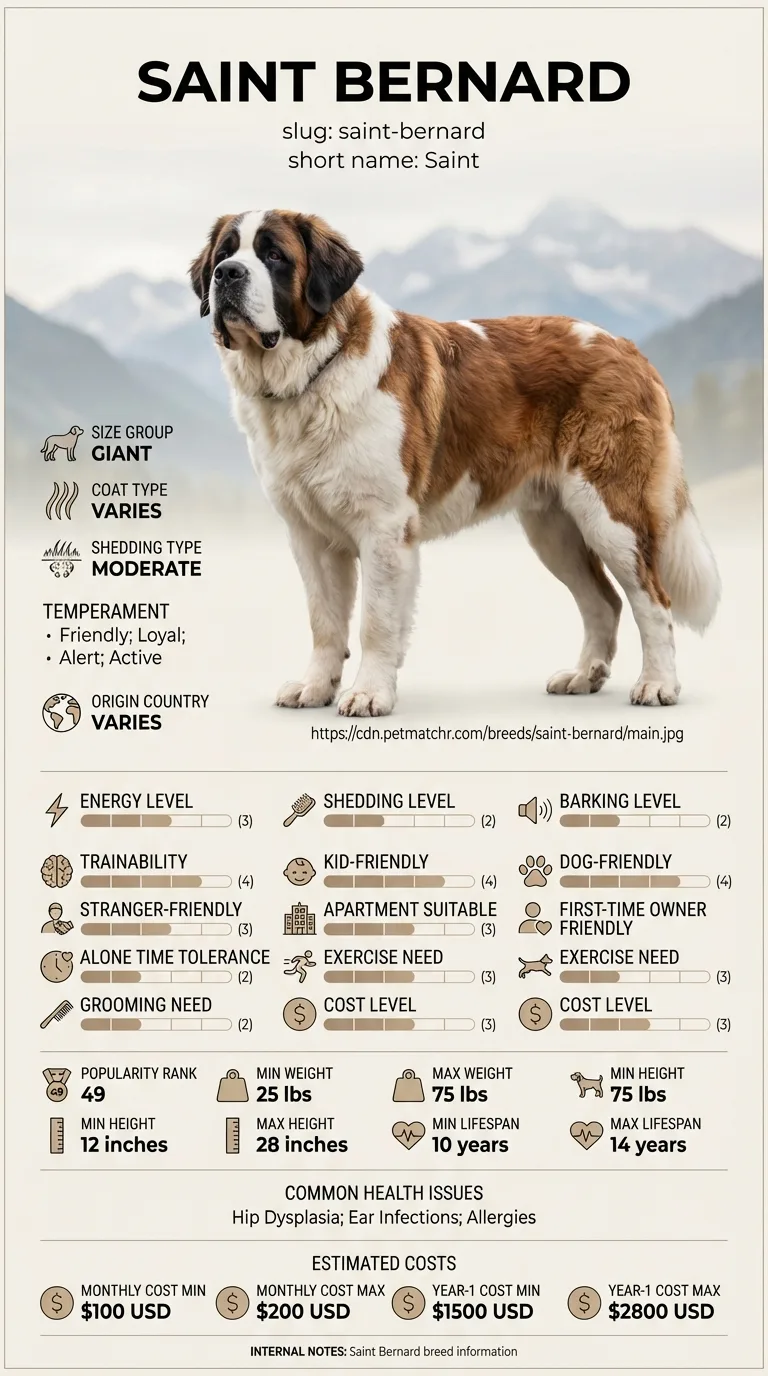
This is common among owners of laid-back, food-motivated Saint Bernards, especially in households with multiple people feeding treats, where it's easy to lose track of total daily calories.
This guide is not medical advice. If your dog shows pain, sudden behavior change, or worsening symptoms, consult a licensed veterinarian.
Some links may be affiliate links. We may earn a commission at no extra cost to you. We only suggest products we believe are helpful for dog owners.
We research and check what we publish, but we do not warrant that any figure, date, price, or statement is accurate, complete, or current, and we accept no liability for any loss, cost, injury, or other harm arising from the use of this site. Use it as one reference among several. You remain responsible for your own decisions and for your dog's care - confirm anything that matters with a licensed veterinarian or another qualified professional before you act on it. Full disclaimer.
Check this first
Obesity itself isn't a sudden emergency, but it dramatically raises the stakes of several genuine emergencies this breed already faces: overweight dogs overheat faster and more severely, carry higher bloat risk, and put more strain on an already vulnerable heart. So while there's no single 'obesity emergency' moment, an overweight Saint Bernard reaching any of those crisis points, heatstroke, bloat, or acute heart failure, tends to have a narrower safety margin than a lean one would.
Day-to-day, the signs of concerning weight gain are gradual: reduced willingness to walk, faster tiring, visible loss of a waistline, and difficulty feeling ribs under a layer of fat. These call for a vet visit to set a weight-loss plan, not urgent care.
The practical takeaway is that managing weight in this breed isn't just about appearance, it's about maintaining the safety margin on cardiac strain, heat tolerance, and joint load that this breed already operates with less room to spare on than most.
If any of these apply, call your vet or an emergency clinic now. The rest of this page is for the cases that are not an emergency.
Obesity is a particularly consequential problem for Saint Bernards because their naturally low exercise drive doesn't provide the built-in calorie burn that more active breeds get from their own energy levels. Extra weight compounds nearly every other documented risk in this breed: it adds mechanical stress to joints already prone to dysplasia, increases cardiac workload in a breed prone to heart disease, and makes an already heat-sensitive dog even less tolerant of warm weather.
Obesity is one of the more common, largely preventable health concerns in Saint Bernards, driven directly by the mismatch between their low energy level and how easily overfeeding can go unnoticed under a heavy coat.
Saint Bernards carry a naturally low energy level and exercise need, traits well suited to their historical role and modern household life, but this same low drive means they don't self-regulate calorie balance through activity the way a higher-energy breed might, making portion control an active owner responsibility rather than something the dog's own behavior handles.
Free access to food, generous treat-giving, and a lack of routine weigh-ins or body condition checks are the main environmental drivers, compounded by a thick coat that can visually hide weight gain until it's already become significant.
Talk to your vet if you're unsure of your dog's ideal weight, if body condition checks suggest weight gain, or before starting any weight-loss plan, since portion and exercise recommendations should be tailored to the individual dog. Rapid, unexplained weight loss or gain, or new mobility struggles alongside excess weight, deserve prompt evaluation.
Weight gain in this breed usually comes from a predictable set of everyday habits rather than one dramatic mistake.
See all Saint Bernard health problems, which breeds are prone to obesity, or the full Saint Bernard breed guide for temperament, exercise needs and ownership costs.
Gradual, safe weight loss in a giant breed typically takes several months rather than weeks, since rapid weight loss can carry its own health risks; most vets recommend a slow, steady reduction with regular weigh-ins to track progress.
Success means reaching and maintaining a body condition where ribs are easily felt and a waist is visible, sustained through ongoing portion control and activity rather than a one-time diet, since weight management in this breed is a continuous, lifelong habit.
Marta didn't realize her Saint Bernard, Biscuit, had gained noticeable weight until her vet's hands-on exam found it difficult to feel his ribs at a routine checkup. Between free-feeding and treats from Marta's kids, Biscuit had gradually gained about fifteen pounds over a year without anyone noticing under his thick coat. Marta switched to measured meals, cut treats to a small daily allowance from his regular kibble, and added short daily walks. Over six months, Biscuit lost the extra weight gradually, and his energy and willingness to move both visibly improved along the way.
Key takeaway: The weight gain was invisible under Biscuit's coat until a hands-on vet check caught it, which is exactly why regular physical body condition checks matter more than visual impression alone in this breed.
Their naturally low exercise drive and energy level mean fewer daily calories are burned through activity compared to more energetic breeds, so even modest overfeeding can lead to gradual, hard-to-notice weight gain.
Healthy weight varies by individual frame size within the breed's roughly 120 to 180 pound range, and a vet-assessed body condition score, checking for a visible waist and easily felt ribs, is more useful than a single target number.
Extra weight adds strain to joints already at risk for hip and elbow dysplasia, increases cardiac workload in a breed prone to heart disease, and makes heat regulation even harder in a breed that already struggles with warm weather.
You should be able to feel (though not necessarily see) the ribs with light pressure, and there should be a visible waist when viewed from above. A vet can confirm with a formal body condition score.
Measured portions of an appropriate diet, a vet-approved gradual calorie reduction, and consistent low-impact exercise like moderate walks or swimming tend to work better than sudden, drastic changes.
Excess weight is associated with a shorter lifespan and more joint, heart, and metabolic problems across dog breeds generally, which matters even more for a breed whose typical lifespan is already a relatively short eight to ten years.
Indirectly, a significant amount, since obesity accelerates joint disease, cardiac strain, and other conditions that carry their own ongoing veterinary costs, making weight management one of the more cost-effective preventive steps an owner can take.
Yes, their low natural exercise drive makes it easy for excess weight to build up gradually.
Feel for the ribs under light pressure and look for a visible waist from above; both should be present in a healthy weight dog.
Yes, extra weight adds significant strain to joints already at risk for hip and elbow dysplasia.
Measured portions, limited treats, and consistent low-impact exercise like moderate walks or swimming.
Yes, extra body fat adds insulation and makes an already heat-sensitive breed even less tolerant of warm weather.
A one-page prep sheet for this condition: the signs, the questions to ask, what to get priced. Unlocks here.
You get: Vet visit prep sheet
No spam. One-click unsubscribe. See our privacy policy.
Preview page 1 before you decide.