Living
Which breed should you choose overall?
It depends on space and budget more than temperament — both score well with kids and other dogs. Lean Cocker for apartments and tighter budgets; lean Saint Bernard only with a house that has real space.

Quick answer
Which breed should you choose overall?
It depends on space and budget more than temperament — both score well with kids and other dogs. Lean Cocker for apartments and tighter budgets; lean Saint Bernard only with a house that has real space.
English Cocker Spaniel or Saint Bernard? On paper they differ most on apartment suitability, and on the scales Saint Bernard is the heavier at 120–180 lbs. Here is how the two compare on everything that shapes an ordinary week.
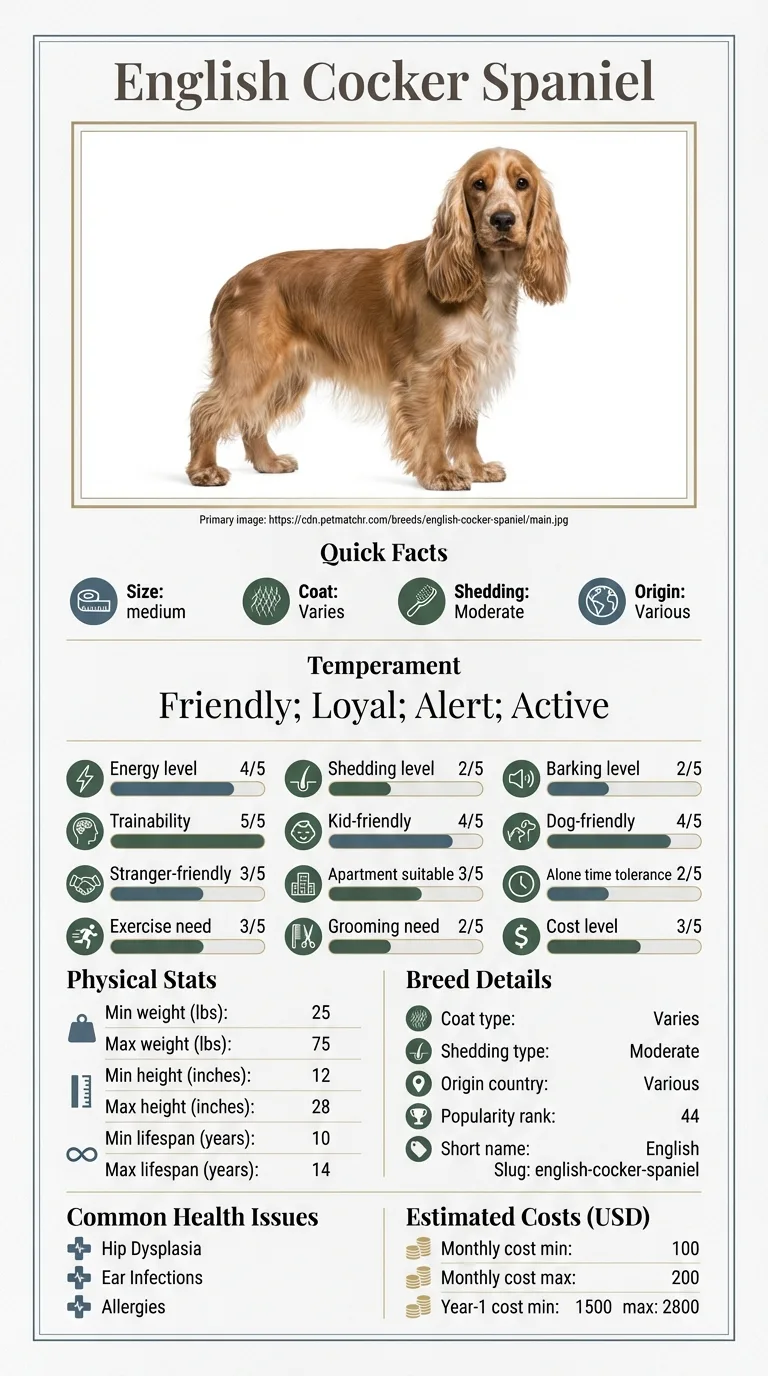
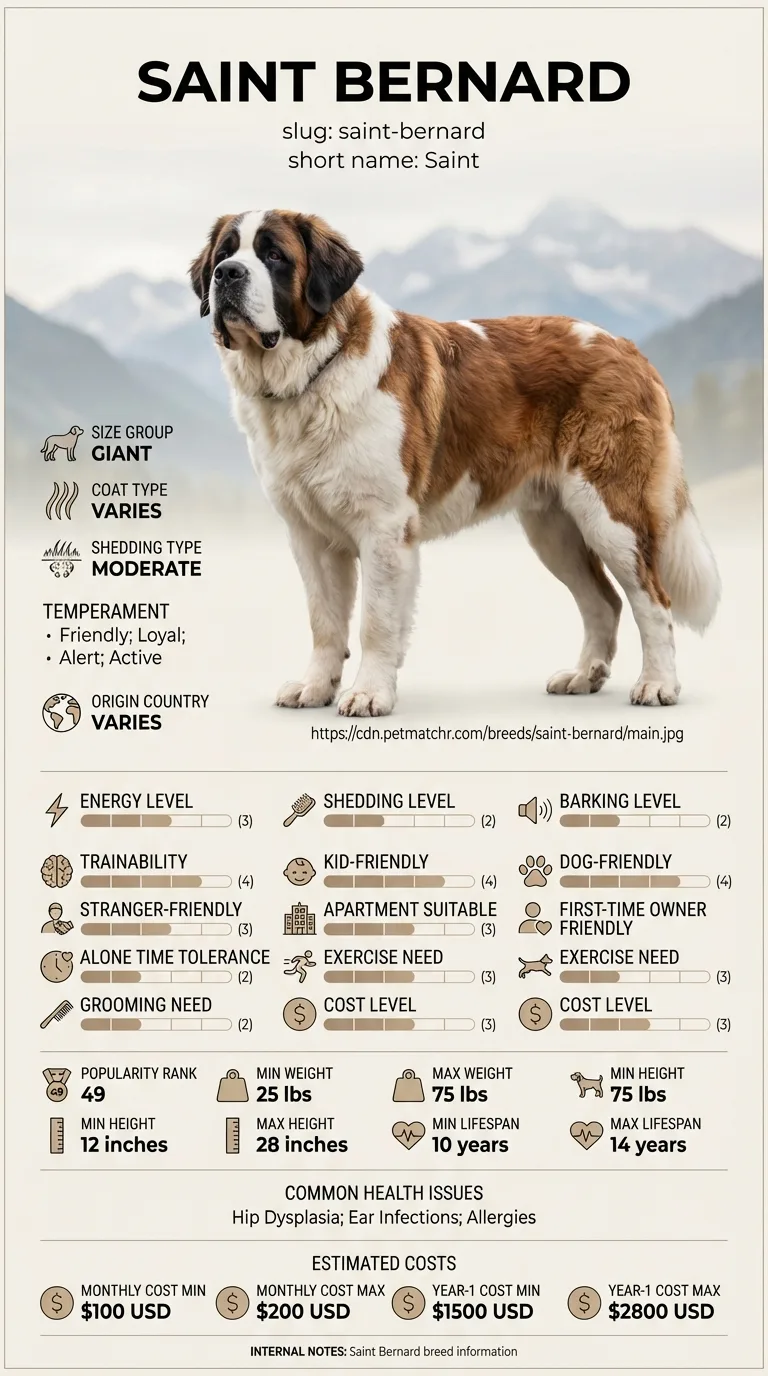
This is for someone already down to English Cocker Spaniel and Saint Bernard and deciding between them. For this pair the decision usually turns on apartment suitability and exercise need, so those are covered first and in most detail. Anyone choosing from a flat has a clear answer here: English Cocker Spaniel rates 4/5 against 1/5. Breed history is left out; what follows is what you will actually live with.
Between English Cocker Spaniel and Saint Bernard, apartment suitability is what separates them; neither is the lower-effort dog overall.
Choose English Cocker Spaniel if you are in a flat or a smaller home, this is your first dog and shedding is a problem in your house.
Choose Saint Bernard if you do not want a standing grooming appointment, your walking routine is modest and the dog will be alone during the working day.
| Feature | english cocker spaniel | saint bernard | Winner |
|---|---|---|---|
| Size class | medium | giant | Equal |
| Weight | 26–34 lbs | 120–180 lbs | Equal |
| Height | 15–17 in | 26–30 in | Equal |
| Lifespan | 12–14 years | 8–10 years | english cocker spaniel |
| Exercise need | High (4/5) | Low (2/5) | saint bernard |
| Grooming need | High (4/5) | Moderate (3/5) | saint bernard |
| Shedding | Moderate (3/5) | High (4/5) | english cocker spaniel |
| Energy level | High (4/5) | Low (2/5) | Equal |
| Barking | Moderate (3/5) | Low (2/5) | saint bernard |
| Apartment suitability | High (4/5) | Very low (1/5) | english cocker spaniel |
| Good for first-time owners | High (4/5) | Moderate (3/5) | english cocker spaniel |
| Tolerates being alone | Low (2/5) | Moderate (3/5) | saint bernard |
| Trainability | High (4/5) | Moderate (3/5) | english cocker spaniel |
| Good with kids | Very high (5/5) | Very high (5/5) | Equal |
| Good with other dogs | High (4/5) | High (4/5) | Equal |
| Friendly to strangers | High (4/5) | High (4/5) | Equal |
| Cost level | Moderate (3/5) | Very high (5/5) | english cocker spaniel |
| Coat | Medium, silky and feathered | Short or long double coat | Equal |
| Origin | Various | Various | Equal |
| Typical monthly cost | $100–$200 | $150–$310 | Equal |
| Typical first-year cost | $1,400–$2,900 | $2,200–$4,200 | Equal |
The Cocker Spaniel tops out around 34 lbs and 17 inches at the shoulder — a genuine medium dog. The Saint Bernard is in an entirely different category: 120 to 180 lbs and up to 30 inches tall, classed as giant. That's roughly five times the Cocker's weight sharing the same living room. Furniture, car space, and even the vet's scale need to accommodate a Saint Bernard in a way a Cocker never will.
Cocker Spaniels rate high on exercise need and energy (4/5 each) — they were bred to work a field all day and still want a real walk plus play. Saint Bernards score low on both (2/5), content with a stroll and a lot of couch time. If you want a jogging partner, the Cocker is built for it; the Saint Bernard is not.
Both breeds need real grooming work — the Cocker at 4/5, the Saint Bernard at 3/5 — but the coats differ. The Cocker's silky, feathered coat mats and tangles without regular brushing and trims. The Saint Bernard sheds more heavily (4/5 vs 3/5) whether short- or long-coated. Expect a vacuum upgrade with either dog, but expect more hair in the corners with the Saint Bernard.
This category has the widest gap in the whole comparison: the Cocker scores 4/5 for apartment suitability, the Saint Bernard just 1/5. A 150-lb dog in a small unit is a logistics problem before it's a temperament one — doorways, stairs, and turning radius all matter. The Saint Bernard barks less (2/5 vs 3/5), which helps with neighbors, but size alone rules out most apartments.
Cockers rate 4/5 for trainability and 4/5 for first-time owners — biddable is one of their defining traits. Saint Bernards land a notch lower on both (3/5 each), not because they're difficult exactly, but because a stubborn giant breed is harder to manage physically if training lapses. A first-time owner has more margin for error with the Cocker.
Both breeds score a full 5/5 with kids, and both rate high (4/5) with other dogs and strangers — this is one area where the size gap doesn't translate into a temperament gap. The Saint Bernard's reputation as a gentle giant holds up in the data. The real household question is space and cost, not friendliness.
The Cocker lives longer on paper — 12 to 14 years against 8 to 10 for the Saint Bernard, a gap typical of small-versus-giant breeds. Both share a risk for hip dysplasia. The Saint Bernard's list adds elbow dysplasia, dilated cardiomyopathy, entropion, and bloat (GDV), all more common in large, deep-chested dogs. The Cocker's risks run toward ears, eyes, and kidneys instead.
Monthly costs run $100–200 for the Cocker versus $150–310 for the Saint Bernard, and the first-year gap is starker: $1,400–2,900 against $2,200–4,200. Food volume alone explains a lot of it — a 150-lb dog eats far more than a 30-lb one. Cost level is rated moderate (3/5) for the Cocker and very high (5/5) for the Saint Bernard.
English Cocker Spaniel weighs 26–34 lbs and lives 12–14 years; Saint Bernard weighs 120–180 lbs and lives 8–10 years. The two diverge most on apartment suitability, exercise need and energy level and 1 other rated axes. They are level on good with other dogs, good with kids and friendly to strangers, so those cannot decide it. The comparison marks an easier option only where one exists. Facts like weight and country of origin are not scored. Both dogs are rated from the same dataset, which is what makes the numbers comparable with each other even though any individual dog sits somewhere inside its breed's range.

The Cocker Spaniel by a wide margin — it rates 4/5 for apartment suitability against the Saint Bernard's 1/5. Size and exercise needs both work against the Saint Bernard in a small space.
The Saint Bernard, rated 4/5 against the Cocker's 3/5. Both need regular grooming, but the Saint Bernard leaves more fur behind.
It's workable but harder than the Cocker — 3/5 for first-time owners versus the Cocker's 4/5. The challenge is usually managing size and strength rather than temperament.
Expect $150–310 a month versus $100–200 for the Cocker, and $2,200–4,200 in the first year versus $1,400–2,900. Food and vet costs scale with body weight.
Hip dysplasia is the one condition both lists share. Beyond that, the Saint Bernard faces bloat and heart issues typical of large, deep-chested breeds, while the Cocker's risks run toward ears, eyes, and kidneys.
The Cocker Spaniel, at 12–14 years against the Saint Bernard's 8–10 — a gap common between medium and giant breeds.
The Saint Bernard, rated 2/5 against the Cocker's 3/5, despite its size.
It depends on space and budget more than temperament — both score well with kids and other dogs. Lean Cocker for apartments and tighter budgets; lean Saint Bernard only with a house that has real space.
$100–200 for the Cocker Spaniel versus $150–310 for the Saint Bernard, driven mainly by food volume for a dog that can weigh six times as much.
The Cocker rates high (4/5) and wants daily activity; the Saint Bernard rates low (2/5) and is content with shorter walks.
The Cocker Spaniel, at 12–14 years, well ahead of the Saint Bernard's 8–10 — typical of the medium-versus-giant breed gap.
Secure checkout on Stripe. We never see your card.
7-day money-back guarantee. Instant access.

Health information here is general and is not veterinary advice. If your dog shows pain, sudden behaviour change, or worsening symptoms, consult a licensed veterinarian.
Some links on this site are affiliate links. We may earn a commission at no extra cost to you, and we only suggest products we believe are helpful for dog owners.
We research and check what we publish, but we do not warrant that any figure, date, price, or statement is accurate, complete, or current, and we accept no liability for any loss, cost, injury, or other harm arising from the use of this site. Use it as one reference among several. You remain responsible for your own decisions and for your dog's care - confirm anything that matters with a licensed veterinarian or another qualified professional before you act on it. Full disclaimer.
Match your lifestyle to the right dog.
Take quizNot sure which breed is right for you? Take our 2-minute quiz to find out.
Take the quiz