Health
Why do Saint Bernards get back problems?
Mainly from sheer body mass and a very fast growth rate, not from an unusually long spine — their build is proportional, unlike true long-backed breeds.

Quick answer
Why do Saint Bernards get back problems?
Mainly from sheer body mass and a very fast growth rate, not from an unusually long spine — their build is proportional, unlike true long-backed breeds.
A Saint Bernard's spine is not shaped like a Dachshund's, and its back problems do not work the same way. The risk here comes from sheer mass and growth speed, not from an unusually long back on unusually short legs.
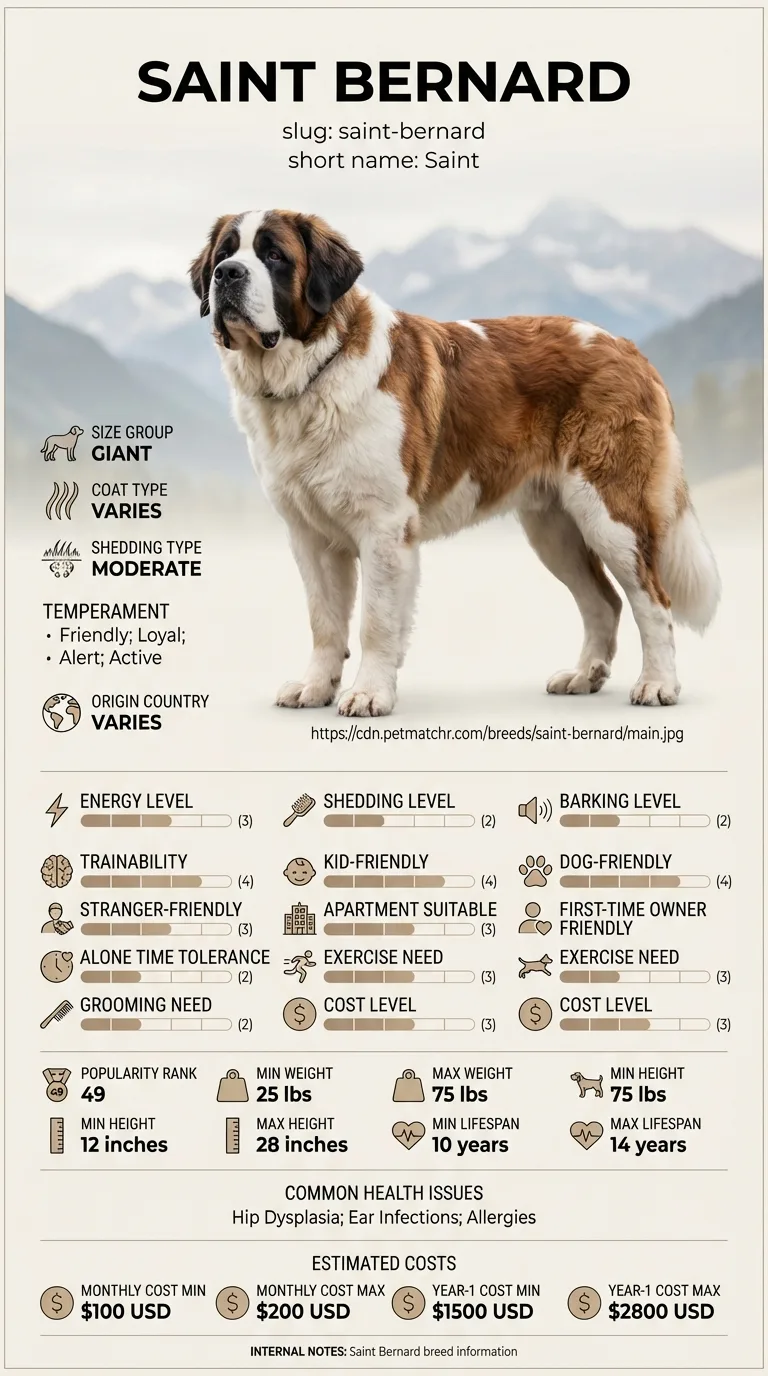
Owners who read a generic 'back problems' description online and picture a low-slung, long-backed dog, then are confused about how that applies to a large, proportionally built giant breed.
This guide is not medical advice. If your dog shows pain, sudden behavior change, or worsening symptoms, consult a licensed veterinarian.
Some links may be affiliate links. We may earn a commission at no extra cost to you. We only suggest products we believe are helpful for dog owners.
General back problems in a Saint Bernard stem from the mechanical demands of a very large, fast-growing frame rather than from an unusually shaped spine. Cumulative strain on back muscles, ligaments and discs builds through puppyhood growth and continues through an adult life spent carrying substantial body weight.
Mild, cumulative back strain is common in giant breeds generally given their size and growth speed, though it varies widely in severity from dog to dog. Most cases are manageable with sensible precautions rather than progressing to a serious spinal condition.
The breed's rapid growth to a very large adult size means the spine's supporting structures must keep pace with substantial weight gain in a relatively short window. Even a well-formed, proportionally built spine like this breed's carries more mechanical load simply because of the sheer mass it supports throughout life.
Hard, slippery flooring, repeated jumping from height, and forced high-impact exercise during the growth period all add avoidable strain. A home set up for a mid-size dog — without ramps, without non-slip surfaces — often unintentionally increases risk for a dog this size.
See a vet for any reluctance to jump, a hunched or tense posture, or apparent discomfort when touched along the back. Treat as urgent any sudden inability to move normally, dragging of the hind legs, or obvious distress after a fall or awkward landing, since these can indicate a more serious spinal injury requiring prompt evaluation.
See all Saint Bernard health problems, which breeds are prone to back problems, or the full Saint Bernard breed guide for temperament, exercise needs and ownership costs.
Sensible precautions like ramps and non-slip flooring can be put in place within a weekend. Reducing risk during the growth period is a two-year commitment; weight management and daily habits are ongoing for the dog's whole life.
Success is a dog that moves through daily life without repeated jarring impacts on its spine — using ramps, staying lean, and showing no signs of back discomfort — recognizing that some baseline risk from sheer size can be managed but not fully eliminated.
A Saint Bernard puppy can gain well over a hundred pounds in under two years, and that growth rate puts real, sustained demand on the spine's supporting muscles, ligaments and the discs between vertebrae, long before the skeleton is fully mature. Add an adult body that may reach 180 pounds, and ordinary movements — jumping off furniture, twisting to greet someone, an awkward slip on a hard floor — carry more force through the spine than the same movement would in a mid-size dog.
This is different from the disc-degeneration pattern seen in structurally long-backed breeds, and it is also different from the more specific spinal conditions covered elsewhere, like cervical instability or degenerative myelopathy. What this page describes is general musculoskeletal back strain: the cumulative wear-and-tear risk that comes simply from being a very large, very heavy dog whose frame does a lot of physical work every day.
Most of the controllable risk in this breed's back health sits in the growth years, when the frame is at its most vulnerable to poorly managed strain.

Duke, a Saint Bernard puppy, went from 30 pounds at four months to over 100 pounds by his first birthday. His family had not anticipated how quickly he would outgrow being able to safely jump on and off their tall bed, something he had done without issue as a smaller puppy. After a vet mentioned the growth-period strain risk at a routine checkup, Duke's family added a ramp to the bedroom and stopped letting him jump into the truck, switching to a fold-out step instead. Duke is now four years old with no back issues reported, and his family credits the early habit change, made well before any problem appeared, with avoiding the strain his rapid growth could otherwise have caused.
Key takeaway: The risk showed up as a growth chart, not a symptom — acting on Duke's size trajectory before any sign of back trouble was what made the difference, rather than waiting to react to a problem after it appeared.
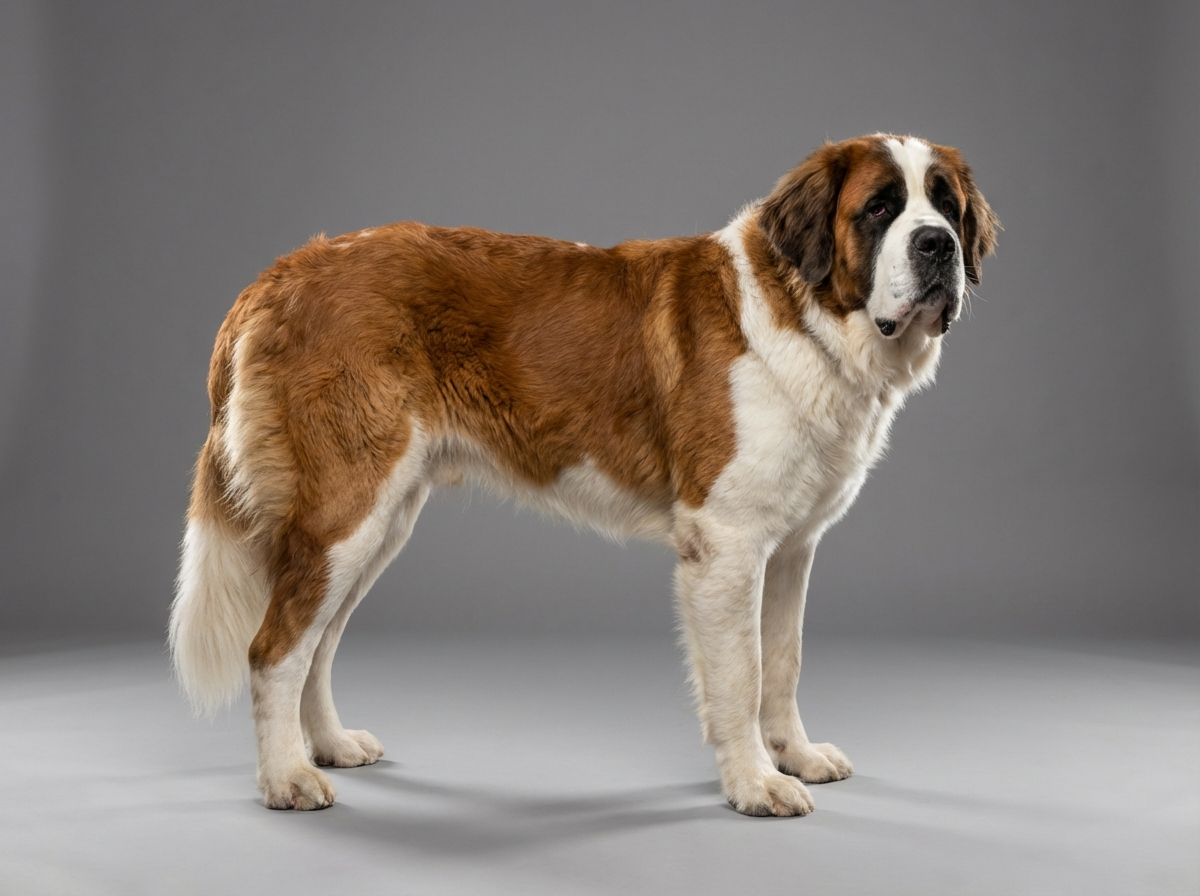
No. Saint Bernards have a proportionally built frame, not the elongated spine and shortened legs seen in chondrodystrophic breeds. Their back risk comes from sheer size and growth speed, not spinal shape.
Rapid growth during the first two years combined with the dog's eventual large adult weight — both add mechanical stress to the spine that a smaller or slower-growing breed does not experience to the same degree.
Moderate, controlled exercise is fine and important for development, but avoid repetitive high-impact activity like forced long runs or repeated jumping until growth plates have closed, generally around 18 to 24 months.
This page covers general strain and cumulative wear on back muscles and ligaments. A herniated or slipped disc is a distinct, more acute condition covered separately, though chronic strain can be a contributing factor over time.
Yes — every extra pound adds load the spine has to support with every step, which is especially significant in a breed that is already large by design.
A hunched or reluctant posture, refusal to jump, yelping when touched along the back, or a change in gait are all worth a vet visit rather than being dismissed as tiredness.
Not entirely, given the breed's size, but sensible growth-period management, weight control and non-slip flooring meaningfully reduce risk compared to no precautions at all.
Mainly from sheer body mass and a very fast growth rate, not from an unusually long spine — their build is proportional, unlike true long-backed breeds.
The first 18 to 24 months, while the skeleton is still growing and gaining substantial weight.
Yes — non-slip surfaces reduce the awkward slips and braces that commonly trigger acute back strain in heavy dogs.
Yes, especially in a growing puppy or a heavy adult — a ramp or step reduces repetitive high-impact landings.
Yes — reduced body weight lowers the mechanical load carried through the spine with every stride.
A one-page prep sheet for this condition: the signs, the questions to ask, what to get priced. Unlocks here.
You get: Vet visit prep sheet
No spam. One-click unsubscribe. See our privacy policy.
Preview page 1 before you decide.