Living
Which breed fits most families better?
The Saint Bernard, if you have the space and budget for a giant breed - it's friendlier, easier for a first-time owner, and calmer overall. The Malinois needs an experienced, active owner instead.

Quick answer
Which breed fits most families better?
The Saint Bernard, if you have the space and budget for a giant breed - it's friendlier, easier for a first-time owner, and calmer overall. The Malinois needs an experienced, active owner instead.
Belgian Malinois or Saint Bernard? On paper they differ most on exercise need, and on the scales Saint Bernard is the heavier at 120–180 lbs. Here is how the two compare on everything that shapes an ordinary week.
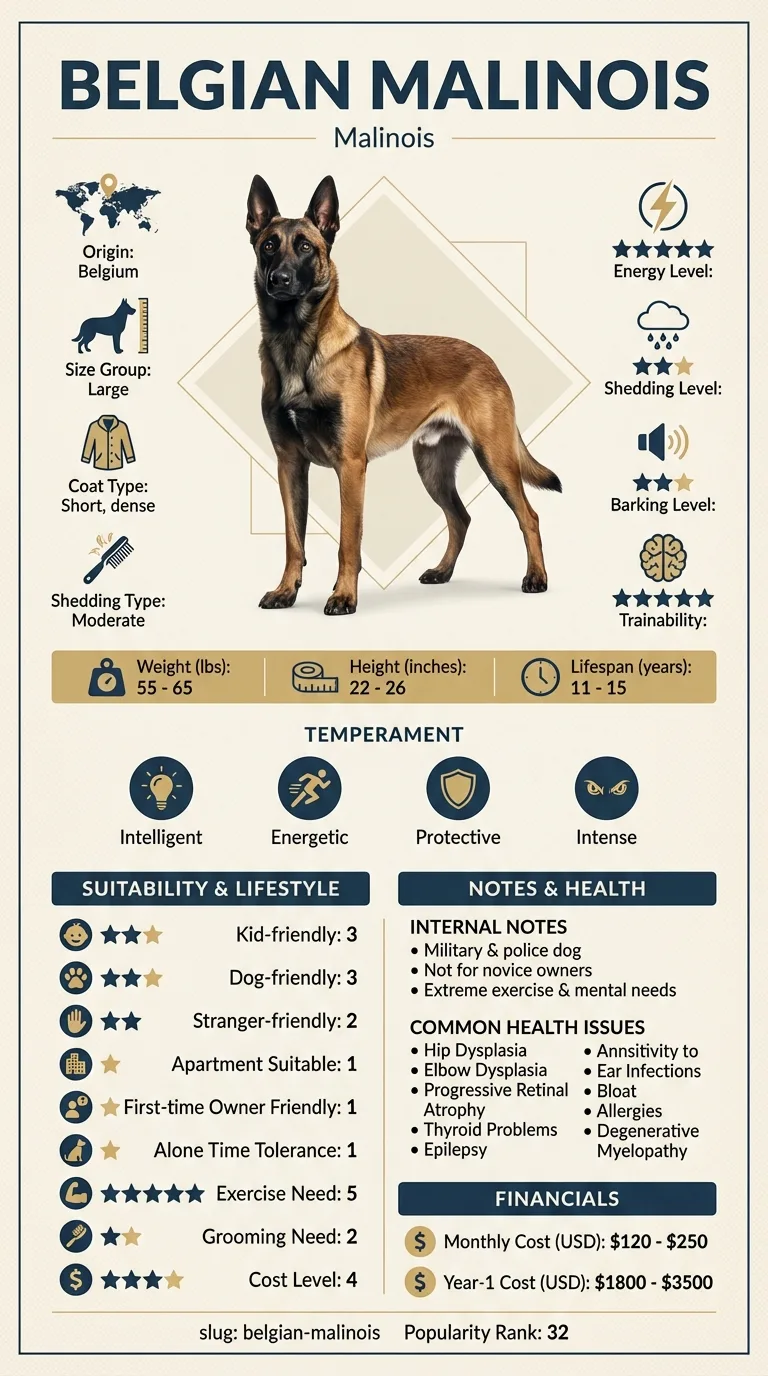
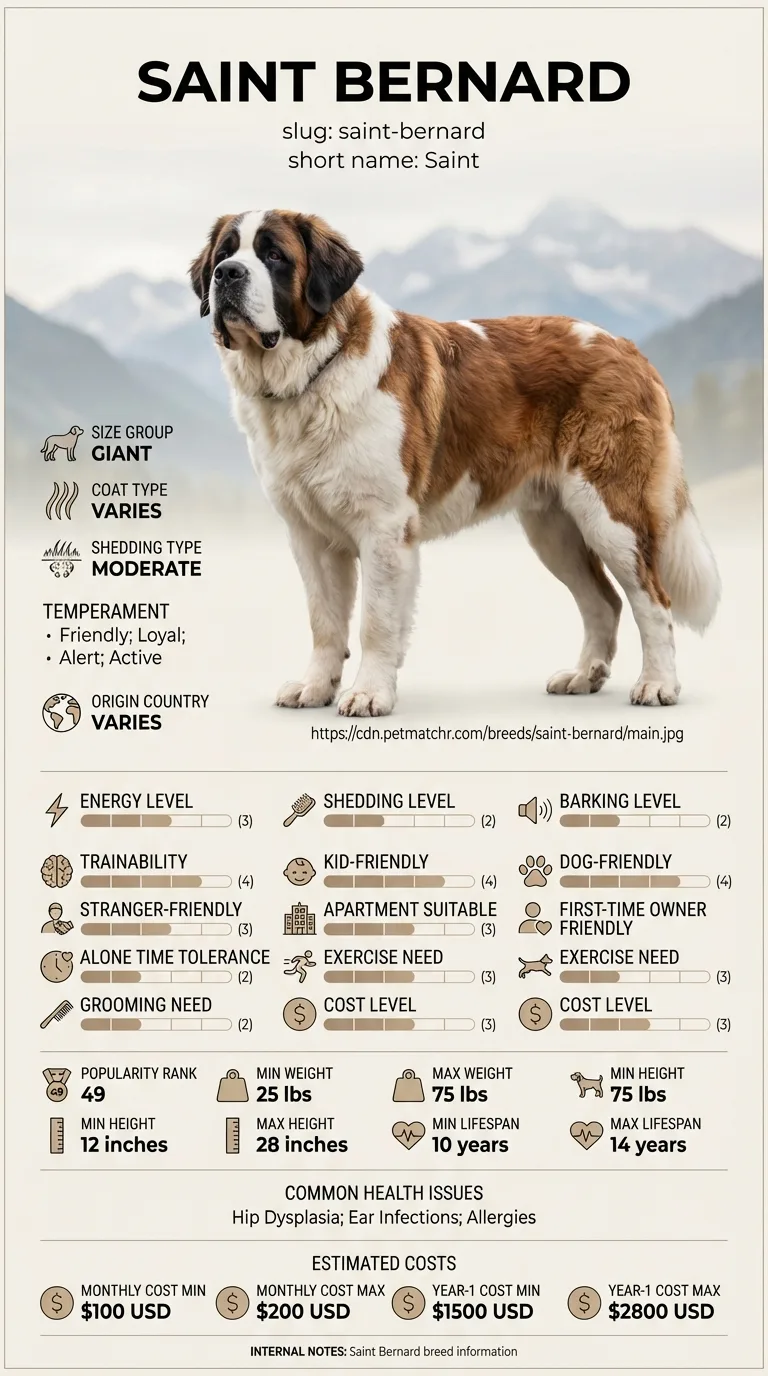
This is for someone already down to Belgian Malinois and Saint Bernard and deciding between them. For this pair the decision usually turns on exercise need and energy level, so those are covered first and in most detail. Both rate 1/5 for flats, so housing does not settle this one. It is written for the decision rather than the breed history.
Between Belgian Malinois and Saint Bernard, exercise need is what separates them, and Saint Bernard is the lower-effort dog of the two to keep.
Choose Belgian Malinois if you do not want a standing grooming appointment, shedding is a problem in your house and you want a dog that picks up training quickly.
Choose Saint Bernard if this is your first dog, your walking routine is modest and the dog will be alone during the working day.
| Feature | belgian malinois | saint bernard | Winner |
|---|---|---|---|
| Size class | large | giant | Equal |
| Weight | 55–65 lbs | 120–180 lbs | Equal |
| Height | 22–26 in | 26–30 in | Equal |
| Lifespan | 11–15 years | 8–10 years | belgian malinois |
| Exercise need | Very high (5/5) | Low (2/5) | saint bernard |
| Grooming need | Low (2/5) | Moderate (3/5) | belgian malinois |
| Shedding | Moderate (3/5) | High (4/5) | belgian malinois |
| Energy level | Very high (5/5) | Low (2/5) | Equal |
| Barking | Moderate (3/5) | Low (2/5) | saint bernard |
| Apartment suitability | Very low (1/5) | Very low (1/5) | Equal |
| Good for first-time owners | Very low (1/5) | Moderate (3/5) | saint bernard |
| Tolerates being alone | Very low (1/5) | Moderate (3/5) | saint bernard |
| Trainability | Very high (5/5) | Moderate (3/5) | belgian malinois |
| Good with kids | Moderate (3/5) | Very high (5/5) | saint bernard |
| Good with other dogs | Moderate (3/5) | High (4/5) | saint bernard |
| Friendly to strangers | Low (2/5) | High (4/5) | saint bernard |
| Cost level | High (4/5) | Very high (5/5) | belgian malinois |
| Coat | Short, dense | Short or long double coat | Equal |
| Origin | Belgium | Various | Equal |
| Typical monthly cost | $120–$250 | $150–$310 | Equal |
| Typical first-year cost | $1,800–$3,500 | $2,200–$4,200 | Equal |
This is the biggest size mismatch in the batch: the Saint Bernard runs 120-180 lbs and 26-30 inches, genuinely a giant breed, against the Malinois's 55-65 lbs and 22-26. A large adult Saint Bernard can outweigh the Malinois by more than double. If floor space and furniture durability factor into your decision, that gap alone should carry real weight. A Saint Bernard puppy also takes far longer to reach that full size, so plan for a slow, heavy-boned adolescence.
These two sit at nearly opposite ends of the activity scale. The Malinois rates 5/5 on exercise need, the Saint Bernard just 2/5 - giant breeds like this one are built for calm presence more than sustained work, and over-exercising a young Saint Bernard can actually stress its joints. A Saint Bernard wants a walk and a nap; a Malinois wants a job.
The Malinois wins both categories here - 2/5 grooming against the Saint Bernard's 3/5, and moderate shedding (3/5) against the Saint Bernard's high (4/5). A Saint Bernard's double coat, whether short or long-haired, sheds heavily and needs regular brushing to keep ahead of it, especially through seasonal blowouts. Expect noticeably more fur to manage around the house with the Saint Bernard.
Both breeds rate at the bottom for apartment suitability, tied at 1/5 - size and activity level rule out small spaces for very different reasons, the Malinois's drive and the Saint Bernard's sheer mass. Barking favors the Malinois slightly (3/5 moderate versus the Saint Bernard's 2/5 low), one of the few areas where the giant breed is the quieter housemate.
The Malinois trains faster and more precisely, rating 5/5 against the Saint Bernard's moderate 3/5 - this is a breed known for being loving but stubborn as an adult. First-time-owner scores flip that pattern: 3/5 for the Saint Bernard, just 1/5 for the Malinois. A gentle giant that's slower to train can still be an easier day-to-day dog than a sharp one that needs a firm handler.
The Saint Bernard wins clearly across kids (5/5 versus 3/5), other dogs (4/5 versus 3/5), and strangers (4/5 versus 2/5) - it's a breed developed around rescue work and gentle temperament with people. The Malinois's more reserved, discerning nature isn't a flaw, but it's a different kind of dog for a house full of visitors and children's friends. Keep the size gap in mind around toddlers - even gentle enthusiasm from a 150-lb dog can knock a small child over.
Lifespan is a stark contrast: the Malinois runs 11-15 years, the Saint Bernard just 8-10 - giant breeds typically age faster and this pairing shows why. Shared risks are hip and elbow dysplasia and bloat. The Saint Bernard's remaining risks (dilated cardiomyopathy, entropion) are largely giant-breed-specific, while the Malinois carries more working-dog concerns like degenerative myelopathy and thyroid problems. Regular cardiac screening is worth asking a Saint Bernard breeder about specifically.
The Saint Bernard is the pricier breed to keep, rating 5/5 (very high) against the Malinois's 4/5 (high) - $150-310 monthly versus $120-250, and $2,200-4,200 in the first year versus $1,800-3,500. Feeding a 150-lb dog, plus larger-format everything from crates to medications, adds up fast. Even routine items like a bed or crate cost noticeably more at that size, and pet insurance premiums typically run higher for giant breeds too.
Belgian Malinois weighs 55–65 lbs and lives 11–15 years; Saint Bernard weighs 120–180 lbs and lives 8–10 years. The two diverge most on exercise need, energy level and good for first-time owners and 4 other rated axes. Almost every rated axis separates them at least slightly. In the table, a "winner" means easier for an ordinary household — not better. Size, coat and origin are recorded without a verdict. Because both breeds are scored the same way, the gaps are reliable even where the absolute numbers are rough.

Substantially - 120-180 lbs and 26-30 inches versus 55-65 lbs and 22-26 for the Malinois. This is the largest size gap in this batch of comparisons, roughly double the weight at the high end.
The Malinois, by a wide margin - 11-15 years against just 8-10 for the Saint Bernard. Giant breeds tend to have shorter lifespans, and this pair illustrates that clearly.
Yes - it rates 3/5 for first-time owners against the Malinois's 1/5, despite being less trainable overall (3/5 versus 5/5). A calmer, more patient temperament can outweigh a slower learning curve for a new owner.
The Saint Bernard, rated 4/5 (high) against the Malinois's 3/5 (moderate), and it also needs more grooming overall (3/5 versus the Malinois's 2/5).
The Saint Bernard runs higher - $150-310 a month against $120-250 for the Malinois, reflecting the cost of feeding and caring for a genuinely giant breed.
Both share hip dysplasia, elbow dysplasia, and bloat risk. The Saint Bernard additionally carries dilated cardiomyopathy and entropion risk; the Malinois's list adds thyroid problems, epilepsy, and degenerative myelopathy.
The Saint Bernard, decisively - 5/5 with kids and 4/5 with strangers, against the Malinois's 3/5 and 2/5. Gentleness with people is essentially the Saint Bernard's defining trait.
The Saint Bernard, if you have the space and budget for a giant breed - it's friendlier, easier for a first-time owner, and calmer overall. The Malinois needs an experienced, active owner instead.
About $30-60 more per month - $150-310 versus $120-250 for the Malinois - and roughly $400-700 more in the first year.
The Malinois by a wide margin, 5/5 versus the Saint Bernard's 2/5 - one of the largest exercise-need gaps in this comparison set.
The Malinois, at 11-15 years against just 8-10 for the Saint Bernard - giant breeds typically run shorter lifespans, and this pairing reflects that.
Secure checkout on Stripe. We never see your card.
7-day money-back guarantee. Instant access.
Health information here is general and is not veterinary advice. If your dog shows pain, sudden behaviour change, or worsening symptoms, consult a licensed veterinarian.
Some links on this site are affiliate links. We may earn a commission at no extra cost to you, and we only suggest products we believe are helpful for dog owners.
We research and check what we publish, but we do not warrant that any figure, date, price, or statement is accurate, complete, or current, and we accept no liability for any loss, cost, injury, or other harm arising from the use of this site. Use it as one reference among several. You remain responsible for your own decisions and for your dog's care - confirm anything that matters with a licensed veterinarian or another qualified professional before you act on it. Full disclaimer.
Match your lifestyle to the right dog.
Take quizNot sure which breed is right for you? Take our 2-minute quiz to find out.
Take the quiz