Costs
Saint Bernard cost in Cheyenne
About $135–$279/month and $1,980–$3,780 for year one — one of the cheapest markets here, where the real constraint on a giant breed is stock and lead time rather than price.

See Saint Bernard price across all cities →
Quick answer
Saint Bernard cost in Cheyenne
About $135–$279/month and $1,980–$3,780 for year one — one of the cheapest markets here, where the real constraint on a giant breed is stock and lead time rather than price.
A Saint Bernard in Cheyenne costs about $135 to $279 a month, with the first year near $1,980 to $3,780 — among the lowest figures on this list, helped by Wyoming's low general cost of living and the absence of a state income tax. What Cheyenne does not offer is inventory. Wyoming is the least populous state in the country and Cheyenne is its largest city, which means the constraint on owning a cost-level-5 breed here is availability rather than affordability.
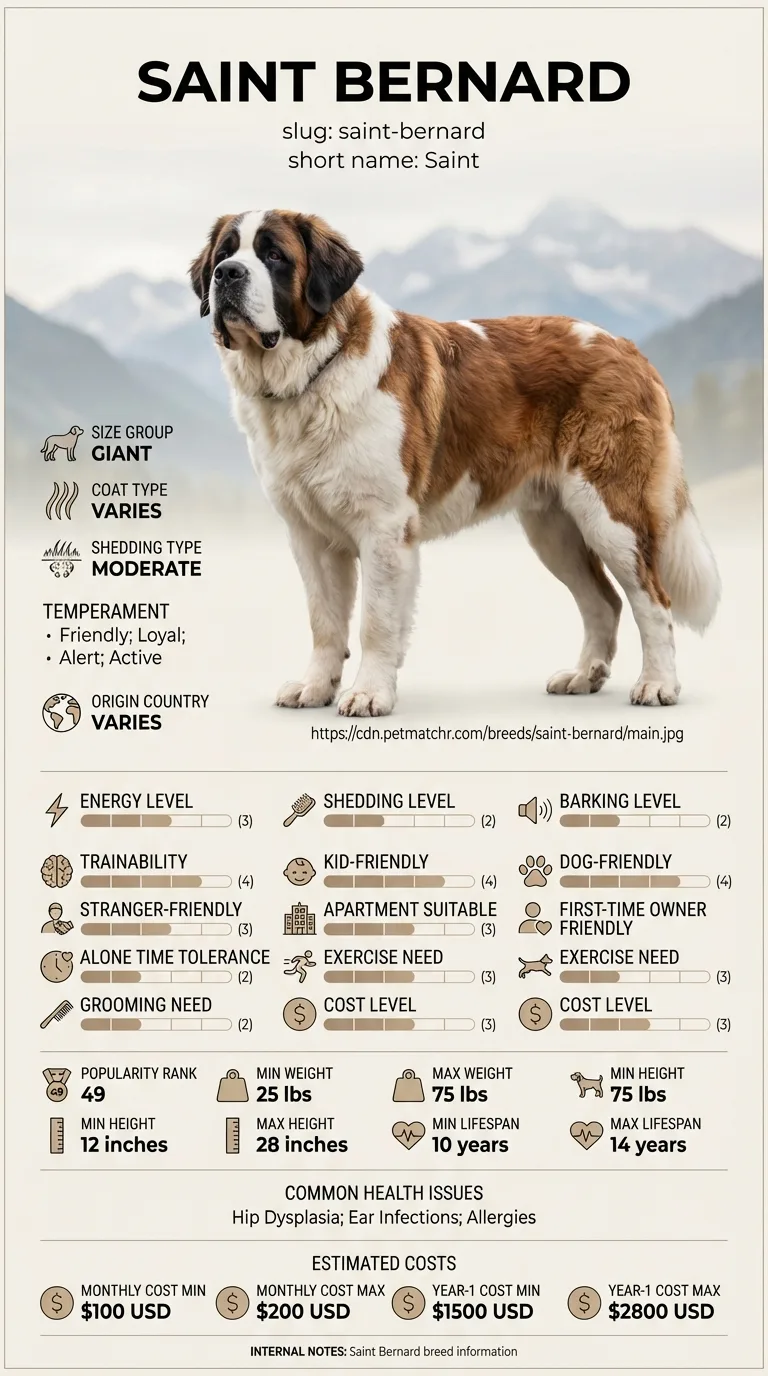
The documented conditions here are Hip Dysplasia, Elbow Dysplasia, Dilated Cardiomyopathy, Entropion and Bloat (GDV). Wyoming's low pricing softens the routine side of that list, but specialist capability is thin in a state this size, and a complex case may involve driving south along the Front Range as well as paying for it.
Cheyenne prices well under the national average, with a short parasite season and an ordering discipline that substitutes for the shelf availability a larger market provides.
Estimate · source: estimation · confidence: medium · updated 2026-09-06 · not a quote
| Item | Cost range |
|---|---|
One-time setup (giant crate, weight-rated bed, ramp, harness, first exam, spay/neuter) Best ordered as a single planned batch, since almost none of it is stocked locally and each item arrives on its own lead time. | $468 - $810 |
| Item | Cost range |
|---|---|
Food (bought with a bag of margin in hand) Wyoming's retail pricing is favourable; the discipline is keeping enough on hand that a stockout never forces an abrupt brand change. | $65 - $115 |
Parasite prevention (six-month high-plains window) Hard winters keep the schedule short, which counts double for a dog sitting in the top weight bracket for dosing. | $29 - $52 |
Each range starts from a national baseline for this breed's size class and is then adjusted for local cost of living and veterinary pricing. The baselines, and the source each one came from, are listed on our sources page (dataset 2026.09). Two inputs, the purchase price and the emergency reserve, have no published national figure we could verify, so we leave them to you rather than invent them.
These are planning estimates, not quotes. Your own numbers will move with the individual dog, your vet and your insurer. Build a budget with your own figures.
In Cheyenne the argument for insurance is less about local prices, which are low, and more about the possibility that serious care happens somewhere else.
Enrol early if a referral case with travel attached would be difficult to fund, and check how the policy treats care received outside your immediate area.
An owner with a solid reserve and the flexibility to travel for care is reasonably placed to self-fund in a market this affordable.
Cheyenne rewards planning more than shopping. The prices are already good; what costs money here is being caught without something.
Wyoming's cost profile is genuinely favourable. There is no state income tax, the general cost of living runs under the national line, and Cheyenne's veterinary and boarding pricing reflects that. The high-plains winter also keeps the parasite-prevention window to roughly six months, which is worth real money for a dog dosed in the top weight bracket.
The friction shows up somewhere else. Owning the largest category of dog in one of the smallest markets in the country means the things you need are the things nobody stocks. Prescription diets in giant-breed formulations, replacement bedding, a second crate for a vehicle, a muzzle or harness in the right size — each of those is a normal purchase in Denver and a two-week wait here.
None of that is expensive. It is simply a different planning discipline. The owners who do well in this market buy ahead, keep a spare of anything the dog destroys, and accept that the answer to running out is rarely a same-day trip across town.
Concretely, that means buying the setup items as a single planned order rather than as needed, and buying the durable version of each. A bed rated for the actual adult weight will not need replacing mid-winter, which matters more here than in a city where a replacement is an afternoon errand.
It also means being deliberate about food. A giant breed's consumption makes stockouts consequential, and abruptly switching brands because the usual one is unavailable is a genuine risk in a deep-chested dog. Keeping a bag of margin in the house is a cheap insurance policy in a market with a thin supply chain.
On the medical side, the sensible Cheyenne move is to know before you need it which referral practices along the Front Range handle giant-breed orthopedics and cardiology, and roughly how long the drive takes. That is a phone call and an afternoon, and it removes the worst kind of uncertainty from an already stressful day.

A Cheyenne family brought their Saint Bernard puppy home with a standard large crate, assuming they would size up locally when he outgrew it. He outgrew it faster than the special order arrived, and for two weeks there was simply no crate in the house that fit him. Nothing went badly wrong, but the housetraining routine came apart and had to be rebuilt. Everything they have bought for him since has been ordered a size and a season ahead.
Key takeaway: In Cheyenne the money is easy and the logistics are not. Order giant-breed gear before you need it, because there is rarely a shelf to fall back on.
About $135–$279, among the lowest on this list, supported by Wyoming's low cost of living and absence of a state income tax.
Roughly $1,980–$3,780 including the initial exam, spay/neuter and the giant-breed equipment order.
Because giant-size gear and formulations are low-turnover stock, and the least populous state does not support carrying items that sell a couple of times a year.
Keep a bag of margin in the house. Running out and switching brands abruptly is a real risk in a deep-chested dog, and same-day replacement is not always available here.
Worth quoting. Low local pricing does not reduce the cost of a giant-breed surgery, and a complex case may involve travel to a Front Range referral practice.
Around $1,100. It is set mostly by the dog's size rather than by Wyoming's affordable service pricing.
About $135–$279/month and $1,980–$3,780 for year one — one of the cheapest markets here, where the real constraint on a giant breed is stock and lead time rather than price.
This guide is not medical advice. If your dog shows pain, sudden behavior change, or worsening symptoms, consult a licensed veterinarian.
Some links may be affiliate links. We may earn a commission at no extra cost to you. We only suggest products we believe are helpful for dog owners.
We research and check what we publish, but we do not warrant that any figure, date, price, or statement is accurate, complete, or current, and we accept no liability for any loss, cost, injury, or other harm arising from the use of this site. Use it as one reference among several. You remain responsible for your own decisions and for your dog's care - confirm anything that matters with a licensed veterinarian or another qualified professional before you act on it. Full disclaimer.
One sheet with every line item, the emergency fund and when insurance pays off - unlocks on this page.
You get: 12-month budget sheet
No spam. One-click unsubscribe. See our privacy policy.
Preview page 1 before you decide.