Living
Easier for a first-time owner?
The Pug, rated Very high (5/5) versus the Schnauzer's Moderate (3/5).

Quick answer
Easier for a first-time owner?
The Pug, rated Very high (5/5) versus the Schnauzer's Moderate (3/5).
Pug or Schnauzer (Standard)? On paper they differ most on shedding, and on the scales Schnauzer (Standard) is the heavier at 26–50 lbs. Here is how the two compare on everything that shapes an ordinary week.
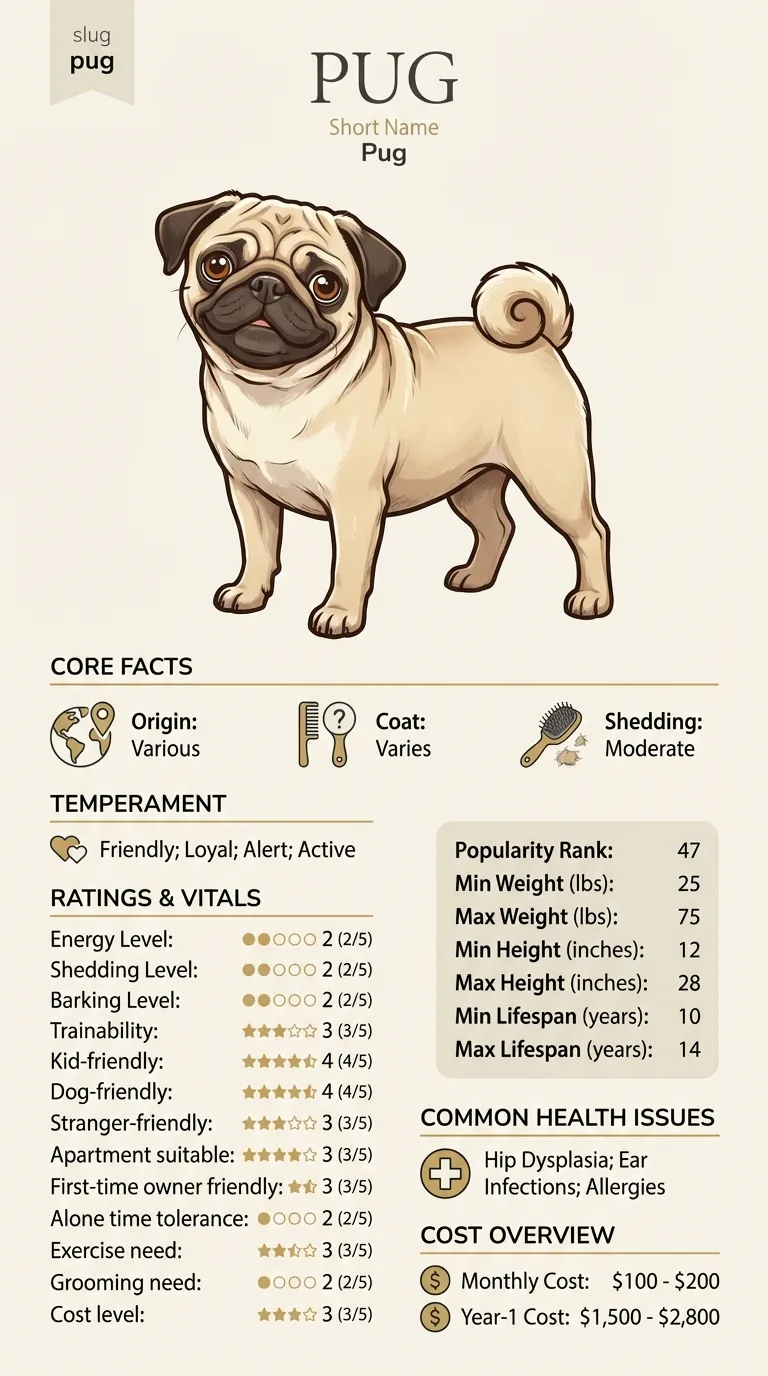
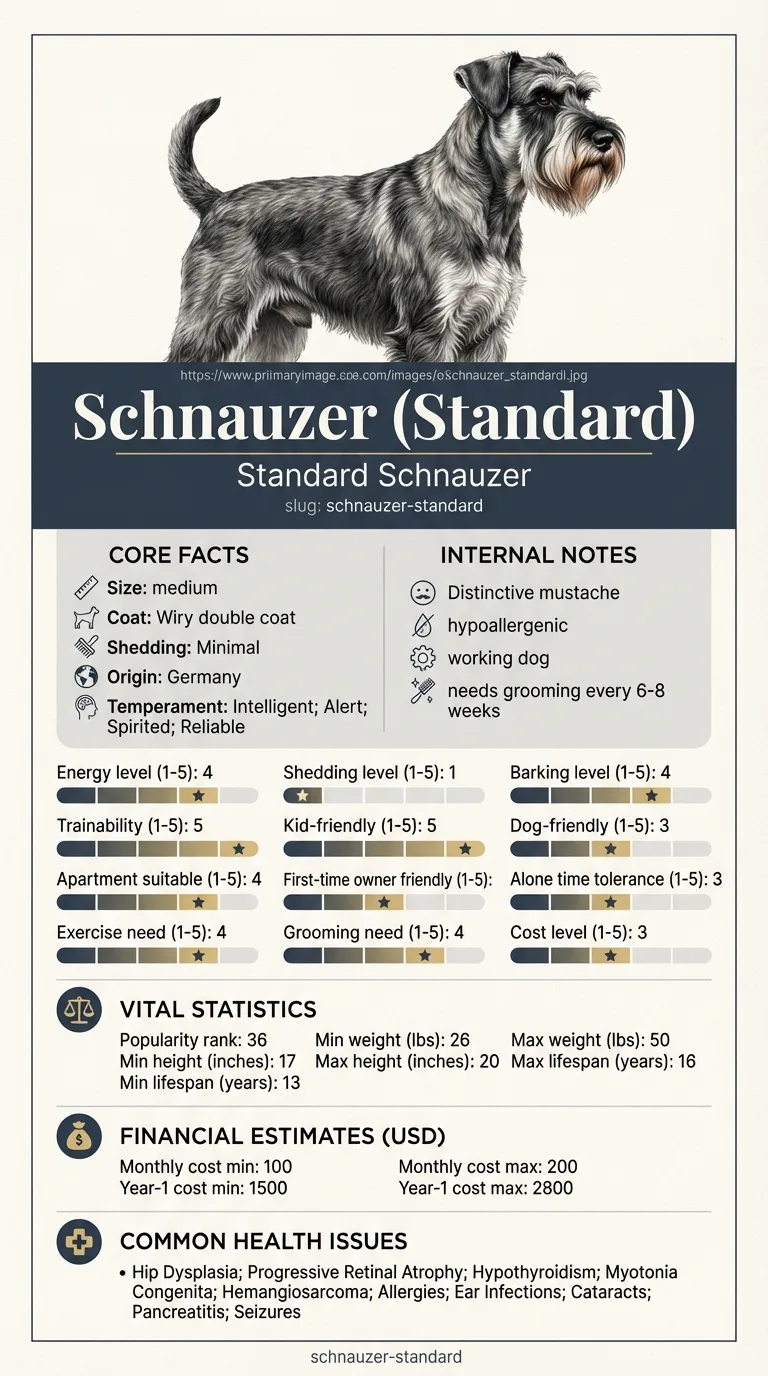
This is for someone already down to Pug and Schnauzer (Standard) and deciding between them. For this pair the decision usually turns on shedding and exercise need, so those are covered first and in most detail. Anyone choosing from a flat has a clear answer here: Pug rates 5/5 against 4/5. It is written for the decision rather than the breed history.
Between Pug and Schnauzer (Standard), shedding is what separates them, and Pug is the lower-effort dog of the two to keep.
Choose Pug if you are in a flat or a smaller home, this is your first dog and you do not want a standing grooming appointment.
Choose Schnauzer (Standard) if shedding is a problem in your house, the dog will be alone during the working day and you want a dog that picks up training quickly.
| Feature | pug | schnauzer standard | Winner |
|---|---|---|---|
| Size class | small | medium | Equal |
| Weight | 14–18 lbs | 26–50 lbs | Equal |
| Height | 10–13 in | 17–20 in | Equal |
| Lifespan | 13–15 years | 13–16 years | schnauzer standard |
| Exercise need | Low (2/5) | High (4/5) | pug |
| Grooming need | Low (2/5) | High (4/5) | pug |
| Shedding | High (4/5) | Very low (1/5) | schnauzer standard |
| Energy level | Low (2/5) | High (4/5) | Equal |
| Barking | Low (2/5) | High (4/5) | pug |
| Apartment suitability | Very high (5/5) | High (4/5) | pug |
| Good for first-time owners | Very high (5/5) | Moderate (3/5) | pug |
| Tolerates being alone | Low (2/5) | Moderate (3/5) | schnauzer standard |
| Trainability | Moderate (3/5) | Very high (5/5) | schnauzer standard |
| Good with kids | Very high (5/5) | Very high (5/5) | Equal |
| Good with other dogs | High (4/5) | Moderate (3/5) | pug |
| Friendly to strangers | Very high (5/5) | Moderate (3/5) | pug |
| Cost level | Moderate (3/5) | Moderate (3/5) | Equal |
| Coat | Short, smooth double coat | Wiry double coat | Equal |
| Origin | Various | Germany | Equal |
| Typical monthly cost | $80–$150 | $100–$200 | Equal |
| Typical first-year cost | $1,100–$2,300 | $1,500–$2,800 | Equal |
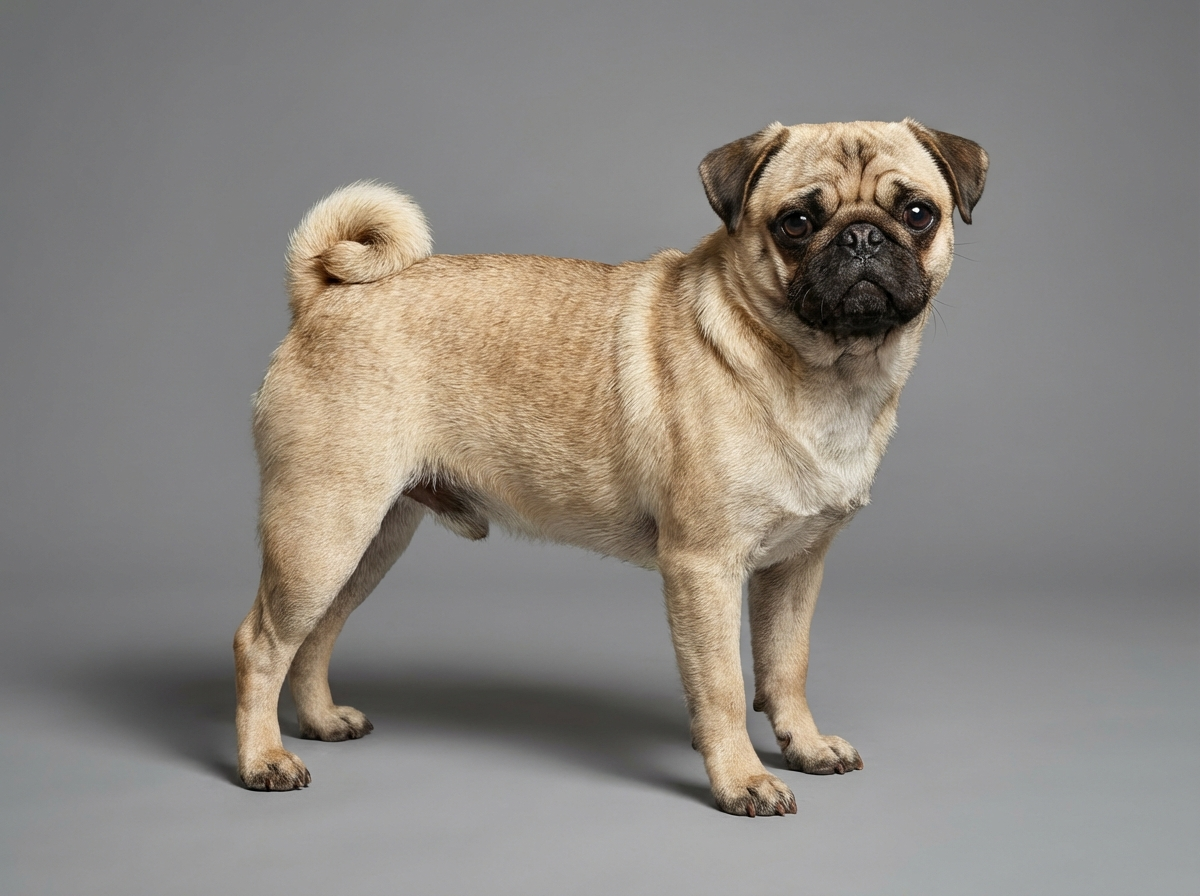
Step up one size class and the Standard Schnauzer is roughly double the Pug's weight, running 26–50 pounds and standing 17–20 inches versus the Pug's 14–18 pounds and 10–13 inches. The build difference is just as notable in shape: the Pug is a compact, square, brachycephalic dog, while the Standard Schnauzer has a squarely-proportioned, athletic frame with a distinctive wiry coat and bearded muzzle built for working farm duty in Germany. Neither breed counts as large, but the Schnauzer's leaner, more muscular structure means it needs more room to move than its weight alone suggests, especially for daily off-leash time.
Exercise need tells a clear story: Low (2/5) for the Pug against High (4/5) for the Standard Schnauzer, a breed originally built to work all day on German farms and still needing real daily activity to stay settled. Energy level readings list Low for the Pug and High for the Schnauzer too, though both breeds can surprise owners — a Schnauzer left under-exercised tends to get vocal and destructive, while a Pug's energy ceiling is capped by its breathing more than its motivation. A 30-minute brisk walk or play session is closer to what the Schnauzer needs daily than the short strolls a Pug is happy with.
Grooming flips the usual small-dog assumption: the Pug needs only Low (2/5) grooming while the wiry-coated Standard Schnauzer needs High (4/5), including regular hand-stripping or clipping to keep its coat's texture and color correct. Shedding runs the opposite direction — High (4/5) for the Pug against Very low (1/5) for the Schnauzer, whose wiry double coat is prized precisely because it holds onto dead hair instead of scattering it. In practice this means Schnauzer owners trade a grooming-table habit and semi-regular professional visits for a couch that stays far cleaner than a Pug owner's ever will.
Barking is the category to weigh most carefully here: Low (2/5) for the Pug versus High (4/5) for the Standard Schnauzer, a breed bred partly as a farm watchdog and still quick to sound off at noises, visitors, or boredom. Apartment suitability follows a similar pattern, Very high (5/5) for the Pug against a still-respectable High (4/5) for the Schnauzer. A Schnauzer can absolutely live in an apartment, but thin walls and a vocal, alert temperament are a combination worth testing with neighbors' patience in mind before committing, especially compared to the near-silent Pug.
There's a real tradeoff in this category. The Standard Schnauzer rates Very high (5/5) for trainability — it's a genuinely quick, willing learner descended from working stock — while the Pug sits at a more modest Moderate (3/5), often more interested in charm than compliance. Yet for first-time owners the ranking reverses: Very high (5/5) for the Pug against Moderate (3/5) for the Schnauzer, whose intelligence and spirited, reliable-but-independent streak can outpace a novice's handling skills. In short, an experienced trainer gets more out of a Schnauzer, while a first-timer will find the Pug the more forgiving companion day to day.
Both breeds score Very high (5/5) with kids, so families aren't choosing between them on that basis. The gap opens with other dogs and strangers: the Pug rates High (4/5) for sociability with other dogs and Very high (5/5) with strangers, while the Standard Schnauzer sits at Moderate (3/5) on both. That tracks with the Schnauzer's alert, reliable temperament — it tends to size up new dogs and unfamiliar people before warming up, rather than greeting everyone the way a Pug typically does. Households that host frequently or run a dog park routine may find the Pug's instant friendliness the easier fit.
Lifespan is close — 13–15 years for the Pug against 13–16 for the Standard Schnauzer — but the health picture diverges sharply in scope. The Schnauzer's list runs to ten conditions, including Hip Dysplasia, Progressive Retinal Atrophy, Hemangiosarcoma, Pancreatitis, and Seizures, reflecting a breed with a broader range of documented hereditary concerns to screen for. The Pug's shorter list of five is narrower but more severe per-condition, centered on its flat face and compact spine: Brachycephalic Airway Syndrome, Pug Dog Encephalitis, Corneal Ulcers, Hemivertebrae, and Obesity. Prospective owners of either breed should ask breeders for the relevant genetic and cardiac screening results before committing.
Cost level is rated Moderate (3/5) for both breeds, but the dollar figures still favor the Pug: $80–$150 monthly and $1,100–$2,300 in year one, against the Schnauzer's $100–$200 and $1,500–$2,800. The difference is mostly grooming-driven — regular hand-stripping or professional clipping for that wiry coat adds a recurring expense the low-maintenance Pug simply doesn't have. Add in the larger food portions a 26–50 pound dog requires compared to a 14–18 pound one, and the Schnauzer's ongoing budget runs noticeably higher even though both land in the same 'moderate' cost tier overall.
Pug weighs 14–18 lbs and lives 13–15 years; Schnauzer (Standard) weighs 26–50 lbs and lives 13–16 years. The two diverge most on shedding, exercise need and grooming need and 5 other rated axes. They are level on cost level and good with kids, so those cannot decide it. In the table, a "winner" means easier for an ordinary household — not better. Size, coat and origin are recorded without a verdict. Because both breeds are scored the same way, the gaps are reliable even where the absolute numbers are rough.

The Standard Schnauzer by far — Very low (1/5) shedding versus the Pug's High (4/5) — but it needs High (4/5) grooming effort in return.
No, actually easier — the Schnauzer rates Very high (5/5) for trainability against the Pug's Moderate (3/5), though the Pug is still the more forgiving choice for a first-time owner.
The Standard Schnauzer, rated High (4/5) versus the Pug's Low (2/5), reflecting its farm-watchdog heritage.
No — the Pug needs only Low (2/5) exercise, while the Standard Schnauzer needs High (4/5) daily activity to stay settled.
The Pug, which rates Very high (5/5) friendliness to strangers against the Schnauzer's Moderate (3/5).
The Standard Schnauzer's list runs to ten conditions including Hemangiosarcoma and Seizures, versus five for the Pug.
Close but not identical — both rate Moderate (3/5) overall, though the Schnauzer's grooming needs push its monthly cost about $20–$50 higher.
The Pug, rated Very high (5/5) versus the Schnauzer's Moderate (3/5).
The Pug, rated Low (2/5) barking against the Schnauzer's High (4/5).
The Standard Schnauzer, rated High (4/5) versus the Pug's Low (2/5).
The Standard Schnauzer, rated Very low (1/5) versus the Pug's High (4/5).
See every pug comparison.
Secure checkout on Stripe. We never see your card.
7-day money-back guarantee. Instant access.

Health information here is general and is not veterinary advice. If your dog shows pain, sudden behaviour change, or worsening symptoms, consult a licensed veterinarian.
Some links on this site are affiliate links. We may earn a commission at no extra cost to you, and we only suggest products we believe are helpful for dog owners.
We research and check what we publish, but we do not warrant that any figure, date, price, or statement is accurate, complete, or current, and we accept no liability for any loss, cost, injury, or other harm arising from the use of this site. Use it as one reference among several. You remain responsible for your own decisions and for your dog's care - confirm anything that matters with a licensed veterinarian or another qualified professional before you act on it. Full disclaimer.
Match your lifestyle to the right dog.
Take quizNot sure which breed is right for you? Take our 2-minute quiz to find out.
Take the quiz