Health
Is a squinting eye in a Papillon urgent?
Yes. Squinting with watering, redness or pawing at the face suggests ocular pain, which can mean a corneal ulcer or glaucoma. Both need same day care.

Quick answer
Is a squinting eye in a Papillon urgent?
Yes. Squinting with watering, redness or pawing at the face suggests ocular pain, which can mean a corneal ulcer or glaucoma. Both need same day care.
Progressive retinal atrophy is the one you screen for. A painful eye is the one you drive for.
Owners staring at a Papillon that has suddenly started holding one eye half shut, and buyers trying to work out what an eye certificate on a breeder's paperwork actually covers.
This guide is not medical advice. If your dog shows pain, sudden behavior change, or worsening symptoms, consult a licensed veterinarian.
Some links may be affiliate links. We may earn a commission at no extra cost to you. We only suggest products we believe are helpful for dog owners.
We research and check what we publish, but we do not warrant that any figure, date, price, or statement is accurate, complete, or current, and we accept no liability for any loss, cost, injury, or other harm arising from the use of this site. Use it as one reference among several. You remain responsible for your own decisions and for your dog's care - confirm anything that matters with a licensed veterinarian or another qualified professional before you act on it. Full disclaimer.
Ocular disease in Papillons falls into two groups with completely different urgency. Inherited retinal degeneration is slow, painless and progressive, and it is managed through breeder screening rather than treatment. Acquired surface and pressure problems, principally corneal ulceration and glaucoma, arrive suddenly, cause obvious pain, and can permanently damage the eye within a day or two if they are not seen promptly.
Progressive retinal atrophy is documented among the Papillon's common health issues, which is precisely why specialist eye examination is standard practice for breeding animals in this breed. Acute painful eye conditions are not breed specific but are common across all dogs, and a Papillon's fourteen to sixteen year lifespan gives more opportunity for them to occur.
The inherited component is retinal: photoreceptor cells degenerate over time in affected dogs, and because the condition is recessive in many breeds, apparently healthy parents can produce affected puppies. That is the entire rationale for screening. On the acquired side, the Papillon has a well proportioned fine muzzle rather than the shallow orbits of a flat faced breed, so its eyes are relatively less exposed to injury than a brachycephalic dog's, though a nine inch tall animal still travels at eye level through undergrowth.
Grass seeds, thorns, dust and the sharp corners of low furniture are all at Papillon eye height. Long facial hair, though not extreme in this breed, can carry debris toward the eye if it is left untrimmed. Households with cats have a specific risk, since cat claw injuries to the cornea are common and are frequently deep. Dry indoor air and forced air heating aggravate any tendency toward inadequate tear production.
Go the same day for any eye that is squinting, watering, red, cloudy or being pawed at, and treat a suddenly dilated pupil with a painful red eye as an emergency, because glaucoma can destroy vision within a day or two. Also go promptly for any wound near the eye, any protruding eye, or a dog that has become abruptly unwilling to move around at night. Book a routine appointment for gradual haziness in an older dog with no pain, and for any concern about how well your dog is seeing.
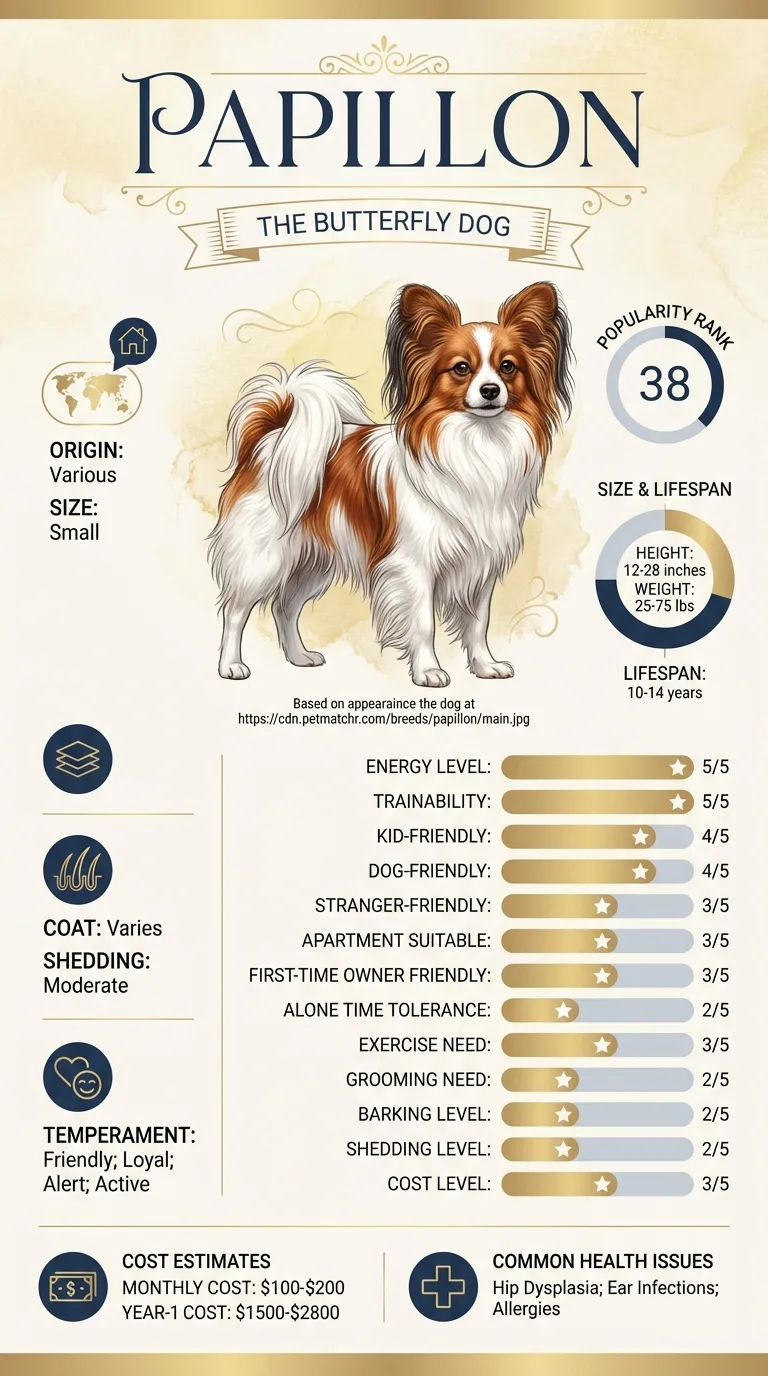
See all Papillon health problems, which breeds are prone to ocular disease, or the full Papillon breed guide for temperament, exercise needs and ownership costs.
A superficial corneal ulcer typically heals in under a week with appropriate treatment; deeper ones take longer and may need surgery. Glaucoma is managed rather than cured and outcomes depend heavily on how fast pressure was lowered. Retinal degeneration progresses over months to years and cannot currently be halted, though the dog adapts as it goes.
Success is an acute eye problem caught the day it appeared and resolved with the eye intact, and, for inherited disease, a dog whose vision loss was anticipated and whose home was adapted before it started walking into furniture.
Three signs together indicate ocular pain: squinting or holding the lid partly closed, excessive watering, and rubbing or pawing at the face. Add redness and you have a dog that needs an appointment the same day.
A corneal ulcer is the commonest cause. The cornea is the clear front surface, and a scratch from a twig, a rough play session or a grass seed breaks its protective outer layer. Ulcers are painful, they can deepen quickly, and a deep one can perforate. They are usually straightforward to treat when caught early and much less so when they are not.
Glaucoma is the emergency that owners have generally never heard of. Fluid produced inside the eye cannot drain properly, pressure climbs, and the optic nerve is damaged by that pressure. Vision can be lost permanently within a day or two if the pressure is not brought down. The eye may look red, the pupil may be dilated and unresponsive, the surface may go cloudy, and the dog is usually in considerable pain, often shown as lethargy or withdrawal rather than as vocalisation.
Because an ulcer and glaucoma look superficially similar and are treated very differently, and because some treatments for one are harmful in the other, this is not a situation for leftover drops from a previous episode. Never put any medication into a painful eye without a vet examining it first.

Screening is the reason inherited blindness is less common than it used to be. It is only useful if you know what you are being shown.
If you think your Papillon has ocular disease, the plan is three steps: write down what you have seen and when it started, book a veterinary appointment rather than waiting for the next flare, and take video of the behaviour or symptom before you go — the thing you are worried about rarely happens in the consulting room. Screening in the parents covers patellar luxation, progressive retinal atrophy, dental disease.
What the vet visit should produce is a diagnosis and a written plan, not just reassurance: what is being ruled out, what the monitoring interval is, and which signs mean you come back sooner. Ask what the treatment costs across a year rather than per visit, because that is the number that decides whether you are managing this condition or reacting to it.
Between appointments, keep a short log — dates, what you saw, what changed. It is the single most useful thing an owner brings to a follow-up, and for ocular disease it is often what separates a clear pattern from a guess.
Ravi noticed his Papillon Odette holding her left eye half closed after a walk through long grass. She was watering, kept rubbing her face along the sofa, and had gone unusually quiet. Ravi had a bottle of eye drops left from an infection eighteen months earlier and nearly used it. Instead he rang the emergency service, who told him firmly not to put anything in and to come in. A stain test lit up a corneal ulcer, and a grass seed was found under the third eyelid. The seed was removed, the ulcer treated, and Odette was comfortable within two days and healed inside a week. The vet mentioned that the old drops in Ravi's cupboard contained a steroid, which would have been the wrong thing entirely for an ulcerated cornea.
Key takeaway: A painful eye is a same day problem, and the most dangerous thing in the house is the leftover bottle from last time. Get it examined, get it stained, and let the diagnosis choose the treatment.
Progressive retinal atrophy is the documented inherited eye condition in the breed, causing gradual painless vision loss. Beyond that, Papillons are subject to the same acquired problems as other dogs: corneal ulcers, dry eye, cataracts in later life, and inflammation. Their fine muzzle means the eyes sit less exposed than in flat faced breeds, which is a modest advantage.
Squinting, holding the eye partly closed, watering, pawing at the face, rubbing along furniture, and avoiding bright light. A dog in ocular pain often also goes quiet and withdrawn, which owners mistake for tiredness. Any of these signs with redness means the same day, not the next available slot.
It depends on what else is happening. Sudden cloudiness with pain, redness and squinting can indicate glaucoma or a deep corneal problem and needs immediate assessment. Gradual haziness in the lens of an older dog with no pain is more likely to be an age related change or a cataract and warrants an appointment rather than a dash.
No, and this is one of the more important warnings on this page. Some eye medications are actively harmful when the cornea is ulcerated, and using the wrong one can turn a treatable problem into a lost eye. Take the dog in and let an examination, including a stain test for ulceration, direct treatment.
Remarkably well when vision is lost gradually, because dogs navigate substantially by smell and memory and adapt as they go. Owners often find the adjustment harder than the dog does. Keeping furniture in fixed positions, using consistent verbal cues and blocking stairs are the practical changes that matter most.
Yes, and treat them as one of the two most important documents alongside a patellar evaluation. Ask for current examinations on both parents, check the dates, and ask what the breeder does if a dog fails. A breeder who can name a dog they retired for an eye finding is telling you the screening is genuine.
Yes. Squinting with watering, redness or pawing at the face suggests ocular pain, which can mean a corneal ulcer or glaucoma. Both need same day care.
Progressive retinal atrophy, which causes gradual painless vision loss. It is the reason breeders should hold current specialist eye examinations on both parents.
Not without a vet examining it first. Some eye medications are harmful when the cornea is ulcerated and can turn a treatable problem into a lost eye.
Commonly around a year, because inherited eye disease can appear later in life. Check the date on any certificate you are shown.
A one-page prep sheet for this condition: the signs, the questions to ask, what to get priced. Unlocks here.
You get: Vet visit prep sheet
No spam. One-click unsubscribe. See our privacy policy.
Preview page 1 before you decide.