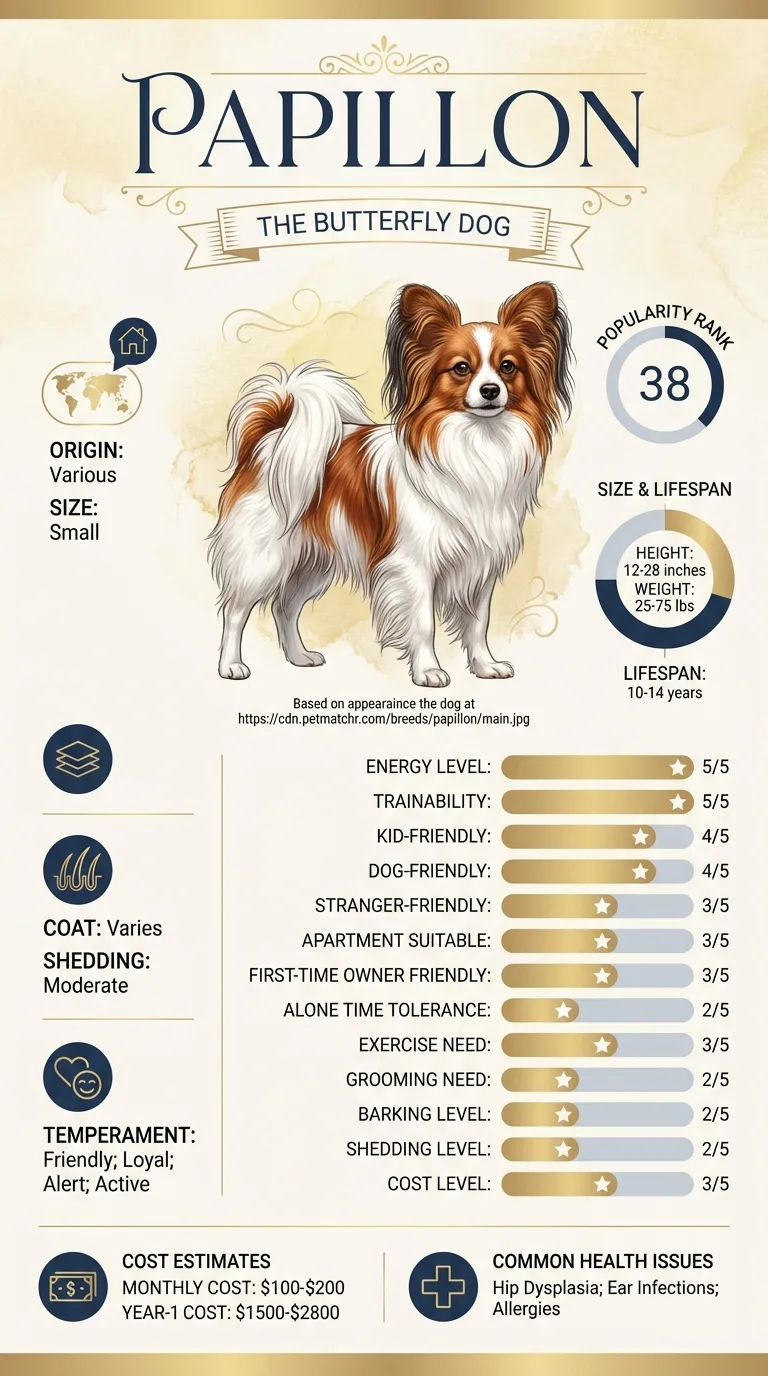
Cancer in Papillons: Longevity, Lumps and Realistic Odds
Quick answer
How often should I check my Papillon for lumps?
Monthly, systematically, with the dog relaxed on your lap. The silky single coat parts easily, so a full nose-to-tail check takes about five minutes and finds things far earlier than a routine annual visit.
Papillons are not on the list of breeds vets brace themselves for. They are, however, on the list of breeds that live long enough to get old.
Owners who have felt a lump under a silky coat and are waiting for an appointment, and owners of a senior Papillon who want a sensible monitoring routine rather than a monthly panic.
Important reminder
This guide is not medical advice. If your dog shows pain, sudden behavior change, or worsening symptoms, consult a licensed veterinarian.
Some links may be affiliate links. We may earn a commission at no extra cost to you. We only suggest products we believe are helpful for dog owners.
We research and check what we publish, but we do not warrant that any figure, date, price, or statement is accurate, complete, or current, and we accept no liability for any loss, cost, injury, or other harm arising from the use of this site. Use it as one reference among several. You remain responsible for your own decisions and for your dog's care - confirm anything that matters with a licensed veterinarian or another qualified professional before you act on it. Full disclaimer.
What this problem looks like
Cancer covers a huge range of conditions, from a small skin mass that is cured by removal to an aggressive internal tumour found late. In a Papillon it is an old-dog problem rather than a breed problem: nothing in the documented health profile predisposes to it, but a fourteen to sixteen year lifespan means a substantial proportion of individuals reach an age where tumours become likely across all breeds.
Common triggers
Age itself, which is by far the strongest determinant across every breed
Remaining unspayed, which leaves mammary tumour risk substantially higher
Chronic inflammation at a site, including long-standing untreated dental disease
Sun exposure on thinly haired or unpigmented skin, particularly the belly and nose
Environmental smoke, which raises risk of nasal and respiratory tumours in dogs sharing the household
Cancer is a leading cause of death in dogs over ten across all breeds, so it is common in absolute terms. What differs is the age of onset. In predisposed breeds it arrives in middle age; in a Papillon it belongs to the last third of a long life, and many individuals reach fifteen or sixteen without ever encountering it.
Why this happens
Breed factors
The Papillon's contribution is longevity rather than predisposition. Fourteen to sixteen years is at the upper end of canine lifespans, and cancer risk climbs steeply with each additional year. The breed's documented issues are structural and degenerative rather than neoplastic. One indirect link is worth noting: dental disease is on the breed's list, and chronic oral inflammation is a site where masses in the mouth can develop and be missed under a lip that is rarely lifted.
Environment factors
The measurable environmental influences are the ordinary ones. Household tobacco smoke raises respiratory and nasal tumour risk in dogs living with it. Ultraviolet exposure matters for a small dog that likes to lie on its back in the sun, since the belly skin is thinly haired and often unpigmented. Obesity contributes to risk across species. None of these override age, and none of them are reasons for guilt if a tumour appears.
What you can do at home (once it is not an emergency)
When to talk to your vet
Book promptly for any lump that is new, that has grown, that is firm and fixed to the tissue beneath, that is ulcerated or bleeding, or that is anywhere on the mammary line of an unspayed female. Also book promptly for unexplained weight loss, a drop in appetite lasting more than a couple of days, a persistent cough, difficulty swallowing, or lameness that does not resolve. Seek urgent attention for pale or white gums with weakness, a rapidly distending abdomen, uncontrolled bleeding from a mass, or sudden collapse, since a bleeding internal tumour is a genuine emergency.
At home, alongside your vet's plan
Do a monthly nose-to-tail lump check on a body map sheet, recording location and size rather than trusting memory.
Weigh your dog on the same kitchen scale each month and keep the numbers, since trend matters more than any single reading.
Lift the lips and look at the gums and under the tongue during tooth brushing, which is where oral masses hide.
Photograph any lump next to a coin so growth can be judged objectively at the next appointment.
Provide shade for a dog that sunbathes on its back, because the belly is the least protected skin on a Papillon.
A needle sample usually returns results within a few days, and a surgical biopsy within one to two weeks. A small skin mass removed completely can be finished business within a fortnight. Chemotherapy protocols run over three to six months of regular visits. Outcomes range from cure to palliation depending on tumour type, and the honest answer to most prognostic questions arrives only after the laboratory report.
For a skin mass, success is a complete excision with clean margins and a dog that forgets the whole thing. For internal disease, success is often measured in good months rather than cure: comfortable, eating, interested, still greeting the door. For most Papillon owners, the realistic version of success is a monthly checking habit that catches something small enough to remove.
Finding lumps under a single silky coat
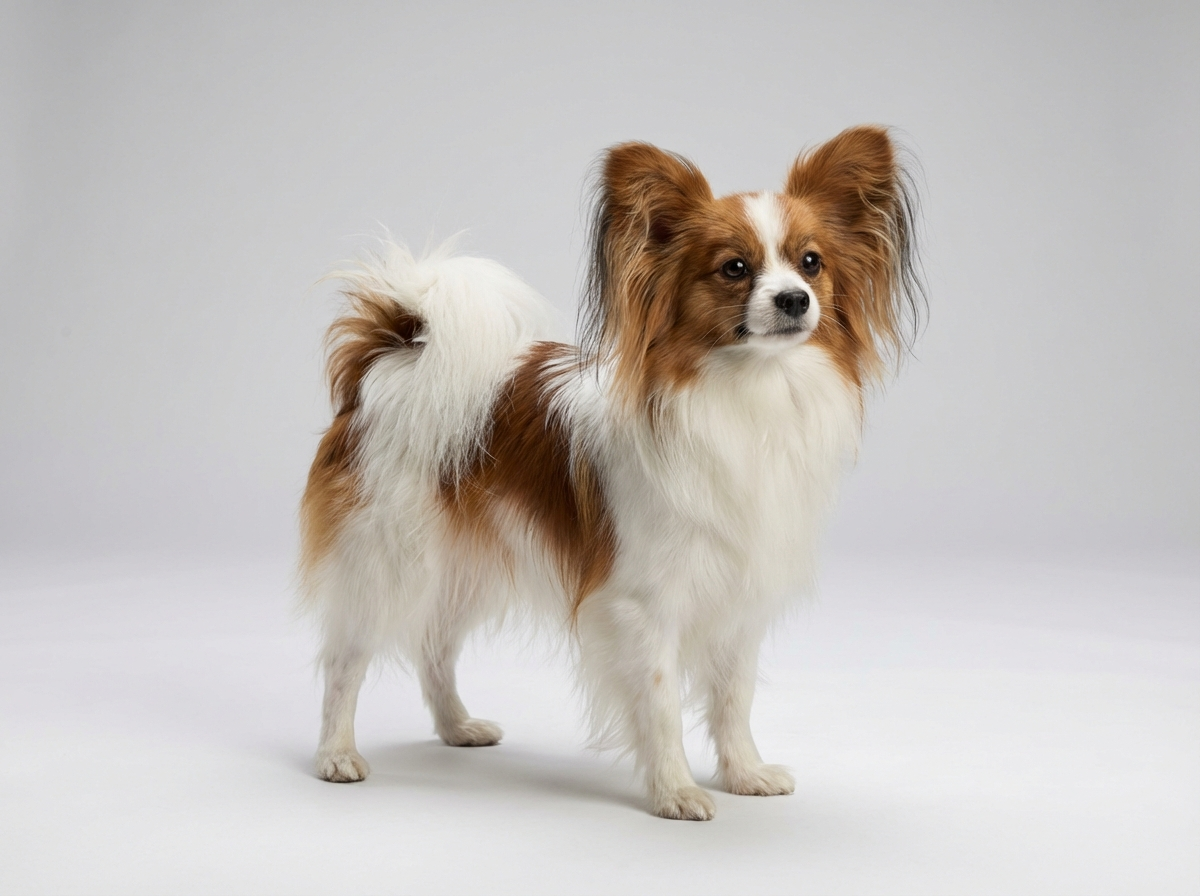
The Papillon coat is an advantage here. A long, silky single layer with no dense woolly undercoat parts easily and lies flat against the skin, so a lump the size of a pea is findable by hand in a way it would not be on a double-coated dog.
Build a routine rather than relying on chance. Once a month, with the dog relaxed on your lap, work systematically: start at the muzzle, then the throat and under the jaw, along each shoulder and down each front leg, along the ribs and the spine, over the belly and the mammary line, then the hips, the hind legs, the tail base and finally between every pair of toes.
Write down what you find and where, with a rough size. A body map on a sheet of paper beats memory. Photograph anything new alongside a coin for scale.
What matters at the next check is not whether a lump exists but whether it has changed. Most Papillons past ten will have at least one soft fatty lump that stays exactly the same for years.
Cancer in Papillons - Finding lumps under a single silky coat
The cancers that never show as a lump
Internal tumours give themselves away through change rather than through anything you can touch, and the changes are frustratingly ordinary.
Weight loss in a dog eating normally is the single most useful sign, which is why weighing a Papillon monthly on a kitchen scale is worth more than it sounds. On a nine pound dog, losing eight ounces is nearly six percent of body weight and would be invisible by eye.
Other patterns worth taking seriously: appetite that has become selective rather than absent, a dog that tires on the same walk it managed a month ago, unexplained lameness that shifts or persists, pale gums, a distended abdomen, difficulty swallowing, or a persistent cough in a dog with no airway history.
None of these are specific to cancer. Every one of them has more common and more treatable explanations, which is exactly why they are worth investigating rather than worrying about. In a fourteen-year-old dog, none of them should be filed under old age.
The pea that Gerd wrote down
Gerd had checked his Papillon, Lotte, for lumps on the first Sunday of every month since she turned nine, marking each one on a photocopied outline of a dog. By thirteen she had four soft fatty lumps that had not changed in years, and he had stopped worrying about them.
In March a fifth appeared on her left flank, firm and about the size of a pea. It was not on the previous month's sheet.
A needle sample identified a low-grade mast cell tumour. It was removed three weeks later with wide margins, and the laboratory confirmed complete excision. Lotte wore a body suit for ten days and was back to normal within two weeks.
Gerd's vet told him plainly that the sheet was the reason it was small enough to take out cleanly. Lotte is fifteen now and the sheet still gets filled in every month.
Key takeaway: The value of a lump check is not the lump you find, it is the record of what was not there last month. Written notes beat memory every time.
Frequently asked questions
Are Papillons a high-cancer breed?
No. Cancer does not appear on the breed's documented health list, which covers patellar luxation, progressive retinal atrophy, dental disease, an open fontanel and a collapsing trachea. The breeds vets associate strongly with cancer, such as Golden Retrievers, Boxers and Bernese Mountain Dogs, are a different picture entirely.
Does living to sixteen increase the risk?
It increases the chance of encountering it, yes. Cancer is largely a disease of accumulated cellular damage, so any breed that routinely reaches its mid-teens gives that process more time. A long life is still an enormous net advantage.
Is every lump on an old Papillon a tumour?
Far from it. Soft, movable fatty lumps, cysts, warty skin growths and inflamed hair follicles are all common in older dogs. The only way to tell is a needle sample, which is quick, cheap and usually needs no sedation in a cooperative dog.
Does spaying reduce cancer risk?
It substantially reduces the risk of mammary tumours, and the protection is greatest when it is done early. It is one of the few genuinely preventive decisions available, and the timing is worth discussing with your vet rather than assuming.
How is a lump investigated?
Usually with a fine needle aspirate: a small needle draws out cells that are examined under a microscope. If that is inconclusive, a biopsy or complete removal with laboratory analysis follows. Imaging is added when the concern is internal rather than in the skin.
Is treatment worthwhile in an old dog?
It depends entirely on the tumour and on the dog, not on the birthday. A twelve-year-old Papillon with good kidneys and a normal heart may have three or four years ahead. Surgical removal of a localised skin tumour is often a genuine cure and a short recovery.
Monthly, systematically, with the dog relaxed on your lap. The silky single coat parts easily, so a full nose-to-tail check takes about five minutes and finds things far earlier than a routine annual visit.
Health
What is the earliest general sign of internal cancer?
Unexplained weight loss in a dog that is still eating. Weigh your dog monthly on the same kitchen scale, because half a pound off a nine pound frame is significant and invisible.
Costs
What does cancer treatment cost?
Removing a small skin mass with laboratory analysis often runs several hundred to a couple of thousand dollars. Referral chemotherapy or radiotherapy runs into many thousands across a course, well outside this breed's normal budget.
Living
How should I care for an older Papillon at home?
Keep the routine steady, food measured, bedding warm and off cold floors, and note changes in a diary. Senior dogs cope best with predictability, and a written record turns vague impressions into information a vet can use.
Training
Can I train my dog to accept examinations?
Yes, and it pays off. A Papillon taught to lie relaxed for handling of its belly, armpits, feet and mouth makes monthly checks and needle samples easy, and this breed's trainability makes that a few weeks of work.
Related DogBreedCompass guides
autoimmune disease in Papillons – Immune-mediated disease produces some of the same vague senior signs and needs separating.
diabetes in senior Papillons – Weight loss and appetite change also point at endocrine disease in an older dog.
Papillon dental issues – Oral masses are found during the dental care this breed needs regularly.
arthritis in older Papillons – Slowing down on walks has cardiac and orthopaedic explanations too.