Health
Is X-SCID a real risk for this breed?
No, it's documented in a couple of unrelated breeds with identified mutations, not this one.

Quick answer
Is X-SCID a real risk for this breed?
No, it's documented in a couple of unrelated breeds with identified mutations, not this one.
This is one of the rare diagnoses where the honest, useful answer is that it almost certainly isn't what's happening, and here's what more realistically is.
Owners of a puppy with recurring, serious infections who've come across this alarming diagnosis name while researching, and anyone wanting to understand immune-related risks that actually do apply to this breed.
This guide is not medical advice. If your dog shows pain, sudden behavior change, or worsening symptoms, consult a licensed veterinarian.
Some links may be affiliate links. We may earn a commission at no extra cost to you. We only suggest products we believe are helpful for dog owners.
We research and check what we publish, but we do not warrant that any figure, date, price, or statement is accurate, complete, or current, and we accept no liability for any loss, cost, injury, or other harm arising from the use of this site. Use it as one reference among several. You remain responsible for your own decisions and for your dog's care - confirm anything that matters with a licensed veterinarian or another qualified professional before you act on it. Full disclaimer.
X-SCID is a severe genetic immunodeficiency documented in a couple of specific breed populations with identified causative mutations, and it has no established relevance to the Old English Sheepdog. A puppy of this breed with recurring infections is far more likely dealing with an actually documented condition like Primary Ciliary Dyskinesia or an ordinary treatable infection pattern.
This condition does not occur in this breed's documented population. Recurring infections in a puppy of this breed should prompt investigation of this breed's actually documented conditions rather than consideration of a disease with no established genetic basis here.
This breed's documented health record does not include X-SCID, and there is no identified causative mutation in this breed's population, unlike the specific unrelated breeds where the condition is actually characterized and documented.
There's no environmental driver relevant to a condition that doesn't occur in this breed; environmental and hygiene factors are far more relevant to the ordinary infection patterns that more realistically explain recurring illness in a puppy of this breed.
Talk to your vet about any pattern of genuinely recurring or unusually severe infections in a puppy. This isn't necessarily an emergency, but a real pattern deserves a proper workup focused on this breed's actual documented conditions rather than assumption in either direction.
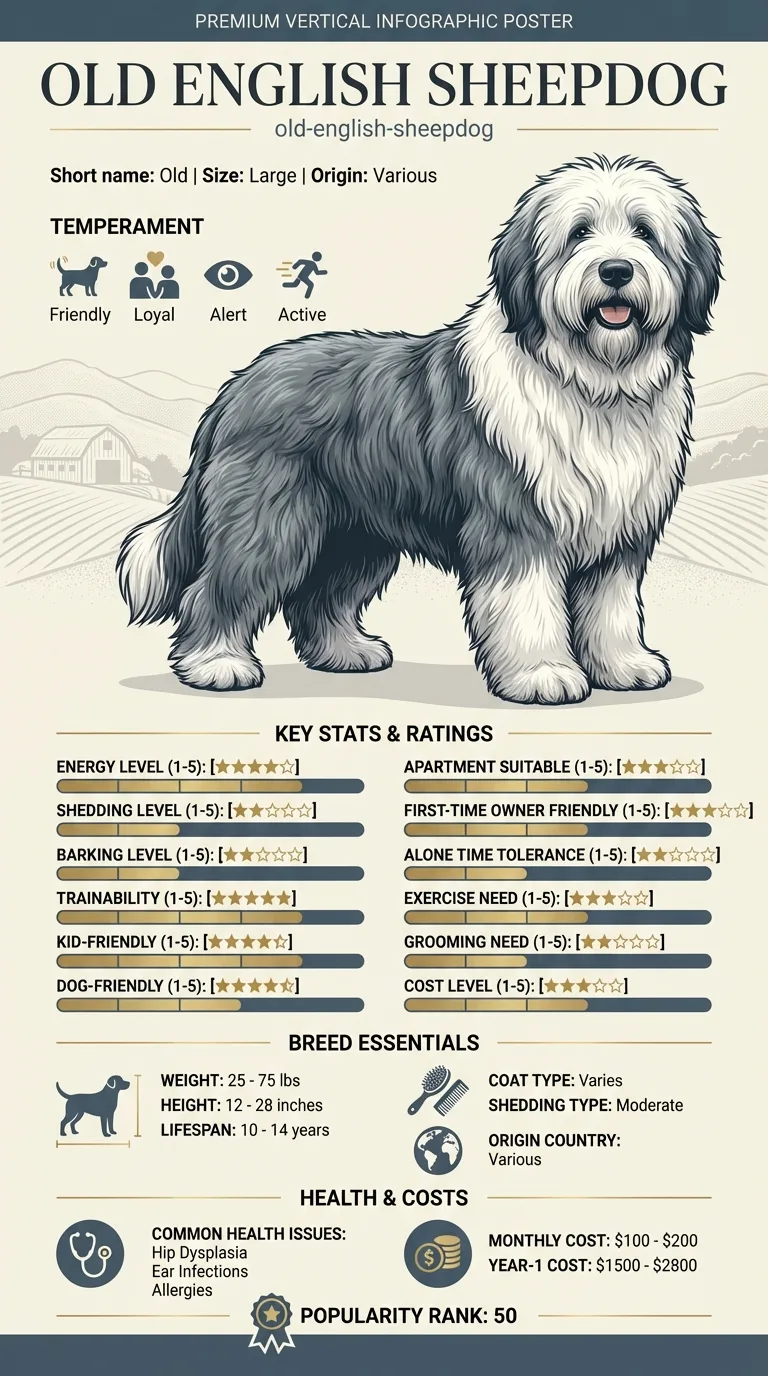
See all OLD English Sheepdog health problems, which breeds are prone to x scid, or the full OLD English Sheepdog breed guide for temperament, exercise needs and ownership costs.
This isn't a relevant diagnostic timeline for this breed. If your puppy has a genuine recurring infection pattern, expect the actual workup, focused on this breed's documented conditions, to take a few vet visits to properly characterize rather than resolve in a single appointment.
Success looks like ruling out irrelevant diagnoses quickly and focusing a workup on this breed's actual documented conditions, getting a puppy with genuine recurring infections to the right diagnosis faster rather than chasing an unrelated rare disease.
X-SCID results from a specific mutation on the X chromosome affecting a gene essential for developing functional T and B lymphocytes, the white blood cells responsible for adaptive immunity. Because it's X-linked, it overwhelmingly affects male puppies, and the specific causative mutations have been identified and characterized in a couple of particular breed populations where the disease is actually documented. This breed's own health record does not include X-SCID, and there's no established genetic basis for it occurring here. A puppy from this breed showing recurring infections is, statistically and practically, almost certainly dealing with something else entirely, most likely an ordinary, treatable infection pattern, or in genuinely persistent cases, an entirely different and far more relevant immune-related condition like immune-mediated thyroiditis, which is documented in this breed.
A puppy with genuinely recurring, unusually severe infections deserves a real veterinary workup, just not one built around a diagnosis with no established relevance to this breed. Far more likely explanations include an underlying condition like Primary Ciliary Dyskinesia, specifically documented in this breed and known to cause recurring respiratory infections through impaired mucus clearance rather than a failed immune system, ordinary exposure and hygiene factors common in any puppy's environment, or ineffective early treatment of an initial infection allowing it to recur or worsen. A vet working through a puppy with a genuine recurring infection pattern would reasonably prioritize these breed-relevant and far more statistically likely explanations well before considering a condition as rare and breed-specific as X-SCID.

When breeder Meredith noticed one puppy in a litter, Thistle, having his second respiratory infection by ten weeks old, a worried late-night search turned up a severe genetic immunodeficiency that seemed to match some of his symptoms. Rather than panicking, Meredith brought Thistle to her vet the next morning and mentioned what she'd read. Her vet explained clearly that the condition she'd found has no documented basis in this breed and that Thistle's pattern, recurring respiratory infections specifically, was far more consistent with Primary Ciliary Dyskinesia, a condition genuinely documented in the breed. Specialized testing later confirmed that diagnosis. Thistle has done well with prompt treatment of each infection as it arises.
Key takeaway: The scariest search result wasn't the right answer, and getting Thistle to an actual vet quickly, rather than assuming the worst online, led to the diagnosis that genuinely applied to his breed instead.
Essentially no. This is a genetic condition documented in a couple of specific breed populations with identified causative mutations, and this breed is not among them, making it a diagnosis with no established relevance here.
It's a severe genetic immunodeficiency where affected puppies, almost always male since it's X-linked, are born with almost no functional immune system and typically die from infection within months without intervention, in the breeds where it's actually documented.
Not specifically about this condition. Recurring infections in a puppy of this breed are far more likely explained by something else, including Primary Ciliary Dyskinesia, which is actually documented here, or ordinary treatable infection patterns.
Ask about a full workup considering this breed's actual documented conditions, particularly Primary Ciliary Dyskinesia if respiratory infections are involved, rather than researching a diagnosis with no established relevance to this breed.
Not particularly, since there's no established mutation or documented cases in this breed's population; genetic testing resources are better directed toward conditions actually relevant here, like thyroid antibody testing or hip screening.
Because it's X-linked, meaning the mutation is carried on the X chromosome; males have only one X chromosome, so a single mutated copy causes the disease, while females typically need two copies to be affected.
There's no established reason to, given the lack of any documented occurrence or identified causative mutation in this breed's population; breeding health screening efforts are better focused on this breed's actually documented conditions.
No, it's documented in a couple of unrelated breeds with identified mutations, not this one.
Primary Ciliary Dyskinesia, which is actually documented in this breed, or an ordinary treatable infection pattern.
No, there's no established relevance to this breed; testing resources are better spent on conditions actually documented here.
It's X-linked, so a single mutated copy on a male's one X chromosome is enough to cause disease.
This breed's actual documented conditions, particularly Primary Ciliary Dyskinesia for respiratory infections.
A one-page prep sheet for this condition: the signs, the questions to ask, what to get priced. Unlocks here.
You get: Vet visit prep sheet
No spam. One-click unsubscribe. See our privacy policy.
Preview page 1 before you decide.