Health
Is this a bleeding disorder or a clotting disorder?
It's more accurately a clotting disorder; affected dogs don't bleed more easily, they have trouble stopping a bleed once it starts.

Quick answer
Is this a bleeding disorder or a clotting disorder?
It's more accurately a clotting disorder; affected dogs don't bleed more easily, they have trouble stopping a bleed once it starts.
The wound isn't the problem; the missing piece that's supposed to plug it is.
Owners whose dog has had unexpectedly prolonged bleeding after a minor injury or routine procedure, and anyone planning a spay, neuter, or other surgery for their dog.
This guide is not medical advice. If your dog shows pain, sudden behavior change, or worsening symptoms, consult a licensed veterinarian.
Some links may be affiliate links. We may earn a commission at no extra cost to you. We only suggest products we believe are helpful for dog owners.
We research and check what we publish, but we do not warrant that any figure, date, price, or statement is accurate, complete, or current, and we accept no liability for any loss, cost, injury, or other harm arising from the use of this site. Use it as one reference among several. You remain responsible for your own decisions and for your dog's care - confirm anything that matters with a licensed veterinarian or another qualified professional before you act on it. Full disclaimer.
Von Willebrand's disease is an inherited deficiency or dysfunction of a protein platelets need to properly plug an injury, making it harder for affected dogs to stop bleeding once it starts rather than making them bleed more easily overall. It often goes unnoticed until surgery or a significant injury reveals prolonged bleeding, which is why pre-surgical screening is a reasonable precaution.
This isn't among this breed's most specifically documented health issues, but von Willebrand's disease occurs across dog breeds broadly often enough that pre-surgical screening is a reasonable, low-cost precaution regardless of how prominently it's discussed for any particular breed.
This breed's documented health record doesn't flag von Willebrand's disease as a defining condition, but its inherited genetic basis means it can occur in any breed's population, following the same clotting-protein deficiency mechanism recognized across dogs broadly.
There's no environmental trigger for the underlying protein deficiency itself, since it's a genetic condition, though certain medications that affect platelet function can compound bleeding risk in a dog that already has this condition.
Talk to your vet about any bleeding that seems disproportionate to the injury or takes unusually long to stop. Seek prompt care for spontaneous nosebleeds, blood in urine or stool without clear cause, or any bleeding that doesn't stop with basic first aid.
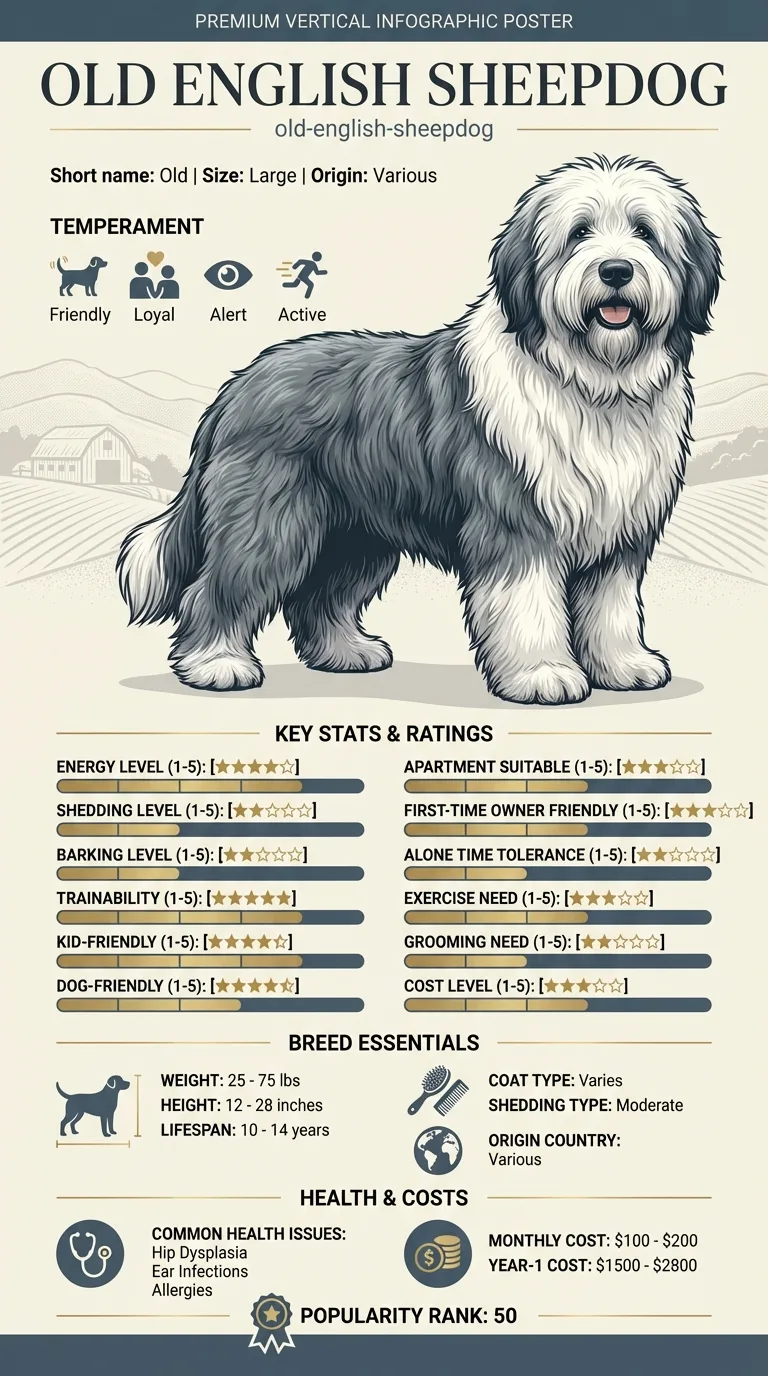
See all OLD English Sheepdog health problems, which breeds are prone to von willebrands disease, or the full OLD English Sheepdog breed guide for temperament, exercise needs and ownership costs.
This is a lifelong genetic condition present from birth, though it's often not discovered until a surgical procedure or significant injury reveals it, sometimes not until adulthood if no prior surgery or major injury has occurred.
Success looks like an early diagnosis through pre-surgical screening, appropriate precautions taken during any necessary procedure, and prompt attention to any bleeding episode, rather than an unexpected discovery during an emergency.
Normal clotting relies on a protein called von Willebrand factor, which acts like a molecular glue helping platelets stick to an injury site and to each other, forming the initial plug that stops bleeding before the rest of the clotting cascade reinforces it. In von Willebrand's disease, a genetic mutation results in too little of this protein, or a version that doesn't function properly, meaning that initial platelet plug forms poorly or not at all. The practical result is prolonged bleeding from cuts, prolonged bleeding after a routine procedure like a nail trim gone slightly too short, or in more severe cases, spontaneous nosebleeds or bleeding from the gums without any obvious injury at all.
Many affected dogs show no obvious signs during normal daily life, since everyday minor bumps and scrapes may not be severe enough to reveal the underlying clotting problem clearly. Surgery, even a routine spay or neuter, is often the first real test, and a dog bleeding more than expected or for longer than expected during or after a procedure is a classic way this condition first comes to light. This is exactly why many vets recommend a simple pre-surgical clotting screen for breeds and individual dogs where von Willebrand's disease is a documented possibility, catching the issue before an elective procedure rather than discovering it mid-surgery.

Before scheduling a routine spay for his Old English Sheepdog puppy Fable, Callum's vet recommended a standard pre-surgical clotting screen, mentioning it as a reasonable precaution for the breed and age regardless of any specific concern. The screen came back showing reduced von Willebrand factor levels, confirming the disease before any incision was ever made. Callum's vet adjusted the surgical plan accordingly, having appropriate blood products on standby and using extra care with incision closure. Fable's surgery went smoothly with only slightly more monitoring than usual, and Callum now shares her diagnosis with any vet handling her future care.
Key takeaway: A screening test run purely as a precaution, not because anything seemed wrong, is what caught Fable's condition before it could complicate a routine surgery in the operating room instead.
It's one of the more commonly diagnosed inherited bleeding disorders across dog breeds broadly, caused by a deficiency or dysfunction of a specific clotting protein rather than any single breed-exclusive mechanism.
It impairs the platelet-plugging step of clotting due to a missing or malfunctioning protein, meaning a dog has a harder time stopping a bleed once one starts, rather than bleeding more easily in general.
Often during or after a surgical procedure, when a dog bleeds more than expected, since everyday minor injuries may not be severe enough to reveal the underlying clotting problem clearly beforehand.
Yes, a pre-surgical clotting screen or specific von Willebrand factor test can identify the condition beforehand, allowing a vet to take extra precautions during any planned procedure.
No, it's a lifelong genetic condition, though it's manageable with precautions like avoiding unnecessary elective procedures, having appropriate blood products available during necessary surgery, and prompt attention to any bleeding episode.
Yes, some affected dogs have mild, rarely symptomatic disease, while others have more significant clotting protein deficiency causing more frequent or severe bleeding episodes.
Yes, since it has a clear hereditary component, testing breeding stock is a reasonable precaution to avoid producing more affected puppies, particularly in lines with any known history.
It's more accurately a clotting disorder; affected dogs don't bleed more easily, they have trouble stopping a bleed once it starts.
Often during or after surgery, when bleeding is more prolonged than expected for a routine procedure.
Yes, a pre-surgical clotting screen can identify the condition beforehand so precautions can be taken.
No, it's a lifelong genetic condition managed through precautions rather than cured.
Yes, given its hereditary component, testing breeding dogs is a reasonable precaution against producing affected puppies.
A one-page prep sheet for this condition: the signs, the questions to ask, what to get priced. Unlocks here.
You get: Vet visit prep sheet
No spam. One-click unsubscribe. See our privacy policy.
See a sample page before you decide.
Early access list
The free prep sheet covers the same-day warning signs, a symptom log and the questions to ask. We are considering a fuller kit that adds a cost worksheet for the usual tests and treatments (US price ranges with their sources) and a plain-English guide to ways of covering the bill. It is not built yet; this list tells us whether it is worth building.
One email, no spam, unsubscribe anytime. Information only, not veterinary advice.