Health
Which direction does a large dog's kneecap typically slip?
Laterally, outward, which is the opposite direction from the medial luxation more classically seen in toy breeds.

Quick answer
Which direction does a large dog's kneecap typically slip?
Laterally, outward, which is the opposite direction from the medial luxation more classically seen in toy breeds.
The same three words, luxating patella, describe a different mechanical problem depending on whether the dog weighs eight pounds or eighty.
Owners who've noticed an occasional skip or hitch in their dog's back-leg gait, particularly one that seems to correct itself after a stride or two.
This guide is not medical advice. If your dog shows pain, sudden behavior change, or worsening symptoms, consult a licensed veterinarian.
Some links may be affiliate links. We may earn a commission at no extra cost to you. We only suggest products we believe are helpful for dog owners.
We research and check what we publish, but we do not warrant that any figure, date, price, or statement is accurate, complete, or current, and we accept no liability for any loss, cost, injury, or other harm arising from the use of this site. Use it as one reference among several. You remain responsible for your own decisions and for your dog's care - confirm anything that matters with a licensed veterinarian or another qualified professional before you act on it. Full disclaimer.
A luxating patella is a kneecap that slips out of its normal groove, graded I through IV by severity. In large breeds like this one, it tends to luxate laterally rather than medially and often occurs alongside hip instability, a meaningfully different pattern than the more commonly discussed toy-breed version of this condition.
This isn't among the small handful of conditions specifically documented as most common in this breed, but patellar luxation does occur in large dogs, particularly alongside hip dysplasia, often enough that it's worth including in any orthopedic workup for hind-leg symptoms.
This breed's documented predisposition to hip dysplasia creates a plausible mechanical pathway toward lateral patellar luxation as well, since hip instability can alter how forces travel down the leg and affect kneecap tracking over time, a pattern seen across large breeds generally.
Excess body weight adds direct load to an unstable joint, and rapid or uneven growth during puppyhood can affect limb alignment in ways that make luxation more likely to develop or progress.
Talk to your vet about any intermittent skip or hitch in the gait, even if it seems to resolve on its own. Seek prompt evaluation for a leg that's held up entirely or a kneecap that appears stuck out of place, which suggests a higher-grade luxation needing more urgent attention.
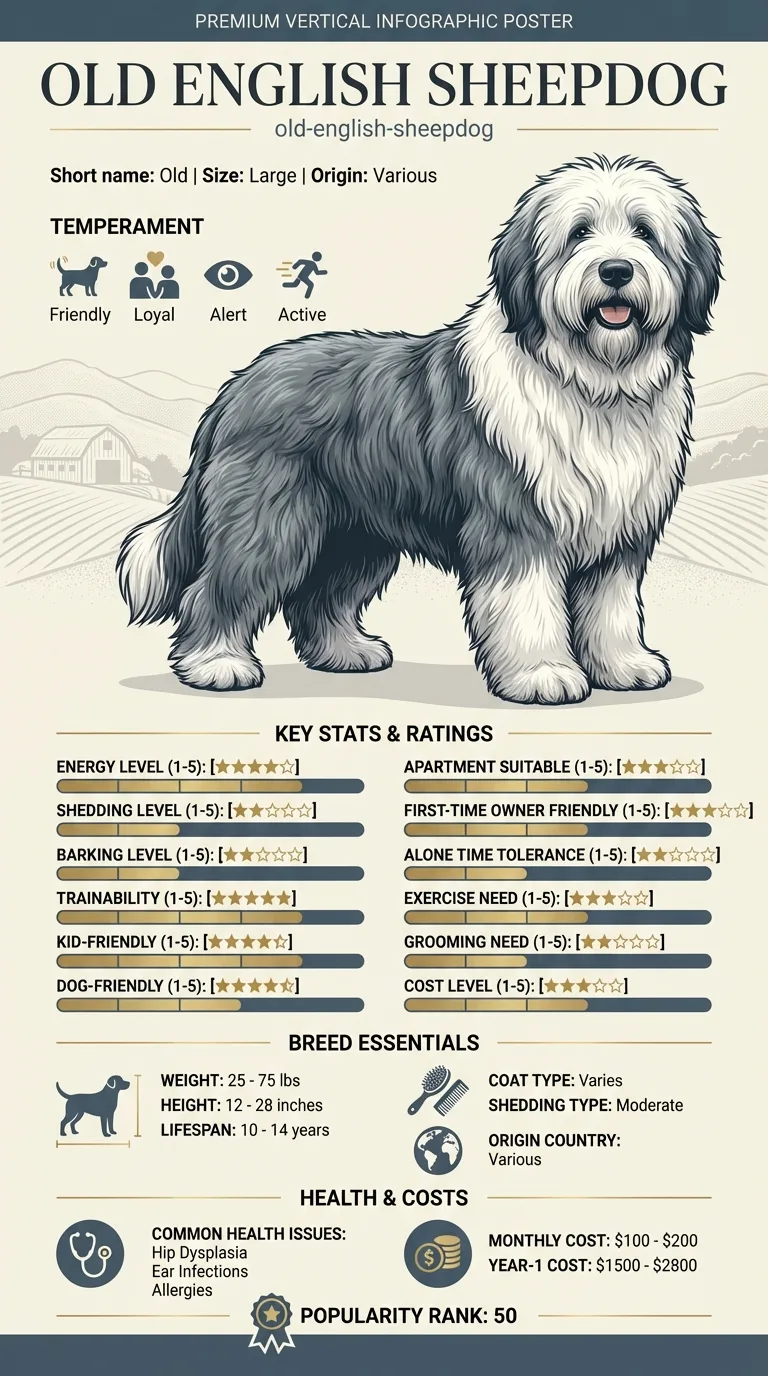
See all OLD English Sheepdog health problems, which breeds are prone to luxating patellas, or the full OLD English Sheepdog breed guide for temperament, exercise needs and ownership costs.
Diagnosis typically happens within a single vet visit once a gait abnormality is noticed. Lower-grade cases may be monitored for months to years without progressing, while higher-grade cases often move toward a surgical decision within weeks of diagnosis.
Success looks like a stable grade that isn't worsening, or for surgical cases, a full return to normal gait and activity after recovery, achieved through appropriate monitoring or intervention based on accurate grading.
Patellar luxation is graded I through IV based on severity. Grade I means the kneecap can be manually pushed out of place but pops right back and rarely causes visible symptoms. Grade II means it slips out occasionally on its own, usually producing an intermittent skip in the gait, a stride where the leg seems to catch before continuing normally. Grade III means the kneecap sits out of place most of the time but can be manually repositioned, and Grade IV means it's permanently displaced and can't be pushed back into the groove at all. Lower grades are sometimes monitored without surgery, while Grade III and IV typically need surgical correction to prevent progressive joint damage and chronic lameness.
In large breeds, lateral patellar luxation is frequently linked to concurrent hip dysplasia and broader limb alignment issues, rather than occurring as an isolated kneecap problem the way it more often does in toy breeds. The mechanics make sense: hip instability can alter how forces travel down the leg, pulling the kneecap's groove and tracking out of ideal alignment over time. This is one reason a large dog diagnosed with a luxating patella, particularly this breed given its own documented hip dysplasia risk, often benefits from a hip evaluation as part of the same workup rather than treating the kneecap in isolation.

Roscoe, a five-year-old Old English Sheepdog in Tacoma, had an odd little skip in his back leg that his owner Ana noticed maybe once every few walks, always correcting itself within a stride. At his next wellness visit, Ana mentioned it, and her vet found a Grade II lateral luxation on exam. Because Roscoe had also shown mild hip laxity on a prior X-ray, his vet recommended evaluating both joints together rather than treating the knee in isolation. Roscoe's plan focused on weight management and a structured, low-impact exercise routine, with surgery held in reserve if the grade progressed. Two years later, his skip hadn't worsened and remained an occasional, minor quirk rather than a growing problem.
Key takeaway: Roscoe's kneecap and hip issues were connected, not coincidental, and treating them as one picture rather than two separate problems gave his family a more accurate long-term plan.
It's less classically associated with large breeds than with toy breeds, but it does occur, and when it does in a large dog it's frequently lateral rather than medial and often linked with concurrent hip issues.
Usually an intermittent skip or hitch in the gait, where the back leg seems to catch for a stride before smoothing back out, rather than a constant, obvious limp.
No, Grade I and often Grade II are frequently monitored without surgery unless symptoms progress. Grade III and IV generally do need surgical correction to prevent ongoing joint damage.
In large breeds, lateral patellar luxation is often connected to hip instability affecting how the leg tracks, so evaluating both joints together gives a more complete and accurate picture than treating the kneecap alone.
A vet can often feel the kneecap slipping during a physical exam, with X-rays used to assess grade, limb alignment, and rule out or confirm any concurrent hip involvement.
Often yes, particularly Grade I and stable Grade II cases, especially with weight management and monitoring to catch any progression early.
It can, particularly in a large-breed dog where added body weight and any concurrent hip instability keep stressing the joint, which is why monitoring and timely intervention matter even for lower grades.
Laterally, outward, which is the opposite direction from the medial luxation more classically seen in toy breeds.
An intermittent skip or hitch in the back-leg gait that corrects itself after a stride or two.
Yes, lateral luxation in large dogs is frequently linked to concurrent hip instability rather than occurring as an isolated issue.
No, lower grades are often monitored, while Grade III and IV typically do need surgical correction.
Through a Grade I to IV scale based on how easily and how often the kneecap slips out of its groove.
A one-page prep sheet for this condition: the signs, the questions to ask, what to get priced. Unlocks here.
You get: Vet visit prep sheet
No spam. One-click unsubscribe. See our privacy policy.
Preview page 1 before you decide.