DogBreedCompass
← Back to breed profile

Newfoundland Back/Spine Issues: The Slow Kind of Disc Disease

Quick answer

What kind of disc disease do Newfoundlands get?

Usually the slow bulging kind seen in large, normally proportioned breeds rather than the sudden explosive kind seen in short-legged dogs. It creeps in over months instead of arriving in an afternoon.

Owners searching for disc disease usually find descriptions of the sudden, dramatic version. In a Newfoundland the far likelier story is a dog who has been subtly wrong for six months and nobody could say when it started.

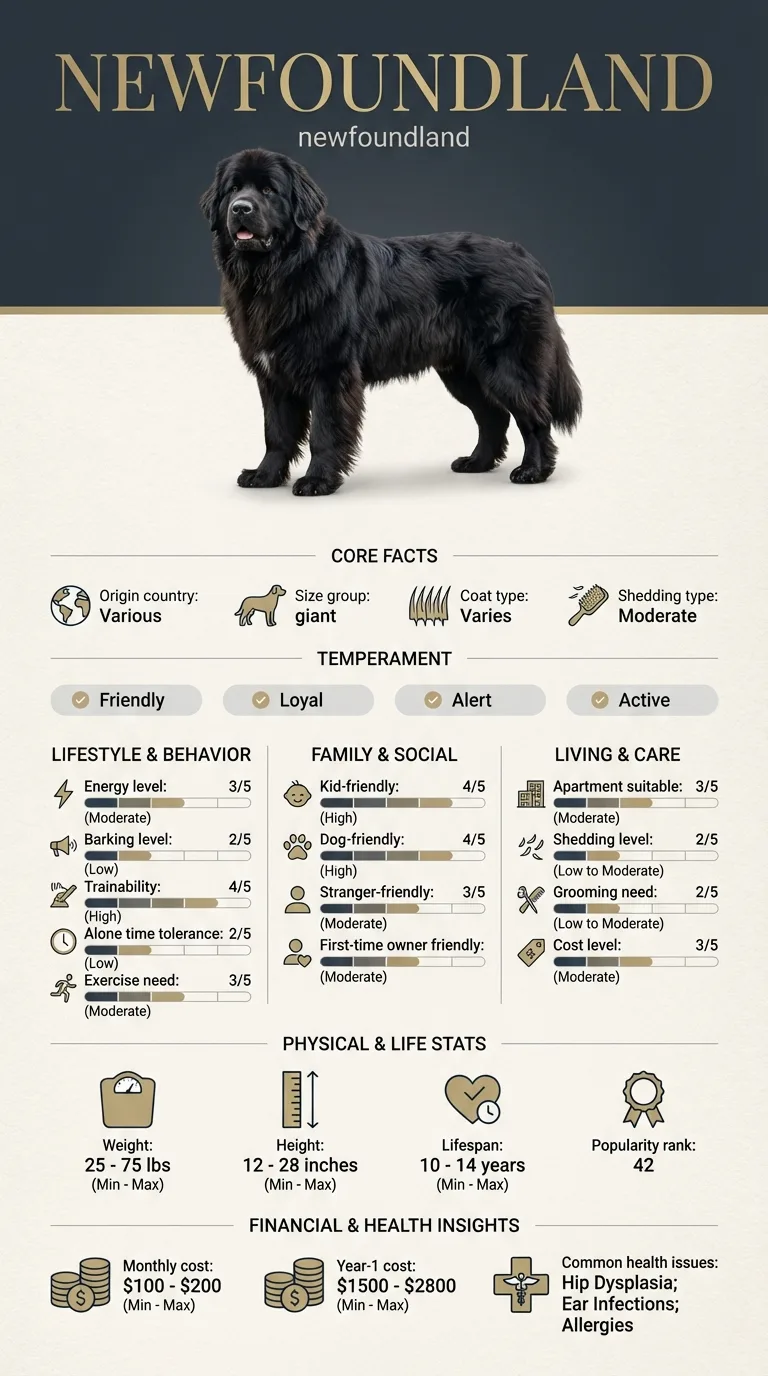
Newfoundland Back/Spine Issues: The Slow Kind of Disc Disease infographic

This page is for owners of adult and senior Newfoundlands whose hind end has become vague, whose walk has developed a swing or a scuff, or who have received a diagnosis containing the words disc protrusion and want to understand what that actually means.

Important reminder

This guide is not medical advice. If your dog shows pain, sudden behavior change, or worsening symptoms, consult a licensed veterinarian.

Some links may be affiliate links. We may earn a commission at no extra cost to you. We only suggest products we believe are helpful for dog owners.

What this problem looks like

Spine problems in this breed usually mean a disc bulging slowly into the spinal canal and squeezing the cord over months or years. The dog does not collapse. It loses coordination gradually: a wider stance, a foot that crosses over, scuffed nails, an inability to reverse. Because the change is slow and the breed is unfussy, families adapt around it without noticing, and the diagnosis often arrives only when someone outside the household comments on the walk.

Common triggers

  • Age-related degeneration of the fibrous disc ring in a large, heavy dog
  • Cumulative loading from a body weight of 100 to 150 pounds
  • Repeated jumping down from vehicles, decking and furniture
  • Slipping and twisting on smooth indoor flooring
  • Concurrent hip disease that alters gait and redistributes spinal load

Slow protrusive disc disease is a recognised problem across large and giant breeds, while the acute extrusive form is concentrated in short-legged chondrodystrophic breeds. Published prevalence specific to Newfoundlands is not established. The breed's documented health issues centre on hips, heart, urinary stones and bloat rather than the spine, so spinal disease here is best thought of as a large-breed problem the Newfoundland shares rather than a breed hallmark.

Why this happens

Breed factors

Two structural facts do most of the explaining. First, the Newfoundland has normal cartilage development, so its discs degenerate the slow fibrous way rather than the fast calcified way, which sets the entire clinical pattern. Second, the breed carries 100 to 150 pounds on a 26 to 28 inch frame, and that mass is transmitted through the discs continuously. Hip dysplasia, the condition heading the breed's documented list, contributes indirectly by changing how the hindquarters load the spine. The calm, patient temperament and low natural energy level then disguise the early functional loss, because a dog who never asked to run does not visibly stop running.

Environment factors

The home environment determines how much sudden loading is added to the slow background degeneration. Smooth floors cause the twisting slips that convert a stable protrusion into a painful flare. Tailgate jumps deliver a large impact through the spine on landing. Uncontrolled play with other dogs, particularly body-slamming games, does the same. On the other side, households that keep a heavy dog fit with steady daily activity maintain the paraspinal and core muscle that stabilises the whole structure, and that muscle is one of the few protective factors genuinely within an owner's control.

What you can do at home (once it is not an emergency)

When to talk to your vet

Book a neurological examination for any persistent change in hind-limb coordination, scuffed hind nails, crossing over, a new inability to reverse, or hind legs that give way. Ask for a neurological exam specifically, not just an orthopaedic one. Treat as an emergency and go immediately if your dog suddenly cannot stand or walk, drags both hind feet, loses bladder or bowel control, cannot urinate, has lost sensation in the toes, or is screaming or panting in unrelenting pain. Acute spinal cord compression is time-critical and outcomes depend on how quickly a neurologist sees the dog. Do not wait overnight to see whether it improves.

At home, alongside your vet's plan

  • Film a monthly thirty-second clip of your dog walking away from you on level non-slip ground, and keep the clips in one folder so you can compare across a year.
  • Inspect the hind nails for scuffing on the upper surface, and note which toes and which foot, since asymmetry is informative.
  • Test whether your dog can still back up in a straight line down a hallway, because losing that ability is an early and specific sign.
  • Remove every jump you can: a car ramp, a step up to any bed the dog uses, and no launching off furniture.
  • Put down non-slip runners on all hard flooring, particularly at turns and doorways where twisting happens.
  • Keep daily low-impact activity consistent, and add swimming with a shallow entry if your vet approves, to maintain the muscle that stabilises the spine.
  • Keep your dog lean and weigh monthly, since load reduction is the one variable you fully control.

See all Newfoundland health problems, which breeds are prone to backspine issues, or the full Newfoundland breed guide for temperament, exercise needs and ownership costs.

What to expect, and how you know it is working

Slowly compressive disease does not resolve. With medical management, pain and comfort usually improve within a few weeks, while coordination changes little because the compression remains. Rehabilitation gains accumulate over two to four months. Following surgery, expect two to three months of tightly restricted activity and a further several months of rebuilding, and be aware that recovery of coordination lags well behind recovery from pain. Some deficits are permanent, and a neurologist should tell you honestly which ones before you decide.

For most Newfoundlands with this condition, success is a stable dog rather than a restored one: comfortable, continent, walking safely on good footing, holding muscle over the hindquarters, and not deteriorating further over six months. Owners who define success as a dog who moves like a four-year-old again will be disappointed, and that mismatch is what leads to repeated second opinions rather than good management.

Extrusion Versus Protrusion, and Why Shape Decides

A disc is a fibrous ring with a gel-like centre, sitting between two vertebrae as a shock absorber. In chondrodystrophic breeds, the ones bred for short curved legs, that gel centre calcifies early in life. Calcified material under pressure behaves like a stone, and when the ring tears it fires upward into the spinal canal in a single traumatic event. That is Hansen type I extrusion, and it is why a Dachshund can be running one minute and unable to walk the next.

The Newfoundland is not built that way. This is a large, long-legged, squarely proportioned working breed with normal cartilage development. Its discs degenerate the way large-breed discs do: the fibrous ring gradually weakens and bulges into the canal over years. That is Hansen type II protrusion, and the clinical picture is entirely different. There is no dramatic moment. Instead the cord is squeezed progressively, and the dog develops a slow deterioration in hind-limb coordination, a wider or scuffing stride, and mild but persistent pain that is easy to attribute to age.

This matters practically. Owners of giant breeds wait for a dramatic event that never comes, and by the time they take the vague hind end seriously the compression is well established. The signal to act on is not sudden collapse. It is a gait that has changed and stayed changed.

Newfoundland Back and Spine Issues - Extrusion Versus Protrusion

Watching the Gait Instead of Waiting for a Crisis

Progressive cord compression shows itself in coordination before it shows itself in strength. These are the things to watch for, ideally on video from behind so you can compare month to month.

  • A wider hind stance than the front, as though the dog is bracing for balance rather than simply standing.
  • Crossing over, where a hind foot lands slightly across the midline instead of tracking straight behind the front foot.
  • Scuffing on turns. Compression often shows first when the dog changes direction on a slippery surface rather than on a straight line.
  • A hind foot that stays knuckled over for a moment after the dog steps onto it, which is one of the most specific things you can see.
  • Difficulty backing up. Reversing requires proprioception, and a dog with cord compression often simply stops being able to do it.
  • Asymmetry between the two hind legs, which is more suggestive of a nerve problem than the even bilateral picture of joint disease.
  • A tail that has become still or is held differently, and any change at all in continence.

What to do next about back/spine issues in Newfoundlands

If you think your Newfoundland has back/spine issues, the plan is three steps: write down what you have seen and when it started, book a veterinary appointment rather than waiting for the next flare, and take video of the behaviour or symptom before you go — the thing you are worried about rarely happens in the consulting room. Screening in the parents covers hip dysplasia, subaortic stenosis, dilated cardiomyopathy.

What the vet visit should produce is a diagnosis and a written plan, not just reassurance: what is being ruled out, what the monitoring interval is, and which signs mean you come back sooner. Ask what the treatment costs across a year rather than per visit, because that is the number that decides whether you are managing this condition or reacting to it.

Between appointments, keep a short log — dates, what you saw, what changed. It is the single most useful thing an owner brings to a follow-up, and for back/spine issues it is often what separates a clear pattern from a guess.

The Video Folder: How Bess's Slide Was Finally Measured

Bess was a nine-year-old Newfoundland whose owner Iain had started filming her monthly on a vet's suggestion, mostly to track arthritis. He never watched the clips back until the practice asked for them. Watching eleven months of thirty-second videos in one sitting was, in his words, uncomfortable. In January she tracked straight. By June her hind feet were landing slightly across the midline. By October she was standing wider behind than in front and one foot scuffed on every turn to the left. No single month had looked different from the one before, which was exactly why nobody in the house had noticed. A neurological examination localised the problem to the lower back and MRI showed a broad disc protrusion compressing the cord. Given her age and the moderate degree of deficit, the neurologist recommended medical management and rehabilitation rather than surgery, and was direct that the coordination she had lost was unlikely to come back. Bess is now ten. She walks twenty minutes twice a day on grass, swims in a heated pool once a week, has a ramp for the car, and has not deteriorated in eight months. Iain keeps filming.

Key takeaway: Slow neurological loss is invisible in real time and obvious in a video folder. In a giant breed, thirty seconds of footage a month is the single most useful monitoring tool an owner has.

Frequently asked questions

Can a Newfoundland get the sudden paralysing kind of disc disease?

It is possible but not typical. The explosive Hansen type I extrusion is characteristic of chondrodystrophic breeds whose disc centres calcify early. A Newfoundland has normal cartilage development, so the usual pattern here is the slow protrusive kind. Any sudden loss of hind-leg function in this breed still needs emergency assessment, because other causes such as a spinal cord infarct or a bleed can produce it.

How is this diagnosed?

A neurological examination localises the problem to a region of the spine, and advanced imaging, usually MRI, shows the disc and the degree of compression. Plain radiographs are of limited value for this because they show bone rather than disc material. Imaging requires general anaesthesia, which for a Newfoundland is a reason to have the heart assessed beforehand.

Is surgery the answer?

Sometimes, and less often than for the sudden type. Slowly compressive disease in a large breed has a more variable surgical outcome than a single acute extrusion, and decisions are made case by case by a neurologist weighing the degree of deficit, the number of sites involved and the dog's age. Many dogs are managed medically with a pain plan and rehabilitation.

Could this be wobbler syndrome instead?

It could, and the two overlap. Cervical spondylomyelopathy, commonly called wobbler syndrome, is compression in the neck and is well recognised in giant breeds. It also produces an unsteady hind end, sometimes with a short, choppy front-leg stride as well. A neurological examination distinguishes them by which limbs are affected and how, which is why the examination matters more than the owner's guess.

Will controlled exercise help or hurt?

Controlled, low-impact exercise generally helps, because the muscles that stabilise the spine need to be maintained and complete rest wastes them fast in a heavy dog. Uncontrolled exercise, jumping and slipping hurt. Your vet or a rehabilitation therapist should set the specific limits rather than you guessing at them.

Does this shorten a Newfoundland's life?

It affects quality of life and mobility more than it affects lifespan directly, but mobility loss in a 130-pound dog has serious practical consequences, because a dog this size that cannot walk cannot easily be carried or nursed at home. That reality is part of why early recognition matters so much in giant breeds.

Quick answers

View more answers
Health

What kind of disc disease do Newfoundlands get?

Usually the slow bulging kind seen in large, normally proportioned breeds rather than the sudden explosive kind seen in short-legged dogs. It creeps in over months instead of arriving in an afternoon.

Health

What is the most useful thing to film?

Your dog walking directly away from the camera on a firm, level, non-slip surface, once a month. Crossing over, scuffing and a widening stance are obvious in comparison and invisible day to day.

Health

Does knuckling matter?

Yes. A hind foot that lands upside down even briefly is a proprioceptive deficit and is one of the clearest signs that the spinal cord, not the joints, is involved. Get it checked.

Costs

How much does investigation cost?

MRI under general anaesthetic plus a neurology consultation is one of the more expensive workups in veterinary practice, and everything scales with a giant breed's drug volumes and staffing. Discuss cost openly with the referral centre before booking.

Living

What should I change at home first?

Traction and jumping. Non-slip flooring throughout the dog's route, a ramp instead of the car tailgate, and no furniture jumping, all of which are free or cheap and reduce the sudden loads that trigger flares.

Related DogBreedCompass guides

  • Newfoundland back problemsThe lumbosacral junction is the other major site of spinal trouble in this breed and produces a different pattern.
  • wobbler syndrome in NewfoundlandsCervical compression in giant breeds is the closest differential diagnosis to hind-end disc disease.
  • chondrodystrophy and NewfoundlandsChondrodystrophy is the trait that determines which type of disc disease a breed gets, and Newfoundlands do not carry it.
  • degenerative myelopathyProgressive painless hind-limb weakness has a neurological differential that owners often reach for first.
  • anesthesia and this breedMRI and surgery both require anaesthesia, which carries breed-specific planning considerations.

Bring the right questions to the vet

A one-page prep sheet for this condition: the signs, the questions to ask, what to get priced. Unlocks here.

You get: Vet visit prep sheet

No spam. One-click unsubscribe. See our privacy policy.

Preview page 1 before you decide.

Related guides