Health
Is CDDY relevant to a Newfoundland?
No. It is the variant behind short, curved legs and early disc calcification in breeds like the Dachshund and Corgi. A Newfoundland is long-legged with normal cartilage development.

Quick answer
Is CDDY relevant to a Newfoundland?
No. It is the variant behind short, curved legs and early disc calcification in breeds like the Dachshund and Corgi. A Newfoundland is long-legged with normal cartilage development.
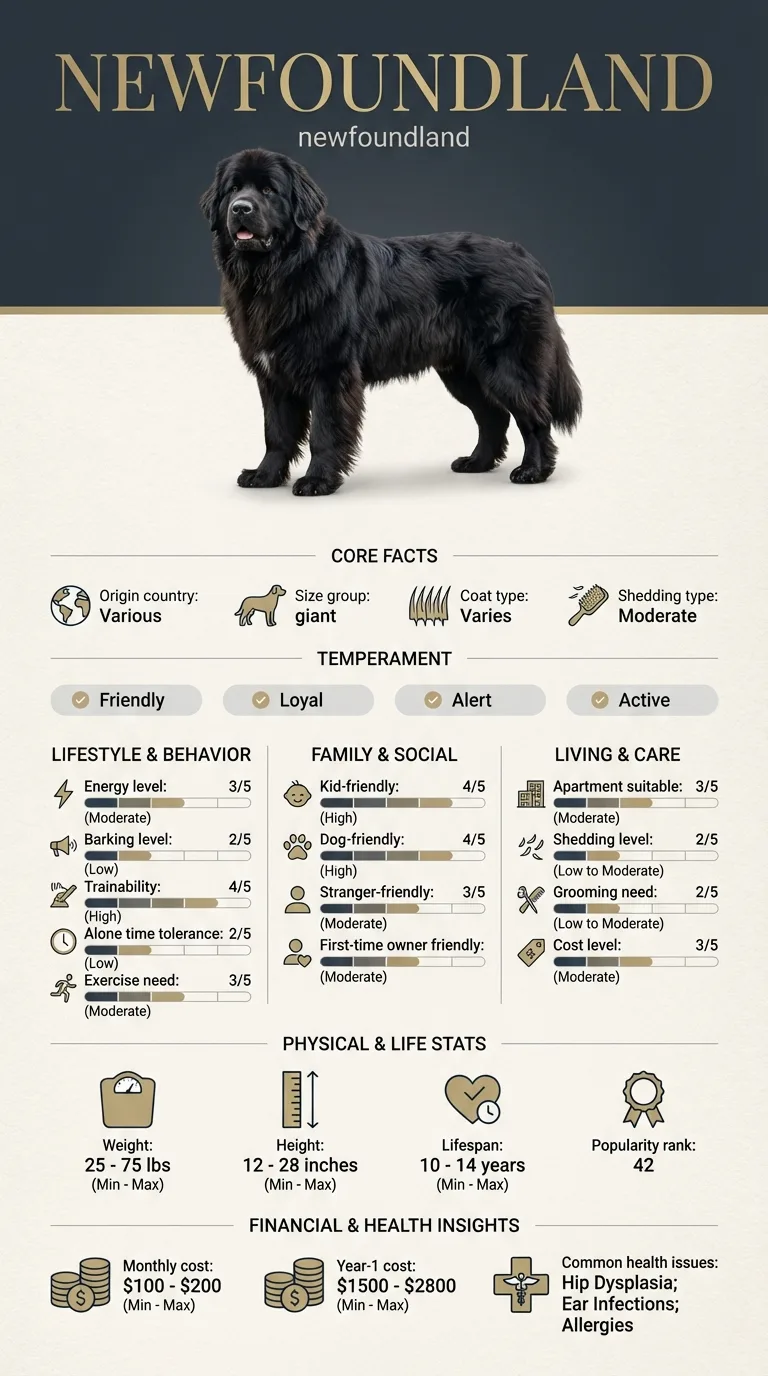
A Newfoundland stands 26 to 28 inches at the shoulder on long, straight legs. It is the anatomical opposite of a chondrodystrophic dog, and the CDDY test is not part of this breed's screening picture.
For owners who have been offered a genetic panel including CDDY, for people researching a Newfoundland mix, and for anyone trying to work out which of the many available DNA tests are worth paying for in this breed.
This guide is not medical advice. If your dog shows pain, sudden behavior change, or worsening symptoms, consult a licensed veterinarian.
Some links may be affiliate links. We may earn a commission at no extra cost to you. We only suggest products we believe are helpful for dog owners.
Chondrodystrophy describes a genetic disruption of cartilage-to-bone conversion that produces short, curved legs and, as a direct consequence, early calcification of the spinal discs. It explains why certain short-legged breeds suffer sudden, explosive disc herniation. The Newfoundland is not one of those breeds. For an owner of this breed the practical value of the topic is negative knowledge: understanding what does not apply, so that screening money and attention go to the conditions that do.
Chondrodystrophy is essentially universal in the breeds defined by it and essentially absent from tall, long-legged working breeds. It does not appear on the Newfoundland's documented list of health issues, which comprises hip dysplasia, subaortic stenosis, dilated cardiomyopathy, cystinuria and bloat. Slow degenerative disc disease of the large-breed type does occur in this breed, but it is a different mechanism entirely and no genetic test predicts it.
The reason this trait does not apply is structural and definitional. The Newfoundland was developed as a powerful working water dog, and its build reflects that: 26 to 28 inches of height, long straight limbs capable of swimming and hauling, and 100 to 150 pounds of muscle and bone. Chondrodystrophy would be incompatible with that function, which is why the breed was never selected for it. Where the Newfoundland's genuine inherited risks lie is in the joints, the heart and the urinary tract, and those are precisely the areas its breed health schemes are built around.
There is no environmental component to a developmental trait a dog either has or does not have. Where the environment does matter is in the disc disease that Newfoundlands genuinely develop: mass, jumping, slipping on smooth floors, and long inactive periods punctuated by hard exercise all influence how quickly a large-breed disc degenerates and how likely a stable bulge is to become a painful one. Those factors are worth acting on regardless of what any genetic panel says.
Book an appointment to plan screening rather than buying tests speculatively, and bring any panel results you already have so someone can tell you which of them matter. Separately, book a neurological examination if your dog shows any persistent change in hind-limb coordination, scuffed hind nails, crossing over when walking, or a new inability to reverse. Go to an emergency clinic immediately for sudden inability to stand or use the hind legs, dragging of both back feet, loss of bladder or bowel control, or severe unrelenting spinal pain. Although the explosive disc disease of chondrodystrophic breeds is not the Newfoundland pattern, acute spinal cord problems from other causes do occur and are time-critical.
See all Newfoundland health problems, which breeds are prone to chondrodystrophy cddy, or the full Newfoundland breed guide for temperament, exercise needs and ownership costs.
There is nothing to treat and no timeline to manage. What is worth planning is the screening calendar: DNA testing can be done at any age and does not change, hip and elbow evaluation is performed at skeletal maturity, and cardiac evaluation is a recurring rather than a one-off event. Building that calendar in the first year and keeping the paperwork saves repeated expense and confusion over the dog's life.
Success here is an owner who has stopped worrying about a condition their breed does not have and has redirected that attention and budget to hips, heart and urinary stones. A well-screened Newfoundland has documented hip and elbow scores, a dated cardiac evaluation, a known cystinuria status, and an owner who watches the gait for the slow spinal changes that giant breeds actually get.
The connection between short legs and disc disease is not a coincidence; it is one gene doing two things.
Long bones grow at cartilage plates near their ends, and in a chondrodystrophic dog that cartilage-to-bone conversion is disrupted, so the limbs finish short and often bowed. The same disrupted process affects the intervertebral discs. In an affected dog the gel-like centre of each disc degenerates and calcifies within the first year or two of life, turning a shock absorber into something closer to a hard pellet. When the surrounding fibrous ring tears, that hardened material is fired explosively into the spinal canal, and a dog can go from normal to paralysed in an afternoon.
A Newfoundland's discs do not do this. This breed has normal cartilage development and long, straight limbs, and its discs degenerate the way large-breed discs do: slowly, fibrously, bulging into the canal over years rather than exploding into it in a moment. That is a genuine problem worth knowing about, but it is a different disease with a different presentation, a different urgency and a different treatment discussion.
So when a Newfoundland owner encounters CDDY on a test panel, the useful response is not to worry about the result but to redirect the budget. There are inherited conditions in this breed genuinely worth testing and screening for, and cartilage development is not among them.

If you are spending money on health screening for this breed, these are the areas that map onto its documented health issues. Confirm the specific tests and schedule with your vet or breed club, since recommendations are updated over time.
If you think your Newfoundland has chondrodystrophy, the plan is three steps: write down what you have seen and when it started, book a veterinary appointment rather than waiting for the next flare, and take video of the behaviour or symptom before you go — the thing you are worried about rarely happens in the consulting room. Screening in the parents covers hip dysplasia, subaortic stenosis, dilated cardiomyopathy.
What the vet visit should produce is a diagnosis and a written plan, not just reassurance: what is being ruled out, what the monitoring interval is, and which signs mean you come back sooner. Ask what the treatment costs across a year rather than per visit, because that is the number that decides whether you are managing this condition or reacting to it.
Between appointments, keep a short log — dates, what you saw, what changed. It is the single most useful thing an owner brings to a follow-up, and for chondrodystrophy it is often what separates a clear pattern from a guess.
Ivo's owner Sasha bought a broad commercial DNA panel for her ten-month-old Newfoundland because a friend with a Dachshund had found it useful. It came back with a long list of variants, almost all of them not detected, including CDDY. She took the report to her vet feeling reassured. The vet read it, agreed that nothing on it was concerning, and then asked a question that reframed the whole exercise: what had been done about Ivo's hips, elbows and heart? The answer was nothing. The panel had covered none of it, because hip dysplasia is assessed on radiographs and cardiac disease on examination and echocardiogram, and neither is visible in a cheek swab. Sasha had spent her health budget on the questions her breed does not raise. Over the following year Ivo had a cardiologist evaluation, which was clear, and hip and elbow radiographs at eighteen months, which showed mild hip changes worth monitoring. He was also tested for cystinuria, which his breeder had documented for both parents but not for the puppies. Sasha keeps all of it in one folder now. Her view of the DNA panel is that it was not wrong, it was simply about a different dog.
Key takeaway: CDDY is a short-legged breed's problem and does not apply here. Spend the screening budget on hips, elbows, heart and cystinuria, which are what this breed's documented health issues actually are.
The variant is characteristic of short-legged, chondrodystrophic breeds, and the Newfoundland is a tall, long-legged working breed with normal limb development. It is not part of the breed's screening picture. If you have a Newfoundland cross, a broad panel could be reasonable, and your vet can advise whether it would change anything practical.
Panels often bundle many variants together, and there is no harm in the extra results other than cost and confusion. What matters is whether the panel includes the tests relevant to this breed and whether you have a plan for acting on the results. Ask your vet which findings would actually change your dog's care.
They do, but of the slow bulging kind that affects large, normally proportioned breeds. It creeps in over months as a gradual loss of hind-limb coordination rather than arriving as sudden paralysis. It is worth knowing about, and it is worth watching your dog's gait, but it is a different condition from the one CDDY causes.
Body proportions vary between individuals, and a heavily coated dog can look shorter-legged than it is. If you have a genuine concern about your dog's conformation or growth, that is a physical examination question for your vet rather than a DNA test question.
Cystinuria testing is the breed-specific DNA test most often discussed for Newfoundlands, because urinary stone disease is on the breed's documented health list and knowing a dog's status changes monitoring. Discuss the current recommended test and its interpretation with your vet or breed club.
No, and this is the most important limitation to understand. DNA panels test specific known variants. The Newfoundland's biggest documented problems, hip dysplasia and cardiac disease, are assessed by imaging and examination rather than by a cheek swab, and a clear panel says nothing about them.
No. It is the variant behind short, curved legs and early disc calcification in breeds like the Dachshund and Corgi. A Newfoundland is long-legged with normal cartilage development.
Cystinuria by DNA test, plus hip and elbow evaluation by radiograph and cardiac evaluation by examination and echocardiogram. Those map onto the breed's actual documented health issues.
They get the slow bulging kind seen in large normally proportioned breeds, which develops over months, rather than the sudden explosive kind that CDDY causes in short-legged dogs.
Not necessarily wasted, but they should not replace hip, elbow and cardiac screening, which are imaging and examination questions. Ask which results would actually change your dog's care.
Cystinuria status, hip and elbow scores, cardiologist evaluation of both parents with dates, and whether any dog in the line died suddenly or young.
A one-page prep sheet for this condition: the signs, the questions to ask, what to get priced. Unlocks here.
You get: Vet visit prep sheet
No spam. One-click unsubscribe. See our privacy policy.
Preview page 1 before you decide.