Health
What does the POMC gene mutation actually affect?
A brain signalling pathway that tells the body it has had enough to eat. A disrupted version weakens that fullness signal, driving a dog to keep seeking food.

Quick answer
What does the POMC gene mutation actually affect?
A brain signalling pathway that tells the body it has had enough to eat. A disrupted version weakens that fullness signal, driving a dog to keep seeking food.
Telling a dog with a genuinely blunted satiety signal to just stop begging is a bit like telling someone with a hormonal thyroid problem to just stop feeling tired. The biology is doing something training alone cannot undo.
For owners who feel they are fighting a losing battle against a food-obsessed dog despite consistent training, and who want to understand the appetite biology behind the behaviour rather than simply being told to try harder.
This guide is not medical advice. If your dog shows pain, sudden behavior change, or worsening symptoms, consult a licensed veterinarian.
Some links may be affiliate links. We may earn a commission at no extra cost to you. We only suggest products we believe are helpful for dog owners.
A mutation affecting the POMC appetite-signalling gene, well documented in Labrador and Flat-Coated Retrievers, blunts the biological fullness signal that would otherwise reduce a dog's drive to keep eating. Whether this exact variant is specifically confirmed in Newfoundlands is less established, but the underlying biological principle, that some dogs experience a genuinely stronger and harder-to-satisfy hunger drive rather than simply lacking discipline, is directly relevant to a breed widely reported by owners as intensely food-motivated.
The specific POMC gene mutation is well characterised in Labrador and Flat-Coated Retrievers and has not been established with the same certainty in Newfoundlands. What is widely and consistently reported, regardless of confirmed genetic status, is a strong food drive in this breed, which is one of the contributing factors behind the very high rate of overweight and obese individuals seen across the population.
The clearest documented driver of this specific mechanism sits in closely related retriever breeds rather than being firmly established in Newfoundlands, and it would be inaccurate to claim certainty the breed carries the identical variant. What is well established for the Newfoundland is a naturally low energy level, meaning relatively few calories are burned through spontaneous activity, combined with widely reported strong food motivation, and together these create similar practical consequences to the confirmed genetic mechanism in related breeds, whatever the precise underlying cause turns out to be in any individual dog.
A household's feeding structure is the main environmental factor that determines whether a strong appetite drive translates into weight gain. Multiple people feeding independently, uncounted treats, and food left accessible all interact badly with a dog whose hunger signal, whatever its origin, does not reliably say enough. Conversely, a single coordinated feeding routine with secured food storage manages a strong appetite drive effectively regardless of whether a specific genetic variant is ever confirmed.
Book an appointment to discuss weight management if your dog's food drive seems to consistently override normal portion control, or if weight is climbing despite what you believe is a measured, consistent diet. This is also worth raising if you are curious about genetic testing for appetite-related variants, though management advice is unlikely to change significantly based on the result. There is no emergency version of this issue on its own, though sudden changes in appetite in either direction always warrant a general veterinary check to exclude other causes.
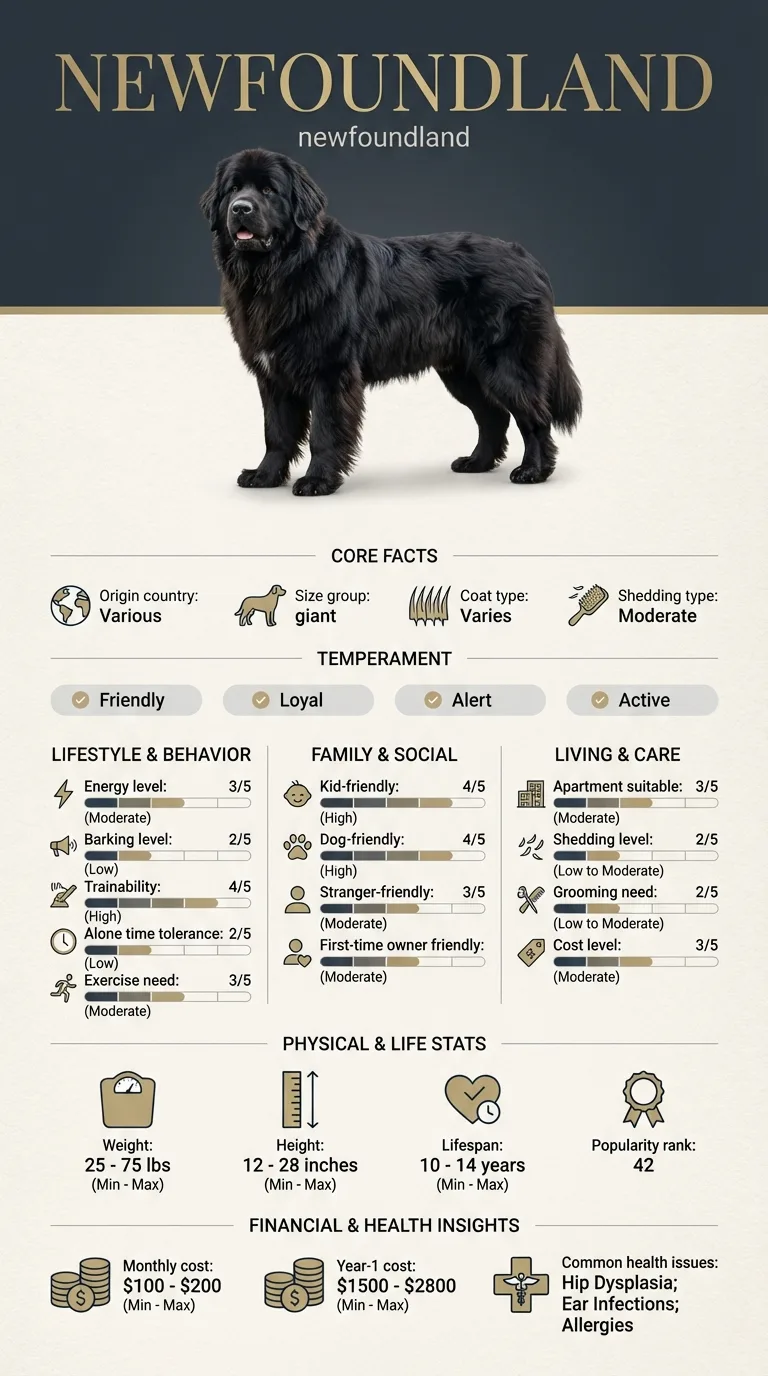
See all Newfoundland health problems, which breeds are prone to genetic predisposition to obesity, or the full Newfoundland breed guide for temperament, exercise needs and ownership costs.
There is no timeline over which a genuinely blunted appetite signal resolves on its own, since this is a fixed biological trait rather than a phase. What can change quickly, often within days to weeks, is how well a household's feeding structure manages the practical consequences, once secured food storage and a single coordinated feeding plan are in place.
Success is not a dog who stops acting hungry, since that behaviour pattern may never fully change. It is a household whose feeding structure reliably controls actual intake regardless of how persistently the dog asks for more, resulting in a stable, healthy weight maintained through management rather than through the dog's own self-restraint.
Appetite in dogs, as in people, is regulated by a signalling pathway in the brain that receives information about energy stores and current food intake and, in a normally functioning system, produces a feeling of fullness that reduces the drive to keep eating. The POMC gene is a key part of that pathway. A mutation that disrupts it does not simply make a dog enjoy food more; it genuinely weakens the biological signal that says enough has been eaten, so the dog continues to feel driven to seek and consume food well past the point a dog with normal signalling would stop.
This has been demonstrated most clearly in Labrador and Flat-Coated Retrievers, where carrying the variant is associated with measurably higher food motivation and a greater risk of obesity independent of activity level or feeding routine. The relevance to Newfoundlands is less about a confirmed identical mutation and more about a shared reality many owners of large, food-driven breeds report: a dog whose hunger does not behave the way a textbook feeding guide assumes it will, and who is not, in any meaningful sense, choosing to overeat out of poor discipline.
Understanding this reframes the whole management conversation. A dog with a genuinely blunted satiety signal is not going to learn to feel full through repetition or willpower, because the signal itself is the thing that is different. The practical response has to work around the biology rather than against it, using measured portions, structural barriers to opportunistic eating, and household consistency, rather than relying on the dog to self-regulate the way a lower-drive dog might.

None of this replaces a proper weight management plan, but it changes how you think about the dog's motivation and where effort is best spent.
If you think your Newfoundland has genetic predisposition to obesity, the plan is three steps: write down what you have seen and when it started, book a veterinary appointment rather than waiting for the next flare, and take video of the behaviour or symptom before you go — the thing you are worried about rarely happens in the consulting room. Screening in the parents covers hip dysplasia, subaortic stenosis, dilated cardiomyopathy.
What the vet visit should produce is a diagnosis and a written plan, not just reassurance: what is being ruled out, what the monitoring interval is, and which signs mean you come back sooner. Ask what the treatment costs across a year rather than per visit, because that is the number that decides whether you are managing this condition or reacting to it.
Between appointments, keep a short log — dates, what you saw, what changed. It is the single most useful thing an owner brings to a follow-up, and for genetic predisposition to obesity it is often what separates a clear pattern from a guess.
Bjorn had been called a bottomless pit by every person who had ever fed him, and his owner, Soren, had spent two years assuming this was simply an unusually persistent begging habit that better training would eventually fix. Despite consistent commands and consequences, Bjorn's interest in food never waned, before or after a full meal. A frank conversation with his vet reframed the problem. Rather than continuing to treat it as a training gap, they discussed the appetite-signalling biology documented in closely related breeds, and agreed that whatever the precise mechanism in Bjorn's case, the practical answer was the same: manage the environment rather than expect him to self-regulate. Soren secured every bin and counter in the house, moved to four smaller meals instead of two, and switched his training rewards to pieces of Bjorn's own measured kibble. Bjorn's weight, which had crept up for two years despite constant scolding, stabilised within two months and continued down toward a healthier target over the following few. Soren says the biggest shift was not any single change but simply no longer being angry at Bjorn for a hunger that was never really about willpower in the first place.
Key takeaway: A dog who never seems to feel full may be reporting a genuine biological signal rather than making a behavioural choice, and managing the environment works far better than trying to train the hunger itself away.
It is well documented in Labrador Retrievers and Flat-Coated Retrievers, with less established evidence specifically in Newfoundlands. The broader lesson, that appetite drive can have a genuine biological basis rather than being purely behavioural, is relevant regardless of whether this precise variant has been confirmed in this particular breed.
No, but it does mean weight management may take more deliberate structure than it would for a lower-drive dog. Measured feeding, environmental control over opportunistic eating, and consistent household rules can successfully manage a strong appetite drive even if the underlying biology does not change.
Training is still valuable, particularly for teaching impulse control around food and calm behaviour at mealtimes, but it should not be expected to reduce the underlying hunger drive itself. The goal shifts from making the dog feel less hungry to managing behaviour around a hunger that may genuinely be stronger than average.
It is optional and mainly satisfies curiosity or informs a breeding decision rather than changing day-to-day management much, since the practical response, measured feeding and environmental control, is the same regardless of the test result.
Some diets designed to increase satiety per calorie, often higher in fibre or protein, can help a dog feel fuller on the same or fewer calories. Discuss this with your vet as part of a broader weight management plan rather than as a standalone fix.
It sits on a spectrum with normal food motivation rather than being entirely separate from it. The specific gene mutation represents one clearly identified, measurable end of that spectrum in the breeds where it has been studied, but strong food drive without the specific mutation is common and needs the same practical management.
The early signs are set out in the sections above, and they are the reason to book a veterinary appointment rather than wait. Genetic Predisposition to Obesity in Newfoundlands is diagnosed by a vet, not from a symptom list, and the sooner it is on record the more options remain open.
A brain signalling pathway that tells the body it has had enough to eat. A disrupted version weakens that fullness signal, driving a dog to keep seeking food.
It is best documented in Labrador and Flat-Coated Retrievers, with less established evidence in Newfoundlands, though the same appetite-drive reality is commonly reported by owners.
Training helps with behaviour around food but does not change an underlying biological hunger signal, so environmental management matters more than willpower.
Measured portions, secured food storage, and consistent household rules rather than expecting the dog to self-regulate.
It mainly satisfies curiosity or informs breeding decisions, since the practical management approach is the same with or without a confirmed result.
A one-page prep sheet for this condition: the signs, the questions to ask, what to get priced. Unlocks here.
You get: Vet visit prep sheet
No spam. One-click unsubscribe. See our privacy policy.
Preview page 1 before you decide.