Health
What does a slipping kneecap look like?
A dog trotting, lifting one hind leg for two or three strides, then dropping it and continuing normally.

Quick answer
What does a slipping kneecap look like?
A dog trotting, lifting one hind leg for two or three strides, then dropping it and continuing normally.
The skip is not the dog being dramatic. It is a kneecap sitting where it should not be, and a leg that cannot straighten until it goes back.
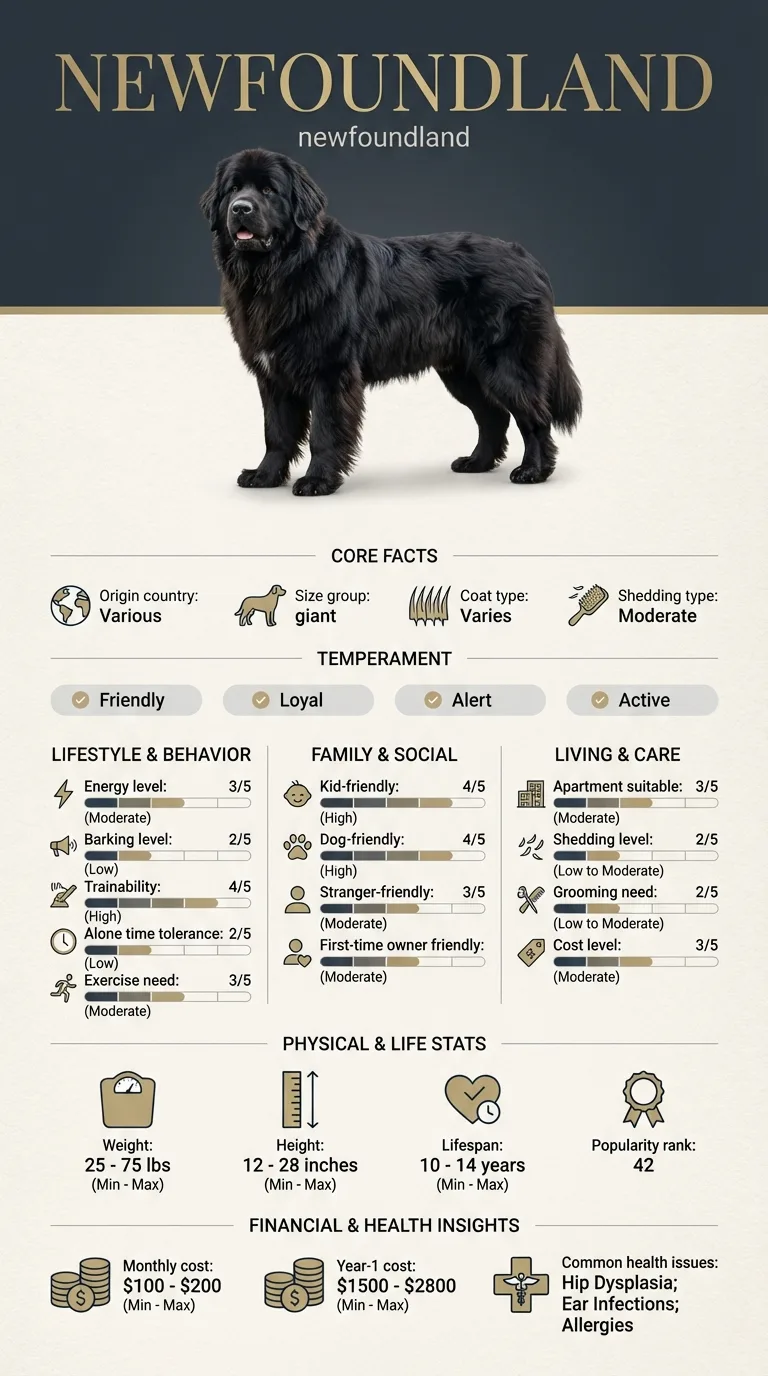
For Newfoundland owners who have noticed an intermittent hind-leg hop and are trying to work out whether this is a kneecap problem or one of the other things a giant-breed hind limb does.
This guide is not medical advice. If your dog shows pain, sudden behavior change, or worsening symptoms, consult a licensed veterinarian.
Some links may be affiliate links. We may earn a commission at no extra cost to you. We only suggest products we believe are helpful for dog owners.
Patellar luxation is the slipping of the kneecap out of the groove it normally slides in, caused by a shallow groove, a misaligned attachment point, or rotation in the limb bones. While the kneecap is displaced the leg cannot fully straighten, producing the characteristic skipping stride. It is primarily a small-breed condition, and in a giant breed the same signs are more often produced by cruciate ligament injury.
This is not among the Newfoundland's documented health issues, which are hip dysplasia, subaortic stenosis, dilated cardiomyopathy, cystinuria and bloat. It occurs in large dogs but is far from the leading explanation for hind-limb lameness in a dog weighing 100 to 150 pounds.
The honest position is that the Newfoundland's build does not predispose it to this condition. Patellar luxation is driven by limb conformation of a kind more typical of small breeds, and it is absent from this breed's documented health list. Where the breed does become relevant is in consequence rather than cause. A dog weighing 100 to 150 pounds transmits far more force through its stifle, so instability of any kind produces cartilage damage faster and progresses to arthritis sooner. The breed's low energy rating of 2 out of 5 also means thigh muscle is not naturally maintained, and muscle is one of the things holding the joint together.
Surfaces and activity patterns matter more than most owners realise. Sharp pivoting on grass at speed, the sudden turns of chase games, and slipping on polished indoor flooring all apply lateral force to a joint designed for straight-line movement. Overfeeding a calm breed with modest exercise needs is the easiest way to increase joint load. Households where a dog is inactive for long periods and then exercised hard on weekends produce exactly the combination of poor muscle support and sudden loading that stresses an unstable joint most.
Book an appointment for any recurring hind-limb lameness, even the intermittent skipping kind, because in a giant breed the more likely explanations are progressive. Go the same day if a hind leg is not bearing weight at all, if there is sudden severe pain, if the knee is visibly swollen, or if the lameness followed an obvious injury. Do not give any human anti-inflammatory or pain medication, several of which are toxic to dogs, and do not attempt to push a displaced kneecap back into place yourself.
See all Newfoundland health problems, which breeds are prone to luxating patellas, or the full Newfoundland breed guide for temperament, exercise needs and ownership costs.
Weight loss and improved footing usually change the frequency of episodes within two to three months. Muscle rebuilding takes a similar period of consistent work. Where surgery is undertaken, expect a controlled recovery of roughly two to three months before the dog returns to normal activity, and longer before muscle is fully restored. Arthritis that has already developed does not reverse, so early attention is worth more than thorough attention later.
Success is a dog that walks and trots without interruption, holds a lean body weight, keeps good muscle over both thighs, and shows no increase in episode frequency over time. In practice the most valuable outcome from reading this page is often a correct diagnosis: many Newfoundlands investigated for a suspected kneecap problem turn out to have something else, and finding that early is what protects the joint.
The kneecap is a small bone embedded in the tendon that runs from the thigh muscles down to the shin. It sits in a groove at the bottom of the femur and slides up and down that groove as the knee bends and straightens, acting like a pulley that keeps the tendon's pull efficient.
That arrangement only works if three things line up: the groove is deep enough to hold the bone, the attachment point on the shin sits directly below the groove, and the bones themselves are straight enough that the tendon pulls in a straight line. Luxation happens when any of these is off. A shallow groove lets the kneecap escape sideways. An attachment point sitting off to one side pulls it out. Rotation or bowing in the femur or tibia does the same.
When it slips, the tendon is running over the side of the joint rather than through it, and the leg cannot fully straighten. The dog lifts the limb, and often a couple of hopping strides with the leg extended is enough to let the kneecap snap back into place. Then everything works again, which is exactly why owners describe it as a dog that skipped a step and carried on.
Over time the repeated escape wears cartilage on the edges of the groove, making it shallower still, and arthritis follows.

Patellar luxation is best known as a small-breed condition, and its classic presentation, the intermittent skip in an otherwise sound little dog, comes from that population. In a giant breed the same anatomical problem behaves differently for reasons that come down to force and to what else is happening in the leg.
A 100 to 150 pound dog puts far more force through its stifle joint than a small dog does. Where a small dog's kneecap may pop out and back for years with minimal consequence, the same instability in a heavy dog does more damage per event and is less likely to be tolerated quietly.
More importantly, the giant-breed stifle has a much more common problem competing for attention. Cruciate ligament injury is the dominant cause of hind-limb lameness in heavy dogs, and its early stages can look deceptively intermittent. A partial ligament tear can produce a lameness that comes and goes with activity, which an owner may reasonably interpret as a skipping kneecap.
The distinction matters because the two conditions head in different directions. Cruciate injury in a big dog generally progresses and usually needs surgical attention, and delaying while assuming a benign kneecap problem costs joint health. Any recurring hind-limb lameness in a Newfoundland deserves an examination rather than a diagnosis made from a video and a search engine.
Recurring intermittent hind-limb lameness has several possible causes in this breed, and what separates them is pattern rather than appearance in any single episode.
If you think your Newfoundland has luxating patellas, the plan is three steps: write down what you have seen and when it started, book a veterinary appointment rather than waiting for the next flare, and take video of the behaviour or symptom before you go — the thing you are worried about rarely happens in the consulting room. Screening in the parents covers hip dysplasia, subaortic stenosis, dilated cardiomyopathy.
What the vet visit should produce is a diagnosis and a written plan, not just reassurance: what is being ruled out, what the monitoring interval is, and which signs mean you come back sooner. Ask what the treatment costs across a year rather than per visit, because that is the number that decides whether you are managing this condition or reacting to it.
Between appointments, keep a short log — dates, what you saw, what changed. It is the single most useful thing an owner brings to a follow-up, and for luxating patellas it is often what separates a clear pattern from a guess.
Marlowe was five and had started lifting his right hind leg for a few strides during walks, then carrying on normally. His owner filmed it, searched the movement, found descriptions of luxating patellas and concluded it was a minor mechanical quirk that plenty of dogs live with. What prompted the appointment two months later was frequency. The episodes had gone from once a week to most days, and Marlowe had started sitting with that leg rolled out to the side. The examination found no instability in his kneecap at all. What it found was a partially torn cruciate ligament, with fluid in the joint and a stifle that was visibly thicker than the other side. The intermittent lameness had been the ligament failing gradually rather than a kneecap slipping in and out. Marlowe had surgery, spent three months in controlled recovery, and is now sound. His surgeon's comment stayed with his owner: in a dog this heavy, the intermittent phase is the window, and it does not stay open.
Key takeaway: The skipping stride is a description of a movement, not a diagnosis. In a giant breed, increasing frequency is the signal that matters, and it should send you to an examination rather than back to the search bar.
It is characteristically a small-breed condition and does not appear among the Newfoundland's documented health issues, which are hip dysplasia, subaortic stenosis, dilated cardiomyopathy, cystinuria and bloat. It can occur in large dogs, but it is not the first explanation to reach for.
Cruciate ligament injury is the leading cause of hind-limb lameness in heavy dogs. Hip dysplasia, which is documented in this breed, and soft tissue strains are also common. All three deserve an examination rather than a guess.
The moment itself is usually more mechanical than painful, since the leg physically cannot straighten. The longer-term cartilage wear that repeated luxation causes does produce pain, which is why episodes should not simply be tolerated.
Mild, infrequent luxation is sometimes managed with weight control, muscle maintenance and monitoring. In a very heavy dog the threshold for intervention is generally lower, because each event does more damage. That judgement belongs to an orthopaedic veterinarian.
Yes, substantially. Reducing the weight travelling through the stifle reduces the force pushing the kneecap sideways at every step, and it also slows the arthritis that follows repeated luxation.
There is a heritable component in the breeds where it is common, related to inherited limb conformation. Since it is not a characteristic Newfoundland problem, a dog of this breed showing it should be assessed on its own conformation rather than assumed to be a breed case.
Do not stop entirely, since muscle is what stabilises the joint and it is lost quickly. Switch to controlled level walking and avoid sharp turns and jumping until you have been examined, then follow the specific advice you are given.
A dog trotting, lifting one hind leg for two or three strides, then dropping it and continuing normally.
Less likely than in a small breed. Cruciate ligament injury is a far more common cause of hind-limb lameness in a heavy dog.
A video of your dog trotting on a level surface filmed from behind, plus notes on which leg and how often.
No. Muscle stabilises the joint and disappears fast. Switch to controlled level walking rather than stopping altogether.
Yes. Force through the stifle scales with body weight, so a lean giant-breed dog experiences meaningfully less sideways pressure on the kneecap.
A one-page prep sheet for this condition: the signs, the questions to ask, what to get priced. Unlocks here.
You get: Vet visit prep sheet
No spam. One-click unsubscribe. See our privacy policy.
Preview page 1 before you decide.