Health
What does the antibody test measure?
The immune attack on the thyroid gland, not the amount of hormone the gland is currently producing.

Quick answer
What does the antibody test measure?
The immune attack on the thyroid gland, not the amount of hormone the gland is currently producing.
A dog can be losing thyroid tissue steadily while every routine hormone level still reads perfectly normal. The gland has reserve, and it uses it.
Written for breeders using antibody screening in their selection decisions, and for owners who have been handed a positive antibody result on a dog that appears completely healthy and told to wait and watch.
This guide is not medical advice. If your dog shows pain, sudden behavior change, or worsening symptoms, consult a licensed veterinarian.
Some links may be affiliate links. We may earn a commission at no extra cost to you. We only suggest products we believe are helpful for dog owners.
Immune-mediated thyroiditis is an autoimmune process in which the body's own immune cells progressively destroy thyroid tissue. Because the gland can compensate for substantial loss, hormone levels often remain normal for years while the destruction continues. Antibody testing detects the attack itself, making it possible to identify affected dogs long before any symptom appears and, crucially, before breeding decisions are made.
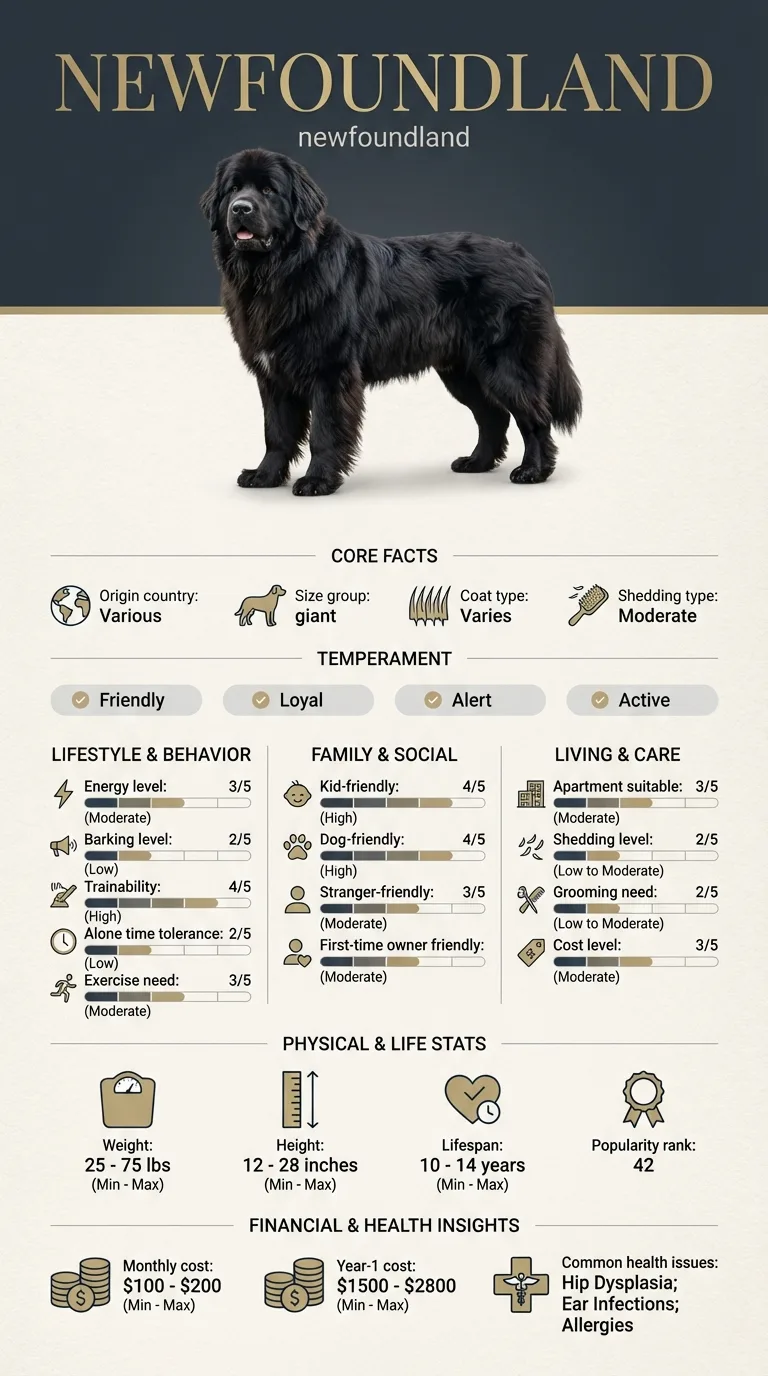
Autoimmune thyroiditis occurs across a wide range of breeds and is a recognised cause of eventual hypothyroidism. It does not appear among the Newfoundland's specific documented health concerns, which centre on hip dysplasia, subaortic stenosis, dilated cardiomyopathy, cystinuria and bloat, so it is best regarded as a general canine condition rather than a breed signature.
The predisposition is genetic rather than structural, which makes this unlike most of the Newfoundland's characteristic problems. Hip dysplasia and heat intolerance follow directly from how the dog is built; autoimmune thyroiditis does not. What the breed context does add is difficulty of detection. A dog rated 2 out of 5 for energy gives an owner little contrast when its stamina declines, and a heavy water-resistant double coat conceals early coat and skin change, so the clinical phase is easy to miss once it eventually arrives. The breed's nine to ten year lifespan also means that a disease which typically becomes clinical in middle age arrives at a point owners still consider early.
Environment plays a limited role in causing autoimmune disease, and owners should be wary of confident claims otherwise. What environment does affect is whether the condition is found. Households that use a breeder or veterinarian with a screening culture discover it; households that do not, discover it years later through symptoms. Access to laboratories that run the relevant panels, and the cost of doing so for a giant-breed dog, also determine in practice who gets tested.
This is a monitoring condition, so most contact is scheduled rather than urgent. Bring forward an appointment if your dog gains weight without an increase in food, becomes noticeably less active, develops symmetrical hair loss, starts seeking warmth in a way that is out of character, or develops recurrent skin infections. Seek urgent care for collapse, profound weakness, an inability to stand, or a dog that is unusually cold with pale gums. Never begin thyroid medication on the strength of an antibody result alone, because treating a dog with normal hormone output creates a new problem rather than preventing one.
See all Newfoundland health problems, which breeds are prone to immune mediated thyroiditis, or the full Newfoundland breed guide for temperament, exercise needs and ownership costs.
This condition unfolds over years rather than weeks. A dog identified as antibody positive as a young adult may remain hormonally normal and symptom free for a long stretch, and monitoring intervals are usually measured in months to a year. If and when hormone output does fall, the picture converges with ordinary thyroid deficiency and management becomes a daily lifelong routine. Some antibody-positive dogs never progress to needing treatment at all.
For a pet, success is quiet: a dog that stays well, gets rechecked on schedule, and is started on treatment at exactly the right moment rather than years late or unnecessarily early. For a breeder, success looks different and more consequential. It is a testing programme thorough enough that the tendency is identified before it is passed on, and a line that is measurably cleaner a few generations later than it was at the start.
The immune system's job is to recognise what belongs to the body and leave it alone. In autoimmune disease that recognition fails, and in immune-mediated thyroiditis the failure is directed at the thyroid gland. Immune cells infiltrate the gland and progressively destroy hormone-producing tissue.
The thyroid has considerable spare capacity, which is both a blessing and the reason this is so hard to catch. A substantial proportion of the gland can be lost before circulating hormone levels drop below the normal range, because the surviving tissue simply works harder. During that period the dog has an active disease process and a normal blood test.
What antibody testing does is look for the attack rather than for the consequence. Detecting antibodies directed against thyroid proteins indicates that the immune process is under way, regardless of whether hormone output has yet fallen. A dog can therefore be antibody positive and hormonally normal, which is exactly the confusing result many owners receive.
That result is not a diagnosis of hypothyroidism and it does not mean treatment should start. It means the dog is on a trajectory that deserves monitoring, and, importantly, that this is information a breeding programme should take seriously.

Two tests answering two different questions produce four possible combinations, and each one implies something different. This is why the result should be explained by a veterinarian rather than read off a page.
For a pet owner whose dog feels well, an antibody result changes very little in the short term. It adds a monitoring schedule and a reason to pay attention to weight, coat and energy, but it does not change today's care.
For a breeder the calculation is completely different. The predisposition to autoimmune thyroid disease is inherited, and a dog that is antibody positive at two years old is likely to develop clinical disease later and to pass the tendency to its offspring. Testing before breeding decisions are made is therefore a way of removing a heritable problem from a line rather than discovering it one generation later.
Because antibody status can appear at different ages, breeders who take this seriously typically retest over time rather than testing once. A clear result at fourteen months is worth having and is not permanent.
There is a broader point here for anyone buying a puppy. In a breed whose documented health concerns already include hip dysplasia, subaortic stenosis, dilated cardiomyopathy, cystinuria and bloat, thyroid screening is an optional extra rather than a core requirement. It is a marker of how thorough a breeder is, more than a box that must be ticked.
Rowan was tested at eighteen months as part of a breeder's routine panel, before any question of breeding arose. He came back antibody positive with completely normal hormone levels, and his owner left the clinic more alarmed than the result warranted, having read the word autoimmune and stopped there. The veterinarian's explanation was the part that mattered. Rowan had an active process and a gland still doing its job. There was nothing to treat, and treating him would have made him unwell. What he needed was an annual blood test and an owner paying attention to weight and coat. Four years on, Rowan has never needed medication. His hormone levels have drifted toward the lower part of the normal range and his last recheck moved to every eight months rather than every twelve. His breeder removed him from the breeding plan the week the first result came back, which was the decision the test was actually run to inform.
Key takeaway: A positive antibody result is a schedule, not a sentence. Its greatest value is to the next generation, and its greatest risk to the current one is being treated for a deficiency the dog does not yet have.
No. It means the immune system is attacking the gland. Hormone output may still be entirely normal, and some dogs remain clinically well for a long time. It identifies a trajectory rather than a current diagnosis.
Generally not. Treating a dog whose hormone levels are normal risks causing the opposite problem. The usual approach is periodic monitoring so that treatment starts when it is actually needed, and that decision belongs to your veterinarian.
Your veterinarian will set an interval based on the dog's age and results, commonly annually. The purpose is to catch declining hormone output early rather than to repeat the antibody finding.
Antibody levels can fluctuate, and in some dogs they decline as the gland is destroyed and there is less tissue left to attack. A falling antibody level is therefore not automatically good news, which is another reason results need professional interpretation.
No. Autoimmune thyroiditis occurs across many breeds. The Newfoundland's own documented health concerns are hip dysplasia, subaortic stenosis, dilated cardiomyopathy, cystinuria and bloat, so this sits outside the breed's core screening priorities.
This is a decision to make with a veterinarian who knows the line, but the general principle is that a heritable autoimmune tendency is not something to propagate deliberately. Breeders who test are testing precisely so they can act on the answer.
Not necessarily. Some dogs have one autoimmune process and nothing else. It is a reason for your veterinarian to keep an open mind about unexplained signs later, not a prediction.
The immune attack on the thyroid gland, not the amount of hormone the gland is currently producing.
The thyroid has spare capacity. Remaining tissue compensates until a large proportion of the gland has been lost.
Usually not. Treating a dog with normal hormone levels causes its own problems. The answer is monitoring, on a schedule your vet sets.
Breeders. The tendency is heritable, and finding it before a mating is far more useful than finding it a generation later.
No. It is an optional extra rather than a core breed screen, and worth discussing with your vet rather than requesting by default.
A one-page prep sheet for this condition: the signs, the questions to ask, what to get priced. Unlocks here.
You get: Vet visit prep sheet
No spam. One-click unsubscribe. See our privacy policy.
Preview page 1 before you decide.