Health
What is the highest-value thing an owner can do?
Keep the dog genuinely lean. It reduces joint force at every step, continuously, for free.

Quick answer
What is the highest-value thing an owner can do?
Keep the dog genuinely lean. It reduces joint force at every step, continuously, for free.
The hip does not break. It loosens, then grinds, then remodels, and each stage is quieter than owners expect.
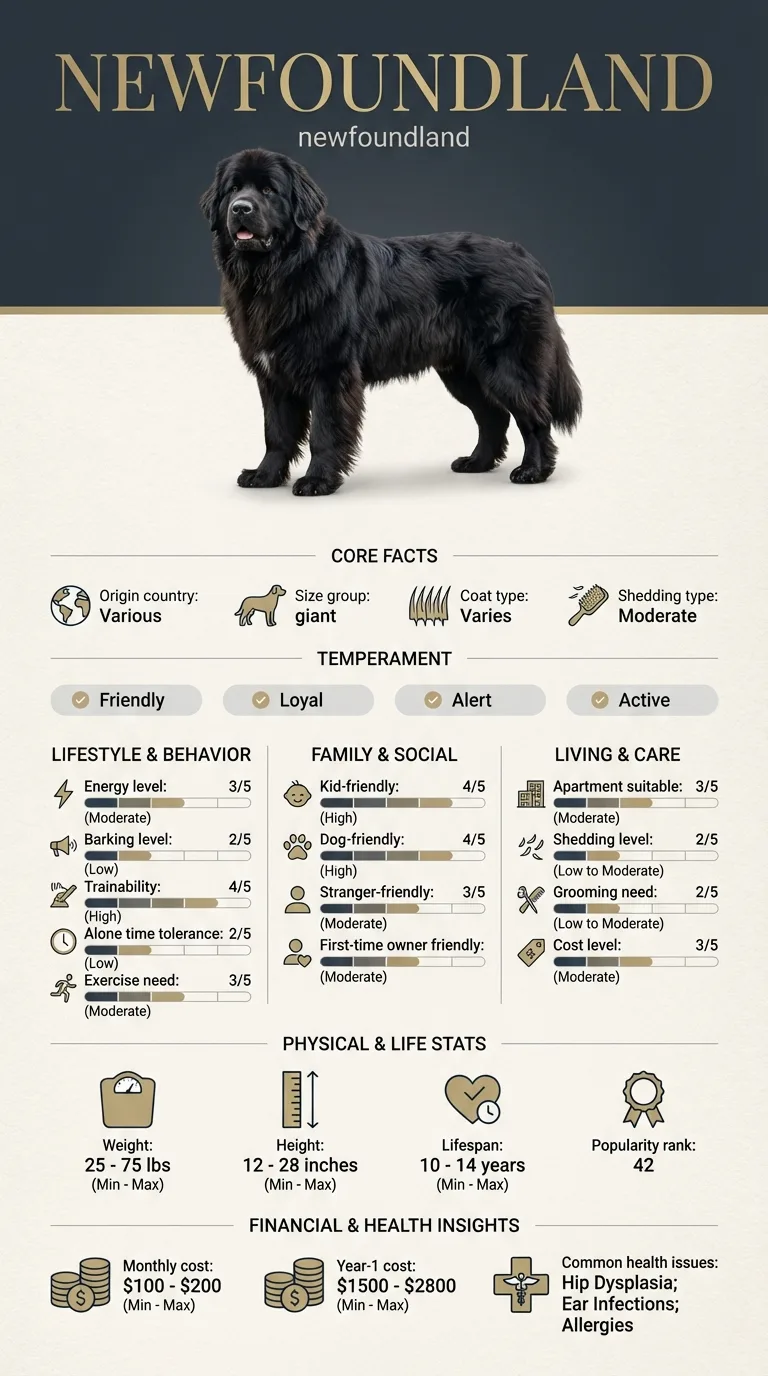
For owners of Newfoundland puppies wanting to protect developing joints, and for families whose adult or senior dog has started hesitating at the stairs, struggling to rise, or bunny-hopping on walks.
This guide is not medical advice. If your dog shows pain, sudden behavior change, or worsening symptoms, consult a licensed veterinarian.
Some links may be affiliate links. We may earn a commission at no extra cost to you. We only suggest products we believe are helpful for dog owners.
Hip dysplasia is a developmental looseness of the hip joint that leads, over years, to cartilage wear and arthritis. In a Newfoundland the process is amplified by body mass, since every step drives substantial force through a joint that does not sit correctly. Owners typically notice the arthritis stage rather than the laxity stage, which is why the condition often appears to arrive suddenly in a middle-aged dog.
Hip dysplasia is listed among the Newfoundland's documented health issues and is one of the defining orthopaedic problems of the giant breeds generally. Severity varies widely, and plenty of affected dogs live comfortably for years with good management.
Two breed characteristics combine here. The first is inheritance: hip dysplasia appears directly on the Newfoundland's documented health concern list, meaning the underlying conformation is passed through the population. The second is mass. At 100 to 150 pounds and 26 to 28 inches at the shoulder, this dog puts more force through each hip than almost any other companion breed, and it does so for a nine to ten year lifespan. Rapid puppy growth is a third factor, because a giant-breed skeleton grows for far longer than a small dog's and spends more time in a vulnerable state. The breed's low energy rating of 2 out of 5 then works against recovery, since these dogs do not naturally maintain hindquarter muscle through spontaneous activity.
Flooring is the most underrated household factor. Polished wood, laminate and tile cause the hind legs to slide apart, which loads a loose hip in exactly the wrong direction, and a heavy dog that has slipped once often becomes reluctant to move confidently indoors. Homes with stairs on the daily route, high vehicle tailgates and elevated furniture add repeated impact. Overfeeding, which is easy in a calm breed that burns little, converts directly into joint force. Cold, damp conditions do not cause the disease but reliably make an arthritic dog stiffer.
Book an appointment promptly for any persistent limp, a change in how your dog rises, reluctance to use stairs it previously managed, or visible loss of muscle over the hindquarters. Do not wait for the dog to cry out; dogs with chronic joint pain very often do not. Seek care the same day if a hind leg is suddenly non-weight-bearing, if there is acute severe pain, if the dog cannot get up at all, or if hind-limb weakness appears abruptly, since sudden neurological signs are a different emergency from gradual arthritis. Always discuss pain relief with your veterinarian rather than using any human medication, several of which are dangerous to dogs.
See all Newfoundland health problems, which breeds are prone to hip dysplasia, or the full Newfoundland breed guide for temperament, exercise needs and ownership costs.
Weight loss and improved footing usually produce a visible difference in six to twelve weeks, which is often the fastest improvement an owner will see. Rebuilding lost hindquarter muscle takes months of consistent work. Arthritis itself does not reverse, so the honest framing is that management slows a curve rather than turning it around. Dogs that have surgery typically face two to four months of restricted, closely supervised recovery before the benefit is apparent.
Success is a dog that gets up without struggling, walks comfortably every day, sleeps well, and keeps enough muscle to support itself into old age. It is not a normal X-ray and it is not a dog that runs like a two-year-old. For most Newfoundland households, success means arriving at the end of a nine or ten year life with a dog that was still walking to the end of the street last month.
A healthy hip is a deep socket holding a well-fitted ball. In dysplasia the fit is loose, and looseness is the beginning of everything that follows. Each time the dog moves, the ball shifts within the socket instead of rotating cleanly inside it.
That abnormal movement does two things. It grinds cartilage, which has no nerve supply of its own but does not regenerate well once worn. And it stimulates the bone underneath to remodel, laying down new bone at the joint margins in an attempt to stabilise something that will not stay put. The remodelled joint is arthritic, and arthritis is where the pain lives.
The timeline explains why owners get caught out. The laxity is present in a young dog, often well before any visible lameness, and the arthritis that produces symptoms arrives years later. A Newfoundland can therefore be developing the problem at eight months while looking like the healthiest puppy in the litter.
Body mass drives the whole process. Every step a 100 to 150 pound dog takes puts far more force through a loose joint than the same step would in a 40 pound dog, which is why the giant breeds carry so much of this disease.

Very few dogs present with dramatic limping. The realistic list is subtler than that, and most of it is about how the dog moves rather than whether it cries out.
Most Newfoundlands with hip dysplasia are managed rather than operated on, and conservative management is far more effective than its unglamorous name suggests. It rests on four pillars: keeping the dog genuinely lean, maintaining the muscle that supports the joint, controlling pain under veterinary direction, and adapting the home so that daily life stops loading the hip unnecessarily.
Of those, body condition does the most work and costs the least. Reducing the weight travelling through a compromised joint reduces the force at every single step, all day, every day. It is the only intervention that operates continuously.
Surgery enters the conversation when pain cannot be controlled adequately, when function is deteriorating despite good management, or in some young dogs where procedures aimed at changing joint mechanics are still an option. Hip replacement is a genuine possibility even in giant breeds, and for the right dog the results can be excellent. It is also a major undertaking, expensive, and requires a long controlled recovery with a very large dog, which is a household commitment as much as a medical one.
The decision belongs to an orthopaedic veterinarian who has seen the imaging. What owners can bring to that conversation is an honest account of what the dog can and cannot do, and a realistic assessment of what recovery care they can provide.
If you think your Newfoundland has hip dysplasia, the plan is three steps: write down what you have seen and when it started, book a veterinary appointment rather than waiting for the next flare, and take video of the behaviour or symptom before you go — the thing you are worried about rarely happens in the consulting room. Screening in the parents covers hip dysplasia, subaortic stenosis, dilated cardiomyopathy.
What the vet visit should produce is a diagnosis and a written plan, not just reassurance: what is being ruled out, what the monitoring interval is, and which signs mean you come back sooner. Ask what the treatment costs across a year rather than per visit, because that is the number that decides whether you are managing this condition or reacting to it.
Between appointments, keep a short log — dates, what you saw, what changed. It is the single most useful thing an owner brings to a follow-up, and for hip dysplasia it is often what separates a clear pattern from a guess.
Sasha was six when her family noticed she had stopped coming upstairs in the evenings. They assumed she preferred the cool of the hallway. Her veterinarian found substantial arthritis in both hips and a hindquarter that had visibly wasted, and asked a question the family had not expected: what is your flooring? The whole ground floor was polished wood. Sasha had been carefully picking her way across it for months, holding her hind legs close together to avoid slipping, and doing almost no real walking indoors as a result. She had stopped using the stairs not because of the climb but because of the landing at the top. Runners went down along every route, a ramp replaced the jump into the car, and her food was weighed for the first time in her life. She lost eleven pounds over five months. A rehabilitation therapist put together a short daily walking and standing routine. Sasha never went back upstairs, but she went back to walking the block twice a day and kept doing it until she was nearly nine.
Key takeaway: For a heavy dog, the surface underfoot is part of the treatment. Fix the floor and the weight before concluding that a slowing Newfoundland has simply got old.
Both. There is a strong hereditary component, which is why the condition is documented in the breed and why hip screening of breeding dogs matters. Growth rate, body condition and early exercise then influence how severely that inherited tendency expresses itself.
Joint laxity is present in young dogs, and some puppies show signs before a year old. Many dogs, though, are comfortable through young adulthood and only become symptomatic in middle or older age when arthritis has accumulated.
You cannot change the genetics, but you can avoid making it worse. Keeping a growing Newfoundland lean rather than chunky, feeding an appropriate large-breed growth diet chosen with your veterinarian, and avoiding repetitive high-impact exercise on hard surfaces during growth are the levers that exist.
No. Some dogs have poor-looking hips on X-ray and function well, while others with milder-looking changes are noticeably uncomfortable. Imaging and clinical signs correlate imperfectly, which is why treatment decisions follow the dog rather than the picture.
For many dogs it is one of the best forms of exercise available, because it builds supporting muscle without loading the joint. Water temperature and the dog's overall health still matter, so confirm it suits your dog with your veterinarian.
It is one of the most expensive routine orthopaedic procedures in veterinary medicine and giant breeds sit at the top end. Get a written estimate that includes imaging, the procedure, hospitalisation, medication and rehabilitation before deciding.
Most well-managed dogs do not. Severe, poorly controlled cases can reach a point where mobility and quality of life are seriously compromised, which is exactly why early weight control and muscle maintenance matter so much.
No. The condition has a substantial heritable component and breeding affected dogs perpetuates it. This is the central reason hip screening exists as a breed practice.
Keep the dog genuinely lean. It reduces joint force at every step, continuously, for free.
A slow or staged rise from lying down. It reads as age long before most owners think of the hips.
Non-slip flooring on the routes your dog uses daily, plus a ramp instead of a jump into the car.
Usually yes, in short, regular, level sessions. Muscle supports the joint, and inactivity costs that support quickly.
Ongoing pain management, rehabilitation and possible surgery make this one of the largest health expenses a Newfoundland household is likely to face.
A one-page prep sheet for this condition: the signs, the questions to ask, what to get priced. Unlocks here.
You get: Vet visit prep sheet
No spam. One-click unsubscribe. See our privacy policy.
Preview page 1 before you decide.