Health
What is the hallmark of myotonia congenita?
Stiffness that improves as the dog keeps moving, known as the warm-up phenomenon, present from puppyhood rather than developing with age.

Quick answer
What is the hallmark of myotonia congenita?
Stiffness that improves as the dog keeps moving, known as the warm-up phenomenon, present from puppyhood rather than developing with age.
Myotonia has a signature no other stiffness has: the dog gets looser the longer it moves, not tighter.
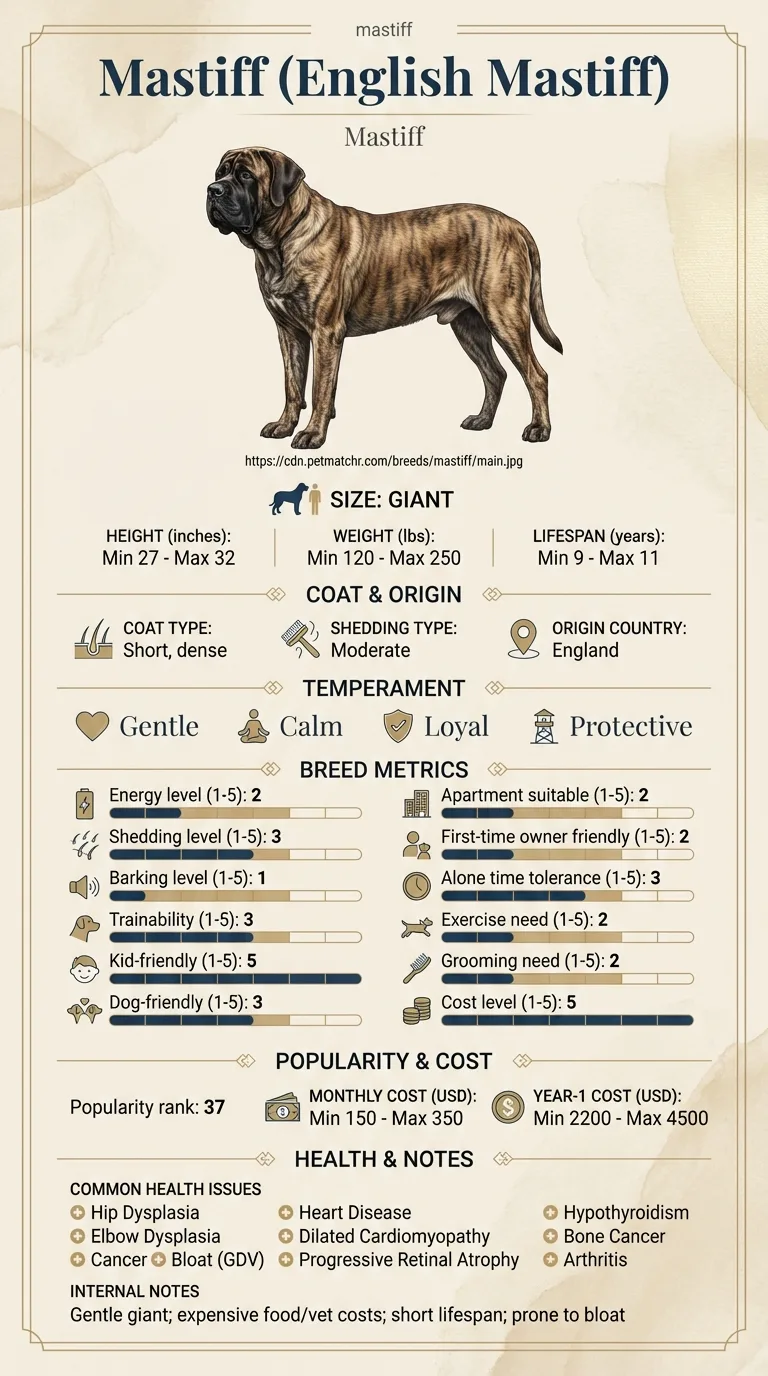
Owners whose Mastiff is stiff and awkward on standing, particularly after rest, and who want to know what conditions genuinely explain that in a dog of this build.
This guide is not medical advice. If your dog shows pain, sudden behavior change, or worsening symptoms, consult a licensed veterinarian.
Some links may be affiliate links. We may earn a commission at no extra cost to you. We only suggest products we believe are helpful for dog owners.
We research and check what we publish, but we do not warrant that any figure, date, price, or statement is accurate, complete, or current, and we accept no liability for any loss, cost, injury, or other harm arising from the use of this site. Use it as one reference among several. You remain responsible for your own decisions and for your dog's care - confirm anything that matters with a licensed veterinarian or another qualified professional before you act on it. Full disclaimer.
Myotonia congenita is an inherited disorder in which muscle fibres cannot relax promptly after contracting, producing rigidity from puppyhood that characteristically eases as the dog continues to move. It is recognised in a small number of specific breeds and is not documented in Mastiffs. For an owner of a stiff Mastiff, the practical value lies in recognising that distinctive warm-up pattern and in knowing which far commoner conditions produce stiffness in a giant breed.
This is a rare condition overall and is not among the health problems listed for Mastiffs. By contrast, arthritis, hip dysplasia and elbow dysplasia all appear explicitly on this breed's documented list, and stiffness on rising is one of the most frequent reasons a middle-aged or older Mastiff is brought to a vet.
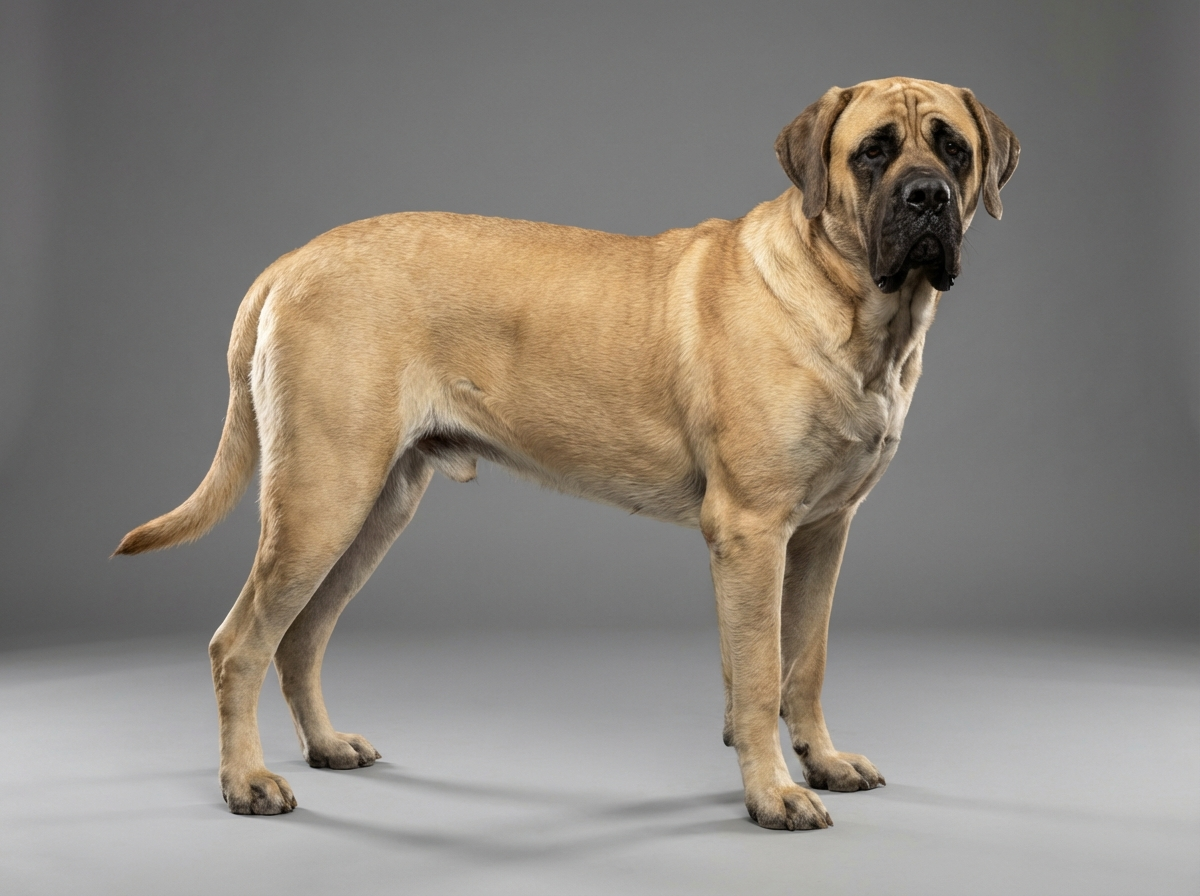
Myotonia congenita arises from an inherited fault in muscle membrane channels, and the breeds in which it is recognised carry specific known variants. Nothing about the Mastiff's build predisposes to it, and it does not appear on the breed's documented health list. What the Mastiff genuinely brings to the subject of stiffness is orthopaedic load. Hip dysplasia, elbow dysplasia and arthritis are all documented in this breed, and a body of 120 to 250 pounds standing 27 to 32 inches at the shoulder places sustained force through every joint. Giant breeds are also the population in which wobbler syndrome is concentrated.
How and where a heavy dog rests changes how stiff it looks. A thin bed on a cold hard floor produces a dog that struggles to get up, while a thick supportive bed in a warm draught-free spot does not. Slippery flooring makes a large dog brace and scrabble on standing, which reads as stiffness even when the joints are reasonable. Weekend-only exercise creates a cycle of overexertion and next-day soreness. Excess weight amplifies all of it, and in a breed this size the difference between a lean dog and a heavy one is measured in tens of pounds.
Book an appointment for any persistent stiffness, for stiffness in a young dog, or for a gait that has changed. Ask specifically about joint radiographs and a thyroid panel, since both cover common and treatable causes. Seek urgent care if your Mastiff suddenly cannot stand, collapses, has episodes of rigidity accompanied by loss of awareness, is dragging a limb, or has lost bladder or bowel control, as these suggest a neurological emergency rather than a muscle or joint problem. Sudden generalised rigidity with altered consciousness should be treated as a seizure and assessed immediately.
See all Mastiff health problems, which breeds are prone to myotonia congenita, or the full Mastiff breed guide for temperament, exercise needs and ownership costs.
Reaching a diagnosis for a stiff Mastiff usually takes two to four weeks, covering examination, radiographs and bloodwork. If arthritis or dysplasia is the answer, expect improvement over six to twelve weeks from weight loss, bedding, flooring and a revised exercise routine, then long-term management rather than resolution. Genuine myotonia would require neurological referral and specialised testing, and management would be lifelong.
Success is knowing what the stiffness is. For most Mastiffs that means identifying a joint or hormonal condition that responds to management, and then seeing the dog rise more easily and move more freely within a few months. It does not mean a dog that never stiffens; a giant breed in its later years will always take a moment to get going. What it should mean is that nothing treatable was missed while a rare diagnosis was being considered.
In true myotonia, muscle fibres fail to switch off. When an affected dog first stands, the hind limbs are rigid and the gait is stiff and hopping, sometimes with both back legs moving together. The dog may fall over if it tries to turn quickly.
The distinguishing feature is what happens next. As the dog keeps walking, the muscles begin releasing more normally and the gait improves substantially, sometimes to near-normal within a few minutes. This warm-up effect is unusual and is the single most useful clue in the whole condition.
Affected dogs are also often visibly over-muscled, particularly across the neck and shoulders, because muscle that is constantly contracting hypertrophies. Some show a stiff, open-mouthed appearance or difficulty swallowing. Signs are present from a young age rather than developing in middle life, which immediately separates it from the arthritic stiffness Mastiff owners are far more likely to be looking at.
Diagnosis rests on electrical testing of the muscle, which produces a characteristic pattern, alongside DNA testing where a variant is known for the breed in question. It is not diagnosed on appearance alone, and it is not something an owner can confirm at home.
Contrast this with arthritis. An arthritic Mastiff is also stiff on rising, but the stiffness eases gradually over a longer period, worsens after heavy exercise rather than improving, and gets worse in cold weather and across years.
These are the conditions worth working through with a vet when a Mastiff moves stiffly, all of which are more plausible in this breed than myotonia.

If you think your Mastiff has myotonia congenita, the plan is three steps: write down what you have seen and when it started, book a veterinary appointment rather than waiting for the next flare, and take video of the behaviour or symptom before you go — the thing you are worried about rarely happens in the consulting room. Screening in the parents covers hip dysplasia, elbow dysplasia, cancer.
What the vet visit should produce is a diagnosis and a written plan, not just reassurance: what is being ruled out, what the monitoring interval is, and which signs mean you come back sooner. Ask what the treatment costs across a year rather than per visit, because that is the number that decides whether you are managing this condition or reacting to it.
Between appointments, keep a short log — dates, what you saw, what changed. It is the single most useful thing an owner brings to a follow-up, and for myotonia congenita it is often what separates a clear pattern from a guess.
Delphine had convinced herself her six-year-old Mastiff, Gideon, had a muscle disorder. He was rigid getting out of his bed each morning, moved like a wooden horse for the first part of a walk, and had the heavy shoulders she had read were typical. Her vet asked one question she had not thought about: was he better or worse by the end of the walk? Delphine realised he was worse. He started stiff, loosened a little, and then deteriorated markedly over the last ten minutes, and the following morning was always the hardest. That pattern is the opposite of myotonia. Radiographs showed advanced arthritis in both hips and moderate elbow changes. His thyroid panel was normal. Gideon lost twenty-four pounds over eight months, moved onto three short daily walks instead of one long one, got a thick orthopaedic bed away from the back door, and started prescribed pain relief. By the following summer Delphine described him as five years younger.
Key takeaway: The direction of change across a walk is what separates a muscle relaxation disorder from joint disease. Delphine's dog got worse with distance, which pointed straight at the documented breed problems rather than at the rare condition she had researched.
It is not among the conditions documented for this breed. Myotonia congenita has been described in a limited number of breeds where a specific inherited variant is recognised. A stiff Mastiff is overwhelmingly more likely to have joint disease, a neck problem or a hormonal condition, all of which are far commoner and treatable.
By what happens with continued movement and by the age of onset. Myotonia typically improves markedly within minutes of starting to move and is present from puppyhood. Arthritic stiffness eases more slowly, worsens after heavy exercise, worsens in cold weather, and develops with age. Your vet will also examine specific joints for pain.
Myotonia is generally described as producing rigidity and difficulty moving rather than pain, which is another point of contrast with joint disease. If your Mastiff flinches, guards a limb, or reacts when a joint is handled, that suggests a painful condition and points the investigation elsewhere.
Where it occurs, myotonia congenita is a lifelong condition managed rather than cured, and treatment decisions belong entirely with a veterinary neurologist. There is no at-home management for it, and no supplement affects muscle membrane function. This is another reason to establish the diagnosis properly rather than assume it.
Far more likely hip dysplasia, which is documented in this breed and produces exactly that gait as a young dog compensates for a loose joint. Bunny-hopping in a growing giant breed should prompt hip radiographs rather than a search for rare muscle disorders.
Video of your dog rising from rest and walking for several minutes afterwards, the age at which the stiffness first appeared, whether it improves or worsens as the walk continues, whether it is worse in cold weather, and whether your dog shows any sign of pain on handling. Those five answers narrow the list dramatically.
Stiffness that improves as the dog keeps moving, known as the warm-up phenomenon, present from puppyhood rather than developing with age.
No. It is recognised in a small number of specific breeds. Stiffness in a Mastiff is far more likely to be arthritis, dysplasia, a neck problem or hypothyroidism.
Arthritic stiffness eases slowly, worsens after heavy exercise and in cold weather, appears with age, and is painful. Myotonic stiffness eases quickly with movement and is not typically painful.
Most often hip dysplasia, which is documented in this breed. It warrants hip radiographs rather than an investigation of rare muscle disease.
Video of your dog rising and then walking for several minutes, the age stiffness began, whether it improves or worsens with continued movement, and whether handling causes pain.
A one-page prep sheet for this condition: the signs, the questions to ask, what to get priced. Unlocks here.
You get: Vet visit prep sheet
No spam. One-click unsubscribe. See our privacy policy.
Preview page 1 before you decide.