Behavior
Is barking a lot unusual for a Mastiff?
Yes - Mastiffs are known for being quiet, so a sudden increase in barking is usually a signal of a specific trigger rather than normal breed behavior.

Quick answer
Is barking a lot unusual for a Mastiff?
Yes - Mastiffs are known for being quiet, so a sudden increase in barking is usually a signal of a specific trigger rather than normal breed behavior.
A Mastiff barking at everything isn't the breed being itself - it's usually the breed telling you something changed.
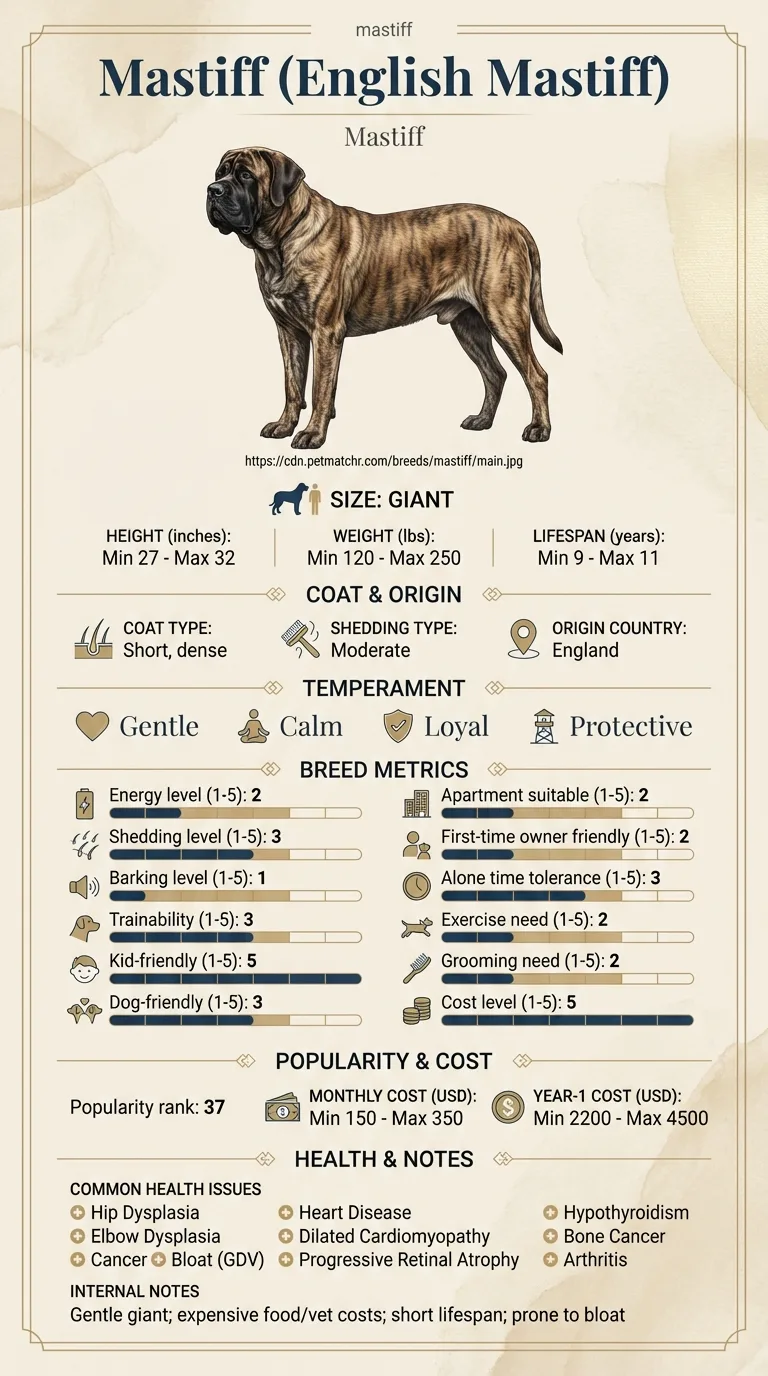
This shows up most for owners of adult or senior Mastiffs who chose the breed partly because it's known for being calm and quiet, and are now confused or embarrassed by a dog that has started barking at the fence, the door, or seemingly nothing at all.
This guide is not medical advice. If your dog shows pain, sudden behavior change, or worsening symptoms, consult a licensed veterinarian.
Some links may be affiliate links. We may earn a commission at no extra cost to you. We only suggest products we believe are helpful for dog owners.
We research and check what we publish, but we do not warrant that any figure, date, price, or statement is accurate, complete, or current, and we accept no liability for any loss, cost, injury, or other harm arising from the use of this site. Use it as one reference among several. You remain responsible for your own decisions and for your dog's care - confirm anything that matters with a licensed veterinarian or another qualified professional before you act on it. Full disclaimer.
Mastiffs are ranked among the least vocal large breeds, relying on their sheer physical presence rather than noise to deter threats. When a Mastiff starts barking repeatedly, persistently, or at things an owner can't identify, it's usually not the dog discovering its voice - it's a response to something specific in the environment, its body, or its routine that has changed.
True excessive barking is not a defining trait of the breed the way it might be for a naturally vocal terrier. Most reports of Mastiffs barking a lot describe a change from a much quieter baseline, which is why owners tend to notice and flag it quickly rather than assume it's just how the dog is.
Mastiffs were bred as estate and property guardians, historically expected to intimidate through size and stand their ground rather than raise a constant alarm. That guardian instinct is still active - it shows up as watchfulness toward unfamiliar people - but the breed's low natural bark tendency means the instinct is usually expressed through posture and presence, not sound. When barking increases, it often means the dog's threshold for what counts as a threat has dropped, which can come from under-socialization, pain, or simply not having had enough calm exposure to a new trigger.
This is a breed that does better with a settled routine and enough space to observe its surroundings without feeling cornered. A small yard facing a busy street, a new fence line changing sightlines, or being left alone for long periods in a high-traffic area can push a naturally low-key dog into a more reactive, vigilant state simply because it has more to react to and less to do about it.
Bring in a trainer or behaviorist if the barking is clearly fear or anxiety-driven, is escalating despite consistent management, or is starting to generalize to more and more triggers. A professional can help build a desensitization plan suited to a large, strong dog where physical management alone isn't enough.
Talk to your vet if the barking is new and sudden, happens alongside pacing, disorientation, or apparent confusion, or seems tied to the dog being touched or moving in a specific way. In a breed with real joint and cardiac risk, ruling out pain or a sensory change should come before assuming the barking is purely behavioral.
See all Mastiff health problems, which breeds are prone to excessive barking, or the full Mastiff breed guide for temperament, exercise needs and ownership costs.
Most owners see a noticeable reduction in trigger-based barking within three to six weeks of consistent management, assuming there's no untreated physical cause underneath it. Barking tied to unresolved pain or sensory decline won't improve until that underlying issue is addressed.
Success isn't a silent dog - it's a return to the breed's normal pattern: an occasional, purposeful bark at something genuinely worth noting, rather than a sustained response to everyday activity near the home.
A Mastiff's baseline is silence punctuated by the occasional deep, deliberate bark used as a warning. When that baseline shifts, it's usually one of these.
Not all barking needs the same response, and treating all of it as a training problem misses the ones that are actually medical. A slow, repetitive bark aimed at a fixed point - the fence, the window, a corner of the yard - is classic alert barking, and it responds to management and desensitization.
A sharper bark that happens when the dog is touched or changes position is worth ruling out physically first, given this breed's joint risk. Barking with pacing or disorientation, especially in a dog over seven, deserves a hearing and vision check before assuming it's behavioral.
The practical rule: a clear external trigger that resolves once the trigger is gone means start with management; barking that seems to come from nowhere means treat it as a signal first.

Duke, a four-year-old Mastiff, had never been a barker - his owner Priya used to joke that he communicated entirely through sighing. That changed over about two weeks when he started barking at the back fence most evenings around dusk. Priya's first instinct was that something was wrong, since this was so far outside his normal behavior. A vet visit ruled out pain or a hearing problem. Walking the yard at the same hour, she found the trigger: a neighbor had started storing construction equipment along the shared fence line, and the unfamiliar shapes and occasional clang were exactly the kind of ambiguous stimulus that put Duke on edge. She couldn't remove the equipment, so she worked with what she could control - moving his evening routine earlier, and standing calmly near the fence with him so he could see there was nothing to escalate over. Within a month the barking had dropped back to the occasional single bark.
Key takeaway: In a breed this quiet by default, sudden or sustained barking is information, not a personality change - the fastest path to quiet is usually finding what specifically triggered it, not just managing the noise.
Not typically. Mastiffs are one of the quieter large breeds and generally bark only for a reason - an approaching stranger, an unfamiliar sound, or genuine distress. Constant or daily barking is usually a change worth investigating rather than a breed trait to just live with.
Sudden onset barking in a dog that wasn't previously vocal points to a specific cause: a new environmental trigger near the home, joint or other pain, hearing or vision decline in an older dog, or a drop in mental stimulation. Look for what changed in the last few weeks before assuming it's just a phase.
Yes. A dog in discomfort may bark when startled, when asked to move suddenly, or when anticipating being touched somewhere sore. Given how common hip and elbow issues are in this breed, ruling out pain is a reasonable first step before assuming the barking is purely behavioral.
Many will alert-bark at an unfamiliar person near the property, which fits their history as a guardian breed. This is usually a short burst rather than sustained barking, and most Mastiffs settle once they've assessed the person isn't a threat.
Identify and manage the trigger first - block the sightline, reduce time spent alone facing the trigger, or change the routine that exposes the dog to it. Pair the trigger with calm, low-key reinforcement at a distance the dog can handle rather than escalating corrections, which tend to increase anxiety-driven barking.
See a vet if barking is new, sudden, paired with pacing or disorientation, happens when the dog is touched or moves in a specific way, or shows up alongside appetite or sleep changes. Those patterns suggest a physical cause rather than a purely environmental one.
Yes - Mastiffs are known for being quiet, so a sudden increase in barking is usually a signal of a specific trigger rather than normal breed behavior.
Check what changed recently near the home or in the dog's routine, and rule out pain, since discomfort can present as reactive barking.
No - corrections tend to increase anxiety-driven barking. Manage the trigger and reinforce calm behavior at a distance the dog can handle instead.
Yes, long unsupervised stretches with nothing to do can turn a naturally watchful dog into a hypervigilant one that barks at anything passing.
With consistent trigger management, most owners see a real reduction within three to six weeks, though full resolution depends on the underlying cause.
Behaviour changes often start with pain. The prep sheet for this page covers what to rule out, and what to ask.
You get: Vet visit prep sheet
No spam. One-click unsubscribe. See our privacy policy.
Preview page 1 before you decide.