Health
What is the earliest sign of spinal trouble in a Mastiff?
Usually scuffed or unevenly worn back toenails and a slight sway or crossing of the hind legs, visible before any obvious weakness.

Quick answer
What is the earliest sign of spinal trouble in a Mastiff?
Usually scuffed or unevenly worn back toenails and a slight sway or crossing of the hind legs, visible before any obvious weakness.
A Mastiff's back does not fail because it is long. It fails because everything above it is heavy and the joints at either end take the strain.
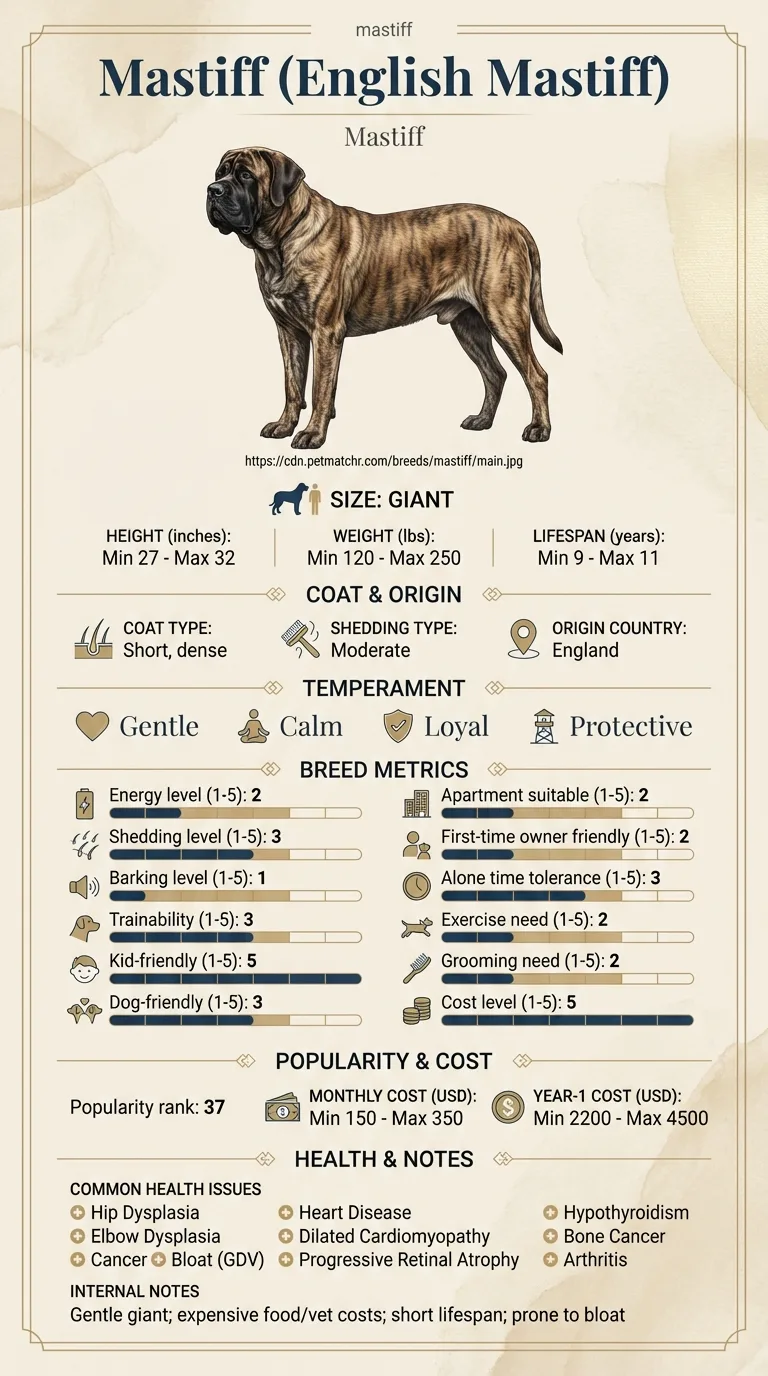
Owners who have noticed a wobble in the hind end, a dog that has become reluctant to jump into the car, or a Mastiff that yelps when it turns its head. It also matters to anyone who has been told their dog has a back problem and wants to understand which back problem, because the answers differ wildly in seriousness.
This guide is not medical advice. If your dog shows pain, sudden behavior change, or worsening symptoms, consult a licensed veterinarian.
Some links may be affiliate links. We may earn a commission at no extra cost to you. We only suggest products we believe are helpful for dog owners.
We research and check what we publish, but we do not warrant that any figure, date, price, or statement is accurate, complete, or current, and we accept no liability for any loss, cost, injury, or other harm arising from the use of this site. Use it as one reference among several. You remain responsible for your own decisions and for your dog's care - confirm anything that matters with a licensed veterinarian or another qualified professional before you act on it. Full disclaimer.
Back problems in an English Mastiff group into neck instability compressing the spinal cord, degeneration at the junction between spine and pelvis, bony spondylosis in older dogs, and ordinary soft tissue strain. The visible result ranges from a dog that simply takes a long time to stand up, to one whose hind legs sway and cross as it walks. Distinguishing them changes the treatment entirely.
Spinal problems are less frequently discussed than hips and elbows in this breed but they are not rare, and wobbler-type disease is specifically associated with giant breeds. Given that a Mastiff typically lives nine to eleven years, degenerative changes in the lower spine are close to expected in the second half of life. What varies is whether they cause symptoms and how early anyone notices.
The mechanics are the story. A dog weighing between 120 and 250 pounds transmits enormous force through the vertebral column, and the heaviest concentration falls where the flexible neck supports a very large head and where the rigid pelvis meets the mobile lumbar spine. Giant breeds are also predisposed to the specific vertebral conformation behind wobbler syndrome. Rapid growth compounds this: a Mastiff reaches most of its adult size while the skeleton is still soft, and loading it hard during that window has consequences later.
Household design does real damage over years. Hard slippery floors cause splays and twists in a dog too heavy to recover its footing. Jumping down from a high car boot delivers a substantial impact through the front limbs and neck each time. Stairs, particularly going down, load the spine repeatedly. Excess weight amplifies everything, and a naturally sedentary breed loses the core muscle that would otherwise stabilise the whole structure.
Arrange an examination for any new wobble, crossing of the hind legs, scuffed nails, reluctance to jump, or pain when the neck is moved or the tail base pressed. Treat as an emergency, going in immediately, any sudden inability to stand or use the back legs, any loss of bladder or bowel control, severe neck pain with a dog that holds its head rigidly low, or rapid worsening of weakness over hours. Spinal cord compression can progress quickly and the window in which surgery is most effective is not open indefinitely. Do not attempt to stretch, manipulate or massage a suspected spinal injury.
See all Mastiff health problems, which breeds are prone to back problems, or the full Mastiff breed guide for temperament, exercise needs and ownership costs.
Getting a specific diagnosis usually means a neurological examination followed by advanced imaging, and that takes two to six weeks including referral. Conservative management is judged over two to three months. Surgical recovery in a giant breed runs to three to six months of strictly controlled activity, which is genuinely demanding to deliver at home.
For degenerative spinal disease, success is a stable dog rather than a cured one: comfortable, able to rise unaided, walking its usual short route without deteriorating, and not losing further coordination over the following year. For an acute injury treated promptly, a full return to normal function is a realistic hope.
Back problem is a symptom, not a diagnosis. In a Mastiff it almost always resolves into one of these.
The most confusing thing about giant-breed spinal disease is that the problem and the symptom can be at opposite ends of the dog. A Mastiff with compression in its neck typically presents with a hind end that sways, crosses over, scuffs its toes and wears the nails down unevenly. Owners reasonably conclude the hips are going.
The reason is that the nerve tracts serving the back legs run through the neck on their way down, and they sit in the part of the cord most vulnerable to compression there. So the hind legs go first while the front legs look almost normal. It is also why a dog with this pattern often has a short, choppy front stride while its rear end appears to be operating with a delay.
This matters practically because hip dysplasia and arthritis produce a superficially similar picture, and they are far more common. The distinguishing features are neurological: scuffed toenails, a foot that is slow to right itself when placed upside down, and a wobble that is worse on turns and on slippery surfaces. A veterinary neurological examination separates them in minutes, and advanced imaging confirms it.
The lower spine tells a different story again. Lumbosacral pain typically shows up as difficulty rising from lying, reluctance to jump into a car or onto furniture, pain when the base of the tail is pressed, and sometimes a tail that hangs limply. The dog walks reasonably once it is up and moving, which is the opposite of the wobbler picture that worsens with distance.

Bruno was seven, 230 pounds, and had begun to look unsteady behind. His owner Kath assumed hips, since that is what everyone had warned her about, and started him on a joint supplement. What changed the direction was a routine nail trim. The groomer pointed out that the outer nails on both back feet were worn flat at an angle while the front ones were normal, and that she had seen the same pattern in another giant breed with a neck problem. A neurological examination found the deficits were consistent with cervical compression rather than hip pain, and an MRI confirmed it. Bruno was managed conservatively with weight loss, strict lead exercise, matting through the house and veterinary pain control. He remained stable for a further two years, which was the honest goal from the outset.
Key takeaway: In a giant breed the hind end is a poor witness to where the problem is. Look at the toenails, and get a neurological examination before assuming hips.
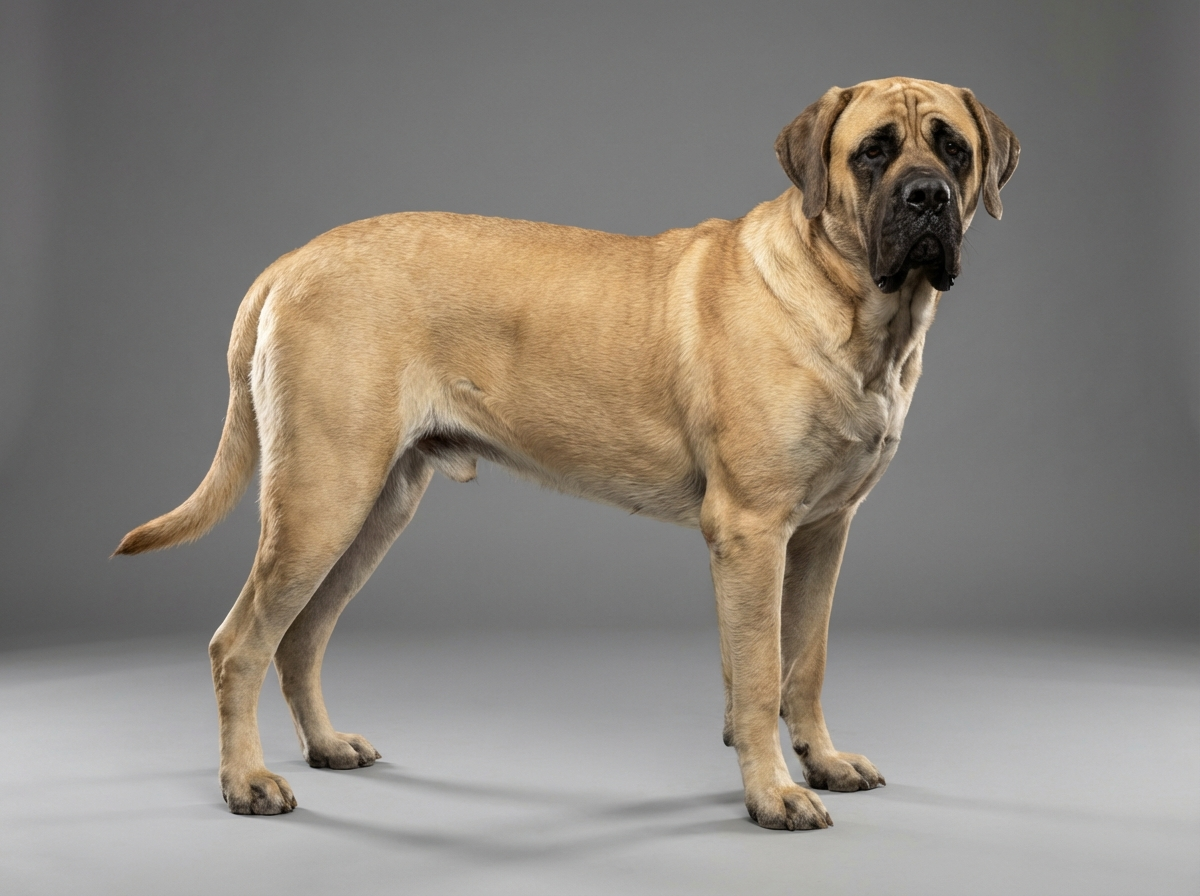
No. That description was borrowed from short-legged, long-backed breeds and does not describe this dog at all. A Mastiff is a tall, square, heavy breed, and its spinal trouble comes from load and from instability at the neck and lumbosacral junction rather than from proportion.
It is instability or malformation in the vertebrae of the neck that compresses the spinal cord. It is well recognised in giant breeds, usually appears in middle age in Mastiff-type dogs, and produces an unsteady, swaying hind end together with neck pain. Diagnosis needs advanced imaging such as MRI.
Look at the toenails and the coordination. Nerve involvement causes scuffed nails, crossed-over back feet and a wobble that worsens on turns. Hip pain is more about difficulty rising and a bunny-hopping gait, with normal foot placement. A vet's neurological examination settles it quickly.
Often it is an incidental finding. Bony bridges along the underside of the spine are extremely common in heavy older dogs and frequently cause no symptoms. It becomes clinically important when the bridging reduces flexibility or impinges on a nerve root, which your vet will assess against how the dog actually moves.
Avoid them where you can, especially descending, which loads the spine and the front limbs hard. Gate off staircases, use a ramp for the car, and rearrange the household so the dog's bed, food and door are on one level.
It can be, particularly for wobbler syndrome and for some lumbosacral cases, and it is done successfully in dogs of this size. It is major surgery with a long, strictly controlled recovery, and the practical challenge of managing a 200 pound dog on enforced rest for months is a genuine part of the decision.
Not entirely, since the underlying vertebral conformation is not something owners control. What does help is keeping the dog lean, avoiding repeated jumping down from heights, providing grip underfoot, and not overloading a growing giant with forced exercise before the skeleton has matured.
Usually scuffed or unevenly worn back toenails and a slight sway or crossing of the hind legs, visible before any obvious weakness.
It can be. A tail that hangs and does not wag, combined with pain at the tail base and trouble rising, points towards the lumbosacral junction.
Yes. Acute inability to use the hind legs, or loss of bladder control, needs immediate veterinary attention, not an appointment next week.
Anything with grip. Rubber-backed runners and mats prevent the slips and splays that make an unsteady giant far worse.
Gentle controlled lead walking on grass, yes, but ask your vet for limits first. Off-lead running and slippery surfaces are the risky parts.
A one-page prep sheet for this condition: the signs, the questions to ask, what to get priced. Unlocks here.
You get: Vet visit prep sheet
No spam. One-click unsubscribe. See our privacy policy.
Preview page 1 before you decide.