Health
What determines whether a dog needs spine surgery?
The neurological grade at diagnosis, especially whether deep pain sensation is present, alongside how the dog responds to initial conservative treatment.

Quick answer
What determines whether a dog needs spine surgery?
The neurological grade at diagnosis, especially whether deep pain sensation is present, alongside how the dog responds to initial conservative treatment.
Nobody warns you how physically demanding 'strict rest' for a dog's back injury actually is until you're carrying a 60-pound Goldendoodle outside to the bathroom four times a day.
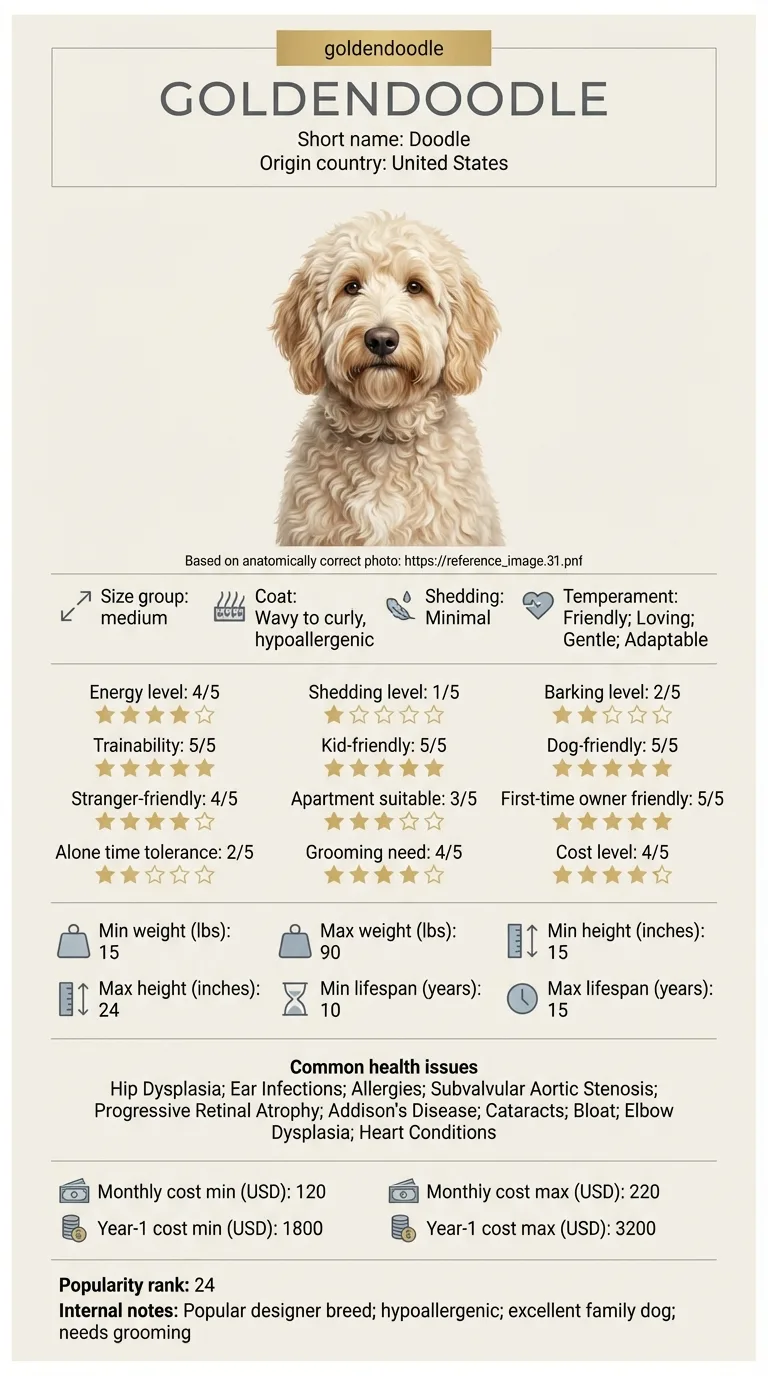
This is toughest on owners of an active, athletic Goldendoodle who suddenly has to be confined and carried for basic needs, and on owners weighing a costly surgery decision against a slower, less certain conservative recovery.
This guide is not medical advice. If your dog shows pain, sudden behavior change, or worsening symptoms, consult a licensed veterinarian.
Some links may be affiliate links. We may earn a commission at no extra cost to you. We only suggest products we believe are helpful for dog owners.
We research and check what we publish, but we do not warrant that any figure, date, price, or statement is accurate, complete, or current, and we accept no liability for any loss, cost, injury, or other harm arising from the use of this site. Use it as one reference among several. You remain responsible for your own decisions and for your dog's care - confirm anything that matters with a licensed veterinarian or another qualified professional before you act on it. Full disclaimer.
Check this first
Any sudden loss of hind-leg coordination or strength, dragging of the paws, or loss of bladder or bowel control is an emergency, full stop — this is true at any grade, but especially critical if deep pain sensation is also lost, since that marks the transition to the most serious stage. Get to an emergency vet or a facility with access to advanced imaging like an MRI as quickly as possible; the time between losing deep pain sensation and getting surgical treatment has a real bearing on the chances of regaining function.
A dog showing only pain — reluctance to move, a hunched posture, yelping when picked up — without any weakness or coordination loss is serious and needs prompt veterinary attention, but it's the grade 1 end of the spectrum and usually doesn't require the same middle-of-the-night urgency as a dog that's suddenly lost the ability to stand.
Once a dog is diagnosed and management has started, watch closely for any sign of worsening during the recovery period — increasing weakness, new dragging of a paw, or reduced reflexes. Regression during what's supposed to be a recovery window means going back to the vet promptly rather than waiting out the rest of the prescribed rest period.
If any of these apply, call your vet or an emergency clinic now. The rest of this page is for the cases that are not an emergency.
Once a Goldendoodle has been diagnosed with a spinal or disc problem, the practical questions shift to what the neurological grade means, whether surgery or strict rest is the right path, and what recovery actually demands day to day. This is less about why the injury happened and more about navigating the weeks that follow a diagnosis.
Serious spinal injuries requiring this level of staged management are uncommon in this breed relative to chondrodystrophic breeds, but when they occur, the grading and recovery process is the same regardless of breed, and getting it right matters enormously for the outcome.
This breed's proportionate build means significant disc injuries are less frequent than in chondrodystrophic breeds, but when a disc problem does occur — from age-related wear, an acute injury, or in combination with existing joint issues — the same neurological grading and treatment framework used across all dogs applies directly.
A traumatic fall, an awkward jump, or a slip on a hard surface is the more typical trigger for an acute spinal event in this breed, rather than a slow, inherited degeneration starting at a young age.
Talk to your vet immediately about any new weakness, dragging, or loss of bladder or bowel control, and promptly about ongoing pain that isn't improving with prescribed treatment. During a recovery period, report any regression right away rather than waiting for a scheduled follow-up.
See all Goldendoodle health problems, which breeds are prone to backspine issues, or the full Goldendoodle breed guide for temperament, exercise needs and ownership costs.
Conservative management typically involves 6 to 8 weeks of strict rest before a gradual return to normal activity, while surgical cases usually add a comparable post-operative rest period plus a structured rehabilitation phase over several more weeks.
Success looks like a dog that returns to normal walking, coordination, and bladder or bowel control, with activity reintroduced gradually under veterinary guidance — not an instant return to full activity the moment the dog seems to feel better.
Vets stage spinal disc problems on a scale from mild pain to complete loss of function, and the grade drives the recommended treatment path more than anything else.
When Alicia's Goldendoodle Cooper suddenly yelped and refused to move one morning, a vet visit and imaging found a grade 2 disc injury — pain with a wobbly gait, but still walking. Her vet recommended conservative management first: strict crate rest, anti-inflammatory medication, and short supervised leash walks only for bathroom breaks. The hardest part wasn't the medication, it was keeping an energetic dog confined for six full weeks. Alicia used slow-feeder puzzles and calm scent games to keep Cooper mentally occupied. By week seven, cleared by her vet, Cooper began a gradual, supervised return to normal walks, and by week ten he was back to his usual routine with no further episodes.
Key takeaway: The medical treatment for a disc injury is often more straightforward than the discipline required to actually follow strict rest for the full recovery window — and cutting that window short is the most common way owners undo the healing.
It refers to whether a dog reacts to a firm pinch on the toes, which tests whether pain signals are still reaching the brain. Its presence or absence is one of the biggest factors in predicting recovery chances and whether surgery is likely to help.
Very strict — typically confinement to a crate or small pen with no jumping, running, or stair use for several weeks, with the dog carried outside for bathroom breaks on a short leash. Even brief unsupervised activity can undo the healing process.
The neurological grade is the biggest factor, alongside how the dog responds to initial rest and pain management, imaging findings, and whether symptoms are stable, improving, or worsening. Higher grades and any regression push the decision toward surgery.
Advanced imaging and spinal surgery for a medium-to-large dog commonly runs into several thousand dollars total, including diagnostics, the procedure, and follow-up rehabilitation.
Many lower-grade cases do recover well with strict rest and medical management, though recovery is typically slower than surgical cases and carries some risk of recurrence.
Structured rehab often includes controlled leash walking, hydrotherapy, and specific strengthening exercises introduced gradually, guided by a rehab specialist to avoid re-injury during the healing window.
Conservative cases often need 6 to 8 weeks of strict rest followed by a gradual return to activity, while surgical cases typically involve a similar strict rest period post-operatively plus a longer structured rehabilitation phase.
The neurological grade at diagnosis, especially whether deep pain sensation is present, alongside how the dog responds to initial conservative treatment.
Diagnostics, surgery, and follow-up rehab together commonly run into the several-thousand-dollar range depending on severity and location.
Confinement with no jumping, running, or stairs, and the dog carried outside on a short leash for bathroom breaks only, for a period of weeks.
Yes — a dog already comfortable in a crate has a much easier and less stressful recovery period if strict rest is ever needed.
Some dogs become restless, frustrated, or anxious during extended confinement, which is normal and can be eased with mental enrichment that doesn't require movement, like food puzzles.
A one-page prep sheet for this condition: the signs, the questions to ask, what to get priced. Unlocks here.
You get: Vet visit prep sheet
No spam. One-click unsubscribe. See our privacy policy.
Preview page 1 before you decide.