Health
Do Goldendoodles have the same back problem risk as Dachshunds?
No, Goldendoodles have a proportionate build without the long-spine, short-leg conformation that drives disc disease in breeds like Dachshunds.

Quick answer
Do Goldendoodles have the same back problem risk as Dachshunds?
No, Goldendoodles have a proportionate build without the long-spine, short-leg conformation that drives disc disease in breeds like Dachshunds.
If you've read that back problems in dogs come from a long spine and short legs, know that description simply doesn't fit a Goldendoodle — but real back pain in this breed still happens, for different reasons.
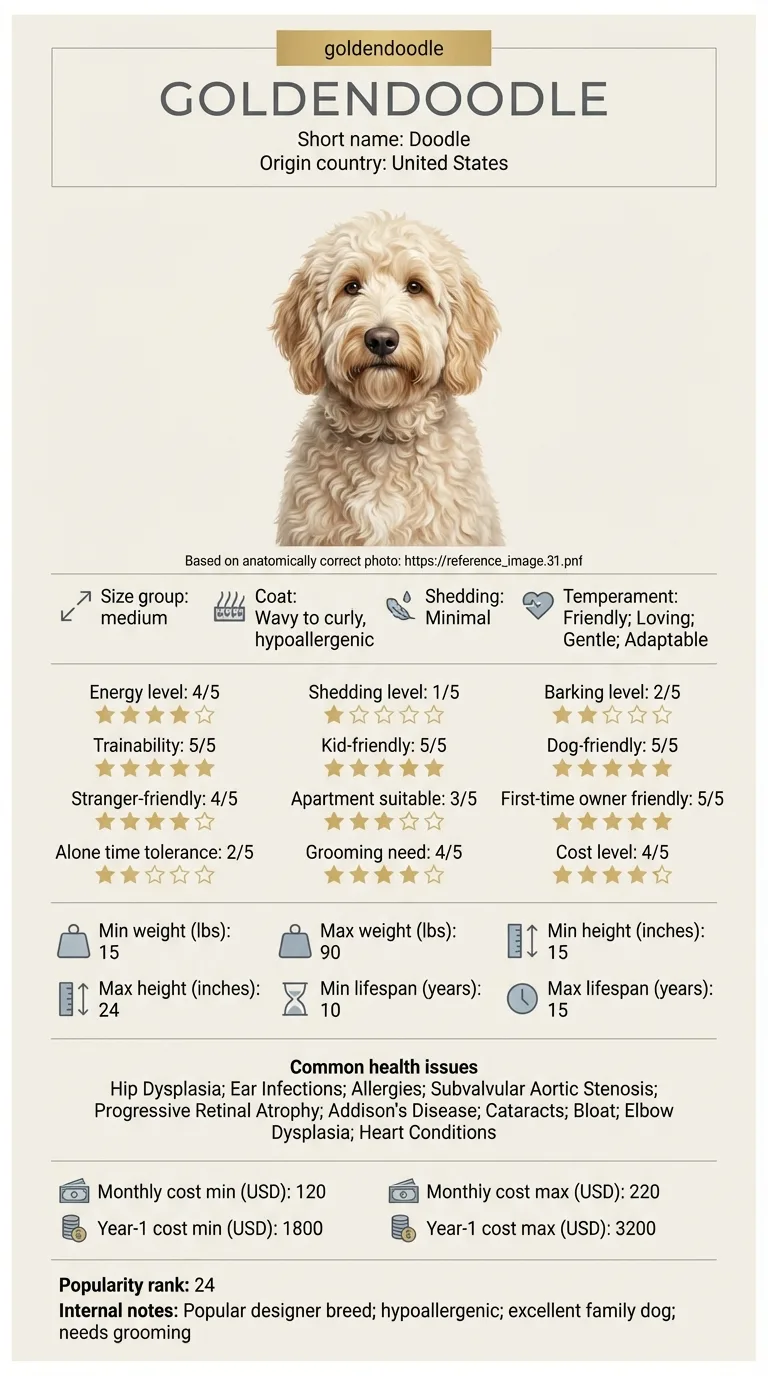
This affects owners of active, athletic Goldendoodles who jump often, especially off furniture or out of vehicles, and owners of dogs already managing hip or elbow dysplasia, since a dog compensating for one painful joint often shifts strain onto its back over time.
This guide is not medical advice. If your dog shows pain, sudden behavior change, or worsening symptoms, consult a licensed veterinarian.
Some links may be affiliate links. We may earn a commission at no extra cost to you. We only suggest products we believe are helpful for dog owners.
We research and check what we publish, but we do not warrant that any figure, date, price, or statement is accurate, complete, or current, and we accept no liability for any loss, cost, injury, or other harm arising from the use of this site. Use it as one reference among several. You remain responsible for your own decisions and for your dog's care - confirm anything that matters with a licensed veterinarian or another qualified professional before you act on it. Full disclaimer.
Check this first
True spinal emergencies are less common in this breed than in chondrodystrophic ones, but they aren't impossible, and the warning signs are the same regardless of body type. Sudden inability to walk or stand, dragging of the back legs, loss of bladder or bowel control, or visible severe pain when touched anywhere along the back are all signs of a possible acute spinal injury or disc problem and require emergency veterinary care immediately — every hour of delay can affect the chance of full recovery in a true disc emergency.
A dog that's reluctant to jump, moves stiffly after rest, or yelps occasionally when touched in a specific spot is showing signs of pain that need veterinary evaluation, but not necessarily on an emergency basis unless the signs above are also present. Your vet will want to distinguish muscular strain, which typically improves with rest and anti-inflammatory treatment, from a joint-compensation pattern tied to hip or elbow dysplasia, which needs its own separate management plan.
Repeated or worsening back discomfort that doesn't improve with a few days of restricted activity is a signal to get imaging done rather than continuing to wait it out, since an underlying joint problem elsewhere in the body is a common hidden driver in this breed specifically.
If any of these apply, call your vet or an emergency clinic now. The rest of this page is for the cases that are not an emergency.
Back problems in Goldendoodles don't come from the long-spine, short-leg conformation that drives disc disease in chondrodystrophic breeds — this breed simply doesn't have that build. Instead, back pain here traces to activity-related strain, compensation for hip or elbow dysplasia, excess weight, or ordinary age-related wear in a medium-to-large frame.
Genuine spinal disease is uncommon in this breed relative to chondrodystrophic breeds, but mechanical back strain and joint-compensation patterns are a realistic possibility, especially in active, heavier, or aging dogs.
Golden Retrievers and Poodles are both proportionate, non-chondrodystrophic breeds, so a Goldendoodle doesn't inherit the disc-disease risk tied to an abnormally long spine and short legs. What the breed does carry is a documented risk of hip and elbow dysplasia, and a compensating gait from either condition is a realistic, breed-relevant path to secondary back strain.
Hard or slippery flooring, frequent high-impact jumping, and carrying excess weight are the environmental and lifestyle factors that most directly affect this breed's spinal health, more so than any inherited structural risk.
Talk to your vet about back pain that doesn't improve within a few days of rest, recurring stiffness after activity, or any reluctance to jump or climb stairs that's new for your dog. Seek emergency care immediately for sudden hind-leg weakness, dragging of the legs, or loss of bladder or bowel control.
See all Goldendoodle health problems, which breeds are prone to back problems, or the full Goldendoodle breed guide for temperament, exercise needs and ownership costs.
A simple muscular strain often improves within a week or two of rest and appropriate treatment, while joint-compensation-driven back discomfort typically improves over several weeks as the underlying joint issue is managed.
Success looks like a dog moving normally, jumping and climbing without hesitation, and staying comfortable through typical daily activity — not the complete absence of any future strain, which no active dog can fully guarantee.
Understanding the real mechanism matters, because the fix is different from what a chondrodystrophic breed needs.
Marisol Vega noticed her Goldendoodle Luna had started arching her back oddly around their Asheville home and seemed reluctant to jump into the car. Assuming a pulled muscle, Marisol gave Luna a week of rest, but the odd posture didn't fully go away. A vet exam found mild hip dysplasia that Luna had been quietly compensating for, likely for months, by shifting her weight and gait — and that compensation was what strained her back. Once Luna started a joint-support and weight-management plan for the hips specifically, her back posture normalized within a few weeks.
Key takeaway: In this breed, back discomfort is often a downstream symptom of an unmanaged joint issue rather than a standalone spinal problem, so treating only the back can miss the actual cause.
No. Dachshunds and similar breeds have a genetically short-legged, long-spine build that predisposes them to disc disease. Goldendoodles have a proportionate medium-to-large frame without that structural risk factor.
Most commonly, repetitive jumping impact, compensation for hip or elbow dysplasia, excess weight, or ordinary age-related spinal wear — mechanical and lifestyle factors rather than an inherited body shape.
Reducing repetitive jumping, especially from height, is a reasonable preventive step for any medium-to-large dog, particularly one already managing joint issues, even though this breed isn't at the same structural risk as a chondrodystrophic breed.
Indirectly, yes. A dog compensating for painful hips often changes its gait and posture, which shifts mechanical strain onto the back and spine over time, even though the original problem is in the joint, not the spine itself.
Sudden loss of hind-leg function, dragging the legs, or loss of bladder control are serious and need immediate care. Mild stiffness or occasional reluctance to jump is worth a vet visit but is rarely an emergency on its own.
Yes. Extra weight adds continuous mechanical load to the spine and its supporting muscles, and this breed's strong food motivation makes weight gain a realistic risk worth actively managing.
Larger body size generally means more mechanical load on the spine during normal movement, so standard-size dogs may be somewhat more prone to strain-related back issues, though individual health and weight management matter more than size alone.
No, Goldendoodles have a proportionate build without the long-spine, short-leg conformation that drives disc disease in breeds like Dachshunds.
Activity-related strain from repeated jumping, or compensation for an existing hip or elbow joint issue, are the most likely causes.
A vet visit with rest and anti-inflammatory medication for a simple strain often costs a few hundred dollars, while imaging and advanced treatment for a suspected disc issue costs considerably more.
Limiting repetitive stair use isn't necessary for most healthy dogs of this breed, but it's a reasonable adjustment for a dog already showing joint or back discomfort.
Teaching a reliable 'off' cue for furniture and vehicles, and using ramps or steps for jumping-prone dogs, can meaningfully reduce repetitive impact over a dog's lifetime.
A one-page prep sheet for this condition: the signs, the questions to ask, what to get priced. Unlocks here.
You get: Vet visit prep sheet
No spam. One-click unsubscribe. See our privacy policy.
Preview page 1 before you decide.