Living
Which is the better overall pick?
For most households, especially with kids or other pets, the Goldendoodle - the gap on those measures is large. The Jack Russell suits an experienced, active single-dog household.

Quick answer
Which is the better overall pick?
For most households, especially with kids or other pets, the Goldendoodle - the gap on those measures is large. The Jack Russell suits an experienced, active single-dog household.
Goldendoodle or Jack Russell Terrier? On paper they differ most on good for first-time owners, and on the scales Goldendoodle is the heavier at 15–90 lbs. Here is how the two compare on everything that shapes an ordinary week.
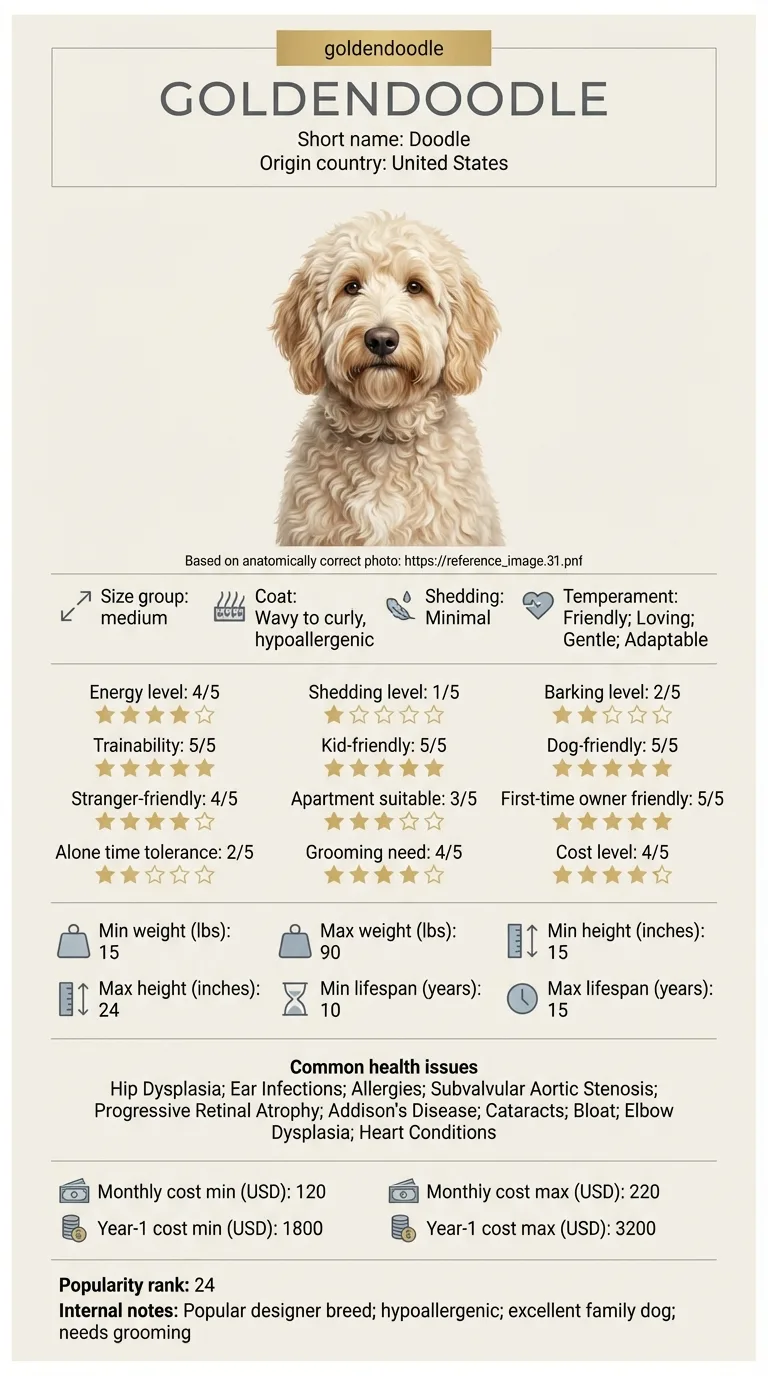
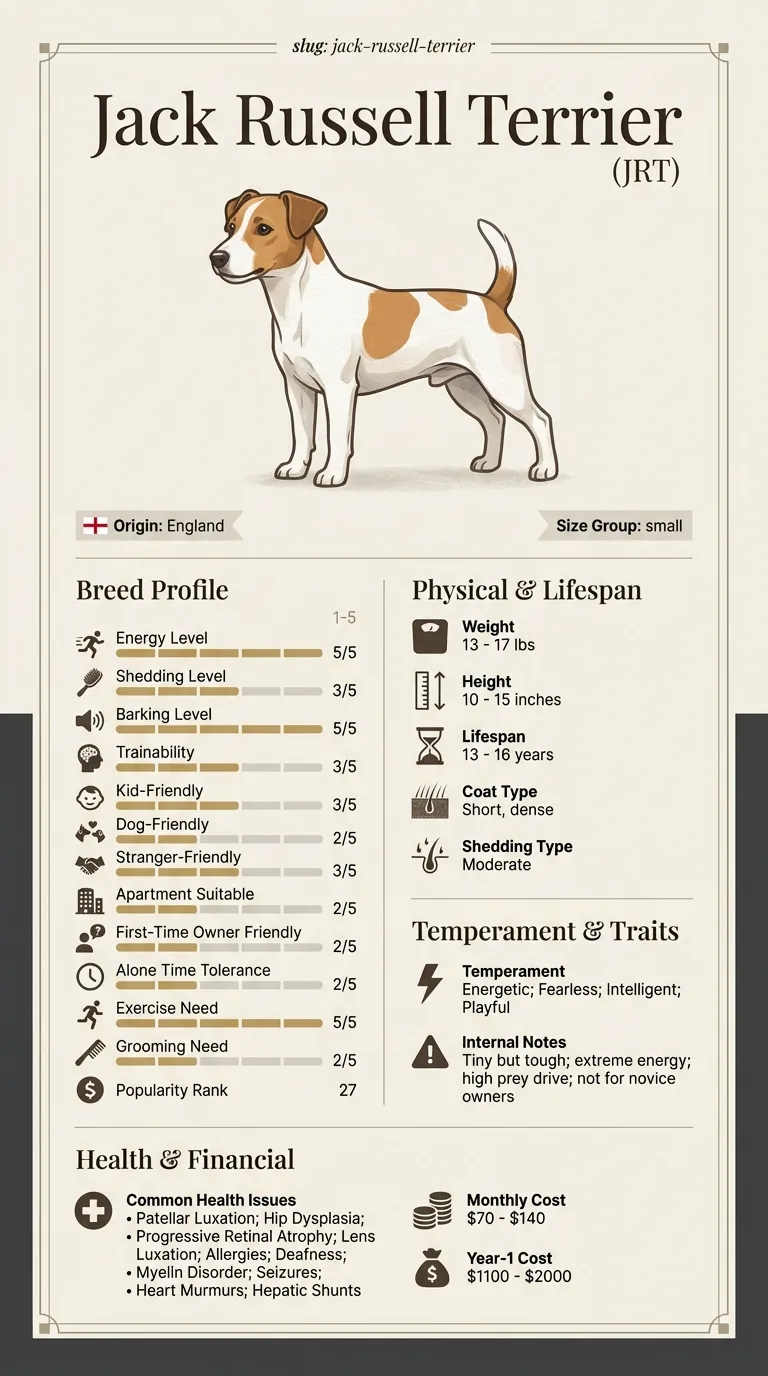
This is for someone already down to Goldendoodle and Jack Russell Terrier and deciding between them. For this pair the decision usually turns on good for first-time owners and barking, so those are covered first and in most detail. Anyone choosing from a flat has a clear answer here: Goldendoodle rates 3/5 against 2/5. The focus throughout is on daily consequences rather than breed background.
Between Goldendoodle and Jack Russell Terrier, good for first-time owners is what separates them, and Goldendoodle is the lower-effort dog of the two to keep.
Choose Goldendoodle if you are in a flat or a smaller home, this is your first dog and shedding is a problem in your house.
Choose Jack Russell Terrier if you do not want a standing grooming appointment, a smaller dog suits your car, your home or your back and you want a dog that can keep up with an active routine.
| Feature | goldendoodle | jack russell terrier | Winner |
|---|---|---|---|
| Size class | medium | small | Equal |
| Weight | 15–90 lbs | 13–17 lbs | Equal |
| Height | 15–24 in | 10–15 in | Equal |
| Lifespan | 10–15 years | 13–16 years | jack russell terrier |
| Exercise need | High (4/5) | Very high (5/5) | goldendoodle |
| Grooming need | High (4/5) | Low (2/5) | jack russell terrier |
| Shedding | Very low (1/5) | Moderate (3/5) | goldendoodle |
| Energy level | High (4/5) | Very high (5/5) | Equal |
| Barking | Low (2/5) | Very high (5/5) | goldendoodle |
| Apartment suitability | Moderate (3/5) | Low (2/5) | goldendoodle |
| Good for first-time owners | Very high (5/5) | Low (2/5) | goldendoodle |
| Tolerates being alone | Low (2/5) | Low (2/5) | Equal |
| Trainability | Very high (5/5) | Moderate (3/5) | goldendoodle |
| Good with kids | Very high (5/5) | Moderate (3/5) | goldendoodle |
| Good with other dogs | Very high (5/5) | Low (2/5) | goldendoodle |
| Friendly to strangers | High (4/5) | Moderate (3/5) | goldendoodle |
| Cost level | High (4/5) | Low (2/5) | jack russell terrier |
| Coat | Wavy to curly, hypoallergenic | Short, dense | Equal |
| Origin | United States | England | Equal |
| Typical monthly cost | $120–$220 | $70–$140 | Equal |
| Typical first-year cost | $1,800–$3,200 | $1,100–$2,000 | Equal |
Weight-wise these two aren't far apart at the low end - a small Goldendoodle can weigh close to a Jack Russell's 13-17 lbs - but the ranges tell different stories. The Jack Russell tops out at 17 lbs and 15 inches with no larger option; the Goldendoodle can grow to 90 lbs and 24 inches depending on the poodle-parent generation. If you want a predictable adult size, the Jack Russell is the more consistent bet.
Don't let the small frame fool you: the Jack Russell rates very high (5/5) for exercise need, a notch above the Goldendoodle's already-high (4/5). This is a working terrier bred to chase and dig, and a bored one gets destructive fast. Energy level lands as a close call despite the different numbers - both breeds need daily, active exercise, and neither is the easy option here.
The Jack Russell is the low-maintenance coat: low (2/5) grooming against the Goldendoodle's high (4/5), which needs regular brushing and trims to avoid matting. Shedding flips that advantage - the Jack Russell sheds moderate (3/5) while the Goldendoodle sheds very low (1/5). It's brushing-and-trimming versus vacuuming, not a clean win either way.
Barking is the standout gap in this comparison: very high (5/5) for the Jack Russell against low (2/5) for the Goldendoodle - enough to rule out a lot of apartment buildings on its own. Apartment suitability follows the same pattern, low (2/5) versus moderate (3/5). A Jack Russell wants a yard to patrol, not a hallway to bark down.
Trainability favors the Goldendoodle clearly, very high (5/5) versus the Jack Russell's moderate (3/5), and first-time-owner suitability is a wide gap too - very high (5/5) against low (2/5). Jack Russells are smart but strong-willed, bred to make independent calls while hunting, and that independence shows up as stubbornness in a training session.
This section has the widest gaps in the comparison. Good with kids: very high (5/5) versus moderate (3/5). Good with other dogs: very high (5/5) versus low (2/5) - Jack Russells carry a real prey-drive reputation that shows up here. Friendly to strangers: high (4/5) versus moderate (3/5). If young kids or a multi-dog household are in the picture, the data leans firmly toward the Goldendoodle.
The Jack Russell lives longer - 13-16 years against the Goldendoodle's 10-15, typical of small, athletic breeds. Shared risks include hip dysplasia, progressive retinal atrophy, and allergies. The Jack Russell's list also carries lens luxation, seizures, and a myelin disorder, more neurological in flavor than the Goldendoodle's list, which leans toward joint and immune conditions like Addison's disease.
This is the cheapest breed in the Goldendoodle's comparison set on a dollar basis: $70-140 a month and $1,100-2,000 in year one, against $120-220 and $1,800-3,200. Cost level is rated low (2/5) for the Jack Russell versus high (4/5) for the Goldendoodle - a meaningful difference if budget drives the decision.
Goldendoodle weighs 15–90 lbs and lives 10–15 years; Jack Russell Terrier weighs 13–17 lbs and lives 13–16 years. The two diverge most on good for first-time owners, barking and good with other dogs and 5 other rated axes. Almost every rated axis separates them at least slightly. The table below marks a winner only where one breed is genuinely easier for a typical owner; size and origin are facts rather than merits and stay level. Ratings come from one source applied to both breeds, so they are meaningful against each other rather than as absolute scores.

Not really - it rates low (2/5) for apartment suitability and very high (5/5) for barking, a combination that tends to generate noise complaints. The Goldendoodle, at moderate (3/5) and low (2/5) barking, is the easier fit for shared walls.
The Goldendoodle by a wide margin - very high (5/5) with kids and very high (5/5) with other dogs, against the Jack Russell's moderate (3/5) and low (2/5). The terrier's hunting background lowers its tolerance around other animals.
The Goldendoodle, very low (1/5) versus the Jack Russell's moderate (3/5). The terrier's grooming is easier overall though, low (2/5) versus the Goldendoodle's high (4/5).
The Goldendoodle is - very high (5/5). The Jack Russell rates low (2/5); its independence and exercise demands are a lot to handle without prior dog experience.
Noticeably - $70-140 a month against the Goldendoodle's $120-220, and roughly $700 less in typical first-year costs.
Some overlap - hip dysplasia, progressive retinal atrophy, and allergies appear on both lists. Beyond that they diverge: the Jack Russell's risks skew neurological, the Goldendoodle's skew toward joint and immune conditions.
The Jack Russell, rated very high (5/5) against the Goldendoodle's high (4/5) - both need daily activity, but the terrier's needs are the highest in this comparison.
For most households, especially with kids or other pets, the Goldendoodle - the gap on those measures is large. The Jack Russell suits an experienced, active single-dog household.
Jack Russell $70-140, Goldendoodle $120-220.
The Jack Russell, very high (5/5).
The Jack Russell, 13-16 years versus 10-15.
Secure checkout on Stripe. We never see your card.
7-day money-back guarantee. Instant access.
Health information here is general and is not veterinary advice. If your dog shows pain, sudden behaviour change, or worsening symptoms, consult a licensed veterinarian.
Some links on this site are affiliate links. We may earn a commission at no extra cost to you, and we only suggest products we believe are helpful for dog owners.
We research and check what we publish, but we do not warrant that any figure, date, price, or statement is accurate, complete, or current, and we accept no liability for any loss, cost, injury, or other harm arising from the use of this site. Use it as one reference among several. You remain responsible for your own decisions and for your dog's care - confirm anything that matters with a licensed veterinarian or another qualified professional before you act on it. Full disclaimer.
Match your lifestyle to the right dog.
Take quizNot sure which breed is right for you? Take our 2-minute quiz to find out.
Take the quiz