Health
Is a squinting eye in a dog an emergency?
Treat it as needing same-day veterinary attention. Squinting means pain, usually from a damaged corneal surface, and a corneal ulcer can deepen dangerously within a couple of days.

Quick answer
Is a squinting eye in a dog an emergency?
Treat it as needing same-day veterinary attention. Squinting means pain, usually from a damaged corneal surface, and a corneal ulcer can deepen dangerously within a couple of days.
The inherited disease will never make your dog squint. The occupational one will, and squinting after a day in cover is not something to sleep on.
Working dog owners deciding whether a half-closed eye can wait until morning, and people whose GSP has started hesitating in dim light and want to know whether that is age or something else.
This guide is not medical advice. If your dog shows pain, sudden behavior change, or worsening symptoms, consult a licensed veterinarian.
Some links may be affiliate links. We may earn a commission at no extra cost to you. We only suggest products we believe are helpful for dog owners.
We research and check what we publish, but we do not warrant that any figure, date, price, or statement is accurate, complete, or current, and we accept no liability for any loss, cost, injury, or other harm arising from the use of this site. Use it as one reference among several. You remain responsible for your own decisions and for your dog's care - confirm anything that matters with a licensed veterinarian or another qualified professional before you act on it. Full disclaimer.
Eye disease in German Shorthaired Pointers divides cleanly into two categories. Inherited retinal degeneration, documented on the breed health list, takes vision away slowly and painlessly over years. Acquired surface injury, driven by the breed's habit of pushing its head through vegetation at speed, arrives suddenly and hurts. The two require completely different responses: one is managed with genetic testing, adaptation and patience, the other with same-day veterinary attention.
Progressive retinal atrophy is documented for the breed but affects a minority of individuals, particularly where breeders test. Corneal injury, by contrast, is a routine occupational hazard for any GSP actually used in the field, and most working dogs will have at least one episode of a sore eye across a 10 to 12 year life. Serious sight-threatening injury is much rarer, and its rarity depends heavily on how quickly the minor ones are treated.
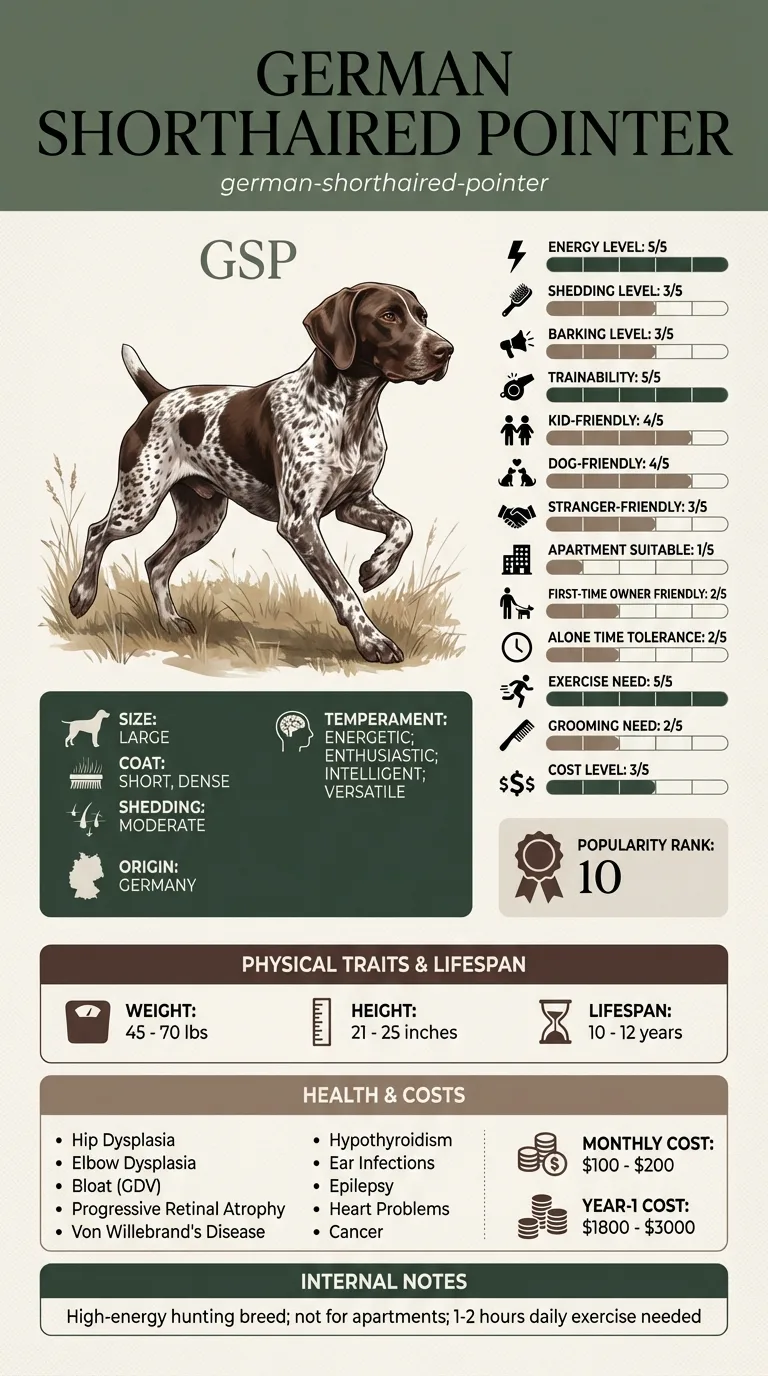
Progressive retinal atrophy is named on the German Shorthaired Pointer's documented health list, which establishes an inherited component and makes eye testing a legitimate question for a breeder. For acquired disease, the drivers are behavioural and physical. A dog rated five out of five for energy and exercise need, described as enthusiastic and versatile and worked one to two hours daily, spends far more time with its face in vegetation than a companion breed. Its height puts the eyes level with cut stubble and low thorn. Unlike some breeds it has no heavy brow furnishings or facial hair to deflect debris.
Terrain determines nearly all of the acquired risk. Cut cereal stubble is notoriously hard on eyes, as are blackthorn, bramble and dense reed. Dry, dusty conditions increase surface irritation. Working in low light at dawn and dusk means the dog cannot see obstacles it would otherwise avoid. Kennel and vehicle environments contribute in a smaller way through dust and draughts. For a dog with declining night vision, poor lighting at home, unfamiliar layouts and changes to furniture placement all magnify the practical consequences.
Go the same day for any squinting or held-shut eye, sudden cloudiness or blue haze across the front of the eye, an eye that looks enlarged, visible blood inside the eye, unequal pupil sizes, persistent face rubbing, or any sudden loss of vision. An object embedded in the eye is an immediate emergency: do not attempt removal, cover it loosely and travel. Acute painful glaucoma and deep corneal ulcers can destroy sight within hours to days, so these are genuinely time-critical rather than merely urgent. Book routinely for gradual night-vision difficulty, which is not an emergency but does deserve proper examination rather than being attributed to age.
See all German Shorthaired Pointer health problems, which breeds are prone to ocular disease, or the full German Shorthaired Pointer breed guide for temperament, exercise needs and ownership costs.
A simple corneal abrasion typically heals within about a week with topical treatment and a protective collar. Deeper ulcers take longer and may need surgical support, with recheck examinations every few days rather than weekly. Progressive retinal atrophy runs over years, with night vision affected first and daytime vision following gradually, and no treatment currently halts it.
For an acquired injury, success is a comfortable eye with a healed surface and retained vision, achieved by going in early rather than waiting. For inherited retinal degeneration, success is a different thing entirely: a dog that navigates confidently by scent, sound and learned routine, in a house whose layout has stayed constant, still enjoying daily outings. Dogs adapt to gradual vision loss remarkably well, and owners generally struggle with it more than the dog does.
The cornea is the clear front window of the eye. It is thin, exquisitely supplied with nerve endings, and completely exposed.
A German Shorthaired Pointer working cover drives its head into vegetation deliberately and repeatedly, because that is where the scent is. Stubble in a cut field is at eye height for a 21 to 25 inch dog. Bramble and blackthorn are worse. Dust, chaff and seed heads land directly on the eye surface.
The result is a distinctive occupational pattern: corneal abrasions and ulcers, foreign material trapped behind the third eyelid, small penetrating injuries from thorns, and irritation from awns lodged in the conjunctival folds. Most of these hurt considerably, which is why the presenting sign is almost always a dog that is holding one eye shut.
This matters more than owners assume because a superficial abrasion and a deep, sight-threatening ulcer look similar from the outside, and both look like an eye that is a bit sore. The difference is established with a fluorescent stain that takes about a minute in a consulting room, and an eye that is deteriorating can go from uncomfortable to perforated within a couple of days.
The eye has less tolerance for delay than almost any other structure. These signs warrant same-day attention rather than a morning appointment.

Piet checked his GSP, Nessa, at the end of a long day on stubble. Both eyes looked clear. On the drive home she started blinking, and by the time they got back she was holding the left one half shut. He called the out-of-hours line rather than waiting for morning, largely because he had been told once that squinting means pain. The stain showed a corneal ulcer with a thin fragment of stubble still lodged under the third eyelid, where he could not possibly have seen it. It was flushed out under sedation that night and the eye healed in nine days with drops and a collar Nessa loathed. The vet's comment stayed with Piet: another twelve hours of rubbing and the conversation would have been about saving the eye rather than treating it.
Key takeaway: A clear-looking eye at the truck does not mean an uninjured eye, because the worst offenders hide behind the third eyelid. Squinting is the sign that matters, and it does not wait until morning.
Progressive retinal atrophy appears on the breed's documented health list. It is an inherited degeneration of the retina causing gradual, painless vision loss that begins with night vision. Other eye problems in this breed are usually acquired rather than inherited, particularly injuries related to working in cover.
Night vision goes first, so the earliest signs are hesitation on stairs in dim light, bumping into things in a poorly lit room, or reluctance to go out into a dark garden. Owners often report the dog seems clingier or more cautious in the evening. Daytime vision remains normal for a long period, which is why it is missed.
Gentle flushing with sterile saline is reasonable for obvious dust or chaff and can help while you arrange an appointment. Never use human eye drops, particularly anything containing steroids, which can turn a treatable ulcer into a perforating one. If discomfort persists after flushing, that is a reason to go in, not a reason to flush again.
Fluorescein stain adheres to areas where the corneal surface layer is missing, making an ulcer visible under blue light. It distinguishes a scratch that will heal in days from a deep defect that needs urgent intervention, and it is quick, painless and inexpensive. It is the single most useful test in first-opinion eye work.
Yes, and this is the instruction owners most often abandon early. A dog that rubs a healing ulcer can convert a superficial injury into a perforation in seconds. For a breed rated five out of five for energy, a determined dog will find a way, so the collar needs to be on continuously rather than only when supervised.
DNA testing is available for specific retinal mutations in many breeds and is used by breeders to avoid producing affected puppies. Whether a relevant test exists for a particular line is a question for the breeder and your vet. A test result relates to a specific mutation and does not rule out every possible cause of vision loss.
Treat it as needing same-day veterinary attention. Squinting means pain, usually from a damaged corneal surface, and a corneal ulcer can deepen dangerously within a couple of days.
Progressive retinal atrophy is on the breed's documented health list. It causes gradual painless vision loss, beginning with night vision, and does not make the eye sore.
No. Steroid-containing drops in particular can worsen a corneal ulcer severely. Sterile saline for flushing obvious debris is the only reasonable home measure.
Check both eyes after every session in cover, flush obvious dust, and consider protective eyewear for dogs worked routinely in thorn or stubble.
A stain and topical treatment is inexpensive; surgical repair of a deep ulcer or a specialist ophthalmology referral is a considerably larger unplanned expense.
A one-page prep sheet for this condition: the signs, the questions to ask, what to get priced. Unlocks here.
You get: Vet visit prep sheet
No spam. One-click unsubscribe. See our privacy policy.
Preview page 1 before you decide.