American Staffordshire Terrier vs Chihuahua: Which Suits Your Home?
Quick answer
Which breed is actually easier to live with day to day?
It depends what 'easier' means -- the Chihuahua is cheaper and needs less exercise, but it also barks far more (5/5) and trains less readily (2/5) than the AmStaff. Neither is a clean win.
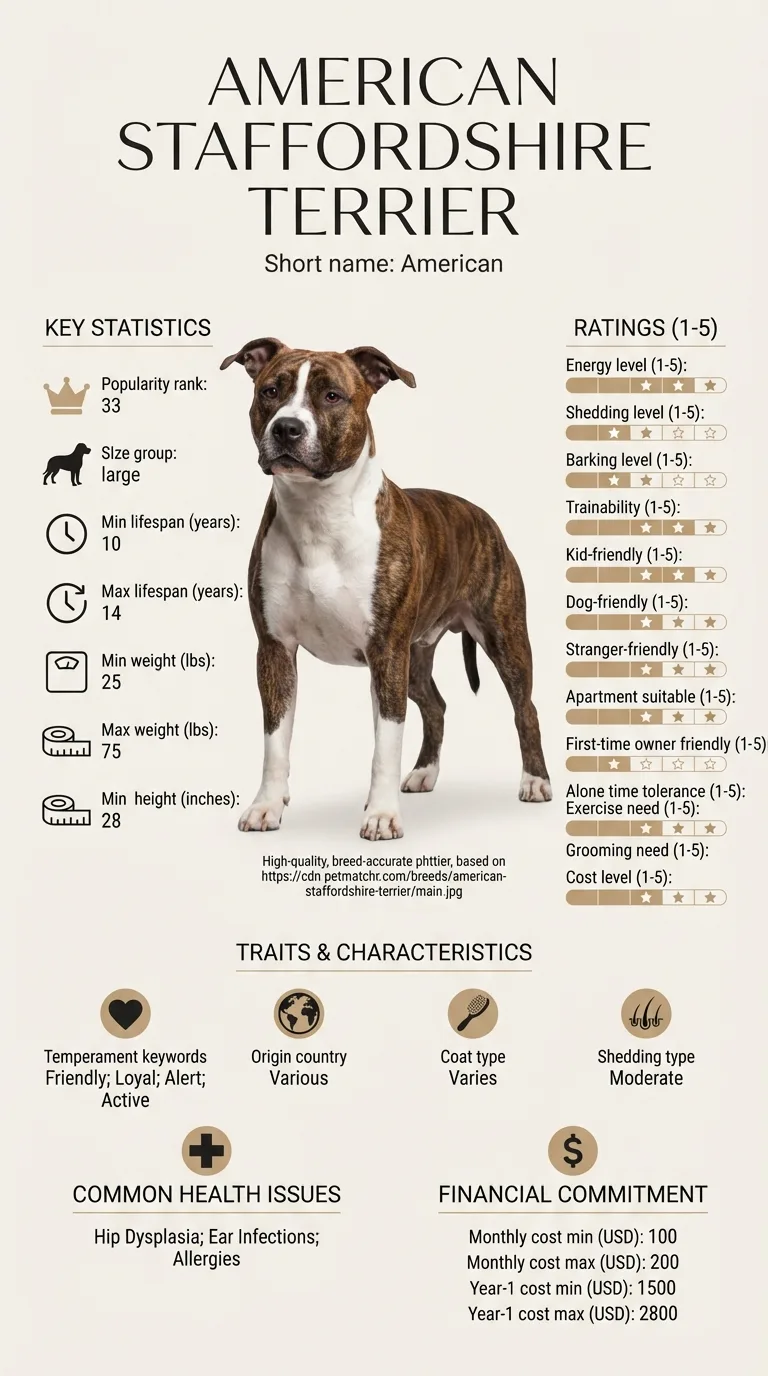
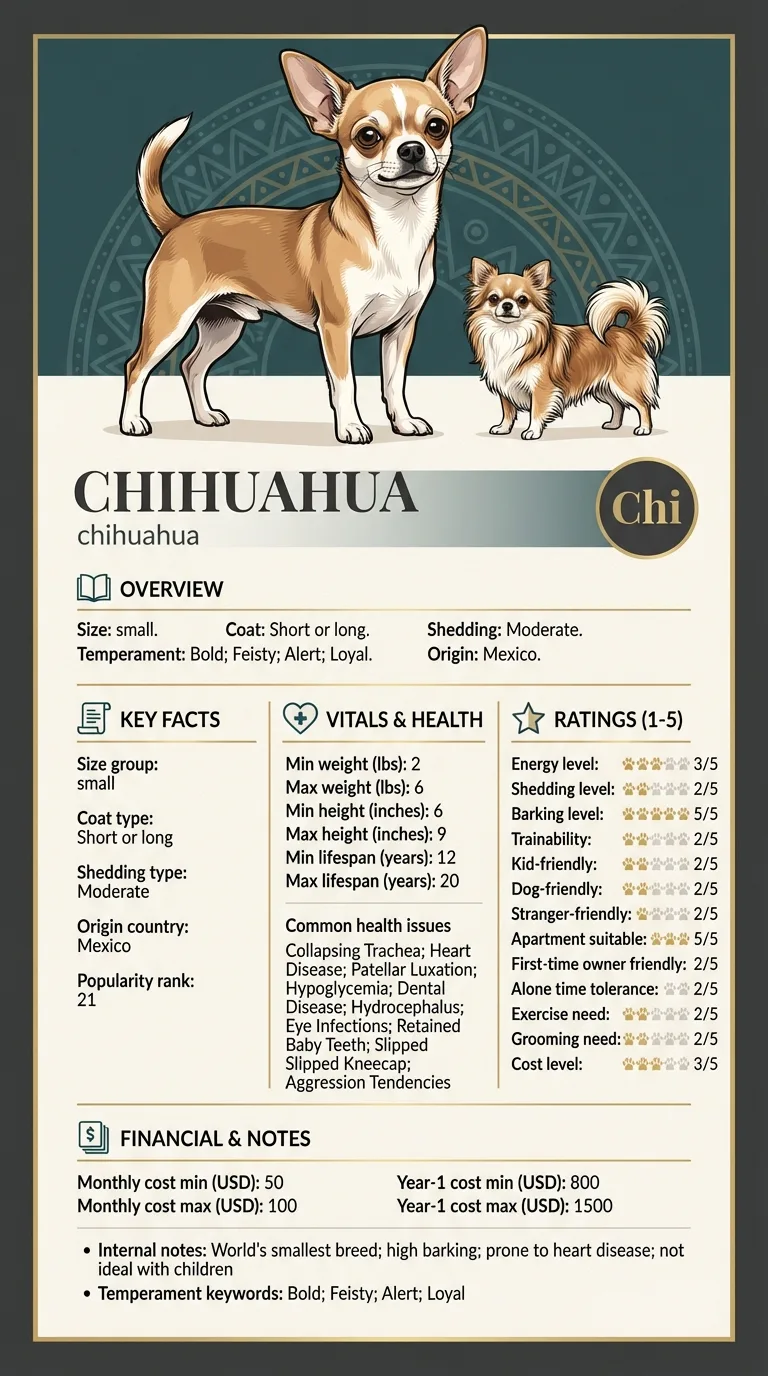
American Staffordshire Terrier or Chihuahua? On paper they differ most on barking, and on the scales American Staffordshire Terrier is the heavier at 40–70 lbs. Here is how the two compare on everything that shapes an ordinary week.
This is for someone already down to American Staffordshire Terrier and Chihuahua and deciding between them. For this pair the decision usually turns on barking and exercise need, so those are covered first and in most detail. Anyone choosing from a flat has a clear answer here: Chihuahua rates 5/5 against 3/5. Breed history is left out; what follows is what you will actually live with.
Quick verdict
Between American Staffordshire Terrier and Chihuahua, barking is what separates them, and Chihuahua is the lower-effort dog of the two to keep.
Choose american staffordshire terrier if...
Choose American Staffordshire Terrier if this is your first dog, you do not want a standing grooming appointment and the dog will be alone during the working day.
Choose chihuahua if...
Choose Chihuahua if you are in a flat or a smaller home, shedding is a problem in your house and your walking routine is modest.
Head-to-head comparison
Feature
american staffordshire terrier
chihuahua
Winner
Size class
medium
small
Equal
Weight
40–70 lbs
2–6 lbs
Equal
Height
17–19 in
6–9 in
Equal
Lifespan
12–16 years
12–20 years
chihuahua
Exercise need
High (4/5)
Low (2/5)
chihuahua
Grooming need
Very low (1/5)
Low (2/5)
american staffordshire terrier
Shedding
Moderate (3/5)
Low (2/5)
chihuahua
Energy level
High (4/5)
Moderate (3/5)
Equal
Barking
Low (2/5)
Very high (5/5)
american staffordshire terrier
Apartment suitability
Moderate (3/5)
Very high (5/5)
chihuahua
Good for first-time owners
Moderate (3/5)
Low (2/5)
american staffordshire terrier
Tolerates being alone
Moderate (3/5)
Low (2/5)
american staffordshire terrier
Trainability
High (4/5)
Low (2/5)
american staffordshire terrier
Good with kids
High (4/5)
Low (2/5)
american staffordshire terrier
Good with other dogs
Low (2/5)
Low (2/5)
Equal
Friendly to strangers
High (4/5)
Low (2/5)
american staffordshire terrier
Cost level
Moderate (3/5)
Moderate (3/5)
Equal
Coat
Short, stiff and glossy
Short or long
Equal
Origin
Various
Mexico
Equal
Typical monthly cost
$100–$200
$50–$100
Equal
Typical first-year cost
$1,400–$2,900
$800–$1,500
Equal
Deep dive
Size and build
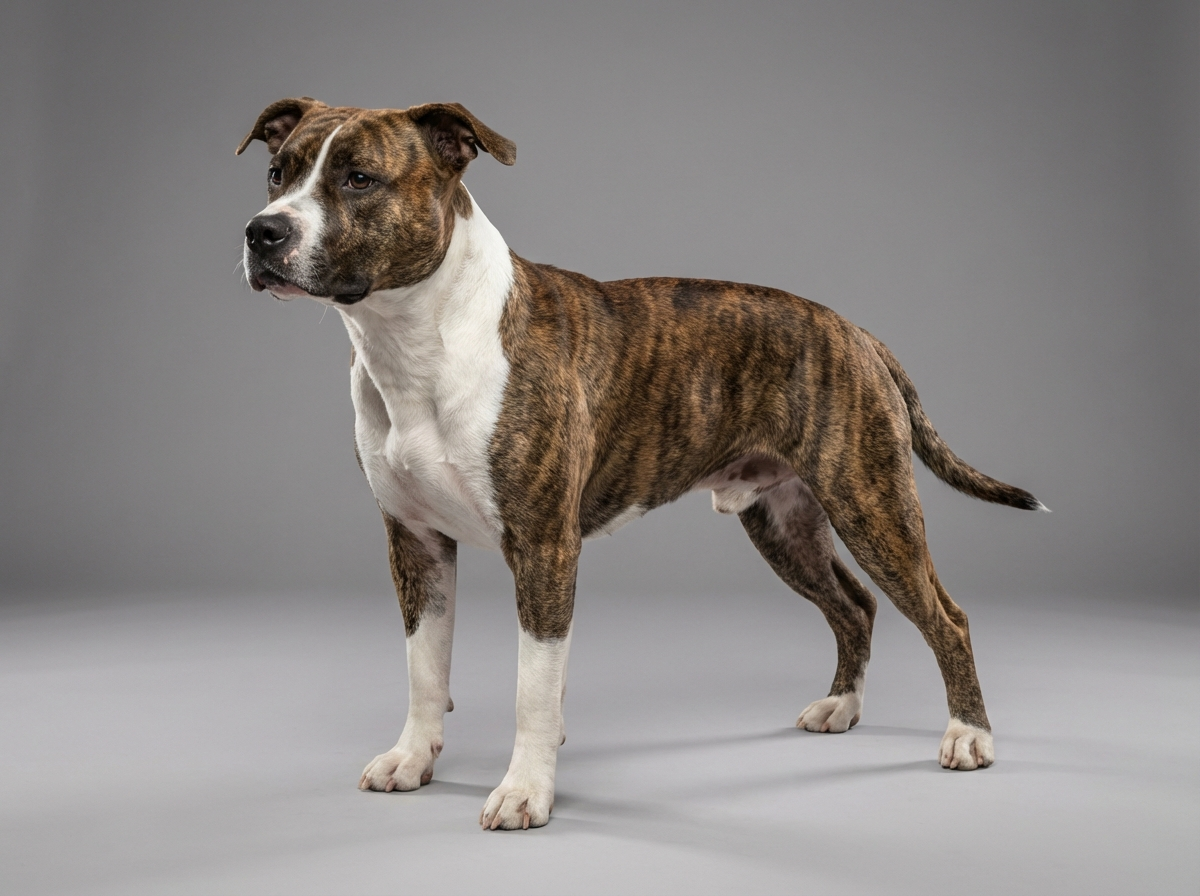
Few comparisons on this site have a size gap this extreme: the AmStaff runs 40 to 70 pounds, the Chihuahua 2 to 6 pounds. A single AmStaff can outweigh ten Chihuahuas. Height follows the same pattern -- 17 to 19 inches against 6 to 9.
Energy and exercise
The AmStaff needs considerably more exercise, rating high (4/5) against the Chihuahua's low (2/5). A short walk and some indoor play cover a Chihuahua's needs; the AmStaff wants a longer, more active routine to stay settled.
Grooming and shedding
Both breeds are easy on the grooming front -- very low (1/5) for the AmStaff, low (2/5) for the Chihuahua -- but shedding runs slightly higher for the AmStaff, moderate (3/5) versus the Chihuahua's low (2/5). Neither will demand professional grooming visits.
Apartment living, noise and time alone
Here's a twist worth flagging: the Chihuahua rates very high (5/5) for apartment suitability, but also very high (5/5) for barking, versus the AmStaff's low (2/5) on noise. A Chihuahua's small size makes it easy to house, but its vocal habits can be the bigger issue for apartment neighbors and shared walls than square footage ever was.
Training and owner experience
This is where the numbers surprise people: the AmStaff rates high (4/5) on trainability and moderate (3/5) for first-time owners, while the Chihuahua rates low (2/5) on both. Chihuahuas have a well-earned reputation for being harder to housebreak and train consistently than their size suggests, which runs against the assumption that a smaller dog is automatically the easier one.
Kids, other dogs and visitors
The AmStaff outscores the Chihuahua clearly with kids (4/5 versus 2/5) and with strangers (4/5 versus 2/5); the Chihuahua's temperament tags -- bold, feisty, alert -- translate in practice to a dog that can be snappish with unfamiliar people or rough handling from small children. Compatibility with other dogs ties at low (2/5) for both.
Health and lifespan
The Chihuahua actually has the longer potential lifespan -- 12 to 20 years, against the AmStaff's 12 to 16 -- one of the longest ranges in this entire comparison set. Its health list runs to ten items, including collapsing trachea, hydrocephalus, hypoglycemia, and dental disease, plus a listed tendency toward aggression. The AmStaff's shorter list centers on joints, skin, and heart.
Cost to keep
The Chihuahua is markedly cheaper to keep: $50 to $100 monthly versus $100 to $200 for the AmStaff, and $800 to $1,500 in year one versus $1,400 to $2,900. Its tiny size keeps food and medication costs low, even with a longer list of health conditions to potentially manage.
American Staffordshire Terrier vs Chihuahua at a glance
American Staffordshire Terrier weighs 40–70 lbs and lives 12–16 years; Chihuahua weighs 2–6 lbs and lives 12–20 years. The two diverge most on barking, exercise need and apartment suitability and 3 other rated axes. They are level on cost level and good with other dogs, so those cannot decide it. The comparison marks an easier option only where one exists. Facts like weight and country of origin are not scored. Both dogs are rated from the same dataset, which is what makes the numbers comparable with each other even though any individual dog sits somewhere inside its breed's range.
American Staffordshire Terrier vs Chihuahua: Which Suits Your Home? - American Staffordshire Terrier vs Chihuahua at a glance
Frequently asked questions
Is a Chihuahua really easier to own than an AmStaff, given the size difference?
Not necessarily, according to the data. The Chihuahua rates low (2/5) on trainability, first-time-owner fit, and kid-friendliness -- all lower than the AmStaff's scores in those same categories. Small size doesn't automatically mean easy to handle.
Which breed barks more?
The Chihuahua, by a wide margin -- it rates very high (5/5) for barking against the AmStaff's low (2/5), one of the biggest gaps in this comparison.
Which breed lives longer?
The Chihuahua, potentially by several years -- its lifespan range runs 12 to 20 years, versus the AmStaff's 12 to 16. Chihuahuas are known for unusually long lifespans relative to most breeds.
Is the Chihuahua good with kids?
Not especially, per this data -- it rates low (2/5) with kids against the AmStaff's high (4/5). Chihuahuas can be more fragile physically and less tolerant of rough handling, which is worth knowing if young children are in the house.
How much cheaper is the Chihuahua to keep?
Substantially -- around $600 to $1,400 less in the first year ($800-$1,500 versus $1,400-$2,900 for the AmStaff), and about half the monthly cost.
What health issues show up for the Chihuahua?
Ten conditions are listed, including collapsing trachea, heart disease, hypoglycemia, dental disease, and hydrocephalus, plus retained baby teeth and a noted tendency toward aggression. It's a longer list than the AmStaff's five-item one, despite the Chihuahua's longer expected lifespan.
Which breed is friendlier toward strangers?
The AmStaff, rating high (4/5) against the Chihuahua's low (2/5). This lines up with the Chihuahua's bold, feisty temperament tags -- a trait that can read as wariness or snappishness toward unfamiliar people.
Which breed is actually easier to live with day to day?
It depends what 'easier' means -- the Chihuahua is cheaper and needs less exercise, but it also barks far more (5/5) and trains less readily (2/5) than the AmStaff. Neither is a clean win.
Costs
How much does each breed cost monthly?
$100-$200 for the AmStaff versus $50-$100 for the Chihuahua -- the smaller dog costs roughly half as much to keep month to month.
Behavior
Which breed barks more?
The Chihuahua, rating very high (5/5) versus the AmStaff's low (2/5) -- one of the largest gaps of any category in this comparison.
Health
Which breed has the longer expected lifespan?
The Chihuahua, with a range up to 20 years versus the AmStaff's ceiling of 16 -- though its health list is longer at ten conditions versus five.
Health information here is general and is not veterinary advice. If your dog shows pain, sudden behaviour change, or worsening symptoms, consult a licensed veterinarian.
Some links on this site are affiliate links. We may earn a commission at no extra cost to you, and we only suggest products we believe are helpful for dog owners.
We research and check what we publish, but we do not warrant that any figure, date, price, or statement is accurate, complete, or current, and we accept no liability for any loss, cost, injury, or other harm arising from the use of this site. Use it as one reference among several. You remain responsible for your own decisions and for your dog's care - confirm anything that matters with a licensed veterinarian or another qualified professional before you act on it. Full disclaimer.