Health
What is a molera?
A soft spot on top of the skull where the bone plates have not fused. Common in Chihuahuas, often harmless, but it leaves that area unprotected.

Quick answer
What is a molera?
A soft spot on top of the skull where the bone plates have not fused. Common in Chihuahuas, often harmless, but it leaves that area unprotected.
Neurological signs are not one disease. They are a category, and the useful first question is not what is wrong but where in the nervous system the problem sits.
Owners of a Chihuahua showing something neurological, whether a seizure, a wobble, a head tilt or a change in awareness, who need to know how worried to be tonight and what the vet will be trying to work out.
This guide is not medical advice. If your dog shows pain, sudden behavior change, or worsening symptoms, consult a licensed veterinarian.
Some links may be affiliate links. We may earn a commission at no extra cost to you. We only suggest products we believe are helpful for dog owners.
We research and check what we publish, but we do not warrant that any figure, date, price, or statement is accurate, complete, or current, and we accept no liability for any loss, cost, injury, or other harm arising from the use of this site. Use it as one reference among several. You remain responsible for your own decisions and for your dog's care - confirm anything that matters with a licensed veterinarian or another qualified professional before you act on it. Full disclaimer.
Check this first
Neurological signs vary enormously in urgency and the difference is worth knowing in advance.
If any of these apply, call your vet or an emergency clinic now. The rest of this page is for the cases that are not an emergency.
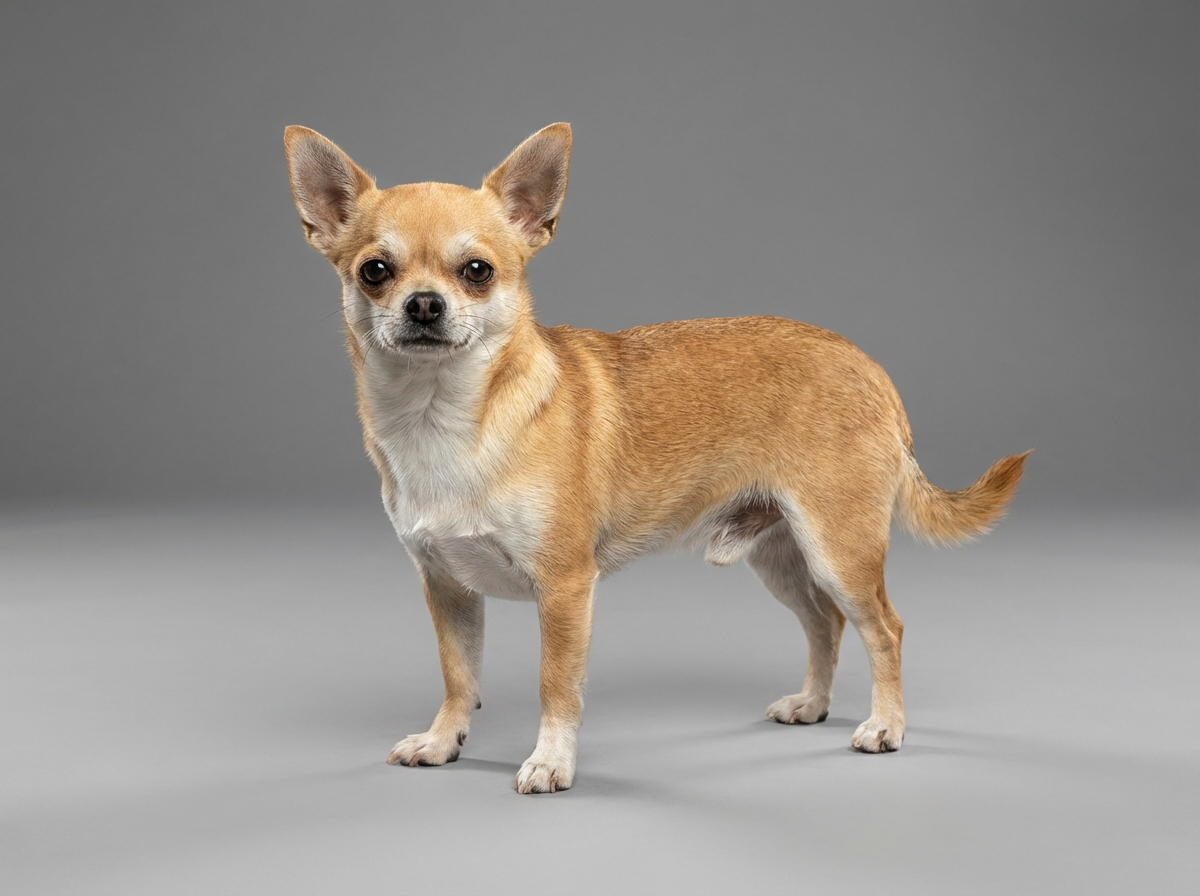
Neurological disease in Chihuahuas covers several distinct problems that share a vocabulary. Hydrocephalus, an accumulation of fluid within the brain, is documented in the breed and connects to its domed skull and frequently open fontanelle. Alongside it sit seizure disorders, balance problems, spinal cord conditions and metabolic causes such as low blood sugar, which is also documented in the breed.
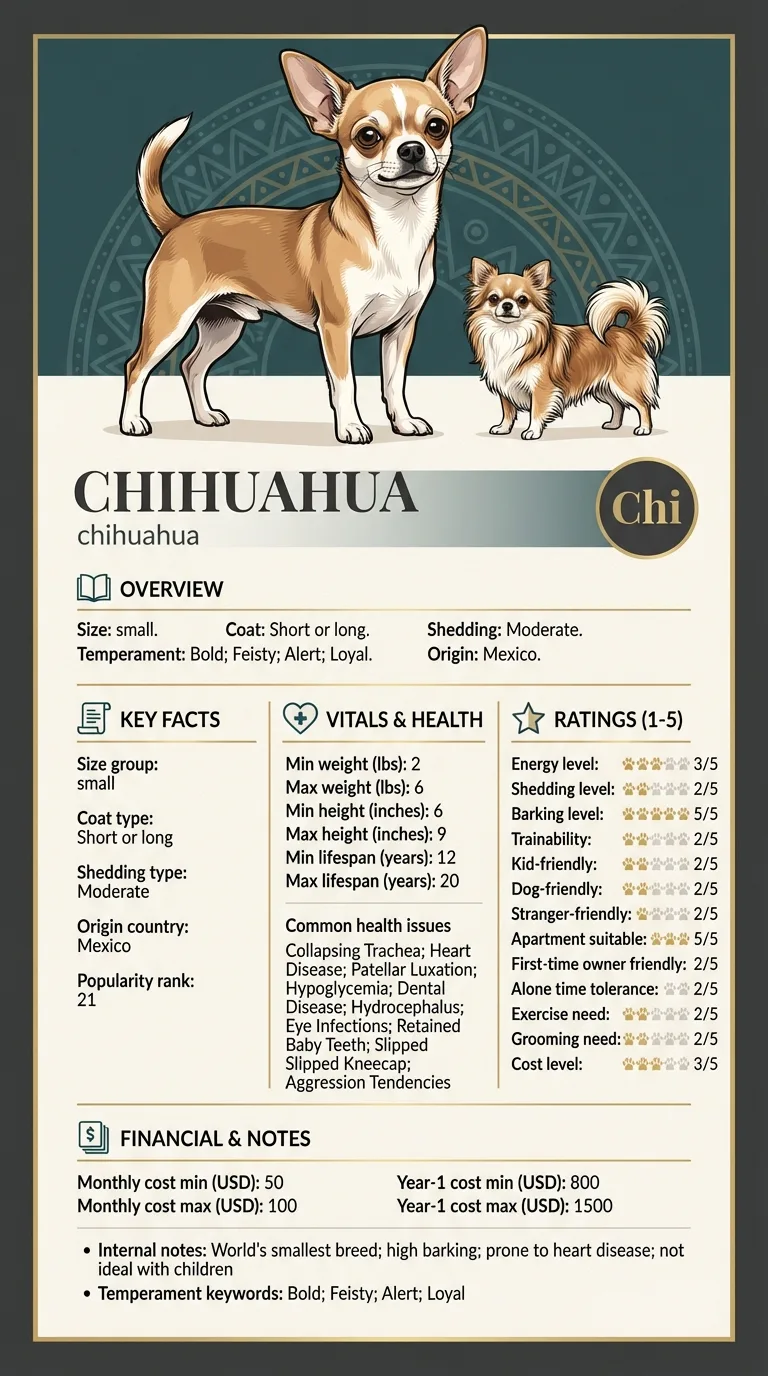
Hydrocephalus is one of the ten documented health issues for Chihuahuas, which puts it firmly on the list for this breed in a way it is not for most others. Severe symptomatic cases remain uncommon, and many Chihuahuas with domed heads and moleras are entirely normal. The broader category of neurological presentations is what owners actually encounter, and most of those turn out to have causes other than hydrocephalus.
Selective breeding for a very small dog with a rounded head has produced a skull that is proportionally large relative to the body and frequently incompletely fused at the top. The same developmental pressures are associated with the drainage abnormalities that cause fluid to accumulate inside the brain, which is why hydrocephalus is documented at breed level here and not in most breeds. The breed's documented tendency to low blood sugar adds a second, entirely different route to neurological signs, and a 6 to 9 inch dog carrying a proportionally large head is also mechanically vulnerable at the neck.
Physical risk is the main environmental contribution. A dog with an unfused area of skull is genuinely vulnerable to a knock that a normal skull would absorb, and households with young children, larger dogs or a habit of picking her up by the head region carry more risk. Missed meals matter for the same reason: a very small dog with limited reserves can drop her blood sugar into a range that produces tremors, collapse and seizures within hours. Falls from furniture contribute spinal and head injuries alike.
Go to an emergency clinic immediately for a seizure lasting more than a few minutes, repeated seizures with no full recovery between them, any neurological sign after a head injury or a fall, collapse, unresponsiveness, sudden inability to stand or walk, or persistent head pressing against a wall or furniture. In a dog with an open fontanelle, any knock to the head warrants assessment even if she seems fine. Seek same-day or next-day care for a new head tilt, sudden loss of balance, flickering eye movements or abrupt apparent blindness. Book a routine appointment for a single brief seizure with complete recovery, occasional unsteadiness, or a puppy who is markedly slower to learn than expected. Never administer human medication of any kind.
See all Chihuahua health problems, which breeds are prone to neurologic disease, or the full Chihuahua breed guide for temperament, exercise needs and ownership costs.
Reaching a diagnosis usually takes one to four weeks, involving bloodwork first to exclude metabolic causes, then imaging where indicated. Hydrocephalus diagnosed in a puppy is often apparent within the first months of life. Response to medical management, where it works, is typically visible within one to three weeks. Shunt surgery, in suitable cases, produces improvement over weeks to months and requires long-term monitoring. Seizure disorders are managed with the aim of reducing frequency, and finding the right control usually takes several months of adjustment.
Success depends heavily on which problem it turns out to be, and honesty matters here. For a mildly affected hydrocephalic dog, success may be a dog who is a little clumsy and a little slow to learn but comfortable, safe and happy for many years. For a seizure disorder, success is usually fewer and shorter events rather than none at all. For a metabolic cause such as low blood sugar, success can be complete, with a feeding routine that simply prevents the problem. What is consistent across all of them is that a named diagnosis and a written log are worth more than any single treatment.
A neurologist's first task is localisation, because the sign tells you the address before it tells you the cause. Problems in the forebrain change awareness and behaviour: circling, staring, pressing the head into furniture, seizures, apparent blindness with pupils still reacting. Problems in the brainstem and the balance system produce head tilt, flickering eyes, falling to one side and a drunken gait. Problems in the spinal cord produce weakness, dragging, and loss of coordination without any change in awareness.
For Chihuahuas specifically, hydrocephalus belongs to the first category. Cerebrospinal fluid, produced continuously inside the brain, normally circulates and drains. When drainage is obstructed, fluid accumulates and pressure rises against brain tissue. In a puppy whose skull plates have not yet fused, the head can enlarge and dome further, and the soft spot may become tense. Affected puppies are often slow to learn, unsteady, and may have eyes that seem to point down and outward.
The molera itself needs care in interpretation. A soft spot on the head is common in this breed and is not by itself a diagnosis of hydrocephalus. Many Chihuahuas have one and are entirely normal. It does mean that region of the skull offers no bony protection, which is a real practical consideration in a household with children or larger dogs.
Seizures form the third major group and have many possible causes, from inherited epilepsy to liver shunts to low blood sugar, the last of which is separately documented in this breed.

If you think your Chi has neurologic disease, the plan is three steps: write down what you have seen and when it started, book a veterinary appointment rather than waiting for the next flare, and take video of the behaviour or symptom before you go — the thing you are worried about rarely happens in the consulting room. Screening in the parents covers collapsing trachea, heart disease, patellar luxation.
What the vet visit should produce is a diagnosis and a written plan, not just reassurance: what is being ruled out, what the monitoring interval is, and which signs mean you come back sooner. Ask what the treatment costs across a year rather than per visit, because that is the number that decides whether you are managing this condition or reacting to it.
Between appointments, keep a short log — dates, what you saw, what changed. It is the single most useful thing an owner brings to a follow-up, and for neurologic disease it is often what separates a clear pattern from a guess.
Tavo was nine weeks old when he came home. His new owner Priti noticed at his first bath that the top of his skull felt soft under her fingers, and assumed something was badly wrong. Her vet examined him properly, ultrasounded through the soft spot on the spot, and found normal fluid spaces and a normal-looking brain. Tavo had a molera and nothing else. What the vet did do was change the household rules: no picking him up by the head or scruff, supervised contact with Priti's nephew, and a note in his file to reassess if he ever took a knock. He is six now and has had no neurological problem of any kind. The soft spot has partially closed and Priti still tells every dog sitter about it. Her point is that the finding needed a vet's interpretation rather than an internet search, and that the outcome was a set of handling rules, not a diagnosis.
Key takeaway: A molera is a common Chihuahua feature, not a verdict. Have it assessed properly, then treat it as a handling constraint rather than a disease.
No. A molera is common in this breed and many dogs with one are entirely healthy and have normal brains. It becomes concerning when it is large, tense rather than soft, or accompanied by a markedly domed head, unsteadiness, unusual eye position or difficulty learning. On its own it is an anatomical feature that requires physical caution rather than medical treatment.
In a young puppy with an open fontanelle, ultrasound through the soft spot can visualise the fluid-filled spaces inside the brain, which is unusually convenient. Otherwise advanced imaging such as MRI or CT is used. Diagnosis rests on imaging alongside the clinical signs, since some dogs have enlarged fluid spaces without any symptoms at all.
Mild cases are often managed medically with veterinary treatment aimed at reducing fluid production. Severe cases may be candidates for a surgically placed shunt that drains excess fluid away from the brain, which is a specialist procedure. Outcomes vary widely with severity, and a frank prognosis conversation with a neurologist is worth having early.
Seizures are not listed among the breed's documented health issues, though hydrocephalus is and can cause them. Importantly, low blood sugar is documented in this breed and can produce seizures and collapse, particularly in puppies and very small adults. That is one reason a first seizure needs bloodwork rather than an immediate assumption of epilepsy.
Do not put your hands near her mouth. Move furniture away, dim the lights and noise, note the time it started, and film it if you can. Most seizures stop within a couple of minutes. If one lasts longer than that, or if a second follows without her fully recovering in between, get to an emergency clinic immediately.
Not at all. Wobbliness can come from the balance system, the spinal cord, a joint, or from low blood sugar, and in this breed neck instability and disc disease both need consideration. This is exactly why localisation matters, and why a vet will examine reflexes and awareness rather than treating wobbly as a diagnosis.
A soft spot on top of the skull where the bone plates have not fused. Common in Chihuahuas, often harmless, but it leaves that area unprotected.
Yes, it appears among the breed's ten documented health issues, and the domed skull and open fontanelle are related anatomical features.
If it lasts more than a few minutes, if several occur without full recovery in between, or if it follows a head injury. Otherwise seek care within a day.
Supervise around children and larger dogs, avoid rough handling of the head, and treat any knock to the skull as a reason for veterinary assessment.
A one-page prep sheet for this condition: the signs, the questions to ask, what to get priced. Unlocks here.
You get: Vet visit prep sheet
No spam. One-click unsubscribe. See our privacy policy.
Preview page 1 before you decide.