Health
Is disc disease in Brittanys the same as in Dachshunds?
No, Brittanys aren't a chondrodystrophic breed. When disc disease occurs, it's typically the slower, age-related type, not the sudden genetic type seen in short-legged breeds.

Quick answer
Is disc disease in Brittanys the same as in Dachshunds?
No, Brittanys aren't a chondrodystrophic breed. When disc disease occurs, it's typically the slower, age-related type, not the sudden genetic type seen in short-legged breeds.
The disc disease that shows up in a Brittany usually gives more warning than the sudden, dramatic version people picture from Dachshund stories, but it's still worth taking seriously.
This mostly concerns owners of an older, active Brittany who's noticed a gradual change in mobility or coordination, and who may be confusing what they've read about IVDD in short-legged breeds with what actually applies to a normally built dog.
This guide is not medical advice. If your dog shows pain, sudden behavior change, or worsening symptoms, consult a licensed veterinarian.
Some links may be affiliate links. We may earn a commission at no extra cost to you. We only suggest products we believe are helpful for dog owners.
We research and check what we publish, but we do not warrant that any figure, date, price, or statement is accurate, complete, or current, and we accept no liability for any loss, cost, injury, or other harm arising from the use of this site. Use it as one reference among several. You remain responsible for your own decisions and for your dog's care - confirm anything that matters with a licensed veterinarian or another qualified professional before you act on it. Full disclaimer.
Intervertebral disc disease in a Brittany follows a fundamentally different pattern than in short-legged, chondrodystrophic breeds. Rather than a genetic trait causing early, sudden disc rupture, this breed's normal skeletal proportions mean disc issues, when they occur, tend to develop gradually through age-related wear, giving owners a longer window to notice symptoms before they become severe.
Clinically significant disc disease is not among the most frequently documented issues for this breed and is less common than it is in chondrodystrophic breeds, but gradual disc degeneration is a realistic concern for some Brittanys as they age, particularly those with a long history of hard physical activity.
Brittanys lack the genetic trait responsible for early, sudden disc calcification seen in chondrodystrophic breeds, which means this breed isn't predisposed to the severe young-onset form of the disease. What can still occur is the slower, age-related degenerative pattern seen in normally proportioned dogs generally, which becomes more relevant simply because this breed tends to stay physically active well into middle age.
Years of repetitive high-impact movement, carrying extra weight, and general aging all contribute to gradual disc wear regardless of breed, and a physically active Brittany accumulates more of this mechanical stress over a lifetime than a low-activity companion dog would.
See your vet for any gradually worsening hind-leg weakness, wobbling, or reluctance to jump that persists beyond a few days. Sudden inability to walk, dragging of the hind legs, loss of bladder or bowel control, or apparent paralysis is an emergency regardless of how gradual prior symptoms were, and needs immediate care.
See all Brittany health problems, which breeds are prone to backspine issues, or the full Brittany breed guide for temperament, exercise needs and ownership costs.
Mild, early-stage degeneration managed conservatively may take several weeks of rest and controlled activity to stabilize. A more significant episode requiring surgery typically involves weeks of guided rehabilitation afterward before returning to full activity, if at all.
Success looks like stable or slowly progressing symptoms managed well enough that your dog maintains a good quality of life, rather than a full reversal of degenerative changes that have already occurred, since the underlying wear doesn't undo itself.
Vets sometimes describe these as Hansen Type I disc disease, the sudden genetic kind, versus Hansen Type II, the gradual degenerative kind. A Brittany's risk profile fits the second category.
Because this version develops slowly, the early signs blend easily into what looks like ordinary aging.

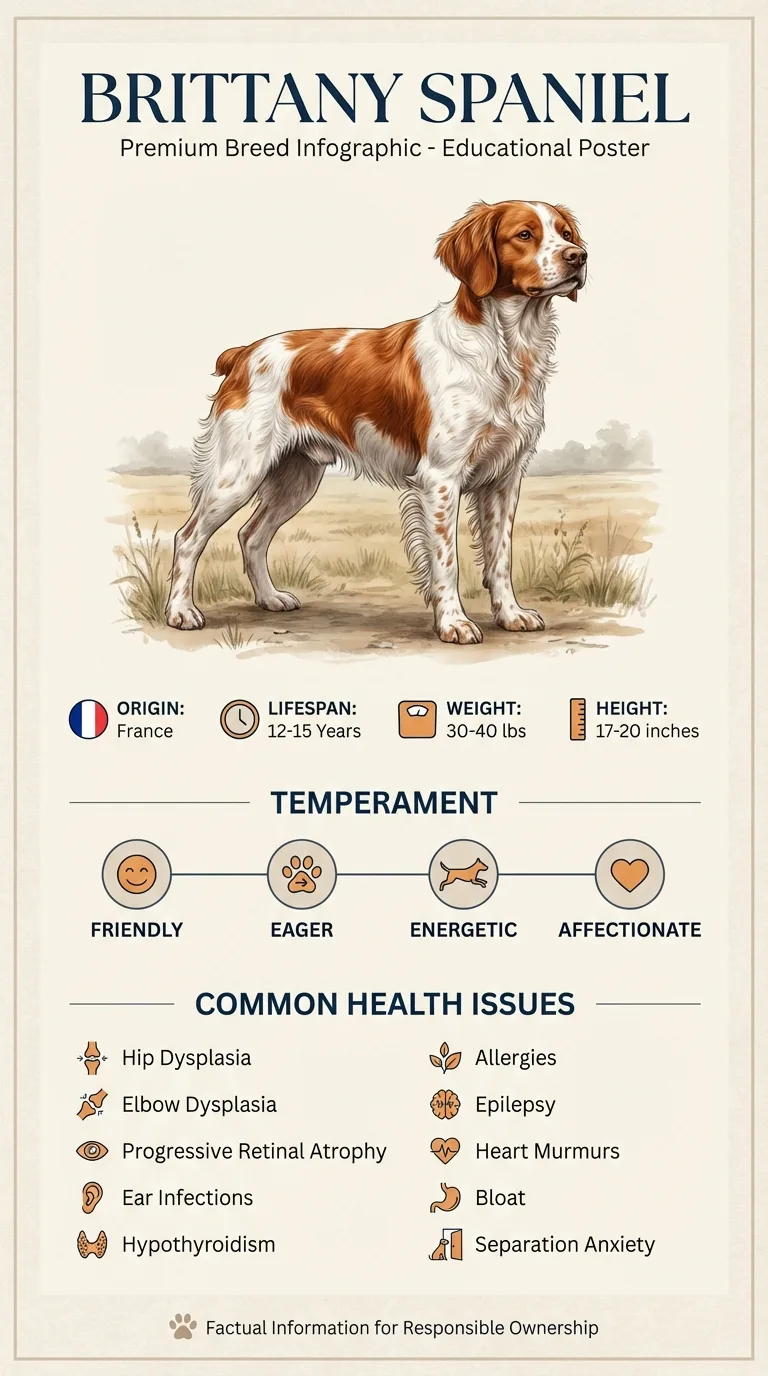
If you think your Brittany has back/spine issues, the plan is three steps: write down what you have seen and when it started, book a veterinary appointment rather than waiting for the next flare, and take video of the behaviour or symptom before you go — the thing you are worried about rarely happens in the consulting room. Screening in the parents covers hip dysplasia, elbow dysplasia, progressive retinal atrophy.
What the vet visit should produce is a diagnosis and a written plan, not just reassurance: what is being ruled out, what the monitoring interval is, and which signs mean you come back sooner. Ask what the treatment costs across a year rather than per visit, because that is the number that decides whether you are managing this condition or reacting to it.
Between appointments, keep a short log — dates, what you saw, what changed. It is the single most useful thing an owner brings to a follow-up, and for back/spine issues it is often what separates a clear pattern from a guess.
Owen first noticed it as a subtle thing: Piper, his eight-year-old Brittany, seemed to drag her back toes slightly on evening walks, just enough to scuff her nails audibly on the pavement. It built over about two months before he mentioned it at her checkup, assuming it was simple aging. A neurological exam found mild hind-end weakness, and imaging confirmed gradual disc degeneration in her lower back rather than the sudden rupture Owen had read scary stories about online. Because it was caught at a mild stage, Piper's vet recommended strict activity restriction and anti-inflammatory medication rather than surgery. Over six weeks, the scuffing noticeably improved, though Owen keeps her on permanently reduced high-impact activity and watches closely for any return of the wobble.
Key takeaway: The gradual version of disc disease common in normally built breeds gives owners real warning time. Catching a slow-developing wobble early, rather than dismissing it as aging, changes what treatment options are available.
No. Dachshunds carry a genetic trait causing early disc calcification and sudden ruptures. Brittanys aren't a chondrodystrophic breed, so when disc disease occurs here, it typically follows a slower, age-related degeneration pattern instead.
A vet starts with a neurological exam checking reflexes and coordination, and imaging such as an MRI or CT scan is used to confirm a disc issue and locate it precisely if surgery is being considered.
Many mild to moderate cases are managed with strict rest, anti-inflammatory medication, and controlled rehabilitation, especially when symptoms are limited to mild weakness rather than significant paralysis.
Significant or worsening hind-leg weakness, loss of the ability to walk, or loss of deep pain sensation are signs that typically push toward a surgical recommendation, since delayed treatment in severe cases can affect the odds of recovery.
Since it's degenerative rather than a young-onset genetic condition, it more commonly appears in middle-aged to senior dogs, though the exact timing varies by individual.
High-impact activity in a dog already showing early symptoms can accelerate irritation, which is why a vet-guided activity plan matters once any hind-end weakness or coordination change is noticed.
There's no guaranteed prevention, but maintaining a healthy weight, avoiding repetitive high-impact strain, and treating any early stiffness promptly can reduce the pace of degeneration.
No, Brittanys aren't a chondrodystrophic breed. When disc disease occurs, it's typically the slower, age-related type, not the sudden genetic type seen in short-legged breeds.
A slowly worsening wobble or weakness in the hind legs over weeks to months is the classic early pattern, unlike the sudden onset seen in other breeds.
Conservative management with medication and rest is far less costly than surgery, which can run into the thousands depending on severity and whether an MRI is needed.
Yes, your vet will likely recommend controlled, low-impact activity rather than high-impact running or jumping while symptoms are being evaluated or managed.
Yes, guided physical rehabilitation exercises, often taught by a veterinary rehab specialist, can meaningfully support recovery and strength rebuilding after a disc-related episode.
A one-page prep sheet for this condition: the signs, the questions to ask, what to get priced. Unlocks here.
You get: Vet visit prep sheet
No spam. One-click unsubscribe. See our privacy policy.
Preview page 1 before you decide.