Health
What's an early sign of arthritis in an active Brittany?
Being slower to rise after rest and less eager to jump into the car are usually the first subtle signs, often before any obvious limping.

Quick answer
What's an early sign of arthritis in an active Brittany?
Being slower to rise after rest and less eager to jump into the car are usually the first subtle signs, often before any obvious limping.
A Brittany that's always been the first one out the door and the last one to slow down doesn't usually announce joint pain outright. It just quietly does a little less.
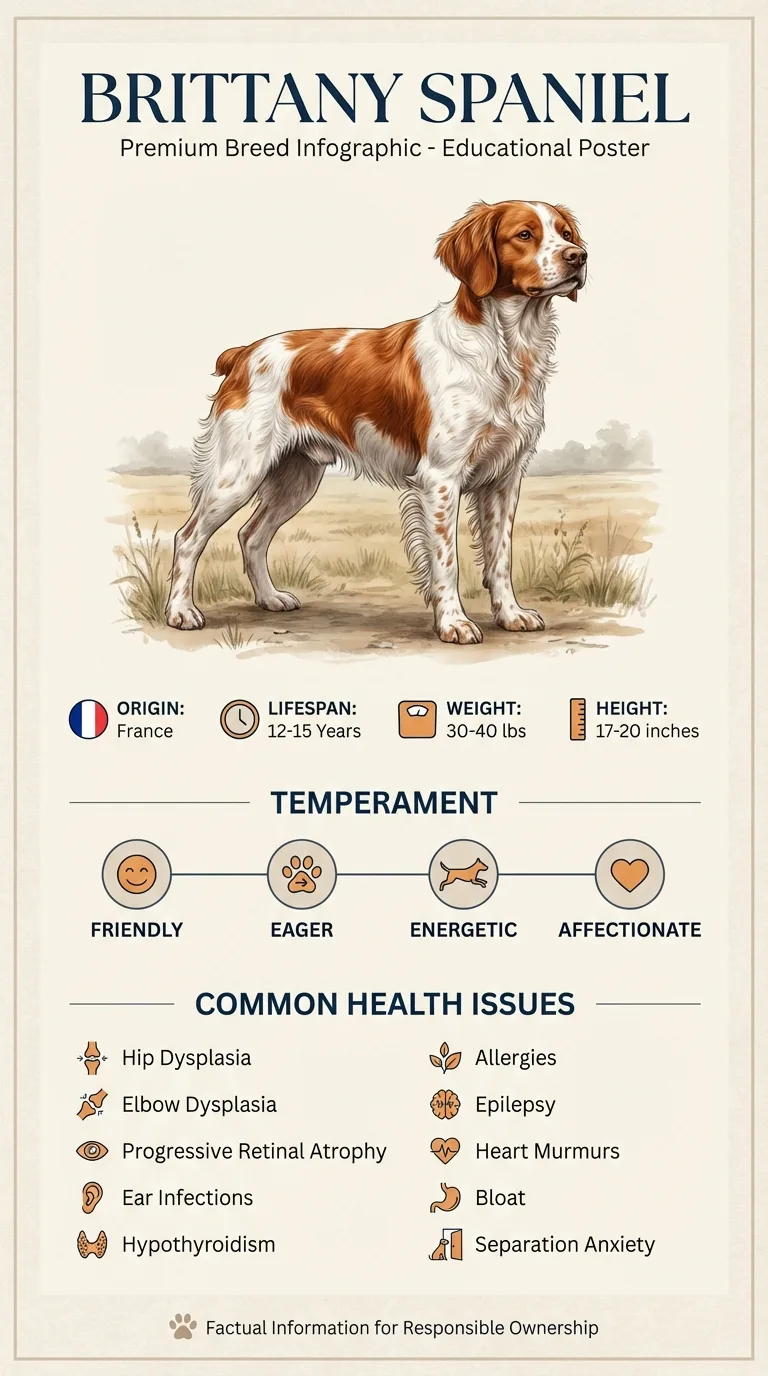
Owners of working or heavily exercised Brittanys are the ones most likely to miss early arthritis, precisely because their dog's baseline activity level is so high that a modest slowdown doesn't look abnormal at first glance.
This guide is not medical advice. If your dog shows pain, sudden behavior change, or worsening symptoms, consult a licensed veterinarian.
Some links may be affiliate links. We may earn a commission at no extra cost to you. We only suggest products we believe are helpful for dog owners.
We research and check what we publish, but we do not warrant that any figure, date, price, or statement is accurate, complete, or current, and we accept no liability for any loss, cost, injury, or other harm arising from the use of this site. Use it as one reference among several. You remain responsible for your own decisions and for your dog's care - confirm anything that matters with a licensed veterinarian or another qualified professional before you act on it. Full disclaimer.
Arthritis in a Brittany is often less about age and more about mileage on joints that may not have been perfectly formed to begin with. Hip and elbow dysplasia, both documented in this breed, create uneven wear patterns that can lead to arthritic changes well before a dog would typically be called a senior, especially in dogs that work fields hard for years.
Given the documented rate of hip and elbow dysplasia in this breed, arthritis is a common outcome for a meaningful share of Brittanys, particularly working and field-active dogs, though the age of onset and severity vary widely by individual joint conformation.
Both hip dysplasia and elbow dysplasia are documented health concerns for this breed, and either one creates a joint surface that doesn't move and bear weight evenly. That uneven mechanical stress is the direct pathway to earlier arthritic change compared to a dog with normally formed joints.
A Brittany's typical life as an active field or hunting companion means more running, jumping, and sudden direction changes on uneven ground than a low-activity breed experiences, which accelerates wear on any joint that already has a conformation weakness.
See your vet if you notice consistent stiffness, reluctance to jump or climb stairs, a limp lasting more than a day or two, or a general decline in exercise tolerance. Sudden inability to bear weight on a limb or acute, severe pain warrants same-day evaluation rather than waiting to see if it resolves.
See all Brittany health problems, which breeds are prone to arthritis, or the full Brittany breed guide for temperament, exercise needs and ownership costs.
Arthritis is a progressive, lifelong condition rather than something that resolves. Most dogs show noticeable comfort improvement within a few weeks of starting an appropriate management plan, but ongoing maintenance is the reality going forward.
Success means a dog that stays comfortable and reasonably active for its age and joint condition, not a return to the joint health of a two-year-old. Slower mornings and modified activity are a realistic new normal, not a failure of treatment.
Hip dysplasia and elbow dysplasia are both documented health concerns in this breed, and both involve a joint that doesn't fit together quite right from a young age. A poorly aligned joint wears unevenly every time it bears weight, which is the mechanical starting point for arthritis.
A dog with mild, undiagnosed dysplasia can look completely normal through puppyhood and young adulthood, especially if it's driven and pain-tolerant the way many field-bred Brittanys are. The joint damage accumulates quietly until the dog is three, four, or five years old and arthritis findings show up on an x-ray that wouldn't be expected in a dog that age without an underlying joint conformation issue.
Because a high-drive Brittany will often push through discomfort to keep working, the early signs are subtle and easy to write off as normal aging or a bad day.

Carla noticed that Duke, her five-year-old Brittany, had started taking a few extra seconds to get up from his bed each morning, but he still ran hard during their weekend hikes, so she didn't think much of it. It was her vet who caught the pattern during a routine visit, asking pointed questions about his morning stiffness that made Carla realize how consistent it had become. X-rays showed mild hip dysplasia that had gone undiagnosed in puppyhood, along with early arthritic changes in both hips. Carla adjusted Duke's routine: shorter, more frequent walks instead of one long weekend blowout, a joint supplement her vet recommended, and a stricter eye on his weight. Within a month, his morning stiffness had noticeably eased, though Carla knows the underlying joint issue isn't going away. She now treats the daily routine adjustments as permanent rather than temporary.
Key takeaway: A dog that's still willing to run hard isn't necessarily pain-free. Morning stiffness and small enthusiasm drops are often the first real signal, well before a dog actually slows down its top-line activity.
In a dog with underlying hip or elbow dysplasia, arthritic changes can appear on imaging as early as two to four years old, well before the dog is considered senior.
Not entirely, especially if dysplasia is present, but maintaining a lean body weight, avoiding excessive high-impact activity in a growing puppy, and treating joint issues early can slow how quickly arthritis progresses.
A vet combines a physical exam checking range of motion and pain response with x-rays of the affected joints. Hip and elbow imaging is often recommended if dysplasia was previously identified or suspected.
Not necessarily, but the type and intensity of activity often needs adjusting. Many arthritic dogs do well with modified, lower-impact exercise rather than a full stop, guided by your vet's assessment of severity.
Weight management, joint supplements your vet recommends, controlled exercise, and prescription pain or anti-inflammatory medication when needed are the common tools. Severe cases sometimes involve additional options your vet can discuss.
Many owners report their dog seems stiffer in cold weather, and while the exact mechanism isn't fully settled, keeping a dog warm and providing supportive bedding is a reasonable and low-risk step regardless.
Dysplasia is the most common underlying cause in this breed given its documented prevalence, but joint injury, past trauma, or a cruciate ligament injury can also lead to early arthritis in an otherwise normally formed joint.
Being slower to rise after rest and less eager to jump into the car are usually the first subtle signs, often before any obvious limping.
Documented hip and elbow dysplasia risk means some dogs start with joints that don't align perfectly, which accelerates wear well before typical senior age.
Ongoing joint supplements typically run a modest monthly cost, while prescription pain management or imaging adds more depending on what your vet recommends.
Generally yes, but adjusted: controlled, lower-impact activity like swimming or leash walking is often better than stopping activity altogether, which can worsen stiffness.
Teaching a dog to accept ramps for the car, wait for permission before jumping, and settle calmly can reduce the joint stress that comes from an eager dog launching itself around.
A one-page prep sheet for this condition: the signs, the questions to ask, what to get priced. Unlocks here.
You get: Vet visit prep sheet
No spam. One-click unsubscribe. See our privacy policy.
Preview page 1 before you decide.