Health
What is the first thing to do if my dog overheats?
Stop the activity, move to shade or air conditioning, wet the coat down to the skin with cool water, and get airflow onto the dog.

Quick answer
What is the first thing to do if my dog overheats?
Stop the activity, move to shade or air conditioning, wet the coat down to the skin with cool water, and get airflow onto the dog.
Heatstroke kills dogs that looked fine twenty minutes earlier. If your Bichon is disoriented, vomiting or staggering after heat exposure, that is an emergency phone call, not a wait-and-see.
Owners who have just had a frightening episode and want to know whether they handled it right, and owners planning summer travel, festivals or long car journeys with a small heavily coated dog.
This guide is not medical advice. If your dog shows pain, sudden behavior change, or worsening symptoms, consult a licensed veterinarian.
Some links may be affiliate links. We may earn a commission at no extra cost to you. We only suggest products we believe are helpful for dog owners.
We research and check what we publish, but we do not warrant that any figure, date, price, or statement is accurate, complete, or current, and we accept no liability for any loss, cost, injury, or other harm arising from the use of this site. Use it as one reference among several. You remain responsible for your own decisions and for your dog's care - confirm anything that matters with a licensed veterinarian or another qualified professional before you act on it. Full disclaimer.
Hyperthermia is a spectrum that ends in a true emergency. For a Bichon Frise the realistic danger points are confinement without airflow, exertion the dog will not stop on its own, and a heavy coat that slows both cooling and any attempt to cool the dog by hand. The condition is almost entirely preventable and, once established, is time-critical.
True heatstroke is rare relative to the number of dogs that simply get uncomfortable in summer, but it is disproportionately fatal when it happens and the circumstances repeat predictably across cases. Vehicles and confinement dominate the picture. A Bichon kept groomed, walked early and never shut in a warm space is at low risk regardless of climate.
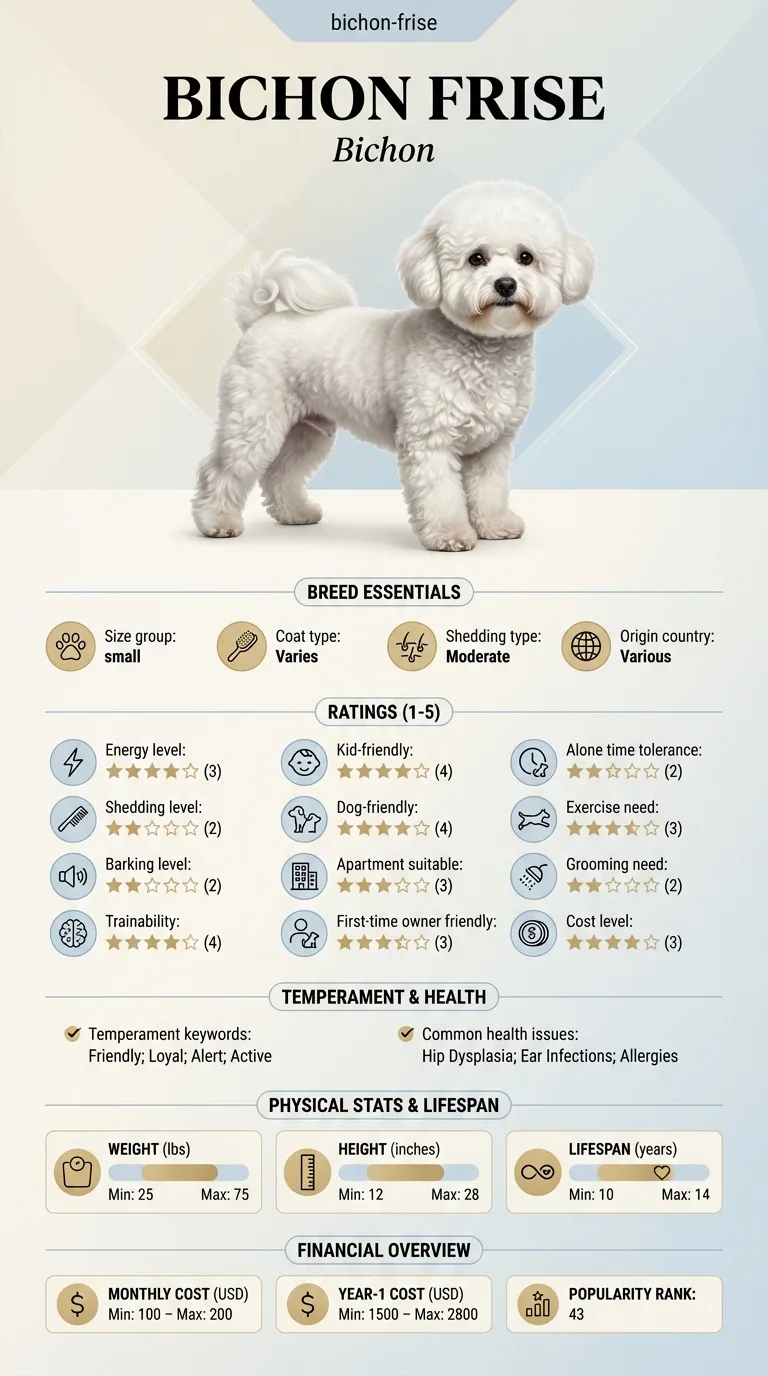
The Bichon has a normal muzzle length and a functioning airway, so it is not fighting the anatomical disadvantage that flat-faced breeds carry. The vulnerability is thermal insulation: a curly dense double coat that sheds very little holds a warm air layer against the skin year-round. Small body mass cuts both ways, since a 12 to 18 pound dog heats up quickly but also responds quickly to effective cooling.
Enclosure is the dominant factor in serious cases. A car, a crate, a conservatory or a garden shed removes airflow and traps radiant heat, and none of those depend on an extreme outdoor temperature to become dangerous. Humidity compounds it by blunting evaporation. Human factors complete the picture: a schedule that runs late, a quick errand that takes twenty minutes, or a social event where nobody is watching the dog.
Call immediately and travel while cooling if your Bichon collapses, has a seizure, becomes unresponsive, has gums that are pale, grey or brick red, or is vomiting or passing bloody stool after heat exposure. Call the same day even if the dog appears to recover, because internal damage can declare itself hours later. Book a routine appointment if heat tolerance has dropped noticeably compared with previous summers, since that often reflects a treatable underlying change rather than the weather.
The instinct is to reach for ice, and that instinct is wrong. Ice water and ice packs applied directly cause surface blood vessels to constrict, which slows the transfer of heat out of the body and can trap the core temperature high. It also risks cold injury to skin.
What works is cool or tepid water, applied continuously, with airflow. Wet the dog thoroughly, concentrating on the belly, the inside of the thighs, the armpits and the paws where blood vessels run close to the surface. Then put a fan on the dog or drive with the windows down and the air conditioning running. Evaporation is what removes the heat; a wet dog in still air simply stays a wet hot dog.
A Bichon's coat complicates this. Water sits on top of a dense curly coat rather than soaking through, so it is worth working the water down to the skin with your hands rather than pouring it over the top. A matted dog is harder to cool for exactly this reason.
Do not force water into the mouth of a dog that is not fully alert. Offer it, and let the dog choose.

See all Bichon Frise health problems, which breeds are prone to heat sensitivity hyperthermia, or the full Bichon Frise breed guide for temperament, exercise needs and ownership costs.
Early heat stress resolves in ten to twenty minutes with proper cooling. Genuine heatstroke requires hospitalisation and monitoring over one to several days, and recovery from organ effects can take weeks. Prevention habits, by contrast, take a single summer to become automatic.
Success is a summer where the escalation never gets past the first stage: the dog pants, you notice, you stop, and everyone goes home. It also means you can describe your own cooling plan without looking anything up.
Hyperthermia moves through recognisable stages. The value of knowing them is that intervention at the earlier ones is easy and intervention at the later ones is often too late.
If you think your Bichon has heat sensitivity & hyperthermia, the plan is three steps: write down what you have seen and when it started, book a veterinary appointment rather than waiting for the next flare, and take video of the behaviour or symptom before you go — the thing you are worried about rarely happens in the consulting room. Screening in the parents covers skin allergies, patellar luxation, bladder stones.
What the vet visit should produce is a diagnosis and a written plan, not just reassurance: what is being ruled out, what the monitoring interval is, and which signs mean you come back sooner. Ask what the treatment costs across a year rather than per visit, because that is the number that decides whether you are managing this condition or reacting to it.
Between appointments, keep a short log — dates, what you saw, what changed. It is the single most useful thing an owner brings to a follow-up, and for heat sensitivity & hyperthermia it is often what separates a clear pattern from a guess.
Freddie's owners stopped at a garden centre on a mild May afternoon and left him in the car with two windows part-open, expecting to be five minutes. A queue at the till made it closer to twenty-five. They came back to a dog panting frantically with thick drool and dark red gums, unwilling to stand. They soaked a towel at the outdoor tap, worked water through his coat to the skin, and drove to their vet with the air conditioning on full and windows down. Freddie was treated with fluids and kept in overnight for bloodwork. He recovered fully. The vet's comment was that the drive with airflow, not the towel alone, was what kept his temperature from climbing further.
Key takeaway: The failure was a plan that depended on the errand being short. Assume every stop will take three times as long, and the car stops being an option at all.
That kind of figure comes from studies comparing flat-faced breeds against dogs with normal muzzles, and the Bichon Frise is not a flat-faced breed. It has a functional airway and pants effectively. Applying a brachycephalic risk multiplier to this breed misrepresents its actual risk, which is driven by coat density rather than by anatomy.
Faster than most people believe. On a warm rather than hot day, an interior can climb dozens of degrees within fifteen to twenty minutes, and cracked windows make very little difference. There is no safe duration for leaving a coated dog in a parked car in summer.
You can with a rectal thermometer, and it is useful information for the vet. Do not delay cooling or transport to do it. If the reading is above the normal canine range your vet gave you, treat that as confirmation to move rather than as a number to keep re-checking.
Serious hyperthermia can affect the kidneys, gut lining and clotting system, and problems sometimes appear a day or two later. That is why a vet will often want bloodwork and a period of observation even for a dog that walks in looking bright.
Yes. Reduced fitness, extra weight, heart or airway conditions and less efficient thermoregulation all stack up with age. Given this breed regularly lives to 14 or 15, plenty of Bichons spend several summers as genuinely old dogs and need shorter, cooler outings than they did at five.
Hydration helps panting work but does not protect a dog from a hot enclosed space or from continued exertion. Water is a supporting measure, not a substitute for shade, airflow and stopping the activity.
Stop the activity, move to shade or air conditioning, wet the coat down to the skin with cool water, and get airflow onto the dog.
No. Ice constricts surface vessels and slows heat loss. Use cool or tepid water with a fan or moving air instead.
Emergency admission with fluids, monitoring and bloodwork is one of the more expensive unplanned bills an owner can face.
Yes, at dawn or after dark, kept short. Replace the daytime walk with indoor scent games rather than skipping stimulation entirely.
Manage it rather than train it. Bring the dog in on a timer during hot spells; excited dogs do not self-limit reliably.
A one-page prep sheet for this condition: the signs, the questions to ask, what to get priced. Unlocks here.
You get: Vet visit prep sheet
No spam. One-click unsubscribe. See our privacy policy.
Preview page 1 before you decide.
