Health
Is EIC a Bichon Frise condition?
No. It is an inherited disorder identified in Labradors and a few related breeds, with a DNA test validated for those populations.

Quick answer
Is EIC a Bichon Frise condition?
No. It is an inherited disorder identified in Labradors and a few related breeds, with a DNA test validated for those populations.
That precise condition belongs to another kind of dog, but a Bichon Frise that goes down after a hot summer walk has a real problem, and two of the likeliest explanations are things you can begin treating in the first two minutes.
Owners whose Bichon has collapsed, wobbled or gone flat after activity, particularly in warm weather. Also owners who want to know what to do at the moment it happens rather than what to read about afterwards.
This guide is not medical advice. If your dog shows pain, sudden behavior change, or worsening symptoms, consult a licensed veterinarian.
Some links may be affiliate links. We may earn a commission at no extra cost to you. We only suggest products we believe are helpful for dog owners.
We research and check what we publish, but we do not warrant that any figure, date, price, or statement is accurate, complete, or current, and we accept no liability for any loss, cost, injury, or other harm arising from the use of this site. Use it as one reference among several. You remain responsible for your own decisions and for your dog's care - confirm anything that matters with a licensed veterinarian or another qualified professional before you act on it. Full disclaimer.
Exercise-induced collapse names an inherited condition of Labrador retrievers in which intense activity produces sudden hind limb weakness. It is not a Bichon Frise condition. When a Bichon collapses around exercise, the realistic causes are heat-related illness, low blood sugar, a cardiac rhythm problem, a slipping kneecap, pain, a seizure, or straightforward exhaustion in an unconditioned dog.
The named genetic condition is not seen in this breed at all. Heat-related collapse, by contrast, is a genuine seasonal emergency presentation in dogs of every breed, and small dogs with dense coats are not exempt. Exhaustion in a dog taken beyond its conditioning is common and largely preventable, and kneecap episodes misinterpreted as collapse are frequent in small breeds.
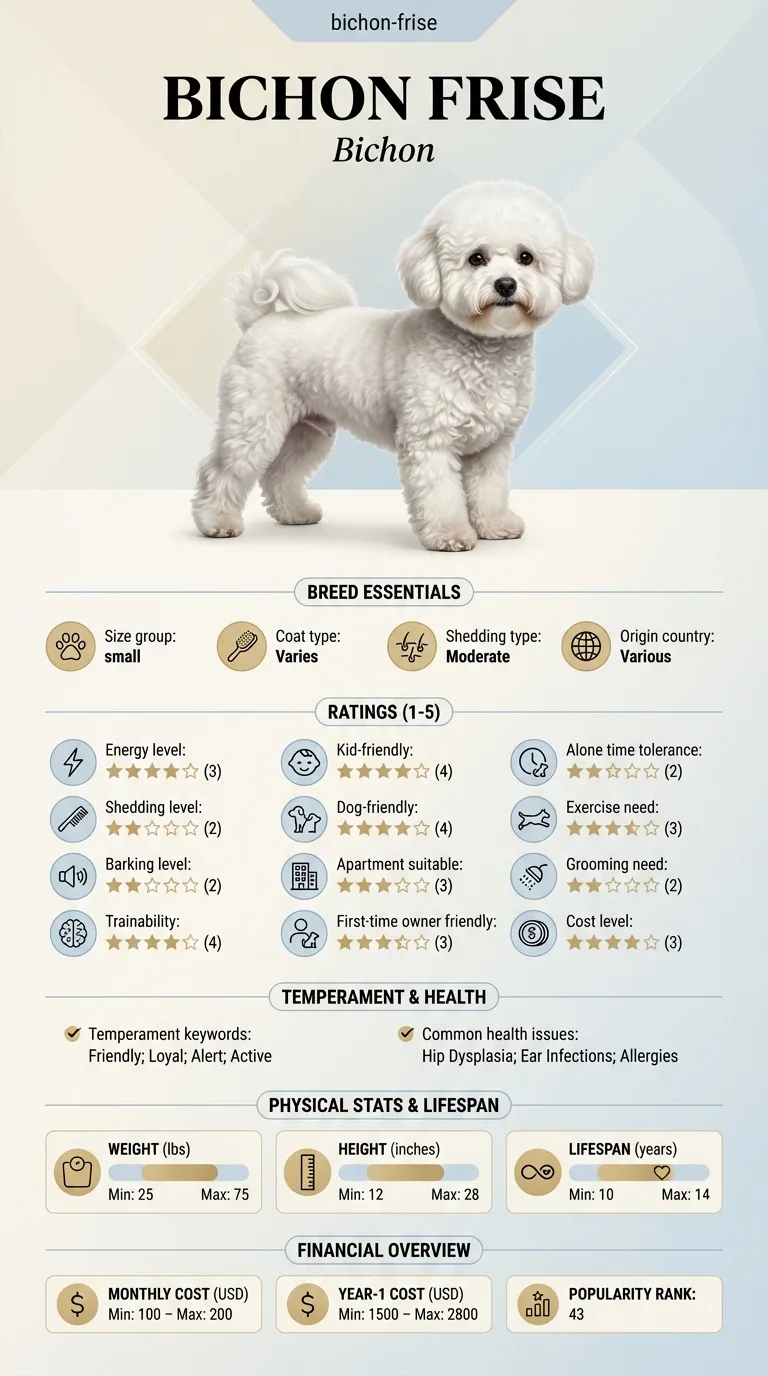
Two breed traits shape the realistic risk. The first is the coat: a curly, dense, very low shedding double coat is an efficient insulator, which is a genuine advantage in cold weather and a genuine liability in a heatwave, because it slows the loss of heat from the skin. The second is the kneecap. Patellar luxation is on this breed's documented health list, and it produces exactly the picture owners describe as collapse: a hind leg failing suddenly in a dog that is fully alert. Body size adds a third factor, since a 12 to 18 pound dog has less energy stored than a large one and depletes it faster.
Weather and pavement do most of the work. Midday summer walks on tarmac expose a dog whose belly sits inches above a surface radiating heat, and shade at human head height is not shade at ten inches. Cars parked even briefly in sun become lethal. On the exercise side, weekend-warrior patterns, where a dog does very little from Monday to Friday and then a long hike on Saturday, produce exhaustion in a breed whose baseline requirement is only two out of five. Excitement matters too: a dog chasing a ball frantically generates far more heat than one walking the same distance.
Book an assessment after any collapse, even one from which your dog recovered in seconds, and take your video and your notes. Go to an emergency clinic immediately, cooling on the way, for collapse in warm weather, for heavy frantic panting with bright red gums and thick drool, for vomiting or diarrhoea after exertion in heat, or for a dog that is unsteady, disoriented or unresponsive. Also go immediately for repeated collapses in one day, for a collapse from which your dog does not fully recover within a minute, for pale, grey or blue gums, or for a seizure. Heat-related illness is a true emergency and deteriorates after the visible signs improve.
See all Bichon Frise health problems, which breeds are prone to exercise induced collapse eic, or the full Bichon Frise breed guide for temperament, exercise needs and ownership costs.
A dog treated promptly for mild heat-related illness usually needs a day or two of quiet recovery and observation, while a severe case may require several days of hospitalisation and can cause lasting organ damage. Exhaustion in an unfit dog resolves within a day, and building genuine fitness for longer outings takes six to eight weeks of gradual increase. Where a cardiac or kneecap cause is identified, the timeline follows that condition rather than this page.
Success is an owner who has correctly identified what the episode was, who has adjusted the routine that produced it, and who knows exactly what to do in the first two minutes if it recurs. For the dog it means summer outings taken at sensible hours, walks matched to actual conditioning, and no repeat episodes. A Bichon Frise that enjoys two short daily walks and a scentwork game on hot afternoons is living well within its design.
A dog that collapses after exercise in warm weather should be treated as overheating until proven otherwise, because heat-related illness kills quickly and treatment starts before you reach a vet.
Dogs cannot sweat meaningfully. They rely on panting to move air across moist surfaces, and the efficiency of that system falls sharply as air temperature and humidity rise. A Bichon Frise carries a curly, dense double coat that sheds very little, which is excellent insulation and works in both directions.
The signs are heavy frantic panting, bright red gums, thick ropy drool, unsteadiness, vomiting or diarrhoea, and in severe cases collapse and seizures.
If you suspect it, begin cooling immediately. Move into shade or air conditioning. Pour or spray cool, not ice-cold, water over the body, concentrating on the belly, the inner thighs and the neck where blood vessels run close to the surface. Get air moving over the wet coat with a fan or an open car window. Offer small amounts of water if your dog is conscious and able to drink.
Then drive to a vet, cooling on the way. Do not decide the dog looks better and stay home. Heatstroke causes internal damage that continues after the temperature has come down, and dogs that appear to recover can deteriorate hours later.

Once heat is excluded, a small dog that collapses after activity has a manageable list of possibilities, and the circumstances usually narrow it considerably.
Ravi took his six-year-old Bichon Frise, Coco, on a walk along a coastal path on a July afternoon. It was a route they had done in April without difficulty. About two miles in she stopped, panted frantically, and would not get up. Her gums were bright red and her drool had gone thick and ropy. Ravi carried her to the shade of a wall, soaked his shirt in water from his bottle and laid it over her belly and inner thighs, and phoned ahead while walking back to the car with the windows down. The clinic recorded a temperature well above normal. Coco was cooled properly, given fluids, and kept in overnight for monitoring. She went home the following afternoon with no lasting damage. The vet's comment was that the cooling Ravi started on the path had almost certainly mattered. Coco now walks at seven in the morning and after nine in the evening from June to September, and does scentwork indoors in between.
Key takeaway: In warm weather the treatment for a collapsed dog begins where the dog is lying, not at the clinic, and the minutes you spend cooling before you drive are the ones that count.
The specific inherited condition of that name is documented in Labrador retrievers and a few related breeds, and there is a validated DNA test for those populations. It is not a Bichon Frise condition and does not appear on the breed's documented health list. A collapsing Bichon needs assessment for the causes that do apply.
There is no single safe number, because humidity, sun, shade, surface temperature and the individual dog all matter. Practical guidance is to walk early morning and late evening in summer, test the pavement with the back of your hand, and choose grass and shade. When in doubt, replace the walk with indoor scentwork.
Use cool water rather than ice-cold. Very cold water causes surface blood vessels to constrict, which can slow the loss of heat from the core, and it can cause shivering that generates more heat. Cool water plus moving air over the wet coat is the more effective combination.
Yes, any genuine loss of consciousness deserves assessment, even a brief one. Film any repeat episode. The distinction between a faint, a seizure and a kneecap slipping is often obvious from thirty seconds of footage and very difficult from a description alone.
It is most associated with very young and very small dogs, but a small adult that has exercised hard on an empty stomach can be affected. If your dog is weak and trembling after exertion and is conscious and able to swallow, your vet may advise something to raise blood sugar. Ask them rather than improvising, and follow it with an examination.
Increase gradually, roughly ten per cent a week, on cool days and even ground, and let your dog set the pace. A breed with an exercise requirement of two out of five will happily do more than that if it is conditioned for it, but taking an unfit dog straight to a long hike is how ordinary exhaustion becomes an emergency.
No. It is an inherited disorder identified in Labradors and a few related breeds, with a DNA test validated for those populations.
Start cooling immediately with cool water over the belly, inner thighs and neck, get air moving, and drive to a vet while cooling.
No. Heat-related illness causes internal damage that continues after cooling, and dogs can deteriorate hours later. Go anyway.
A sudden hop or skip with a hind leg held up, in a fully conscious and alert dog that carries on afterwards. It is often mistaken for collapse.
Modest, at two out of five. Two short daily walks meet the requirement, and fitness for anything longer has to be built gradually.
A one-page prep sheet for this condition: the signs, the questions to ask, what to get priced. Unlocks here.
You get: Vet visit prep sheet
No spam. One-click unsubscribe. See our privacy policy.
Preview page 1 before you decide.