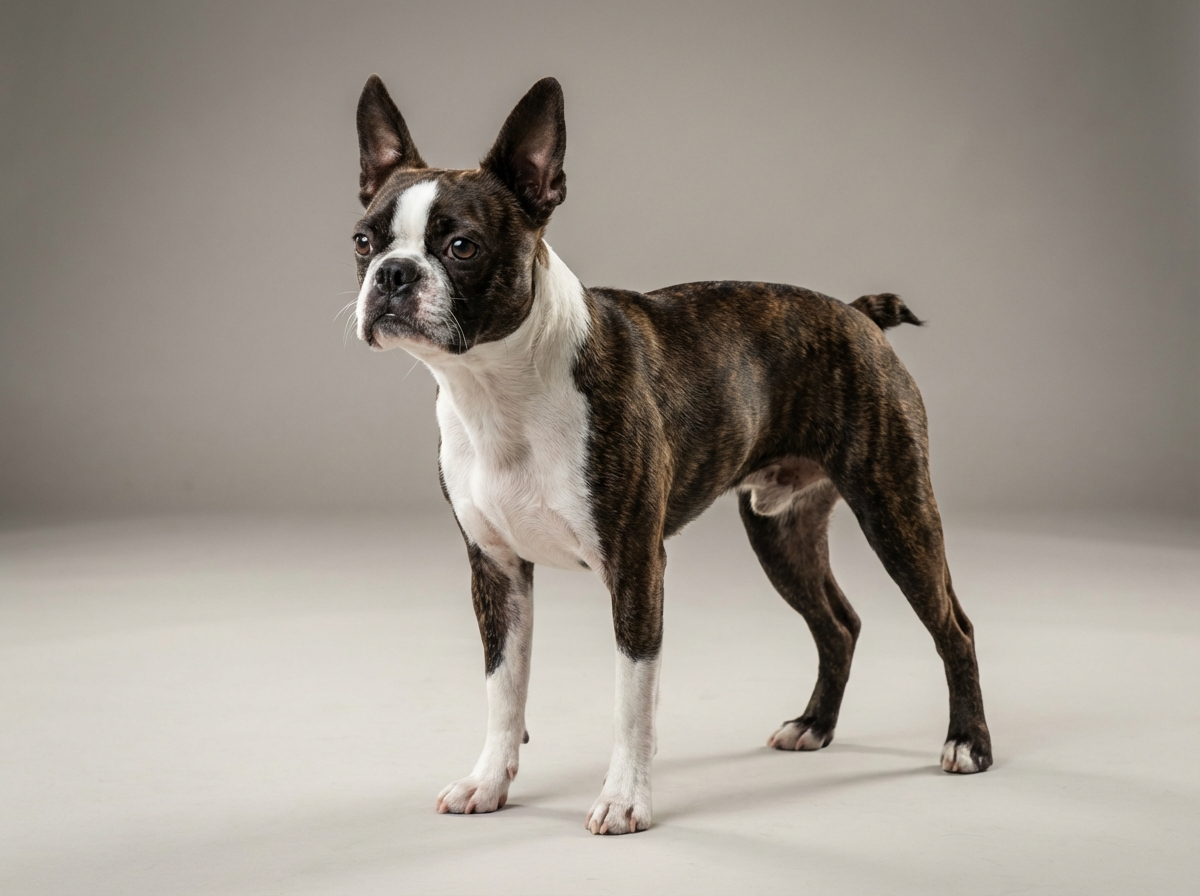
Health
What do I do first?
Shade, cool water on the belly and inner thighs, and air moving over the wet coat. Then phone the nearest hospital.

Quick answer
What do I do first?
Shade, cool water on the belly and inner thighs, and air moving over the wet coat. Then phone the nearest hospital.
For this breed, a collapse during exercise should be treated as heat and airway until proven otherwise, because that is what it usually is and because that version is the one that kills within the hour.
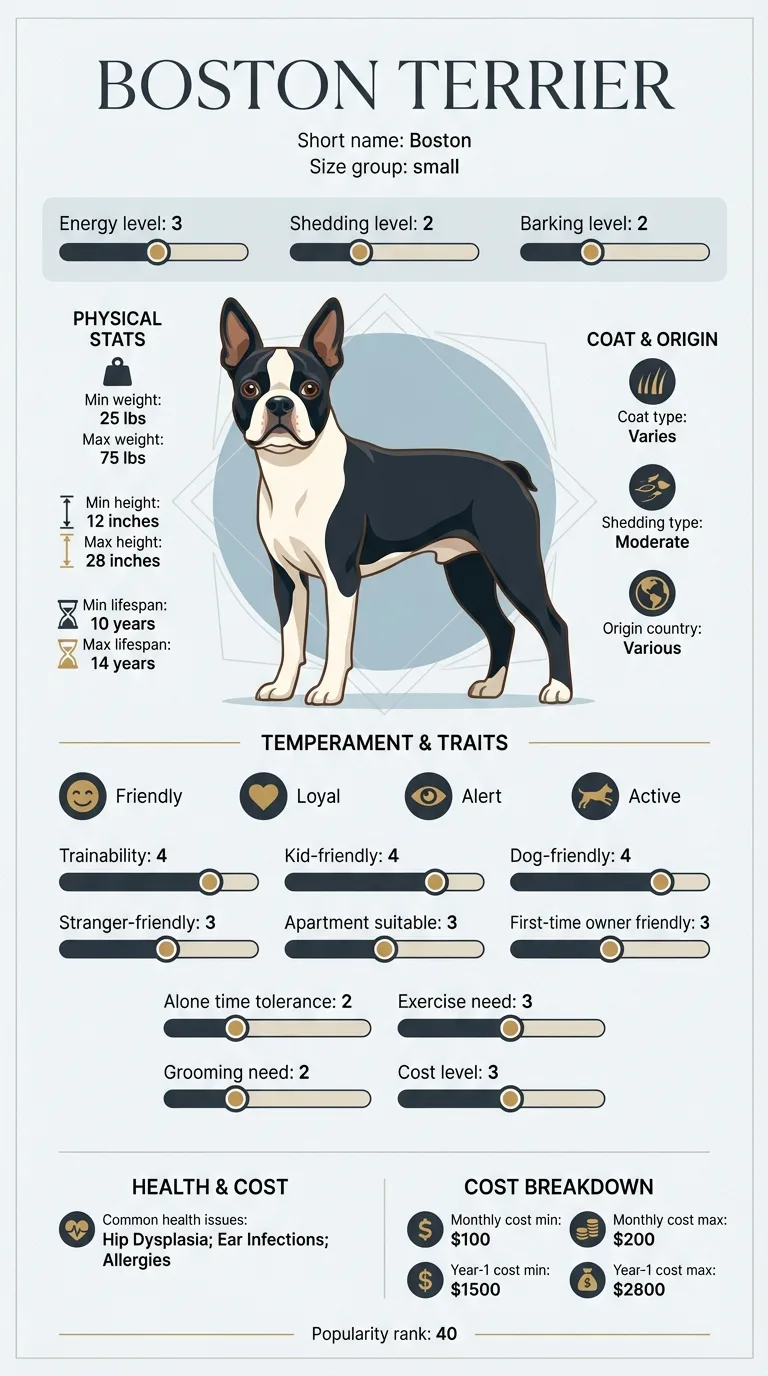
Owners whose Boston has gone down on a warm walk, people who want to know what to do in the field rather than what to read afterward, and anyone deciding how far from home it is safe to walk in summer.
This guide is not medical advice. If your dog shows pain, sudden behavior change, or worsening symptoms, consult a licensed veterinarian.
Some links may be affiliate links. We may earn a commission at no extra cost to you. We only suggest products we believe are helpful for dog owners.
We research and check what we publish, but we do not warrant that any figure, date, price, or statement is accurate, complete, or current, and we accept no liability for any loss, cost, injury, or other harm arising from the use of this site. Use it as one reference among several. You remain responsible for your own decisions and for your dog's care - confirm anything that matters with a licensed veterinarian or another qualified professional before you act on it. Full disclaimer.
Collapse during or after exercise in a Boston Terrier is most often a combined airway and heat emergency rather than the inherited neuromuscular condition the term usually describes. A dog whose panting cannot keep pace with the heat it is generating overheats rapidly, and a narrowed airway makes both the cooling and the breathing worse together. The immediate response - shade, cool water, moving air, and a phone call - matters more than the eventual diagnosis.
The inherited retriever form is not documented in Boston Terriers. Exertional and heat-related collapse in short-faced breeds, by contrast, is a well-recognised emergency presentation, and brachycephalic airway syndrome heads this breed's documented health list. Most Boston owners will never see it, and those who do usually see it once, on a warm day, further from home than they intended.
Dogs cool almost entirely by panting - moving air across moist surfaces so evaporation carries heat away. That mechanism depends on being able to move a large volume of air freely, which is exactly what a shortened, narrowed airway prevents. So a Boston generating heat through exercise is trying to shed it through a restricted passage, and as its temperature rises the airway tissues swell, narrowing things further. The breed's genuine exercise requirement is modest, which is a design feature rather than a limitation to be overcome.
Temperature, humidity and surface heat set the ceiling. Humidity matters as much as air temperature, because evaporation slows in humid air and evaporation is the whole cooling mechanism. Shade, airflow and access to water change the outcome. Distance from home is the underestimated factor: a collapse two hundred metres from the door is manageable, while the same collapse three kilometres out on a hot afternoon is a very different situation.
Any collapse warrants a veterinary examination, including one the dog appears to recover from quickly, because heat damage develops over the following days. Go immediately, cooling as you travel, for a dog that is unresponsive or semi-conscious, whose gums are blue, grey, brick red or pale, whose breathing is frantic and not settling, that is vomiting or has bloody diarrhoea after collapsing, or that feels very hot. Phone ahead so the hospital is ready and say explicitly that the dog is short-faced and has collapsed. If collapses recur despite sensible management, ask for an airway assessment rather than simply shortening walks further.
See all Boston Terrier health problems, which breeds are prone to exercise induced collapse eic, or the full Boston Terrier breed guide for temperament, exercise needs and ownership costs.
A mild overheating event with prompt cooling often resolves within an hour, though observation for twenty-four to forty-eight hours is still warranted. Genuine heatstroke requires hospitalisation and its consequences unfold over several days. Prevention is immediate: a change in walk timing and route takes effect the same afternoon.
A dog that never reaches that point again - which in practice means summer walks moved to the cool hours, a route that stays close to home, water carried, and an owner who stops the game before the dog would.
If your Boston collapses during or after exercise, this is the sequence. It assumes the most likely and most dangerous cause, which is the correct assumption in this breed.
Once the emergency is handled, the diagnostic question matters. Three broad categories account for nearly all exercise collapse, and the circumstances usually point clearly at one.
Respiratory and thermal collapse is the Boston default. It follows exertion, excitement or heat, is announced beforehand by increasingly loud, laboured breathing, and the dog is desperately trying to move air rather than simply unconscious. Gums are often discoloured, the tongue looks broad and dark, and the dog is hot to the touch. Brachycephalic airway syndrome heads this breed's documented health list, and this is the mechanism it produces.
Cardiac collapse is briefer and cleaner. The dog drops without warning, is out for a few seconds, and gets up looking mildly confused. There is no build-up of noisy breathing beforehand and no dramatic recovery period afterward.
Neuromuscular collapse - the true exercise-induced collapse pattern - shows a characteristic sequence: five to fifteen minutes of intense, excited activity, then a wobbling, rocking hind-limb gait, then the back end giving way while the dog remains alert and is not in respiratory distress. It resolves over five to twenty-five minutes.
That third pattern is not typical of Boston Terriers, and a dog whose collapse is preceded by loud breathing on a warm day fits the first category regardless of what an article about retrievers describes.

Danny took his four-year-old Boston, Otis, on a coastal path in late June, setting out at eleven because the breeze made it feel mild. Otis had been fine on the same walk in April. At the furthest point of the loop, Otis stopped, stood with his elbows out and his neck stretched, and then went down. Danny had no water and no shade for two hundred metres in either direction. He carried him to the only patch of scrub available, soaked his own shirt in a stream, and put it over Otis's belly while fanning with the map. It took forty minutes to get back to the car. Otis spent that night on fluids at the emergency hospital. He recovered fully. Danny now walks him at seven in the morning, carries a bottle and a cloth from May to September, and does not go anywhere in summer that he could not carry a fifteen-pound dog back from at a run.
Key takeaway: Plan summer walks around the worst case, not the forecast. The variable that decides the outcome is usually how far you are from shade, water and a car.
The characterised mutation is a retriever condition and is not documented in this breed. A Boston that collapses during exercise should be investigated for airway and thermal causes first, since those are both far more likely and far more urgent.
There is no single safe number, because humidity, sun, surface temperature and the individual dog's airway all matter. The practical rule is to walk early and late, use shaded routes, and judge by your dog's recovery rather than by the forecast.
Within minutes. Heatstroke damages multiple organ systems and the damage can continue after the temperature has been brought down, which is why a collapsed dog needs veterinary assessment even if it seems to recover.
No. Cool water is more effective, because very cold water constricts surface blood vessels and slows the transfer of heat out of the body. Cool water plus moving air is the combination that works.
Yes. Internal damage from overheating is not visible and can develop over the following twenty-four to forty-eight hours. A dog that has collapsed should be seen even if it is bouncing around by the time you get home.
Largely, by managing heat and exertion and by treating significant airway obstruction. A dog whose collapses recur despite sensible management needs its airway assessed rather than its walks shortened further.
Water for the dog rather than just for you, and a cloth or towel that can be soaked. Both are more useful than any cooling gadget, and neither depends on finding a tap.
Shade, cool water on the belly and inner thighs, and air moving over the wet coat. Then phone the nearest hospital.
No. Cool water works better than iced, because very cold water constricts surface vessels and slows heat loss.
Yes. Organ damage from overheating can develop over the following day or two and is not visible at the time.
Early morning and late evening, shaded routes, water carried, and short enough that you are never far from home or a car.
A one-page prep sheet for this condition: the signs, the questions to ask, what to get priced. Unlocks here.
You get: Vet visit prep sheet
No spam. One-click unsubscribe. See our privacy policy.
Preview page 1 before you decide.