Health
Is ARVC a Bernese Mountain Dog disease?
No. It is documented primarily in Boxers. A Bernese with rhythm signs needs a broader workup rather than a Boxer screening protocol.

Quick answer
Is ARVC a Bernese Mountain Dog disease?
No. It is documented primarily in Boxers. A Bernese with rhythm signs needs a broader workup rather than a Boxer screening protocol.
If a Berner faints, ARVC is not the first name on the list. But the fainting still needs answering this week.
Owners who watched their Bernese wobble or drop on a walk and went searching for a cardiac explanation, and owners comparing screening protocols after reading about Holter monitoring in other large breeds.
This guide is not medical advice. If your dog shows pain, sudden behavior change, or worsening symptoms, consult a licensed veterinarian.
Some links may be affiliate links. We may earn a commission at no extra cost to you. We only suggest products we believe are helpful for dog owners.
We research and check what we publish, but we do not warrant that any figure, date, price, or statement is accurate, complete, or current, and we accept no liability for any loss, cost, injury, or other harm arising from the use of this site. Use it as one reference among several. You remain responsible for your own decisions and for your dog's care - confirm anything that matters with a licensed veterinarian or another qualified professional before you act on it. Full disclaimer.
ARVC replaces working right-ventricular muscle with fat and scar, producing extra beats, fast dangerous rhythms and sometimes sudden death. Owners of other breeds screen for it with Holter monitors. For Bernese owners the useful version of this page is a different question: my dog fainted, so what now?
Rare in this breed as a specific diagnosis. Collapse and weakness, on the other hand, are common presentations in any large breed over five, and in a Bernese the shorter seven to ten year lifespan means those years arrive earlier than owners expect.
The Bernese does not carry ARVC as a recognised inherited condition. What it does carry is a documented predisposition to cancer and to histiocytosis, and those disorders reach the heart and the sac around it often enough that any Berner presenting with collapse deserves imaging of the chest and abdomen rather than a narrow rhythm workup.
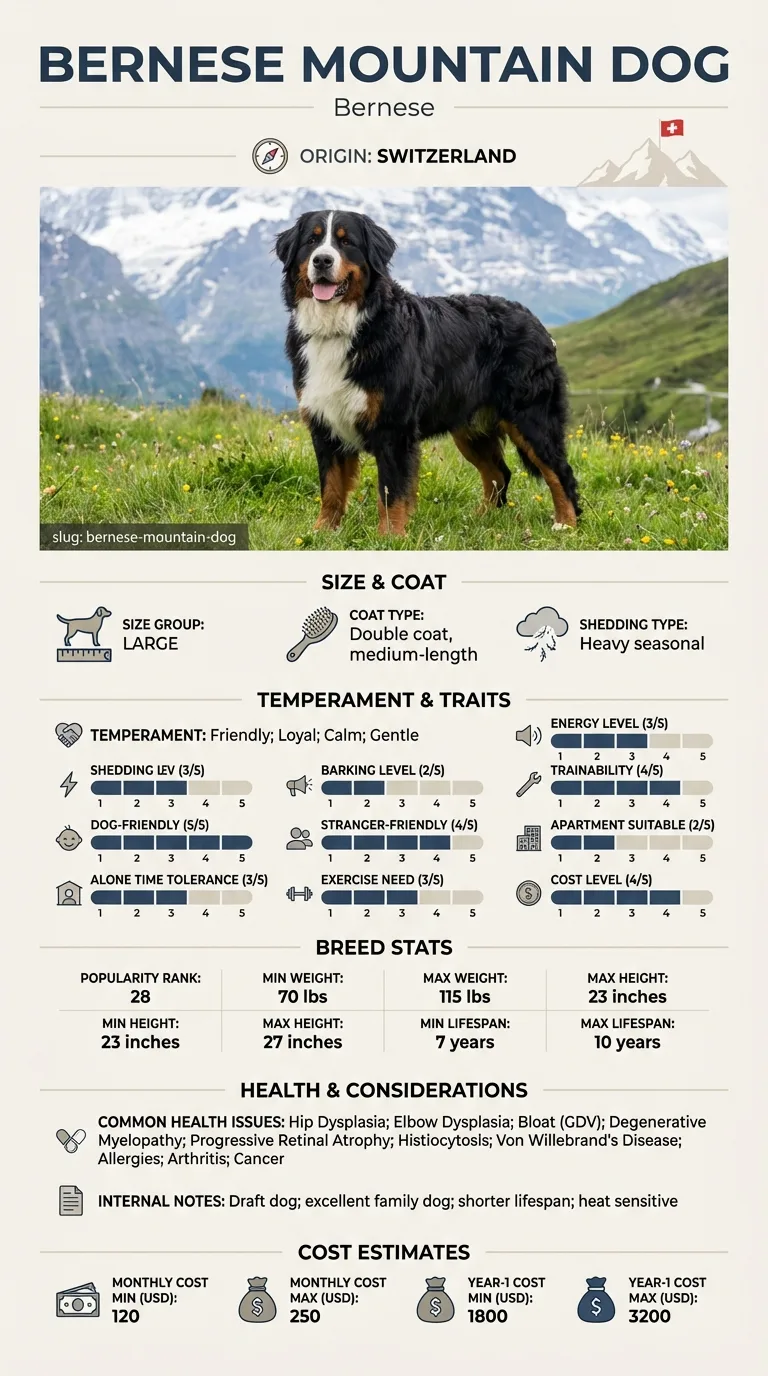
Heat is the environmental multiplier. A double-coated alpine breed with poor heat tolerance and a working history in cool Swiss country will show circulatory strain sooner on a humid afternoon. Obesity adds load to a heart already working hard for a 70 to 115 pound frame, and excess weight is common in a breed with a moderate exercise requirement.
Go to an emergency clinic immediately for collapse with pale or grey gums, a belly that has swollen over hours, breathing that has become laboured or open-mouthed at rest, or a dog who does not fully recover within a minute. Those signs fit pericardial effusion or internal bleeding, which are life-threatening and time-critical. Book within a few days for a single brief faint with complete recovery, an irregular pulse you can feel, or new exercise intolerance in a dog who used to manage the same walk comfortably. Do not wait for a second episode to justify the visit.
What happens in the days between an episode and the specialist appointment shapes how useful that appointment is.
Start here: Bernese Mountain Dog Most Common Genetic Disorders
See all Bernese Mountain DOG health problems, which breeds are prone to arrhythmogenic right ventricular cardiomyopathy arvc, or the full Bernese Mountain DOG breed guide for temperament, exercise needs and ownership costs.
A cause is usually identified within one or two appointments once imaging is done. Where a rhythm disorder is confirmed, it is controlled rather than cured, with medication adjusted over weeks and periodic rechecks thereafter.
A named diagnosis, a dog who is not fainting, and an exercise plan you can follow with confidence. For arrhythmias specifically, success means fewer episodes, not none.
The most important alternative in this breed is not an electrical disease at all. The Bernese has cancer and histiocytosis on its documented health list, and cardiac and pericardial tumours in large breeds can cause exactly the picture owners describe as an arrhythmia: sudden weakness, a distended belly, laboured breathing, collapse. Fluid building in the sac around the heart stops it filling properly. That is a same-day emergency and an ultrasound question, not a Holter question.
The second alternative is rhythm disturbance arising from a heart that is failing for other reasons. Cardiomyopathy in large breeds distorts the chambers, and stretched, diseased muscle generates abnormal beats as a consequence rather than a cause. Here the echocardiogram comes first and the rhythm work second.
The third is non-cardiac. Low blood sugar, a bleeding internal mass, a drop in blood pressure or a neurological event all produce collapse. A vet who checks gum colour, abdominal fluid and blood glucose alongside the heart is not being slow; they are ruling out the things that kill faster.
What ARVC screening looks like, if it is ever indicated, is a twenty-four-hour Holter recorder worn in a vest, counting abnormal beats over a full day and night. It is a specific test for a specific suspicion, and in a Berner that suspicion needs a reason.

Ruedi, a seven-year-old Berner, dropped on a slow walk one September evening and was standing again before his owner Karin reached him. She filmed the next episode four days later while her partner sat with the dog. The clip showed no paddling, no stiffness, and full recovery in about eight seconds. Her vet watched it once and moved straight to imaging rather than to a neurology referral. An ultrasound found fluid around the heart from a mass. It was not a rhythm disease at all, and the video was what pointed the workup in the right direction on the first attempt.
Key takeaway: The label owners arrive with is often the wrong one. Bring the footage and the timing of the episode, and let the workup follow the evidence rather than the search term.
It is not among the conditions documented for the breed, which lists hip and elbow dysplasia, bloat, degenerative myelopathy, progressive retinal atrophy, histiocytosis, von Willebrand's disease, allergies, arthritis and cancer. Individual dogs of any breed can develop unusual disease, but ARVC is not a Bernese screening priority.
Yes, book within days rather than waiting to see if it repeats. Brief collapse with rapid full recovery is the classic description of a heart that lost output for a few seconds. It is worth investigating while the dog looks perfectly well.
Fainting is usually sudden, floppy and short, with the dog normal within seconds. Seizures more often involve stiffness, paddling, drooling and a confused period afterwards. Film it if you can, and note how long recovery took.
Ask for a plan rather than a specific test. If your vet hears an irregular rhythm or dropped beats, a Holter is a reasonable next step. If the exam and echocardiogram point elsewhere, the money is better spent on imaging.
Rhythm-related collapse often happens during exertion or excitement, when the heart is asked for more output. Until a cause is identified, keep this heat-sensitive breed to short, flat, cool walks and avoid stairs and rough play.
A careful annual listen from your vet is the baseline for any large breed. Advanced imaging is warranted when something is heard, when there is a fainting history, or before major surgery in an older dog. Routine echocardiograms in a well young Berner are not standard.
No. It is documented primarily in Boxers. A Bernese with rhythm signs needs a broader workup rather than a Boxer screening protocol.
Keep the dog still, check gum colour, film if you safely can, and phone your vet. Pale gums or laboured breathing means go now.
Short lead walks on flat ground in cool parts of the day. No stairs, no ball throwing, no play with other dogs until you have answers.
An echocardiogram with a specialist is a significant expense, and a Holter adds to it. Ask for an estimate covering both before booking so you can sequence tests sensibly.
Yes, and it helps. Practising quiet lying on one side with rewards means most Berners are scanned awake, avoiding sedation in a dog whose heart is already a question.
A one-page prep sheet for this condition: the signs, the questions to ask, what to get priced. Unlocks here.
You get: Vet visit prep sheet
No spam. One-click unsubscribe. See our privacy policy.
Preview page 1 before you decide.