Health
What drug sensitivity is documented in Australian Shepherds?
A sensitivity to ivermectin is documented in this breed, linked to a gene affecting how certain drugs are cleared from the brain.

Quick answer
What drug sensitivity is documented in Australian Shepherds?
A sensitivity to ivermectin is documented in this breed, linked to a gene affecting how certain drugs are cleared from the brain.
A routine spay or dental cleaning is not routine for every Aussie. A drug sensitivity already documented in this breed means some anesthetic and pain-control drugs need to be handled differently.
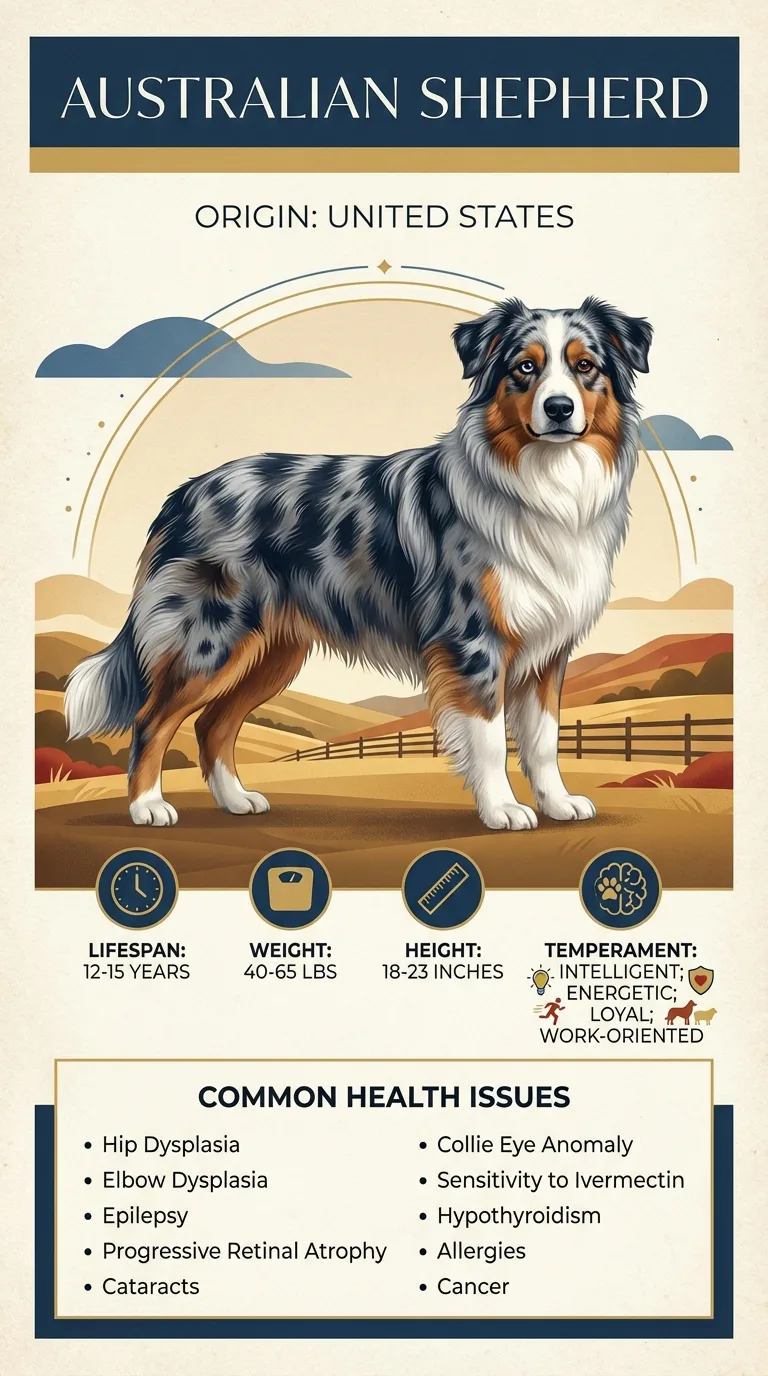
Owners scheduling a first surgery, whether it's a spay, neuter, or something more involved, are often the ones caught unprepared, especially if their vet doesn't routinely treat herding breeds and hasn't asked about drug sensitivity history before.
This guide is not medical advice. If your dog shows pain, sudden behavior change, or worsening symptoms, consult a licensed veterinarian.
Some links may be affiliate links. We may earn a commission at no extra cost to you. We only suggest products we believe are helpful for dog owners.
We research and check what we publish, but we do not warrant that any figure, date, price, or statement is accurate, complete, or current, and we accept no liability for any loss, cost, injury, or other harm arising from the use of this site. Use it as one reference among several. You remain responsible for your own decisions and for your dog's care - confirm anything that matters with a licensed veterinarian or another qualified professional before you act on it. Full disclaimer.
Australian Shepherds carry a documented sensitivity to ivermectin, rooted in a gene mutation that affects a protein pump normally responsible for keeping certain drugs out of the brain. That same mechanism can affect how the breed responds to some anesthetic and pain-control drugs, making pre-surgical planning more important than it would be for an unaffected breed.
The underlying mutation is well documented across herding breeds, including the Australian Shepherd, and reputable genetic testing panels for this breed generally include it as a standard marker rather than an optional add-on.
This breed's documented ivermectin sensitivity stems from a mutation in a gene responsible for a protein pump that keeps many drugs from crossing into brain tissue. When the pump doesn't function normally, affected drugs can accumulate in the brain and produce a stronger or longer-lasting effect than expected.
Risk isn't driven by environment so much as by clinical circumstances: which drugs a vet chooses, whether a dog's sensitivity status is known beforehand, and how closely recovery is monitored after any procedure involving an affected medication.
Talk to your vet before scheduling any procedure that requires sedation or anesthesia, even something as routine as a dental cleaning. If your dog shows unusually slow recovery, wobbliness, or prolonged sedation after any procedure, contact your vet immediately rather than waiting for it to pass on its own.
The drug sensitivity itself isn't the dangerous part — not accounting for it during drug selection is.
See all Australian Shepherd health problems, which breeds are prone to anesthesia sensitivity, or the full Australian Shepherd breed guide for temperament, exercise needs and ownership costs.
Genetic testing results typically return within one to two weeks, giving plenty of lead time before a planned procedure. Once a vet knows a dog's status, adjusting the anesthesia plan adds no meaningful delay to surgery day itself.
Success looks like an uneventful surgery and a normal-length recovery, achieved by planning around the sensitivity rather than by the sensitivity disappearing. It's a lifelong trait to manage, not a phase to outgrow.
This breed's documented sensitivity to ivermectin comes from a mutation affecting a protein pump that normally keeps certain drugs out of the brain. When that pump doesn't work properly, drugs that are normally kept at safe levels outside the brain can build up inside it instead, causing an exaggerated or prolonged effect.
That same pump is involved in how the body handles several other drugs beyond ivermectin, including some sedatives and pain medications used around surgery. A vet aware of this can choose alternative drugs or adjust dosing and monitoring accordingly, which is why disclosing any known sensitivity before a procedure matters more for this breed than for many others.

When Hannah scheduled her Aussie Willow's spay, the clinic's intake form didn't ask about breed-specific drug sensitivity. Hannah remembered reading about it and mentioned it herself, prompting the vet to pull Willow's chart and confirm she'd never been tested. They ran a quick genetic panel two weeks before surgery, which came back positive, and the vet adjusted the anesthesia protocol accordingly. Willow's surgery and recovery were completely uneventful. Hannah later learned a clinic-mate's Aussie, tested only after a rough anesthesia recovery, spent an extra day under observation that could have been avoided with the same simple test beforehand.
Key takeaway: This sensitivity is entirely manageable when it's known in advance. The risk isn't the mutation itself — it's a vet choosing drugs without knowing it's there.
Not every dog carries the mutation at the same level, but it's common enough in herding breeds that vets generally treat any Aussie as a potential carrier unless testing says otherwise.
Yes, a simple genetic test can identify whether your dog carries the mutation, and many owners request it before any planned surgery so the vet can plan drug choices accordingly.
Affected dogs can experience prolonged sedation, slower recovery, or an exaggerated drug response, which is manageable with close monitoring but is easier to avoid than to treat after the fact.
No, ivermectin sensitivity is just the most documented example. The same underlying mechanism can affect how the body handles several other drugs, including some used during and after surgery.
Yes, it's worth noting in your dog's chart at any clinic, including emergency visits, since some emergency medications are also affected by this drug-clearance issue.
It can be, particularly if a drug affected by the sensitivity was used without adjustment. Vets aware of the risk typically choose alternatives or monitor recovery more closely to reduce this.
Yes, older dogs already process drugs more slowly, so an aging Aussie with the sensitivity needs even more careful drug selection than a young, healthy one.
A sensitivity to ivermectin is documented in this breed, linked to a gene affecting how certain drugs are cleared from the brain.
Yes, mention any known drug sensitivity before every surgery so anesthesia drugs can be chosen or adjusted accordingly.
A standalone test typically runs well under a hundred dollars and is often bundled into broader genetic health panels.
It isn't dangerous by itself — it only becomes a risk when an affected drug is given without adjusting the dose or choosing an alternative.
Some preventive products use drugs affected by the same sensitivity, so it's worth confirming with your vet which products are safe for your dog.
A one-page prep sheet for this condition: the signs, the questions to ask, what to get priced. Unlocks here.
You get: Vet visit prep sheet
No spam. One-click unsubscribe. See our privacy policy.
Preview page 1 before you decide.