Health
Is cardiomyopathy a known Australian Shepherd health issue?
No — hereditary cardiomyopathy is documented in breeds like Dobermans and Boxers, not in Australian Shepherds.

Quick answer
Is cardiomyopathy a known Australian Shepherd health issue?
No — hereditary cardiomyopathy is documented in breeds like Dobermans and Boxers, not in Australian Shepherds.
Cardiomyopathy sounds like it could apply to any dog, but the well-documented hereditary forms trace back to a handful of specific breeds, and the Australian Shepherd isn't one of them.
Owners who've read about cardiomyopathy in general canine health articles, or heard about the grain-free diet heart disease investigation, and want to know how much of it actually applies to their Australian Shepherd.
This guide is not medical advice. If your dog shows pain, sudden behavior change, or worsening symptoms, consult a licensed veterinarian.
Some links may be affiliate links. We may earn a commission at no extra cost to you. We only suggest products we believe are helpful for dog owners.
We research and check what we publish, but we do not warrant that any figure, date, price, or statement is accurate, complete, or current, and we accept no liability for any loss, cost, injury, or other harm arising from the use of this site. Use it as one reference among several. You remain responsible for your own decisions and for your dog's care - confirm anything that matters with a licensed veterinarian or another qualified professional before you act on it. Full disclaimer.
Hereditary cardiomyopathy is a well-characterized genetic disease in breeds like Doberman Pinschers, Boxers, and Great Danes, but it isn't established as a breed predisposition in Australian Shepherds. The more relevant angle for this breed is diet-associated dilated cardiomyopathy, a non-hereditary form linked to certain grain-free and boutique diets that can affect dogs of any breed.
Hereditary cardiomyopathy affects a meaningful share of some at-risk breeds over their lifetime, with published estimates for Doberman Pinschers running notably high, while there's no equivalent tracked prevalence for Australian Shepherds because the breed isn't recognized as predisposed. Diet-associated cases are harder to quantify by breed since they depend on what an individual dog is fed rather than on genetics.
Researchers have identified specific genetic mutations behind hereditary cardiomyopathy in breeds like Doberman Pinschers and Boxers, and pedigree studies in those breeds show clear heritability patterns. No comparable mutation or heritability pattern has been documented in Australian Shepherd bloodlines.
For Australian Shepherds, the more relevant environmental factor is diet: certain grain-free, legume-based, or boutique formulations have been associated with taurine deficiency and diet-related dilated cardiomyopathy in dogs of many breeds. Long-term untreated hypothyroidism, a condition genuinely documented in this breed, is another factor that can contribute to heart strain over time.
See a vet promptly if your Aussie develops a persistent cough, tires unusually fast during normal exercise, faints, or shows a swollen abdomen, since these can signal heart problems in any breed. Don't wait for a breed-specific risk factor to justify the visit; these symptoms warrant evaluation on their own.
A serious-sounding condition documented in other breeds can create worry that doesn't map onto your own dog. Avoid these mistakes when researching cardiomyopathy for an Australian Shepherd.

See all Australian Shepherd health problems, which breeds are prone to cardiomyopathy, or the full Australian Shepherd breed guide for temperament, exercise needs and ownership costs.
Because cardiomyopathy isn't a recognized breed risk for Australian Shepherds, there's no standard breed-specific screening timeline to follow the way there is for hip or eye disease. If a diet-associated case is caught early and the diet is switched, some dogs show measurable improvement in heart function within months, though not every case fully reverses.
Success here looks like feeding a well-formulated diet, keeping up with routine wellness exams, and treating any real, documented Aussie conditions like hypothyroidism promptly enough that they don't become secondary contributors to heart strain. It also means not spending worry on a hereditary heart disease risk that current evidence doesn't support for this breed.
Dilated cardiomyopathy has a well-established genetic basis in Doberman Pinschers, where researchers have linked it to specific gene mutations and where published estimates suggest a large share of the breed will develop it over a lifetime. Boxers have their own distinct heart muscle disease, often called Boxer cardiomyopathy or arrhythmogenic right ventricular cardiomyopathy, also tied to breed-specific genetics.
Great Danes and Cocker Spaniels round out the list of breeds where dilated cardiomyopathy shows a clear hereditary pattern. Australian Shepherds, a herding breed with a genetic background distinct from any of these, don't appear in this documented risk group.
Since 2018, the FDA has investigated a possible link between certain grain-free, legume-heavy, or boutique diets and diet-associated dilated cardiomyopathy, a form of heart disease tied to taurine deficiency rather than inherited genetics. This matters for Australian Shepherd owners specifically because it can occur in dogs of any breed, unlike the hereditary forms documented in Dobermans and Boxers.
If you're feeding a boutique or grain-free diet and you're concerned about your Aussie's heart health, the useful conversation with your vet is about the food itself, not about a breed-specific genetic test that doesn't exist for this condition in this breed.

After reading online about the FDA's investigation into grain-free diets and heart disease, Marcus in Tulsa, Oklahoma got worried about the boutique, exotic-protein food he'd been feeding his 2-year-old Australian Shepherd. He brought the food label to his next vet visit and asked directly whether his dog needed a cardiac workup. His vet explained that Australian Shepherds don't carry a known genetic risk for cardiomyopathy the way Dobermans or Boxers do, but agreed the diet itself was worth reconsidering given its ingredient list. They switched to a diet from a manufacturer that met WSAVA nutritional guidelines, and a follow-up exam months later showed a normal, healthy heart.
Key takeaway: The genetic heart disease risk Marcus had read about doesn't apply to Australian Shepherds, but the diet-related angle was a legitimate, breed-independent concern worth addressing anyway.
No. Hereditary cardiomyopathy is well-characterized in breeds like Doberman Pinschers and Boxers, but it isn't recognized as a genetic predisposition in Australian Shepherds. If your Aussie is ever diagnosed with heart disease, it's far more likely to be an acquired or diet-related case than a breed-linked one.
Dilated cardiomyopathy is well documented in Doberman Pinschers, Great Danes, and Cocker Spaniels, while Boxers have their own distinct form sometimes called Boxer cardiomyopathy or arrhythmogenic right ventricular cardiomyopathy. None of these breeds share close genetic lineage with the Australian Shepherd.
The FDA has investigated a link between certain grain-free, legume-heavy, or boutique diets and diet-associated dilated cardiomyopathy in dogs of many breeds, including breeds with no known genetic risk. This is a diet issue rather than an Aussie-specific one, but it's worth reviewing your dog's food with your vet.
Persistent coughing, tiring quickly on walks, fainting spells, and a swollen abdomen are signs that warrant a prompt veterinary visit in any breed. These symptoms matter regardless of whether cardiomyopathy is a known risk for your dog's specific breed.
Hypothyroidism, which is a genuinely documented condition in Australian Shepherds, can contribute to secondary heart changes if it goes untreated for a long time. That's a reason to keep up with routine thyroid testing, not a reason to worry about primary cardiomyopathy.
No. Routine annual Holter monitoring or echocardiograms are recommended for high-risk breeds like Dobermans, but that protocol isn't standard practice for Australian Shepherds. A normal wellness exam with heart auscultation is generally sufficient unless your vet notices something specific.
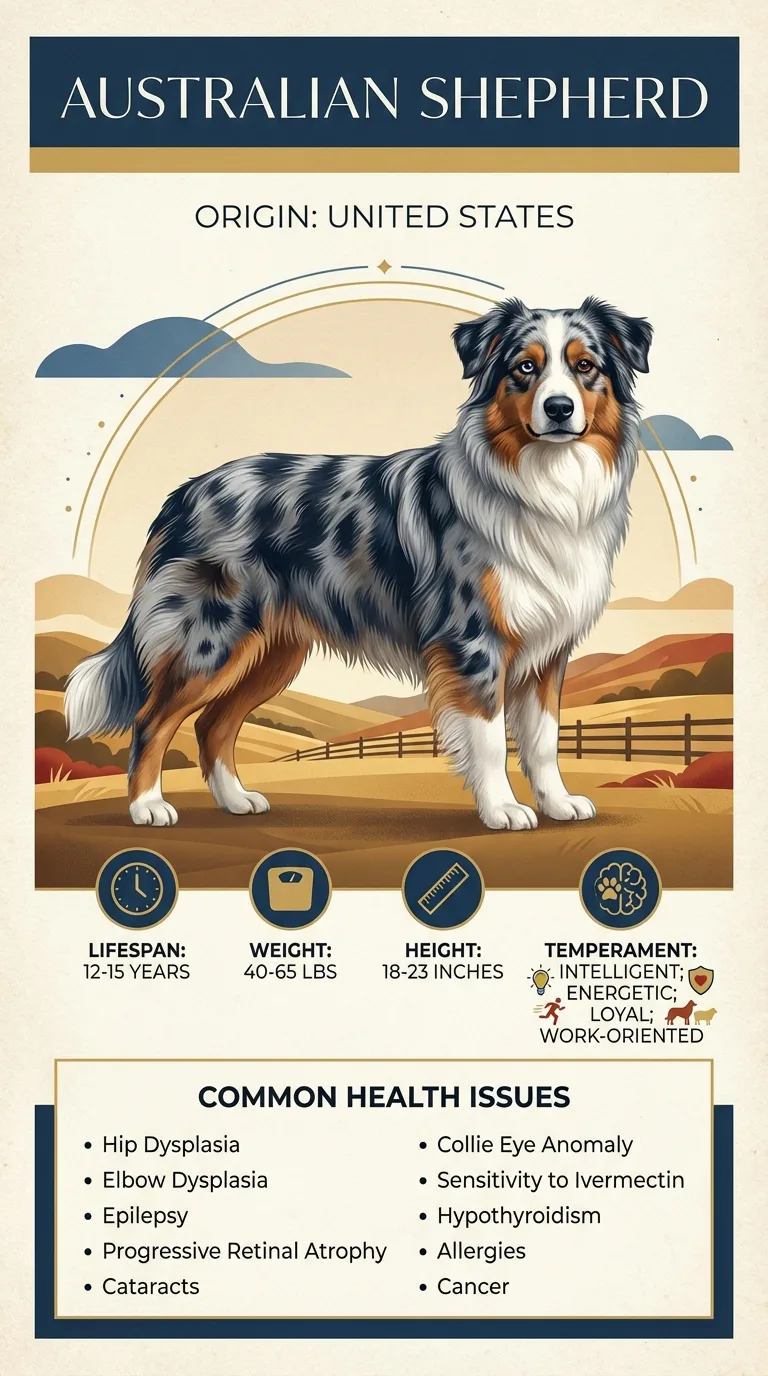
The conditions with real documented prevalence in this breed are hip and elbow dysplasia, progressive retinal atrophy, epilepsy, and hypothyroidism, along with sensitivity to ivermectin-based medications. Those are the areas where screening and preventive care genuinely pay off.
No — hereditary cardiomyopathy is documented in breeds like Dobermans and Boxers, not in Australian Shepherds.
Yes — diets low in taurine, common in some grain-free and boutique foods, have been linked to diet-associated heart disease in dogs of any breed.
Routine cardiac screening isn't standard for Australian Shepherds, so most owners only pay for heart diagnostics if a vet flags a specific concern during an exam.
It's not a routine breed-specific screening for Australian Shepherds the way hip and eye exams are.
Training itself doesn't need to change, but exercise intensity should be paced according to your vet's guidance.
A one-page prep sheet for this condition: the signs, the questions to ask, what to get priced. Unlocks here.
You get: Vet visit prep sheet
No spam. One-click unsubscribe. See our privacy policy.
Preview page 1 before you decide.