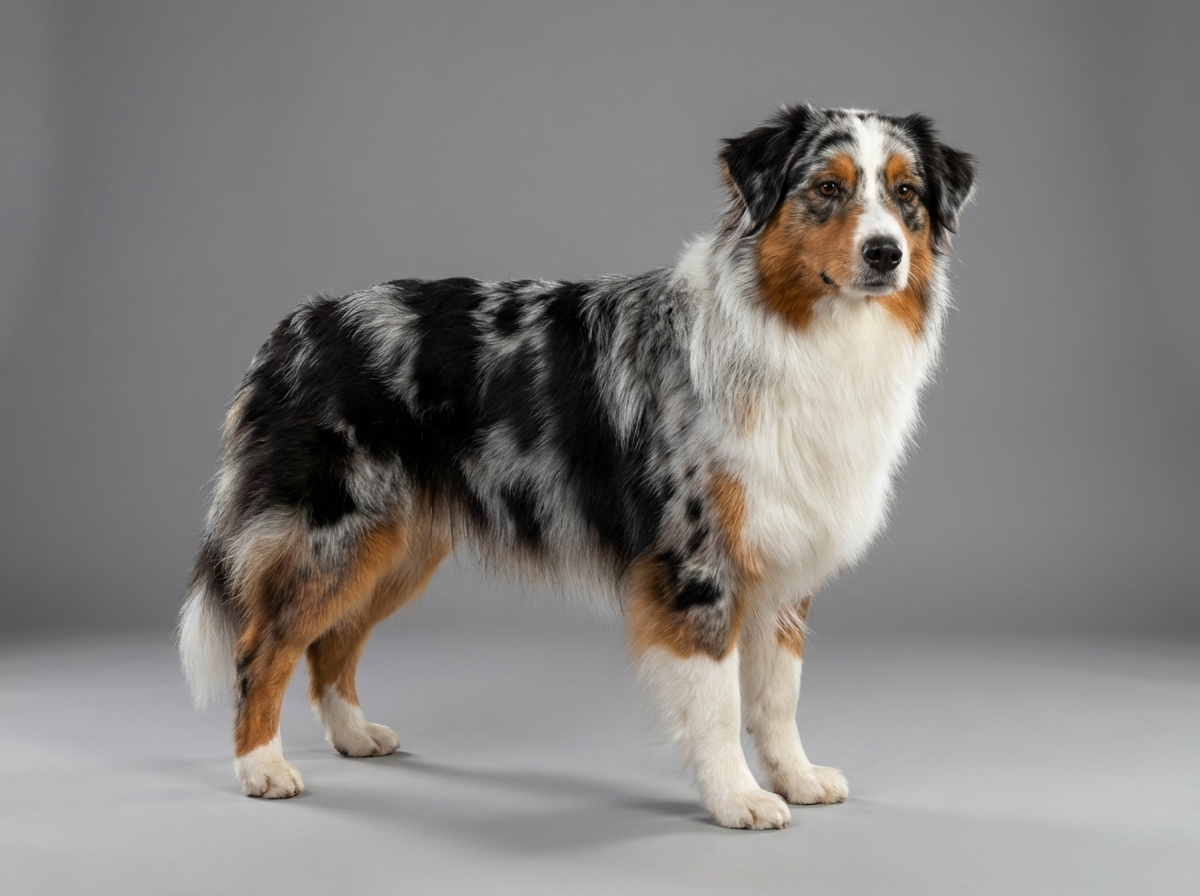
Health
Is hip dysplasia common in Australian Shepherds?
Yes — it's one of the documented common health issues for this breed.

Quick answer
Is hip dysplasia common in Australian Shepherds?
Yes — it's one of the documented common health issues for this breed.
This is a mismatch between how fast a joint forms and how fast the rest of the dog grows — and it matters more in a breed asked to run, pivot, and jump hard for a living.
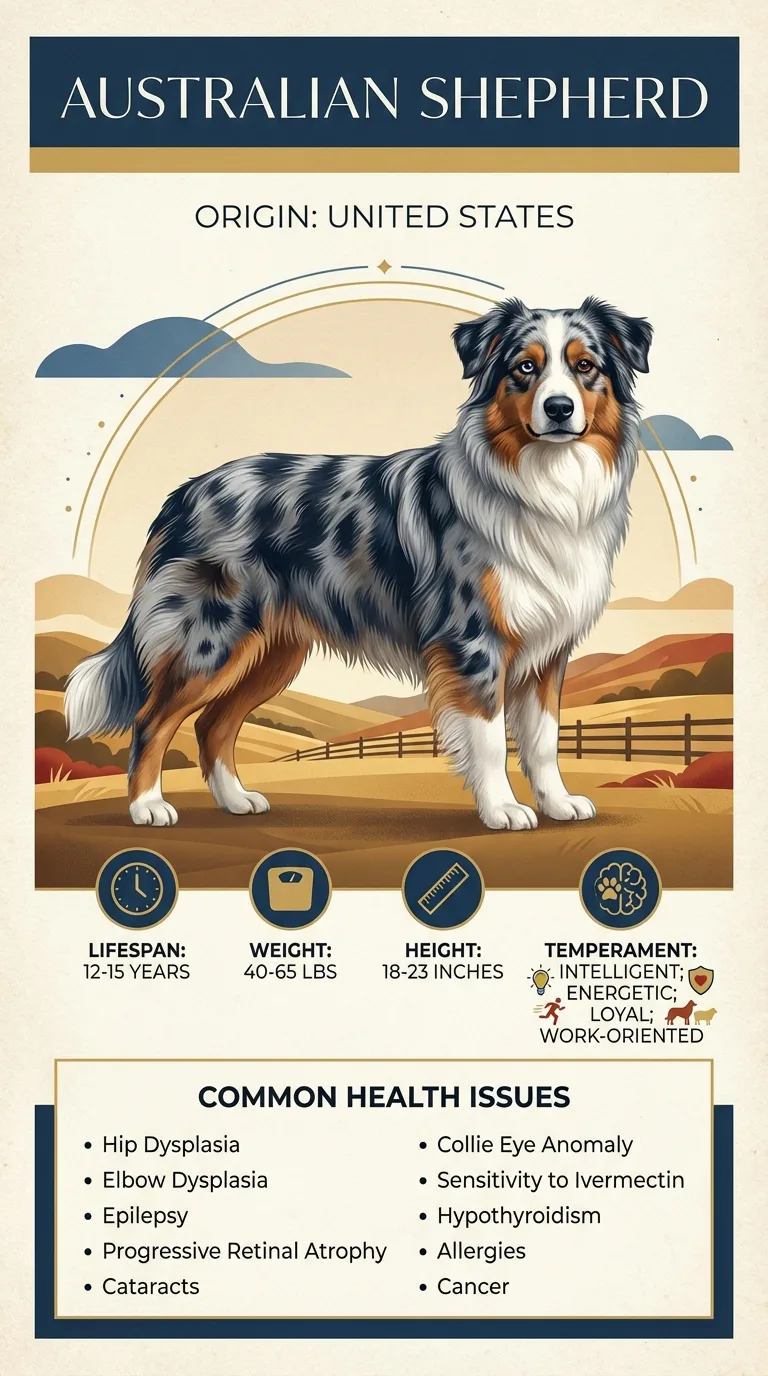
Owners of working, sport, or simply very active Australian Shepherds who've noticed a subtle gait change and want to understand what's actually happening in the joint before their next vet visit.
This guide is not medical advice. If your dog shows pain, sudden behavior change, or worsening symptoms, consult a licensed veterinarian.
Some links may be affiliate links. We may earn a commission at no extra cost to you. We only suggest products we believe are helpful for dog owners.
We research and check what we publish, but we do not warrant that any figure, date, price, or statement is accurate, complete, or current, and we accept no liability for any loss, cost, injury, or other harm arising from the use of this site. Use it as one reference among several. You remain responsible for your own decisions and for your dog's care - confirm anything that matters with a licensed veterinarian or another qualified professional before you act on it. Full disclaimer.
Hip dysplasia is a developmental joint condition where the ball and socket of the hip don't form a snug, stable match, leading to abnormal wear and eventual arthritis. It's a documented health issue for Australian Shepherds, and the breed's high-impact, athletic lifestyle — hard running, cutting, and jumping during herding or sport work — can accelerate how quickly a loose joint develops arthritic changes.
Hip dysplasia is documented as a common health issue in Australian Shepherds, consistent with many medium-to-large athletic breeds. Severity varies widely from mild, barely noticeable laxity to significant mobility impact.
Hip dysplasia is documented as a common health issue in this breed, reflecting an inherited predisposition toward hip joint laxity that's passed down through breeding lines, similar to many active working breeds.
Rapid growth, excess weight during the growth period, and high-impact repetitive activity (hard jumping, forced long runs) before the joint is fully mature can all add mechanical stress that makes an underlying predisposition show up sooner or more severely.
Talk to your vet about any persistent bunny-hop gait, reluctance to jump, stiffness after rest, or a limp that doesn't resolve within a day or two. Sudden severe pain, an inability to bear weight at all, or obvious distress warrants same-day evaluation.
See all Australian Shepherd health problems, which breeds are prone to hip dysplasia, or the full Australian Shepherd breed guide for temperament, exercise needs and ownership costs.
Diagnosis via X-ray typically happens within a single vet visit once symptoms prompt an exam. Management is ongoing and lifelong, though many dogs with mild to moderate dysplasia stabilize well with consistent weight and exercise management within a few months of starting a plan.
Success looks like a comfortable, mobile dog managing daily life and moderate activity without significant pain, even if some accommodation (avoiding hard jumping, maintaining lean weight) becomes a permanent part of the routine rather than a temporary fix.
A dysplastic hip doesn't necessarily hurt on day one. What it does is wear unevenly — a ball that isn't seated tightly in its socket rubs and shifts with every stride instead of rotating smoothly, and that abnormal motion gradually damages the cartilage lining the joint. Over months to years, that damage triggers arthritis: bony changes, thickened joint capsule tissue, and the stiffness and discomfort owners eventually notice.
This is exactly why hip dysplasia can be present from puppyhood but not show up clearly until a dog is an adult, and why an active, athletic breed like the Aussie — asked to run hard, cut sharply, and absorb impact regularly in herding or sport work — tends to put more cumulative stress through a loose joint than a more sedentary dog would, sometimes accelerating how quickly arthritis develops.
Early signs are often subtle: a slight reluctance to jump into the car, a 'bunny hop' gait where both hind legs move together instead of alternating normally at a run, or stiffness that's more obvious after resting than during activity itself. Some dogs compensate so well behaviorally that the first real clue is a change in how a handler perceives the dog's enthusiasm for jumping or hard turns during training.
Diagnosis combines a physical exam — checking for laxity and pain on hip manipulation — with X-rays, sometimes through formal screening programs. Severity varies substantially: some dogs have mild laxity and live comfortably with basic management, while others need more significant intervention. Getting an accurate picture requires imaging, not just watching the dog move.

Nova, a two-year-old Aussie competing in agility, had always attacked the weave poles with total commitment. Her handler noticed she'd started taking the poles slightly wider and seemed a touch hesitant on the A-frame descent — nothing dramatic, just not quite herself. A vet exam found mild hip laxity on manipulation, and X-rays confirmed early hip dysplasia with mild arthritic changes already present. Rather than retiring Nova from the sport, her vet and a canine rehab specialist built a conditioning plan emphasizing controlled strength work and modified training volume. Two years later, Nova is still competing, now with a consistent supplement and conditioning routine and a coach who watches her stride for any change as closely as her scores.
Key takeaway: A subtle change in how a dog moves during the activity it does most is often the earliest real clue — and catching it early gives you options that simply managing pain later on doesn't.
It can be present from puppyhood structurally, but symptoms often first appear in two waves: as mild lameness in dogs under two years old, or as arthritis-related stiffness in middle-aged to senior dogs, depending on severity.
No — the underlying joint looseness can't be reversed, but it can be managed through weight control, controlled exercise, joint support, and in more severe cases, surgical options, all aimed at comfort and mobility rather than a cure.
Instead of the hind legs moving independently at a trot or run, both hind legs move together in a hopping motion, similar to how a rabbit moves. It's one of the more recognizable visual signs of hip instability.
It has a strong hereditary component along with environmental factors like growth rate and body condition during puppyhood, which is why responsible breeders screen breeding stock's hips before pairing dogs.
Through a physical exam checking for joint laxity and pain, combined with X-rays. Formal screening programs use standardized positioning to grade severity consistently.
No — many dogs, especially those with mild to moderate laxity, are managed successfully with weight control, moderate consistent exercise, and joint support. Surgery is generally reserved for more severe cases or dogs not responding to conservative management.
Yes — very high-impact activity (hard jumping, repetitive stair use, forced long-distance running) during the rapid growth period before a puppy's joints fully mature can put extra stress on a joint that's already prone to laxity, though it doesn't create dysplasia where there's no genetic predisposition.
Yes — it's one of the documented common health issues for this breed.
Often a subtle 'bunny hop' running gait, reluctance to jump, or stiffness that's more noticeable after rest than during activity.
Not entirely, since it has a genetic component, but keeping a puppy at a healthy weight and avoiding excessive high-impact exercise during growth can reduce added strain.
It can be, particularly as arthritis develops, though severity varies widely — some dogs show mild discomfort while others are more significantly affected.
Yes, generally — controlled, moderate exercise (like swimming or steady leash walks) helps maintain muscle support around the joint, but high-impact activity is usually limited.
A one-page prep sheet for this condition: the signs, the questions to ask, what to get priced. Unlocks here.
You get: Vet visit prep sheet
No spam. One-click unsubscribe. See our privacy policy.
Preview page 1 before you decide.