Health
Is DCM a documented health risk in Australian Shepherds?
No — it's a documented risk in Dobermans, Great Danes, and Boxers, not in Australian Shepherds.

Quick answer
Is DCM a documented health risk in Australian Shepherds?
No — it's a documented risk in Dobermans, Great Danes, and Boxers, not in Australian Shepherds.
DCM sounds like exactly the kind of disease worth panicking about — but the breeds where it's actually been studied and confirmed don't include the Aussie.
This page is for owners who came across DCM in general dog-heart-health articles or grain-free-diet news coverage and want to know whether it's a real concern for their Australian Shepherd specifically.
This guide is not medical advice. If your dog shows pain, sudden behavior change, or worsening symptoms, consult a licensed veterinarian.
Some links may be affiliate links. We may earn a commission at no extra cost to you. We only suggest products we believe are helpful for dog owners.
We research and check what we publish, but we do not warrant that any figure, date, price, or statement is accurate, complete, or current, and we accept no liability for any loss, cost, injury, or other harm arising from the use of this site. Use it as one reference among several. You remain responsible for your own decisions and for your dog's care - confirm anything that matters with a licensed veterinarian or another qualified professional before you act on it. Full disclaimer.
Dilated cardiomyopathy is a serious genetic heart disease well documented in Doberman Pinschers, Great Danes, and Boxers, but it is not established as a breed-linked condition in Australian Shepherds. For an Aussie, the more relevant health priorities are the breed's actual documented risks: hip and elbow dysplasia, epilepsy, and inherited eye disease.
DCM is a well-studied disease in Dobermans, where a substantial share of the breed is estimated to be affected over their lifetime, and it's similarly significant in Great Danes and Boxers. In Australian Shepherds, it isn't recognized as a breed-associated condition at all, making it a rare, incidental finding rather than a health issue this breed is watched for.
The genetic mutations linked to DCM have been mapped specifically in Doberman Pinscher research lines, with Great Danes and Boxers carrying their own separately studied predispositions. No comparable genetic link has been identified in Australian Shepherd bloodlines, and the breed's actual inherited health issues involve entirely different organ systems.
Outside of the classic predisposed breeds, diet has been the main environmental factor under investigation, specifically certain grain-free and legume-heavy commercial diets studied by the FDA. That inquiry doesn't point to anything Australian Shepherd-specific, and there's no other documented environmental trigger connecting this breed to DCM.
See a vet promptly for a persistent cough, fainting or collapse, labored breathing at rest, or a real decline in exercise tolerance, regardless of whether you suspect a cardiac cause. In an Australian Shepherd, your vet is more likely to investigate common explanations first, but these symptoms always deserve direct evaluation.
DCM gets a lot of general dog-health media coverage, which makes it easy to misapply to a breed where it isn't actually documented. Here are the mistakes worth avoiding.
See all Australian Shepherd health problems, which breeds are prone to dilated cardiomyopathy dcm, or the full Australian Shepherd breed guide for temperament, exercise needs and ownership costs.
Because DCM isn't an established risk in this breed, there's no meaningful monitoring timeline to set up for it specifically. Your dog's regular annual or twice-yearly vet visits, which already include a cardiac listen as part of the standard exam, are sufficient.
Success here means redirecting the attention DCM research generated toward the health areas that actually matter for an Australian Shepherd: joint health, eye health, thyroid function, and appropriate vigilance for the general warning signs any dog owner should know.
DCM's genetic risk factors have been identified through targeted research in Doberman Pinschers, and the disease is separately well documented as a strong risk in Great Danes and Boxers. Australian Shepherd genetics have not produced this same pattern, and the breed's own list of documented health concerns runs in a completely different direction: hip and elbow dysplasia, epilepsy, and inherited eye disease.
The FDA's 2018-2019 investigation into a possible link between grain-free or legume-heavy diets and DCM did include reports across a wide range of breeds, including some outside the classic predisposed list. That investigation was about diet formulation, not about confirming a new Australian Shepherd-specific genetic risk, and no causal mechanism specific to this breed has been established.
None of this means an Aussie's heart is automatically immune to ever developing a problem, since any dog can in principle develop heart disease with age. It means DCM specifically isn't a documented breed risk here the way it is in the classic predisposed breeds, and framing it as an Aussie concern isn't supported by what's actually been studied.

Even without a documented breed predisposition, any dog can develop heart problems later in life, so it's worth knowing the general warning signs rather than the breed-specific ones that don't apply here.

After reading an FDA news article about grain-free diets and DCM, Priya in Boise spent a weekend switching her three-year-old Aussie, Scout, off his usual food and researching cardiac supplements. At Scout's next checkup, her vet explained that the investigation covered a wide range of breeds and diets without confirming an Australian Shepherd-specific risk, and that Scout's bloodwork and heart exam were already normal. Her vet redirected the conversation toward Scout's actual screening needs: hip and elbow x-rays before his next birthday, and watching for the early signs of environmental allergies Priya had mentioned in passing. Priya kept Scout on a vet-approved, well-balanced diet rather than reacting to the DCM headline.
Key takeaway: A widely covered heart disease documented in Dobermans, Great Danes, and Boxers doesn't translate into an Australian Shepherd-specific risk, and the diet news driving the concern wasn't about this breed at all — the genuinely useful focus is the breed's own documented health screening needs.
No — DCM's documented genetic risk is concentrated in Doberman Pinschers, Great Danes, and Boxers. It doesn't appear on the Australian Shepherd's list of established health concerns, which centers on hip and elbow dysplasia, epilepsy, and inherited eye disease.
It's a disease in which the heart muscle weakens and the chambers stretch out, reducing the heart's ability to pump blood effectively. In severely affected breeds it can progress to heart failure or sudden cardiac death, which is why it gets serious research attention in those breeds specifically.
The FDA's investigation into grain-free and legume-heavy diets looked at reports across many breeds, but it didn't establish an Australian Shepherd-specific risk or confirm a cause. If you're unsure about your dog's diet, talking to your vet about a well-balanced, appropriately formulated food is more useful than avoiding a whole diet category out of general concern.
In a breed built for a full day of work, normal fatigue after unusually long or intense exertion is common and not itself a red flag. Persistent reduced stamina during routine activity, fainting, or a new cough are the signs that actually warrant a vet visit.
There's no standard breed-specific cardiac screening protocol for Australian Shepherds the way there is for Dobermans, who are often screened with Holter monitoring and echocardiograms. A general physical exam that includes listening for heart murmurs at routine checkups is the appropriate level of vigilance here.
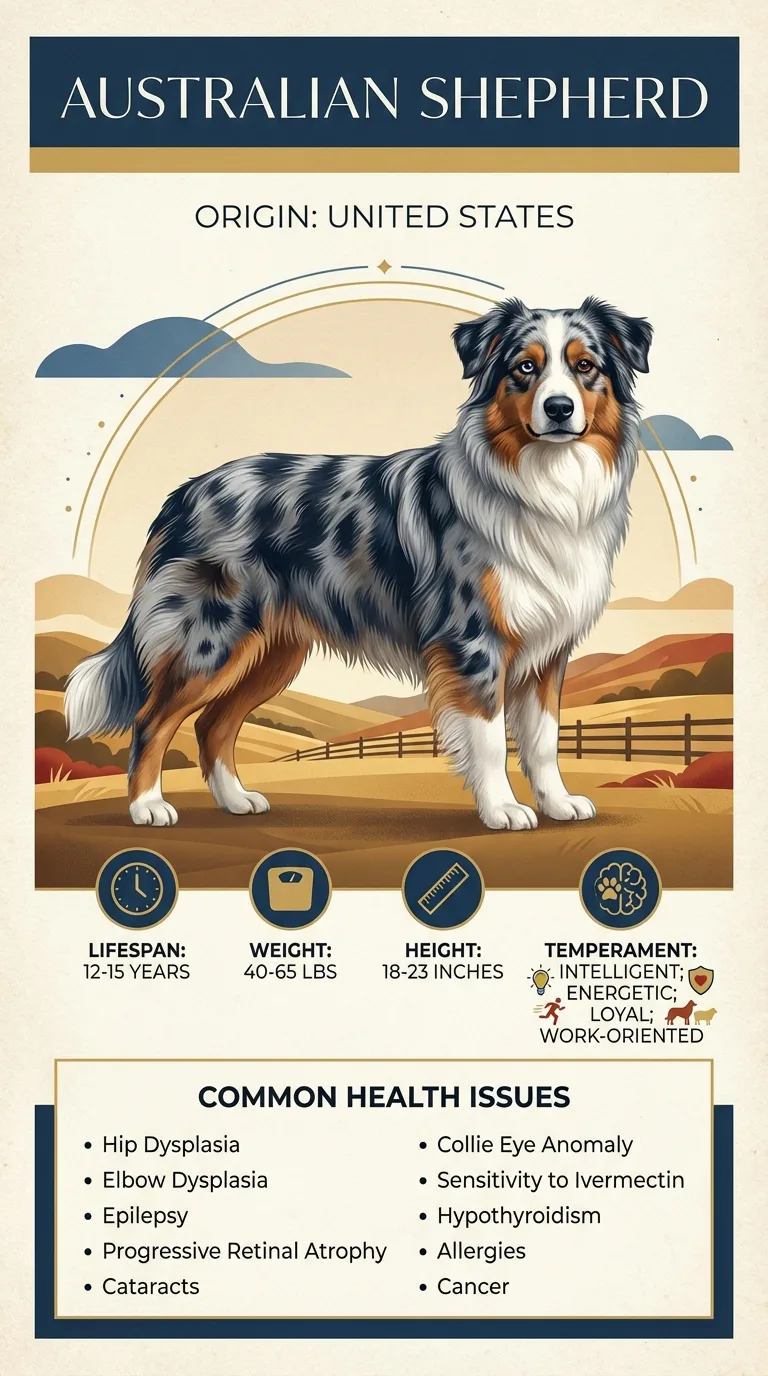
The breed's genuinely documented concerns are hip and elbow dysplasia, epilepsy, progressive retinal atrophy, collie eye anomaly, hypothyroidism, allergies, and cancer, along with a known sensitivity to ivermectin-class drugs. Those are the areas where screening and vigilance actually pay off.
General dog-health resources sometimes list conditions that apply broadly across dogs or to other breeds without making clear which breeds are actually affected. It's worth checking any health claim about your specific breed against a source that names which breeds are actually documented.
No — it's a documented risk in Dobermans, Great Danes, and Boxers, not in Australian Shepherds.
Not because of DCM specifically — talk to your vet about a well-balanced diet rather than avoiding grain-free food purely out of general worry.
No specialized cardiac-screening budget is needed the way it is for DCM-predisposed breeds; a routine annual exam covers the appropriate level of vigilance.
A persistent cough, fainting, rapid breathing at rest, and reduced stamina are general warning signs worth a vet visit in any breed.
No — since DCM isn't a documented risk in this breed, normal exercise and training guidelines for a healthy Australian Shepherd still apply.
A one-page prep sheet for this condition: the signs, the questions to ask, what to get priced. Unlocks here.
You get: Vet visit prep sheet
No spam. One-click unsubscribe. See our privacy policy.
Preview page 1 before you decide.